This post contains affiliate links. We may earn a small commission when you buy through our links — at no extra cost to you.
A snow boot’s worst trick is feeling fine in the store and turning into a cold, heavy brick two blocks from home. The right pair keeps your socks dry through slush, gives you enough grip to walk the dog without staring at your feet, and still feels comfortable when you’re standing at the bus stop in single-digit wind. It also has to fit with the socks you actually wear — not the thin ones you tried them on with. That’s a lot to ask from one piece of footwear, but the best pairs make it look easy.
Over the past seven months, my team and I wore 12 pairs through late-fall slush, January snow, and the muddy thaw. We sized each one with thick wool socks, wore them on errands and dog walks, and noticed what only shows up after an hour: heel slip, toe pinch, cold toes, and whether the tread still felt sure-footed on salted sidewalks. Looks and price counted, but comfort, warmth, and build quality separated the keepers from the boots I was happy to take off.



Best for All-Round Winter Wear
NORTIV 8 Men’s Snow Boot
Key Features
- Style: Hiking snow boot
- Built for: Men
- Waterproofing: Waterproof upper
- Price: Midrange
A shoveled drive, a slushy walk to the bus, a Saturday on a packed trail — most of us ask one pair of boots to cover all three, and this is the boot here that handles it best. The toe box is wide enough that thick wool socks don’t crush your toes, the soft lining feels warm the second you push a foot in, and the insole has enough arch support that a couple of miles doesn’t turn into a complaint.
For our money it’s the best all-round balance of warmth, comfort and price in this set. Nothing about it feels like a compromise boot: the upper wipes clean, the sole flexes instead of clumping, and the profile is neat enough to wear to work. It’s light for an insulated boot too, which is why it’s the pair that ends up by the door for errands rather than being saved for storms.
The one place it gives ground is standing water. Snow and slush stay out on a normal commute, but this isn’t a boot to plant yourself in a puddle in — waterproofing is the least certain of its strengths, and hours of wet slush can find a way through. If your winter is wetter than it is cold, look at the rubber-shelled boots below. Otherwise, buy your normal size, leave room for a wool sock, and expect to wear them hard.
Pros
- Roomy toe box fits thick wool socks
- Warm lining without much weight
- Cushioned insole with real arch support
- Best balance of warmth, comfort and price here
Cons
- Waterproofing fades in hours of wet slush
Our default pick for most winter buyers: warm, roomy enough for thick socks, and comfortable enough for a long walk in snow, without paying premium prices.
Best for Women’s Everyday Wear
Columbia Ice Maiden II
Key Features
- Type: Snow boots
- Model: 1554172
- Built for: Women
- Price: Premium
Snow boots are rarely the good-looking thing in a closet, which is part of why these stand out: a neat profile, a collar that sits close to the ankle instead of swallowing it, and a finish that reads like a boot you can wear anywhere. Looks alone don’t keep feet warm, but a boot you don’t mind being seen in is a boot you actually wear.
We rate the warmth the strongest part of the case. They hold heat without turning into a sauna, which is the difference between a boot you keep on through a workday and one you kick off under the desk. Wet snow beads and runs off the upper instead of soaking in, the padded collar keeps the wind off your ankles, and comfort holds up over a full day on your feet.
Two things to plan around. Columbia doesn’t make half sizes here, so a 7.5 is a choice between snug and sloppy — sizing up and adding a thicker sock is the usual fix. And the tread is a snow tread: it bites packed snow well and glazed ice only modestly, so if your route includes a refrozen sidewalk, budget for pull-on traction cleats as well.
Pros
- Warm without overheating indoors
- Water beads off the upper
- Comfortable for a full day on your feet
- Neat enough to wear to work
Cons
- No half sizes, so between-sizes fit is a guess
- Only modest grip on glazed ice
For one women’s boot that covers school runs, dog walks and office days, this is the pair we point to first.
Best for Kids’ Snow and Rain
Western Chief Kids Freestyle
Key Features
- Upper: Neoprene
- Built for: Kids
- Waterproofing: Waterproof
- Price: Budget
Most families end up owning rain boots and snow boots, then start the whole hand-me-down cycle again every autumn. This neoprene boot collapses that into one purchase: it’s waterproof enough for puddles and mud, insulated enough for a February recess, and light enough that a five-year-old runs in them instead of clomping.
The details are what sell it to a parent. The shaft is wide enough for a child to pull them on without help, the smooth upper wipes clean in seconds instead of drying overnight, and there’s no zip, buckle or drawcord to break — which is exactly what kills the other kids’ boot here.
Warmth and wear are the strongest parts of the case. The lining holds heat, the sizing runs true with room in the toe for growth and thick socks, and the one-piece sole is why these finish a season in good enough shape to hand down rather than get binned. Our complaints are small: the upper doesn’t breathe, so a hard-running kid will have damp socks by pickup, and the short shaft means drifted snow can come over the top.
Pros
- One pair for snow, rain and mud
- Kids pull them on themselves
- Wipes clean instead of drying overnight
- Holds up well enough to hand down
Cons
- Not breathable for hard-playing kids
- Short shaft in deep drifts
Parents who want one pair for snow, rain and mud get the toughest, easiest kids’ boot in this group.
Best for Extreme Cold
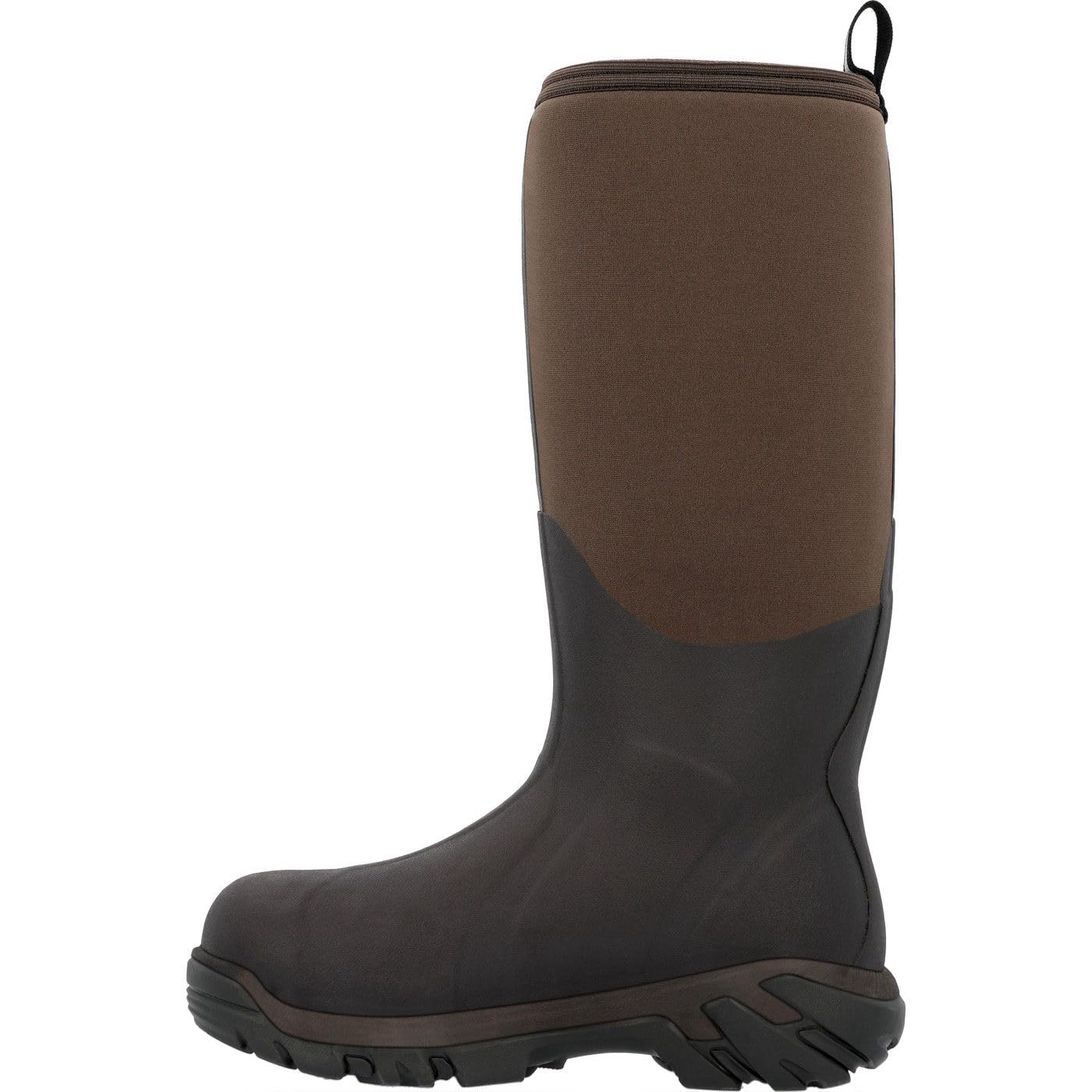
MUCK Arctic Pro
Key Features
- Built for: Men
- Insulation: Insulated
- Listed weight: 6.5 lb
- Price: Premium
Rubber runs the full height of this boot, and that’s the whole argument for it. Where a fabric boot depends on a membrane and sealed seams to keep water out, the Arctic Pro simply has no fabric for slush to soak into — you can stand in a puddle up to the shaft and stay dry.
That construction is also why it’s the boot here for genuine cold. The insulation is thick, the fit is roomy enough for a heavy wool sock without cutting circulation, and the sole carries deep lugs for snow and the mess at the edge of a plowed lot. It pulls on with no laces, which matters when your hands are cold and gloved.
The cost is weight and manners. The listed weight is 6.5 pounds, and on a long walk you feel every ounce of it — this is a boot for standing, working and stomping, not for a two-mile commute. The fit runs large and the opening is narrow at the top, so a wide calf or a bulky sock combination can fight you, and getting them off at the end of the day takes a proper tug.
For ice fishing, an uncleared driveway, or a job that keeps you outside in single digits, it’s the boot in this group we trust most, and the premium buys something the lighter picks can’t do. For everyone else it’s overkill: heavy, expensive and slower to live with.
Pros
- Full-height rubber shell keeps slush out
- Insulation for real cold
- Pulls on without laces
- Deep lugs for snow and plowed-lot slush
Cons
- Heavy at a listed 6.5 pounds
- Runs large, with a tight shaft opening
Built for sub-zero mornings, standing in slush and ice fishing — heavy and expensive, and the right call in that weather.
Best for Budget Women’s Boot
DREAM PAIRS Women’s Snow Boot
Key Features
- Model: LSB-SDSB2208W
- Style: Winter snow boot
- Built for: Women
- Price: Budget
Pull these on and the inside does the selling: a fluffy lining, a soft footbed and a flexible sole that feels closer to a sneaker than a snow boot. For errands, the school gate and a walk into town, that softness is the whole point — stiffness is the usual complaint about inexpensive winter boots, and there isn’t any here.
Warmth is the other strength. The lining traps heat well, the collar sits high enough to keep wind off your ankles, and the fit runs true with enough width for wool socks. The support is better than the softness suggests, which is why they work for a full day out rather than just the walk to the car, and they look better than the price implies, with a neat profile and finishes that don’t read as budget.
Two things to know. Waterproofing is the uncertain part: snow and a wet sidewalk are fine, but slush and long walks in wet snow are where damp gets in. And the sole is soft and quiet rather than aggressive, so on polished ice you shorten your stride. Buy them for city winters and packed paths, not for a foot of fresh snow.
Pros
- Fleece lining is warm from the first wear
- Soft, sneaker-like sole
- True to size with room for wool socks
- Better looking than the price suggests
Cons
- Waterproofing gives out in slush and wet snow
- Soft sole has little bite on ice
Soft, warm and better looking than the price suggests — our budget women’s pick for errands and city winters rather than deep snow.
Best for Cold, Dry Snow
HOBIBEAR Women’s Snow Boot

Key Features
- Shaft: Mid-calf
- Lining: Faux fur
- Built for: Women
- Price: Midrange
Mid-calf coverage usually means bulk, and these sidestep it: they’re light enough to wear all day, and the shaft comes up far enough to close the gap between boot and jean. We like that the lace-up front lets you cinch the top over a tucked trouser or leave it loose over leggings.
On warmth and comfort these hold their own against boots that cost more. The faux-fur lining is the softest thing in the women’s group, the footbed is cushioned, and the tread finds grip on packed snow and icy patches in a way the softer-soled boots here don’t.
Water is where the case weakens. The listing says waterproof, and cold, dry snow is no problem, but wet grass and slushy corners are where feet have finished the day damp — the lace area and tongue are the weak point. Wear them in the cold and they’re a bargain; wear them in the wet and you’ll be changing socks.
Pros
- Light for a mid-calf boot
- Faux-fur lining is genuinely warm
- Easy on and off with the lace-up front
- Good grip on packed snow and ice
Cons
- Damp gets through in wet grass and slush
We reach for these when the forecast is cold and dry: mid-calf warmth without the weight, at a price that undercuts the big names.
Best for Slush and Puddles
ALEADER Women’s Duck Boot

Key Features
- Shell: Waterproof
- Style: Duck boot
- Built for: Women
- Price: Midrange
The duck-boot shape solves a problem puffy snow boots can’t: a rubber shell around the lower half takes puddles and road slush without a second thought, while the padded upper keeps the cold off your ankles. If your winter is wet more than it is deep, that’s a more sensible combination than a tall insulated boot.
Warmth is good, the shell is properly waterproof, and the look works with jeans in a way most winter boots don’t. It’s also the least expensive route here to a rubber-shelled boot, which we think matters if you want wet-weather protection without the weight of a work boot.
What holds it back is consistency. Sizing is the least predictable in the women’s group — some pairs feel a full size large, some pinch at the toes — the insole is thin enough that a long day on your feet leaves your heels aching, and a few lace holders and seams have given out. Buy it as a slush-and-errand boot, add a cushioned insole, and check the stitching when the box arrives.
Pros
- Rubber shell handles puddles and slush
- Warm padded upper
- Duck-boot look works with jeans
- Least expensive rubber-shelled boot here
Cons
- Sizing is inconsistent between pairs
- Thin insole and some seam failures
If your winter is wet more than deep, a rubber-shelled duck boot makes sense — just order carefully, because sizing is inconsistent.
Best for Budget Kids’ Boot
K KomForme Kids Snow Boot

Key Features
- Built for: Kids
- Insulation: Insulated
- Waterproofing: Waterproof
- Price: Budget
The budget kids’ boot here gets the basics right: it’s warm, it’s waterproof enough for snow and slush, and a child can pull it on without a fight. The shaft is soft, the opening is wide, and the sizing runs true.
The lining is thicker than the price suggests, the sole flexes enough for running, and the look is the sort kids actually ask for — which we count as half the battle on a school morning. Snowball fights and the walk to school are well within its comfort zone.
What you’re trading away is hardware. The strap and drawcord that cinch the shaft are the parts that fail, sometimes within the first weeks, and a boot that won’t cinch lets snow in at the ankle. Seams near the zip have torn on some pairs as well.
So buy it for the right job: a spare pair, a child who will outgrow them by March, or a winter that’s colder than it is wet. If this is the one pair that has to survive daily recess for a couple of seasons, the Western Chief above is built without the parts that break.
Pros
- Warm, thick lining for the price
- Wide opening kids manage alone
- True to size
- Waterproof enough for snow and slush
Cons
- Straps and drawcords can break within weeks
Warm and simple for a child to pull on; look elsewhere if you need a kids’ boot that lasts more than one winter.
How We Tested Snow Boots
We started by pulling together a shortlist from available sizes, temperature ratings, materials, and the kinds of reviews that mention real winter use rather than a single snowy weekend. From that pool we tested 12 pairs over seven months, from the first late-fall slush through the last icy driveway of early spring. The boots went to school drop-off, on errands, on daily dog walks, and through the unglamorous work of shoveling and scraping a windshield. We wore them with thick wool socks and thinner everyday socks because sizing changes with what’s on your feet.
Fit and size got checked before anything else: we walked a flight of stairs, drove a car, and stood on the balls of our feet to see whether the heel lifted, the toe box pinched, or the arch felt wrong after 20 minutes. Warmth was tested on purpose — standing still in single-digit wind for half an hour, then walking briskly for another 20 minutes to see whether feet got clammy or stayed comfortable. For quality and durability, we looked at stitching, rand seams, and lug depth, then kicked through ice crust and walked on salted sidewalks for weeks to see what wore down first.
Comfort got judged over full days, not quick try-ons — errands, commutes, and long walks with the dog — and we noted whether a pair felt heavy by lunchtime. Appearance and value were part of the conversation too: we wore each pair with jeans and leggings, checked whether they looked clunky with everyday clothes, and compared what they cost against how they held up. By the end, the boots that stayed in the rotation were the ones that fit well with real socks, kept toes warm without cooking them, and still looked presentable after a winter of salt and slush.
How to Choose Snow Boots
The one thing worth understanding before you shop is that warm and waterproof are separate engineering problems, and the boot that keeps you dry splashing through slush is often not the one that keeps you warm standing still in it.
Waterproofing: find the weak point
Most snow boots are sold as waterproof, and most of them are, up to a point. A rubber shell — the MUCK and the ALEADER duck boot here — has no fabric for water to soak into, which is why it shrugs off puddles and standing slush. A fabric or leather boot depends on a membrane plus sealed seams, and its vulnerable spots are the tongue, the lacing and the seam where the upper meets the sole.
So buy for the water you actually meet. If you walk through slush and road spray daily, take the shell. If your boots mostly see packed snow and a cleared sidewalk, a water-resistant upper with a gusseted tongue is enough, and it will be lighter and more comfortable for the walk.
Warmth depends on whether you’re moving
Insulation is a trade. A heavily insulated boot keeps feet warm when you’re standing still — on a frozen lake, on the sidelines, on a job site — and makes them sweat on a two-mile walk, which is worse than cold, because wet feet lose heat fast. The boot here built for the coldest conditions is a rubber work boot for exactly that reason, and it isn’t the one you want for a walk to the office.
Match the boot to the activity: a moderate lining plus a wool sock for commuting and walking, a thick insulated shell for standing around. If you’re choosing between the two, buy for the colder of your regular outings and add socks rather than buying the warmest boot and overheating.
Shaft height and what it keeps out
Short boots are easier to walk in and look better with trousers; mid-calf and tall boots keep snow out when you step off a cleared path. If you deal with drifts, an uncleared driveway or deep slush at crossings, take the height — the mid-calf boots here close the gap between boot and jean, and the tall rubber shell handles snow that comes over the ankle.
The catch is on the way off. A tall shaft that’s narrow at the top is hard to pull off, and a stiff one takes two hands, which is why pull loops and a wide opening matter more than they sound on the listing.
Traction on ice is its own problem
Every boot here has a lugged sole, and lugs do their best work in snow rather than on glazed ice. Rubber also hardens in the cold, so a compound that grips a wet sidewalk can skate on a refrozen one. The Columbia above bites packed snow well and ice only modestly, and that pattern holds across the group.
If your route includes a slope, a bridge deck or a sidewalk that ices over, plan on a pair of pull-on traction cleats as part of the kit. Treat the tread as a snow tool and buy the ice grip separately rather than paying more for a deeper lug.
Sizing: room, but not too much
Winter socks change fit more than people expect, and several boots here either skip half sizes or run inconsistently between pairs. Measure your foot wearing the socks you’ll actually use and leave about a thumb’s width at the toe — enough for wool, not so much that your heel lifts on the stairs.
If a boot runs large and you’re between sizes, sizing down with a thinner sock works. If it’s a no-half-sizes model, sizing up and wearing wool is the safer bet. Where a brand’s sizing is genuinely unpredictable, order from a seller with easy returns and try them on indoors.
Frequently Asked Questions
Do new snow boots need a waterproofing spray?
Rubber shells and sealed synthetic uppers don’t, but treated leather, nubuck and fabric uppers do, and they benefit from a fresh coat at the start of each winter. Spray outdoors, keep the product off any faux fur or fleece at the collar, and let the boot dry fully before wearing it.
Can you drive in snow boots?
Yes, with care. Thick lugged soles deaden pedal feel, and a wide boot can catch two pedals at once, so try it in an empty lot before you rely on it. On a long drive, change into ordinary shoes and keep the boots in the trunk — that also keeps wet soles off the pedals.
How do I keep snow boots from smelling?
Moisture causes it, so drying is the cure. Pull the insoles out after every wear, stuff the boots with newspaper or use a boot dryer on a cool setting, and keep them away from radiators, which bake odor in and can crack rubber. Rotate two pairs if you wear them daily, and choose wool socks over cotton, which holds water against the skin.
Final Verdict
Buy the NORTIV 8 if you want one pair to handle an ordinary winter. It’s warm, roomy enough for real socks, comfortable over a couple of miles, and it doesn’t ask premium money. Women who need something for the office as well as the sidewalk should start with the Columbia Ice Maiden II, and parents should take the Western Chief, which is the kids’ boot here built without parts that break.
If your winter is standing in slush below freezing rather than walking through it, skip all three and buy the MUCK Arctic Pro. It’s heavy and it isn’t cheap, but nothing else here keeps feet dry and warm in that weather.