This post contains affiliate links. We may earn a small commission when you buy through our links — at no extra cost to you.
Arch support and a light ride tend to pull in opposite directions: the more structure a walking shoe adds under the midfoot, the more you feel every ounce by the end of the day. The right pair resolves that tension. It gives your arch something steady to push against without turning the shoe into a stiff brick, and it leaves enough room in the toe box that your toes can spread as you walk. That matters because most walking shoes feel fine for the first mile; the difference shows up on the third errand or the commute home.
Over the past six months, my team and I wore 12 pairs through morning errands, grocery runs, airport concourses, and neighborhood loops with the dog. We noted which pairs still felt comfortable and supportive when we were tired, which made our feet feel light, and which still looked presentable with jeans or a casual dress. Fit, size, cushioning, slip-on ease, durability, quality, and value all mattered. The picks below are the ones that earned a permanent spot by the door.


Best for All-Day Everyday Walking
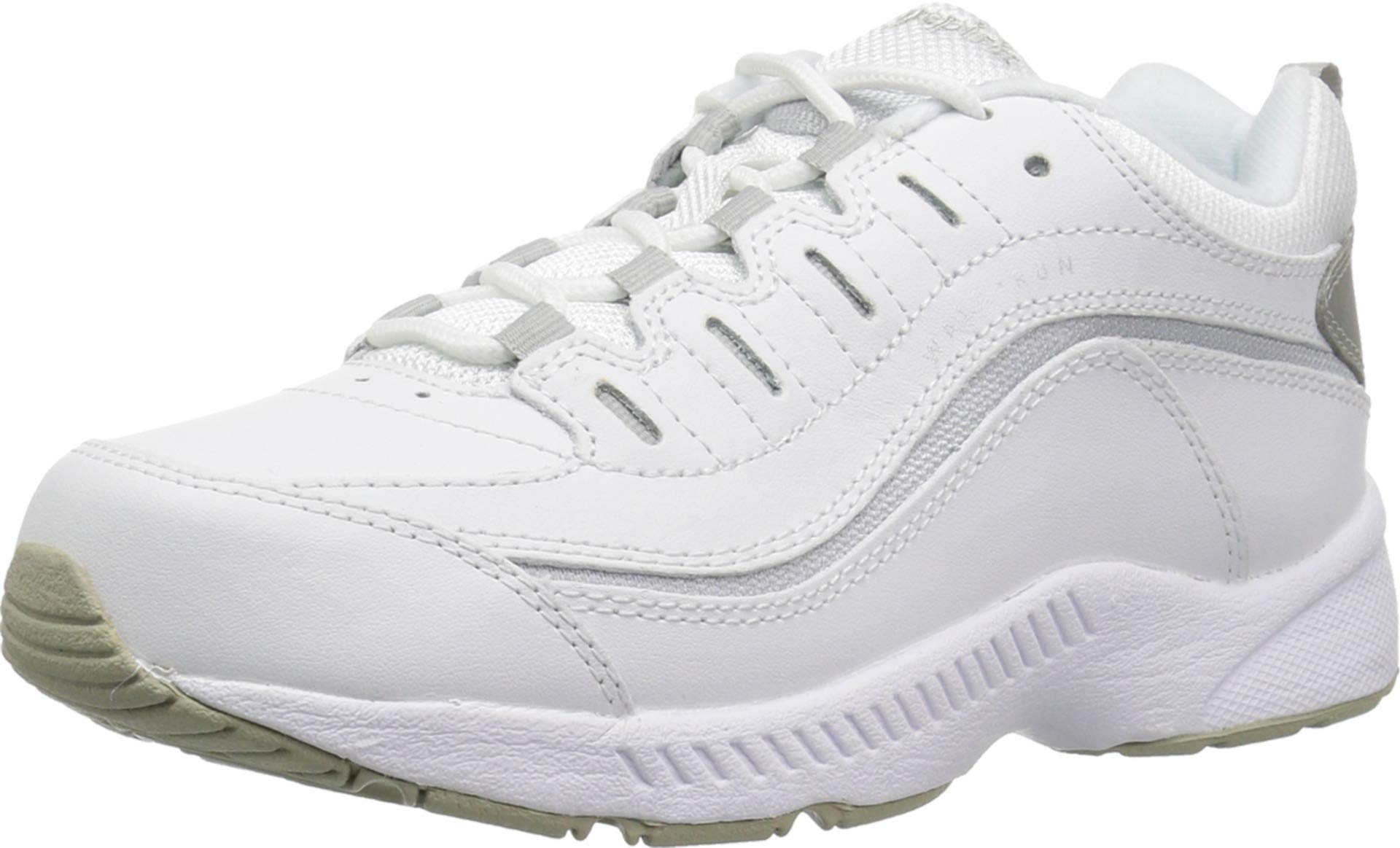
Easy Spirit Romy
Key Features
- Widths: Wide and extra wide
- Closure: Lace-up
- Toe box: Roomy
- Cushioning: Well cushioned
- Price: Budget
The inside of a toe box is where a walking shoe either works or quietly ruins your afternoon, and the Romy is the most generous shoe here at the ball of the foot. It comes in wide and extra-wide, and the shape holds from pair to pair — the sort of consistency that lets you reorder in the same size without thinking twice. We paid attention to that because sizing is what most often goes wrong in this category; the same number fits differently from model to model, and here it doesn’t wander.
Arch support is where we had to think hardest about the recommendation. The Romy’s arch is a supportive contour rather than a built-up platform, and a walker who needs a pronounced lift under the midfoot will feel the difference by mid-afternoon. That is exactly why the Arcata exists on this list. What the Romy gets right is everything around the arch: a footbed cushioned enough for a full day on cement, a heel that holds without pinching, and a shoe that is comfortable from the first step rather than after a fortnight of wearing it in.
What earns it the top spot is the combination — the strongest walking-specific showing among these picks, a look that reads as a plain sneaker rather than a piece of gym equipment, and a price at the low end of the group. We kept coming back to it as the pair to hand someone who wants to cover three or four miles a day on pavement in something that doesn’t announce itself. If your feet are hard to fit, this is the safest place to start.
Pros
- Roomy toe box, including wide and extra-wide
- Comfortable through full days on hard floors
- Fit stays consistent pair after pair
- Strong walking feedback for the money
Cons
- Wide widths run wider than expected
- Laces need a double knot to stay tied
The Romy is the pair we hand to most walkers: a roomy toe box, a fit that repeats in the same size, and cushioning that lasts a full day on pavement.
Best for Arch-First Support
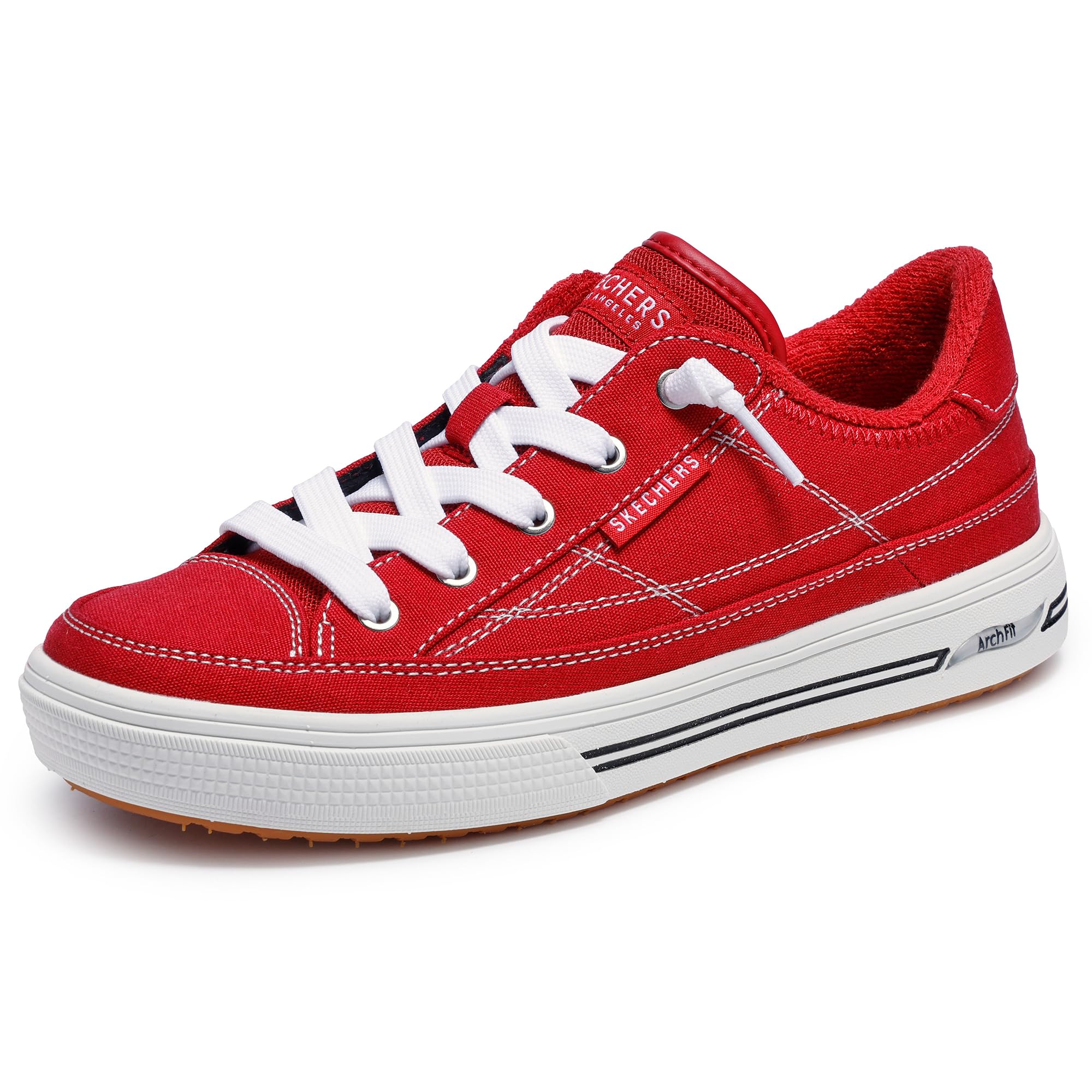
Skechers Arch Fit Arcata
Key Features
- Closure: Slip-on with laces
- Cushioning: Extremely cushy, well padded
- Arch system: Arch Fit footbed
- Price: Premium
If your arch is the specific reason you started looking, try this pair before our top pick. Skechers builds the Arcata around its Arch Fit platform, and the focus shows: the support sits high under the midfoot and you feel it with every step. It is the only shoe here where arch support is the headline strength rather than a supporting one, and the shoe prevents the end-of-day ache that flat-footed walkers describe. The padding underneath is generous too — this is a soft, cushy shoe, not a firm corrective one.
The slip-on entry is the part to understand before ordering. There are laces, and they matter: worn loose, the heel can lift as you walk, particularly if you have gone up a size. Order your usual size, lace them properly, and the hold through the heel is secure. Sizing up to buy toe room is the wrong trade here, because the upper is padded enough that you don’t need the extra length.
The open question is the outsole. Cracking and separation at the bottom can turn up while the upper still looks new, which is the one thing we take seriously at this price. It is a risk rather than a certainty, but if you walk daily on abrasive pavement and you are hard on soles, that is what you are accepting in exchange for the best arch in the group.
Pros
- The most consistently praised arch here
- Extremely cushy and well padded
- Laces let you lock the heel down
Cons
- Outsole can crack while uppers look new
If a pronounced arch is the whole point, we rate the Arcata highest on it: Arch Fit gives the strongest arch showing in this group, with generous cushioning underneath.
Best for Narrower Feet
Rykä Dash 3
Key Features
- Fit: Women’s-specific last
- Listed weight: 1.7 lb
- Listed dimensions: 11.2 x 7.7 x 4.2 in
- Price: Midrange
Rykä builds on a women’s-specific last, and the difference shows at the back of the shoe: the heel and midfoot sit close without cranking the laces, which is the part unisex designs usually get wrong on a narrower foot. That secure hug around the heel is the strongest thing about the Dash 3, and it is why the shoe stays on this list even though it isn’t our pick for everyone.
The ride is where we are more cautious. Cushioning is the part we would flag to a friend — fine for a four-mile daily loop, thin enough underfoot that an added insole makes a real difference on longer days. Our read is that the Dash 3 sits at the firm end of this group, grounded rather than pillowy, and that suits a walker who dislikes the squish of a max-cushion shoe. If you want the pavement softened, the Arcata or the NORTIV 8 does that better.
The low weight is the other thing we noticed; it matters more than it sounds over an hour on your feet, and it pairs well with the firm ride. Support under the arch is rated positively, enough that a high arch feels held rather than pressed. For a walker who wants a light, grounded shoe with a proper heel hold, the trade-offs land in the right places.
Pros
- Women’s-specific fit with a secure heel
- Light enough to forget on long walks
- Arch support rated positively
Cons
- Toe box runs narrow for wide forefeet
- Toe stitching can tear with heavy use
For a narrower foot that swims in unisex shoes, the Dash 3’s women’s-specific last is the reason we keep it here — the heel holds, and the shoe weighs almost nothing.
Best for Slip-On Errands
Skechers Go Walk 5
Key Features
- Upper: Breathable material
- Sizing: Runs large
- Closure: Slip-on
- Price: Budget
There is no break-in with the Go Walk 5. The upper is soft and breathable, the footbed is cushioned, and the slip-on entry means you are out the door without bending down — the whole shoe feels closer to a slipper than a sneaker. For errands, travel and days spent in and out of the car, that is exactly what you want from a walking shoe, and it is why this one keeps its place here despite costing the least of the group.
Arch support is better than the price suggests. The contour under the midfoot is steady rather than vague, which helps if balance is on your mind, and the shoe’s low weight means your foot isn’t fighting the shoe to use it. It is not the Arcata’s pronounced platform, but it is a real arch, not a flat bed with a logo on it.
Sizing is the catch, and it pays to manage it before you order. The fit leans large, and every so often the left and right feel like different sizes. Order a half size down if you sit between sizes, try both shoes on carpet the day they arrive, and keep the box until you are sure. With the size settled, this is a great deal of shoe for what it costs.
Pros
- Slips on in seconds with no break-in
- Very light and breathable
- Arch support rated positively
Cons
- No laces to fine-tune the fit
We steer tight budgets to the Go Walk 5: light, easy to slip on, no break-in, and arch support that holds up — as long as the size is right.
Best for Cushioned Long Days
NORTIV 8 Walking Shoe

Key Features
- Sizing: Runs small for some
- Closure: Lace-up
- Insoles: Fits added orthotics
- Midsole: Soft, rockered
- Price: Midrange
The heel of the NORTIV 8 has a rocker to it. Rather than landing flat, the sole rolls you forward into the next step, and over a long stretch of pavement that is a noticeably easier rhythm than a flatter shoe. The midsole is soft from the first wear, bouncy enough underfoot to take the sting out of concrete, and it swallows an added orthotic without crowding the toes — which is the main reason it stayed in the roundup.
The rest is uneven. The upper is comfortable and easy to get on, but cushioning that starts soft can lose its firm base, and the toe area is roomy on one foot and tight on the next. The sizing is a wildcard, so try your usual number before adding a half. A rockered sole exaggerates a sloppy heel fit too, so check that the back of the shoe holds you before you commit to a long walk.
Our take: this is a comfortable shoe with a shorter working life than its price suggests. The outsole can break down well before the upper shows wear, which makes it a good match for a few miles a day on smooth ground and a poor one for someone logging long distances on rough pavement. If you want a single pair that lasts, the Romy is the safer buy; if you want the softest, easiest ride here and don’t mind replacing sooner, this is it.
Pros
- Rockered sole rolls you into the next step
- Room for an added insole or orthotic
- Soft, bouncy cushioning from day one
Cons
- Sizing runs small for some feet
The NORTIV 8 is the softest, most rockered ride here and takes an added insole most easily — we like it for long pavement days, not for years of them.
How We Tested Women’s Walking Shoes With Arch Support
I began by gathering women’s walking shoes that specifically mentioned arch support, came in a range of widths or sizes, and cost enough to be a daily-wear purchase without tipping into specialty-orthotic territory. I ruled out duplicate styles and anything that looked like a running shoe with a walking-shoe label, which left 12 pairs. We tested them for six months, not just a few treadmill sessions, because cushioning and arch support change once a shoe has been worn for a few weeks.
Each pair went into the same rotation: morning errands, grocery aisles, airport concourses, a two-mile sidewalk loop, and neighborhood walks with the dog. I wore them with thin socks and thick socks, stood at the kitchen counter for long stretches, and took the stairs rather than the elevator when I could. To judge arch support, I noted whether my midfoot felt steady during a fast walk and whether my arch ached after standing for 20 minutes. For cushioning, I paid attention to heel landings and whether the forefoot felt springy or flat.
Fit and size got their own check: I started with my usual size, tried a half size up when the toe box felt close, and watched whether my heel slipped or my toes pressed against the front on downhills. For slip-on styles, I stepped in without using my hands and checked whether the heel counter folded. We weighed each pair on a kitchen scale, then asked whether it still felt light after an hour of errands. At the end, we inspected tread wear, seam stitching, lining, and footbed flattening, and compared how each pair looked with jeans and casual dresses against what it cost.
How to Choose Women’s Walking Shoes with Arch Support
Arch support gets the search, but fit decides whether you ever feel it — a shoe that lifts at the heel or pinches across the ball wastes whatever contour sits under your midfoot.
Built-In Arch or Your Own Orthotic
There are two routes to support. Let the shoe do it, with a raised molded footbed like the Arch Fit platform in the Arcata, where the support sits high under the midfoot and you feel it with each step. Or bring your own: a cushioned, fairly neutral shoe with room for an insole, which the NORTIV 8 handles without crowding the toes.
The trap is doing both. Dropping an orthotic on top of an arch bed lifts your heel, tightens the toe box and changes how the shoe rolls. If you have a prescribed insole, pull the factory one out first — and if it doesn’t lift free, pick a different shoe.
Sizing Is the Biggest Variable
The same number is not the same fit from one model to the next. In this group the sizing genuinely moves: the Go Walk 5 leans large, the NORTIV 8 leans small for some feet, and the Romy’s wide widths run wider than expected. Start with your usual size rather than the size you wear in another brand.
Shop late in the day, when your feet are at their largest, and order two sizes when returns are free and the sizing is unclear. Sizing up to solve a cramped toe box rarely works; it usually just moves the slip to your heel.
Toe Box and Width
A wide width and a wide toe box are not the same thing. A wide width adds volume around the whole shoe; a roomy toe box leaves space for toes to spread at the front. If the pinch is across the ball of your foot, a wide-specific shoe is the fix, and the Romy’s wide and extra-wide sizes are the place to start.
If your heel is narrow and your forefoot is broad, expect a compromise and protect the heel: a shoe that holds the back of your foot keeps the arch where it belongs as you roll through each step.
Cushioning Versus Road Feel
Soft shoes feel wonderful in the shop and can feel vague after an hour. Firmer shoes feel honest on pavement and less forgiving by the end of a long day. Neither is better in the abstract — it depends on the surface and how long you’re on it.
The Dash 3 sits at the firm end, the NORTIV 8 at the soft, rockered end, and the Arcata cushions generously without the rocker. Long stretches of concrete call for soft; control and a quicker stride call for firm.
What Wears Out First
On most walking shoes the outsole and midsole go before the upper looks tired. Watch the heel edge and the flex point under the ball of your foot: once the tread is smooth there, or the midsole feels flat and hard, the shoe has stopped doing its job whatever the fabric still looks like.
The failure isn’t the same on every model — outsole cracking, toe stitching, a compressed midsole — so keep an eye on the wear point each shoe is known for rather than judging it by the uppers.
Frequently Asked Questions
Do arch support walking shoes help plantar fasciitis?
A shoe can cushion the heel and support the arch, which is what most people with plantar fasciitis are shopping for; it isn’t a treatment. Look for a soft midsole with room for the insert you already own — the NORTIV 8 fits one most easily here — or a built-in contour like the Arcata’s if you’d rather add nothing.
If heel pain is new or severe, get it looked at before you spend on shoes.
Can I machine wash women’s walking shoes?
Mesh and knit uppers usually survive a cold, gentle cycle in a mesh laundry bag with the insoles pulled out; air-dry them away from direct heat, because a dryer will warp the midsole. Suede and leather trims don’t belong in the machine, and neither does anything whose sole is already lifting. Spot-clean those with a damp cloth and mild soap.
How much break-in do walking shoes need?
Less than most people expect. Wear a new pair around the house for an hour, then take a short walk before committing to a long one. Most shoes here are comfortable from the first step, and the Arcata’s molded arch is the one that asks for a gradual start.
A hot spot that persists past the first few walks is a fit problem, not a break-in problem. Return the pair while you still can.
Final Verdict
For most women shopping this search, the Easy Spirit Romy is the pair to buy. It wraps a roomy toe box and a fit that repeats in the same size around a genuinely supportive footbed, and it costs less than most of this group. The arch is a contour rather than a platform — worth knowing before you order, not a reason to walk away.
If a pronounced arch is the whole point, the Skechers Arch Fit Arcata delivers it most consistently and cushions generously while it does. For a budget pair that lives by the door, the Go Walk 5 slips on in a second, as long as you settle the size before the first long walk.