This post contains affiliate links. We may earn a small commission when you buy through our links — at no extra cost to you.
Every November I do the same thing: step out of bed onto cold hardwood, hop to the rug, and promise myself I’ll replace the pair that flattened out last spring. Slippers are the most-worn shoes in most houses and the least thought-about purchase — people buy them in a hurry in December and then live with whatever shows up. What a good pair actually fixes is specific: warm feet that don’t turn clammy by mid-morning, a sole that grips a wooden staircase, and a lining that’s still cushioned in February instead of packed flat.
The thing first-time buyers don’t realize is that slippers loosen. Wool and fleece relax roughly half a size as you break them in, so the pair that feels almost too snug on day one is usually the one still staying on your heel in March. My team and I have spent the past six months in 14 pairs — up and down stairs, out to the mailbox, through a lot of early mornings — and the ones that held up got the fit, the warmth, and the wear right. The survivors are below.

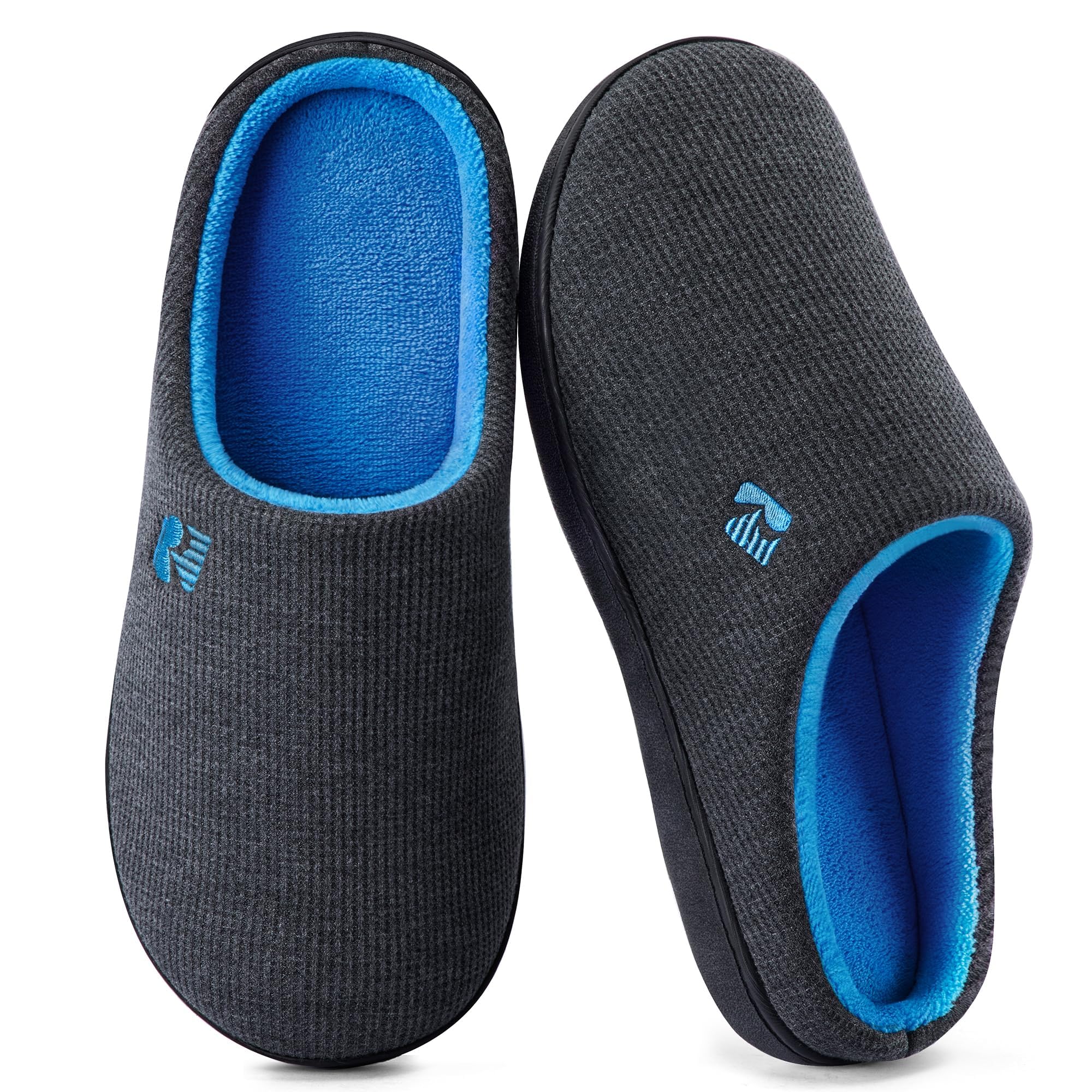


Best for Cold-Floor Mornings
Wishcotton Warm Bootie Slipper
Key Features
- Sole: Rubber, non-slip
- Style: Heel-covering bootie
- Package dimensions: 10 x 8 x 4 inches; 14 ounces
- Price: Midrange
A bootie that closes over the heel is the shape to start with when the floor is cold, and the Wishcotton is the version of it we are happiest to recommend. The fuzzy collar comes up over the ankle instead of gaping open at the back, and the rubber outsole wraps a little way up the side, which turns a wet doorstep into a non-event rather than a change of socks.
Fit is what puts it first. Sizing is the argument this category has with itself: backless scuffs slide off narrow feet, closed styles pinch wide ones, and half sizes are rare. Of the pairs here, this is the one whose sizing holds up best, and a bootie has nothing to re-seat under your heel every few steps. Warmth is not in question either; the fleece lining and that collar are the reason these are the ones we reach for on a January morning.
They are also warmer than some people want. In a house with the heating running, a whole evening in them was more than we needed, and if you run hot, a backless scuff makes better sense. On a cold porch the coverage is exactly the point, and that is the trade you are making.
Ours arrived with care instructions for keeping the pile soft, which is the right instinct: brush or spot-clean the lining rather than washing it and the inside stays pleasant far longer. It sits in the middle of this group on price, well below the UGG and above the budget pairs, and it is the pair we point to first.
Pros
- Heel-covering bootie keeps ankles warm
- Most dependable sizing of the pairs here
- Rubber sole handles wet doorsteps
Cons
- Outsole can start to separate with daily wear
We recommend this bootie to anyone whose winter mornings start on a cold floor: the most dependable fit here, warmest coverage, and a sole that shrugs off a wet doorstep.
Best for Men’s House Wear
RockDove Men’s Original Two-Tone
Key Features
- Style: Open-back scuff
- Footbed: Memory foam
- Dimensions and weight: 10.8 x 4.6 x 3.2 inches; 15.52 ounces
- Price: Midrange
Open-back scuffs are what most men default to, and the RockDove is the pair we recommend without much hedging. It is light, it is warm without cooking your feet, and it sits at the bottom of this group on price. The two-tone upper looks more considered than a house slipper needs to, which is why it also works as a gift for someone who will never shop for one himself.
Weight is where it surprises: 15.52 ounces is light for a slipper with a sole this solid, and that sole is thick enough that gravel on the driveway does not come through on the walk to the mailbox. The open heel keeps air moving, so a long evening in them does not turn into a foot sauna, and they are easy to step out of at the door.
Width is the thing to think about. The fit runs narrow for some feet, and because nothing presses across the back of the heel, this shape is more forgiving than a closed bootie if you sit between a standard and a wide.
Pros
- Light for a slipper with a solid sole
- Warm without overheating
- Tidy two-tone upper
Cons
- Sizing runs small, so order up
- Outsole can detach at the toe
The men’s pair we recommend first: light on the foot, warm without overheating, and tidy enough to give as a gift.
Best for Support and Balance
Skechers Keepsakes Ice Angel
Key Features
- Widths: Standard and wide
- Outsole: Firm and supportive
- Arch support: Cushioned footbed
- Price: Upper midrange
Plush is easy and support is not, and the Keepsakes Ice Angel is the pair here that takes the footbed seriously. There is a cushioned arch underfoot rather than a flat slab of foam, and the outsole is firm enough to cross a porch or a yard without the slipper twisting under you.
That structure is why we recommend it to anyone who is on their feet at home all day, or who wants a little more confidence on stairs. It is also the pair here that comes in wide widths, which matters more than the plush race suggests: a slipper that presses across the ball of the foot is the one that ends up at the back of the closet.
The trade is softness. This is a firmer feel than the fuzzy booties, and if you want to sink into a slipper it will not be the one. Grip is good on hard floors, the lining holds heat well, and the closed shape suits a cold hallway.
Pros
- Cushioned arch underfoot
- Firm outsole for porch and yard
- Available in wide widths
Cons
- Lining can pull away from the sole
Our pick for anyone who stands at a counter all day or wants steadier footing on stairs, since it is the one pair here with real arch support.
Best for Doorstep Errands
ULTRAIDEAS Memory Foam Slipper
Key Features
- Use: Indoor and outdoor
- Style: Slip-on
- Footbed: Memory foam
- Price: Midrange
The test we keep coming back to for an indoor-outdoor slipper is the mail run: out the door, across wet paving, back in, without changing shoes or soaking a sock. This pair manages it. The bottom is solid enough to keep grit and damp out, and there is a tread on it that holds on a wet step.
Inside, it is the slipper people picture when they hear the phrase memory foam: soft underfoot, warm, and forgiving on a hard kitchen floor after an hour of standing. The upper is plush without being bulky, and the colors are cheerful enough that the pair by the door does not have to be beige.
This is the one we point to when someone wants a single slipper for the whole house and the doorstep and does not want to think about it again. It is not the warmest bootie here and not the most supportive, but it handles more situations than anything else in this group at its price.
Sizing is the catch, and it is consistent: these run small, so go up a size, especially if you wear thick socks from November on. Treat them as house slippers that can step outside rather than shoes, and they will do exactly what you bought them for.
Pros
- Sole handles wet steps and grit
- Plush memory-foam footbed
- One pair for indoors and the doorstep
Cons
- Memory foam compresses with heavy daily wear
For one pair that covers the kitchen, the porch and the mail run, this is the one we send people to first.
Best for a Premium Gift
UGG Scuffette II
Key Features
- Sizes: Whole sizes only
- Lining: Plush fleece
- Dimensions and weight: 13 x 9 x 5 inches; 3 pounds
- Price: Premium
The Scuffette II sits in its own price bracket here, and we think it earns that for one kind of buyer: someone who wants a house slipper that looks like a shoe rather than a novelty. The finish is the whole argument. The upper reads as something you could wear to a cafe, and the open back keeps it from looking like a boot.
Warmth is genuinely good. The fleece lining is thick, the pair holds heat on a cold floor, and it does so without the clammy feeling a closed bootie can bring after an hour. Sizing is the practical part: these come in whole sizes only and they run on the small side, so a half size goes up, not down, and the open back takes up the slack.
What the money buys beyond the look is a slipper that will not embarrass you on a video call, not indestructibility. If warmth per dollar is the measure, the bootie at the top of this list beats it comfortably; if you want the pair that looks like something, this is the one.
Pros
- Looks like a shoe, not a novelty
- Thick fleece lining holds heat
- Open back suits warmer rooms
Cons
- Heel lining wears through with daily wear
Worth it if the look matters, since it is the only pair here that reads as a shoe rather than a house slipper.
Best for Cold Rooms
EverFoams Fuzzy House Slipper
Key Features
- Style: Low-profile slip-on
- Footbed: Memory foam
- Outsole: Rubber
- Price: Midrange
If your house is the kind where the thermostat sits low and the kitchen floor never quite warms up, this is the pair to look at. Warmth is what the EverFoams does best: the lining traps heat quickly, and there is enough room inside for a pair of thick socks on the worst mornings.
The footbed is memory foam of the soft, forgiving kind rather than a firm one, which is pleasant on tile and not much use if you want arch support. The profile is low, so they do not feel clunky, and they stay on the foot better than a backless scuff when you head down the stairs.
What you get is warmth and cushioning rather than structure, and for a bedroom or a kitchen that is the right trade. If you want a firm footbed under a long day of standing, the Skechers is the better answer; if you want the warmest thing in this group to shuffle around in, this is it.
Pros
- Warmest lining in this group
- Room for thick socks
- Stays on better than a backless scuff
Cons
- Sizing is inconsistent, so check the chart
The pair to buy for a cold house: warmth is its strength, and it leaves room for thick socks without squeezing.
Best for Tight Budgets
Donpapa Fuzzy Memory Foam Slipper

A very cheap slipper has one job: be warm and soft enough that you stop noticing the floor. The Donpapa does that, and it does it with a plushness that does not feel like a compromise. The upper is thick, the inside is fuzzy, and the whole thing feels more considered than the price suggests.
Warmth is strong on a cold morning and the memory foam takes the edge off a hard floor, which is most of what anyone asks of a house slipper. The thickness is doing real work here; this is a pair you feel around your foot rather than a thin cover over your toes.
Two things to know before ordering. They run small, so go up a size rather than trusting your shoe size, and they are strictly an indoor pair, since the soft sole lets a stone path straight through to your foot.
As a second pair for a guest room, a first slipper for a teenager, or a stopgap while you work out what you actually want, it earns its place. It is not the pair to buy if you want one slipper for five winters; it is the pair to buy if you want to spend very little and be warm tonight.
Pros
- Thick fuzzy upper holds heat
- Soft footbed on hard floors
- Inexpensive way to try the category
Cons
- Soles can crack with daily wear
- Fuzz transfers to socks and floors
A sensible second pair for a guest room or a first slipper for someone young: warm, soft and inexpensive enough to replace without a thought.
Best for Men on a Budget
VeraCosy Men’s Two-Tone

Key Features
- Style: Open-back scuff
- Footbed: Memory foam
- Outsole: Rubber
- Price: Budget
The VeraCosy has the hardest sole of the pairs here, and that is both the point and the problem. It is the one that shrugs off a wet step and a gravel path, and it is also the one that clacks across hardwood and tile in a way the soft-soled slippers do not. In a small apartment with someone asleep upstairs, that is a real consideration.
Everything else is quietly competent. They slip on and off without hands, the two-tone upper looks sharper than the price suggests, and the memory foam is comfortable for the first few months, which is the part of a slipper most people actually notice.
Sizing is the practical snag. These run large, so order your usual size rather than sizing up, and if you sit between sizes take the smaller one. A slipper that is a size too big slides off at the heel every few steps, which is worse than a slipper that starts snug.
For a carpeted house they are an easy recommendation: warm, tidy-looking, and simple to get on. For bare floors and thin walls, look at one of the softer-soled pairs instead.
Pros
- Hard sole handles wet steps and gravel
- Slips on without hands
- Sharp-looking two-tone upper
Cons
- Memory foam flattens after a few months
A good men’s slipper for a carpeted house: easy to step into, warm, and tidier-looking than the price suggests.
How We Tested: Six Months, 14 Pairs, and a Lot of Stairs
We started with a long list of a few dozen pairs — styles we’d worn ourselves plus ones that kept surfacing in customer reviews — then filtered by construction (real wool versus synthetic fleece), whether the size range genuinely covered both men’s and women’s feet, and care instructions. A slipper you can’t wash is a slipper with a short life. That left 14 pairs, split across backless scuffs, full-back mules, and bootie styles.
Testing ran from October into March. Each pair went through the same routine: the 6 a.m. kitchen floor while the coffee brewed, the wooden staircase up to the bedroom, an hour standing at the counter making dinner, a walk out to the mailbox on a damp deck, and a full workday under a desk. We wore every pair barefoot and again over socks, noting where the heel slipped, where the toe pinched, whether an hour of standing left our arches aching, and whether feet felt warm or overheated after 60 minutes.
Traction got checked on hardwood, tile, and that damp deck, plus a deliberate shuffle down carpeted stairs to see whether a loose back slid off mid-step. For durability, we inspected seams, sole flex, and how much loft the lining held after eight weeks and again after one wash according to the care label. We also paid attention to appearance — whether a pair was presentable enough to answer the door or walk to a neighbor’s — and to value, judging each one against how it looked at the end of six months rather than how it looked in the box.
How to Choose Winter Slippers
Warmth is the easy part. The pair you are still wearing in February is the one whose shape, size and sole match the way you actually move through your house.
Choose the shape before the fluff
Three shapes cover almost everything here. A backless scuff is the easiest to step into and the coolest on the foot, which suits heated houses and anyone who runs warm. A bootie that closes over the heel holds warmth in and stays put on stairs, at the cost of feeling like more shoe. A low slip-on sits between the two.
Our rule: if your floors are cold and you carry laundry up and down stairs, start with the closed bootie. If you kick your slippers off a dozen times a day, an open back is the practical choice.
Sizing is where most disappointment starts
The same size number is not the same foot across brands, half sizes are rare, and memory foam packs down in the first week, which can free room or make a loose pair looser still. That combination is why fit is the loudest complaint about winter slippers.
Measure your foot in inches and compare it to the chart instead of ordering your shoe size. Wearing thick socks means going up; a pair that runs large, like the VeraCosy, means taking the smaller of two sizes. Open backs forgive half a size, closed booties do not.
The sole decides where they can go
A rubber outsole with a little tread means a trip to the bin, the mailbox or the woodpile does not end in wet socks. A fabric or soft foam bottom is an indoor sole: fine on carpet, slick on tile, and finished by a wet path.
Stiff, hard soles are the most durable and the loudest. If the slippers will live on hardwood and the house is quiet, a softer sole is worth the shorter life.
Cushioning is comfort, not support
Memory foam feels wonderful and holds nothing up. If you stand at a counter for hours or want confidence on stairs, look for a cushioned arch and a firmer outsole; the Skechers does that better than anything else here. Otherwise buy for softness and expect the footbed to flatten.
Linings wear at the heel first, and some shed fuzz for the first week. Spot-clean rather than machine wash, because heat and agitation are what finish off a glued sole.
Frequently Asked Questions
Are winter slippers worth it if I already wear thick socks?
Socks keep feet warm but they slide on hardwood and give you nothing to grip. A slipper adds an outsole, a footbed and a little structure, which is the difference between shuffling and walking normally through the house.
Buy a roomy pair and wear the socks inside it. The warmest styles on this list leave space for a thick sock without squeezing across the toes.
How often should I replace winter slippers?
Not on a calendar. Press the footbed with your thumb and hold for a few seconds: if the dent stays, the foam has gone and you are wearing a sock with a sole.
The other signals are a lining worn through at the heel and an outsole peeling at the toe. Any one of those means replace, whatever the age.
Do winter slippers fit wide feet?
Some do. The Skechers comes in wide widths, and backless scuffs are more forgiving than closed booties because nothing presses across the heel.
Memory foam also compresses after a week or two and frees a little room, so a pair that feels snug on day one is not automatically the wrong size.
Final Verdict
The Wishcotton bootie is the pair we recommend to most people. It closes over the heel, its sizing is the most dependable in this group, and the rubber rim means a wet doorstep does not end the morning.
Buy the RockDove if you are shopping for a man and want a light, tidy pair; the Skechers if you want arch support underfoot; and the UGG only if the look matters as much as the warmth.