This post contains affiliate links. We may earn a small commission when you buy through our links — at no extra cost to you.
There’s a moment every camper knows: boots off, socks peeled, feet finally free — and then the scramble to find something to put them in. The wrong answer is a pair of soggy running shoes that never dried out or a slide that skids off a gravel path in the dark. A good camp shoe covers the hours between hikes, cushioned enough to stand at the stove, grippy enough for the 2 a.m. walk to the bathroom, and easy to shove on one-handed when your hands are full of tent stakes.
Fit is the tricky part — feet swell after a day of hiking, so a pair that feels right at 8 a.m. can pinch by dinner. My team and I have spent six months in 12 pairs of camp shoes, wearing them on gravel, through wet grass, and across the occasional creek, judging sizing, cushioning, and durability along the way. A couple made the cut on looks and color alone; most had to earn their place in the duffel. Here’s what held up.



Best for All-Round Camp Shoe
Crocs Classic Clog
Key Features
- Fit: Roomy, no half sizes
- Sizing: Unisex adult
- Closure: Slip-on, no laces
- Price: Budget
A single molded piece of foam with a heel strap is a low bar for a shoe, and that is exactly the point. The Classic Clog is the simplest way to solve the middle-of-the-night walk to the bathhouse: no laces to fumble, no lining to soak through, nothing to dry except the shoe itself. We keep coming back to it because it asks nothing of you — step in, flip the strap forward while you’re shuffling around the fire, flip it back when you’re walking to the water tap.
Fit is the one decision to make up front. There are no half sizes, and the clog is cut roomy through the instep, so anyone between sizes is better off with the smaller one; wide feet get along with it without complaint. Give it a day before you judge it — the roominess that feels sloppy on the first afternoon is what lets your toes spread after eight hours in boots.
Around camp it does the jobs boots can’t: the shower block, the trash point, the drive into town for ice. It packs flat, and because it is one piece there’s no seam to split and no lining to mildew. The ventilation holes are a genuine feature on a hot afternoon, and they’re the reason a pair of socks is worth packing for a cold one.
Colors matter more than a spec sheet suggests: a bright pair is easier to find by feel in a dark tent, which sounds trivial until you’ve done the barefoot search at three in the morning.
Pros
- Steps on and off hands-free
- Rinses clean and air-dries fast
- One of the lowest prices here
Cons
- Heel strap can snap within weeks
Our default camp shoe: it slips on in the dark, rinses clean in the morning, and costs less than most picks here — exactly what a shoe by the tent door should do.
Best for Rough Ground
Crocs Offroad Sport Clog
Key Features
- Front: Closed toe
- Strap: Adjustable Velcro
- Sizing: Unisex, runs large
- Price: Midrange
The difference between this and the Classic is a shell that covers your toes. On a site full of roots, rocks, and fire-ring debris that is not a small thing — you stop thinking about where you put your foot. The front is closed, the upper is roomier through the toe box than the Classic, and the heel strap is Velcro rather than a fixed band, so it adjusts over a thick sock or a bare foot.
For rougher sites we rate it above the Classic. Gravel and pine needles stay out of the shoe instead of rattling around under your arch, the adjustable strap is what makes it work with wool socks in October, and it takes orthotics without a fight. Sizing is the thing to get right: it runs large, and with no half sizes the safe move is to order down if you’re between. The closed front also makes it warmer than the open clogs, which helps in shoulder season and costs you a little in July.
What you don’t get is the Classic’s breezy simplicity. There’s more shoe here, and it takes a little longer to rinse sand out of the covered toe. If your camping is mostly a manicured loop with a bathhouse, that extra coverage is weight you don’t need; if it’s a fire ring in a national forest, it’s the pair we’d grab.
Pros
- Closed toe keeps gravel and debris out
- Velcro strap adjusts over thick socks
- Room for orthotics and wide feet
Cons
- Velcro strap can tear at the anchor
We reach for this one when the ground around camp is rough: the closed toe and Velcro strap turn a clog into a shoe you can wear to the woodpile without watching every step.
Best for Longer Walks
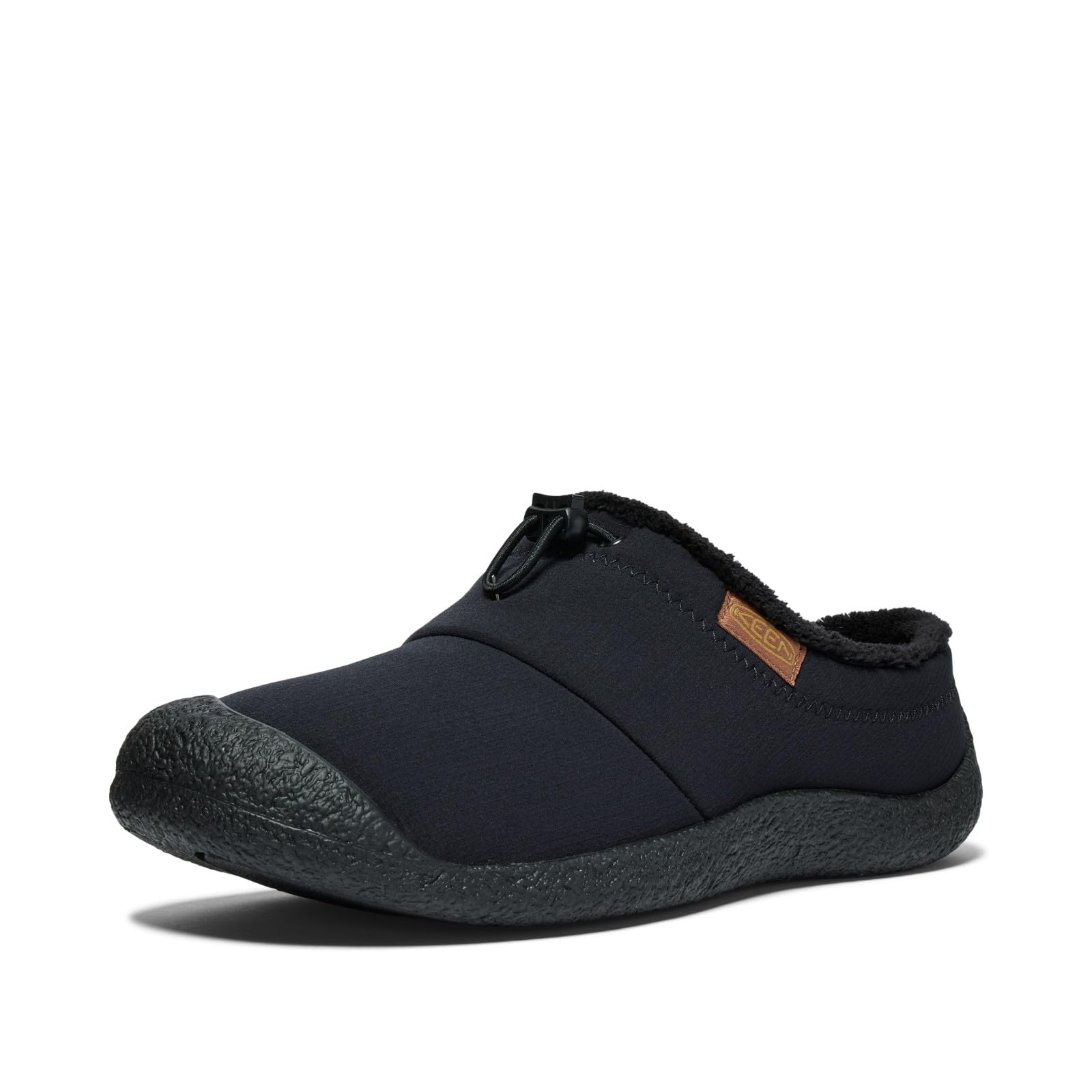
KEEN Howser III
Key Features
- Sole: Rubber, indoor/outdoor
- Style: Slip-on shoe
- Toe box: Wide
- Arch support: Cushioned footbed
- Price: Premium
The Howser III is the most expensive shoe on this list, and the only one we treat as footwear rather than footwear-adjacent. It’s a slip-on built like a shoe: a rubber outsole, a wide toe box that lets your toes splay after a day in stiff boots, and enough structure that the walk to the camp store doesn’t feel like a compromise.
Support is what you’re paying for. The arch and the cushioned footbed are what we want underfoot while dinner cooks, and the wide toe box is genuinely kind to feet that have been squeezed since breakfast. It also goes on without hands, which matters more than it should when you’re carrying a water jug back from the tap.
What you give up is packability and drying speed. It’s a shoe, not a foam clog: it takes up more room in a duffel and won’t shrug off a soaking the way foam does. For car camping, where space is cheap, that’s a fair trade; for a trip where every item earns its place in the pack, the clogs win.
Pros
- Real arch support underfoot
- Wide toe box for tired feet
- Rubber sole grips indoors and out
- Slips on without using hands
Cons
- Most expensive pick in this roundup
- Bulky and slow to dry
If you want a camp shoe you can walk a mile in, this is the one we point to — a wide toe box, real arch support, and a rubber sole for gravel roads.
Best for Cold-Weather Camping
Thermoball Traction Bootie
Key Features
- Upper: Water-resistant
- Weight: 8.82 oz
- Insulation: Thermoball
- Price: Premium
A cold morning is where camp shoes earn their keep or get abandoned. The Traction Bootie is built for that moment: Thermoball insulation, a water-resistant upper, and a sole with enough tread that a walk across wet gravel doesn’t end with a wet sock.
The listed weight is 8.82 ounces, light enough to justify as a second pair on a short trip, and the back is cut like a mule, so you step into it rather than haul it on. The warmth is the headline: it turns sitting out for the last of the fire into something you do rather than something you endure.
We rate it the best cold-weather pick here, and the only one that makes a freezing bathroom run tolerable. The water claim needs reading carefully, though — it’s water-resistant rather than waterproof, so dew, wet grass, and slush are fine, and standing water is not. Size is the other thing to know: it runs big, so take the smaller of two sizes.
Pros
- Warmth for freezing mornings
- Easy on and off in the dark
- Light enough to pack as a spare
Cons
- Runs a size big
For cold-weather camping this is the pair we want by the sleeping bag: insulated, water-resistant, and easy to kick on when the boots have frozen solid.
Best for Wet Camp Days
PIMIO Garden Clogs

Key Features
- Strap: Heel strap
- Sizing: Unisex, generous
- Drainage: Quick-dry
- Price: Budget
It’s a Crocs clone on paper, right down to the holes and the heel strap, and that’s the pitch: the same shape for less. The functional difference is the drain-and-dry build, which makes it the pair you wear for a river crossing or a swim rather than the pair you save for gravel.
We keep this one in the wet-trip slot. The listing promises arch support; the footbed is flat enough that a long walk on a rocky path will remind you what you paid. For the ten minutes between the tent and the water it does the job, and it dries on the outside of your pack instead of souring inside it.
Sizing runs generous and wide, so if you’re between sizes the smaller one is usually right. Against the Classic you’re trading a little refinement for drainage and a slightly lower price, and that’s the right trade only if water is a regular part of your camp day.
Pros
- Drains and dries quickly
- Generous width for wide feet
- Lower price than the Crocs alternatives
Cons
- Strap and trim can break early
- Slippery on wet tile and concrete
We like it for camps with water at the end of the day: it looks like a Croc, drains like a water shoe, and dries before the fire dies down.
Best for Packing Light
LongBay Women’s Slipper

Key Features
- Care: Machine washable
- Sizing: Runs small
- Outsole: Non-slip rubber
- Price: Budget
These arrive flat and stay flat, which is the whole argument for a soft camp slipper over a clog. It folds into the gap beside a sleeping bag, weighs almost nothing in the hand, and doesn’t mind being squashed for eight hours in a car. For a trip built around a duffel and a cooler, it’s the easiest second pair to justify.
On your foot they’re warm and soft rather than supportive. The outsole is non-slip rubber, which is what you want on a bathhouse floor, but there isn’t much under the arch and the back sits low enough that the heel can slip when you walk fast. Order up a size — the fit runs small and the label is optimistic.
We treat them as the spare pair: by the tent door for nighttime and short walks, with a clog handling anything longer. Machine washable is the detail that sells them, because after a muddy weekend they go in with the towels instead of festering in the car until the next trip.
Pros
- Packs flat in a duffel
- Machine washable after muddy trips
- Non-slip rubber outsole
Cons
- Seams can let go within weeks
We keep these as the duffel-dwellers: warm, soft, machine washable, and cheap enough to leave in the camping bin between trips.
How We Tested Camp Shoes: Gravel, Creeks, and 2 A.M. Bathroom Walks
We built the shortlist the way a shopper would: roughly 40 pairs from brands we already trust, filtered by weight, packed size, price, and whether they came in half sizes or wide widths. Anything that weighed more than about a pound per shoe or needed two hands to pull on got cut. That left 12 pairs, worn over six months of camping — a dusty desert site, a damp forest one, a few river days, and more driveway packing sessions than I’d like to admit.
At each site the shoes lived by the tent door and went everywhere: the walk to the bathroom in the dark, twenty minutes standing at the stove, the drive to town for ice, the shuffle around the fire. We weighed every pair on a kitchen scale and stuffed each into a duffel beside a sleeping bag to see how much room it really stole, then timed how long it took to pull on one-handed while holding a headlamp.
Sizing got the most scrutiny. We compared each pair against our usual street size, then had testers with wide feet and high arches wear them after a full day of hiking, when feet are at their biggest, noting where toes pressed the front and where heels slipped. Cushioning was judged by whether feet ached the morning after a long evening of standing around, and a shoe that worked at the tent but not on a town errand lost points for versatility. Water resistance meant a five-minute soak in a basin and a stopwatch to see how quickly each pair dried on a line. At season’s end we checked stitching, sole separation, and crushed heel counters, looked at how the colorways held up once mud dried and got brushed off, and asked whether each pair still felt worth what it cost.
How to Choose Camp Shoes
The right camp shoe is the one you can get into without using your hands and out of without untying anything; everything else is a trade between weight, warmth, and how much ground you plan to cover.
Fit, Half Sizes, and the Heel Strap
Camp shoes get worn at the end of the day, when feet have swollen, and often barefoot. That makes a roomy fit more useful than a precise one. Most foam clogs here are cut generous and none of them come in half sizes, so if you’re between sizes the smaller one is usually right — the exception is the soft LongBay slipper, which runs small and wants a size up.
The heel strap matters more than it looks. Forward, the shoe is a slipper you can kick off outside the tent; back, it stays on for the walk to the water tap. If you plan to wear thick socks, check that the strap adjusts before you commit.
Match the Sole to the Ground
An open-topped clog is fine on grass and packed dirt and less fun on a site full of roots and sharp gravel, where a closed front keeps stones out and stops you watching every step. If your routine includes a walk down a gravel road or a path to a swimming hole, pay for tread and coverage; if it’s ten steps to the bathhouse, an open clog is lighter and cooler.
Wet tile is the exception. A foam sole with worn tread is not the place to trust your footing, and drainage does not mean grip — a quick-dry clog that empties water can still skate across a wet concrete floor.
What a Pair Costs You in Pack Space
This is where soft slippers and foam clogs beat anything with structure. A pair of clogs lies flat against the side of a duffel; a soft bootie folds into the gap beside a sleeping bag; a shoe with a rubber outsole and a real footbed, like the Howser III, takes up roughly the room of a second pair of sneakers.
On a car trip that’s irrelevant. On a backpacking trip it decides whether the second pair comes at all, and it’s the first thing to weigh when you’re choosing between a clog and a slipper.
Warmth, Water, and Drying Time
Summer camping wants a shoe that drains and dries — foam is dry by breakfast after a wet evening, and a quick-dry clog is drier still. Cold-weather camping is the opposite problem, and an insulated bootie is the only thing in this guide that keeps a bare foot warm on frozen ground.
Read water claims carefully. Water-resistant handles dew, wet grass, and slush; it does not handle standing water, and nothing here is a wading shoe. If your camp days end in a lake, buy for drainage instead of warmth.
How Long They Last
The failure point on almost every shoe in this guide is the strap or the pull loop, not the sole. Straps tear at the anchor, loops rip off, and soft uppers let go at the seams. Look at how the strap is attached before you buy, and treat anything stitched onto a soft upper as the disposable part.
Soles matter too, but more slowly: a foam clog wears down at the heel first, and that’s when a shoe that was grippy on gravel starts feeling vague on wet concrete.
Frequently Asked Questions
Do I really need camp shoes if I already have hiking boots?
Yes, for any trip longer than one night. Boots need to come off at the end of the day so they can dry, and your feet need to spread out after hours in a stiff sole. A second pair also means wet boots stay outside the tent instead of in it.
One pair per person is enough. Leave the spare at home and spend the space on a dry bag.
Can I hike in camp shoes?
Not on anything rough. Clogs and soft slippers have no ankle support and thin soles, and the one pick here with real arch support and a rubber outsole is still a slip-on, not a trail shoe.
Wear them for the bathhouse, the camp loop, or a flat path to the water. Put the boots back on for rocks, roots, or anything with a climb in it.
Can I wear camp shoes in a campground shower?
The foam clogs and the quick-dry pick are the ones built for it: they drain, they dry fast, and they don’t mind a splash of cleaning solution. Anything with fabric, insulation, or a soft lining stays damp for a day afterwards.
If you’d rather not wear the same pair around the fire, keep a dedicated shower pair clipped to the outside of your bag.
Final Verdict
The Crocs Classic Clog is what we put by the tent door on most trips: it goes on without hands, rinses clean, and asks for nothing from your pack. It’s the shoe we recommend to anyone who camps a few weekends a year and wants one pair that does everything.
Spend up only when the trip demands it — the Howser III if you plan to walk further than the bathhouse, or the Thermoball Bootie if the forecast turns cold and wet.