This post contains affiliate links. We may earn a small commission when you buy through our links — at no extra cost to you.
A waterproof trail shoe is a trade-off you feel on the first climb. The membrane that keeps creek water out also holds heat in, stiffens the upper, and can pull the fit tighter than the same shoe in its non-waterproof version. What you get in exchange is a run that doesn’t end with squelching socks and a two-day drying session — dry feet on wet roots, cold stream crossings, and muddy spring mornings that would otherwise send you home early. The trick is finding a pair that seals out water without turning your foot into a brick.
Over the past six months my team and I have run 12 pairs of waterproof trail shoes through exactly that kind of weather, from sloppy singletrack to rainy road-to-trail commutes. The differences came down to things you only notice after mile ten: whether the arch support actually holds up when the insole gets damp, whether traction survives wet clay, and whether sizing runs true once the membrane is in play. Here’s one thing nobody tells first-time buyers — waterproof uppers almost always fit snugger than the standard version, so if you’re between sizes, go up a half. The picks below are the pairs we kept lacing up even when the forecast was dry.
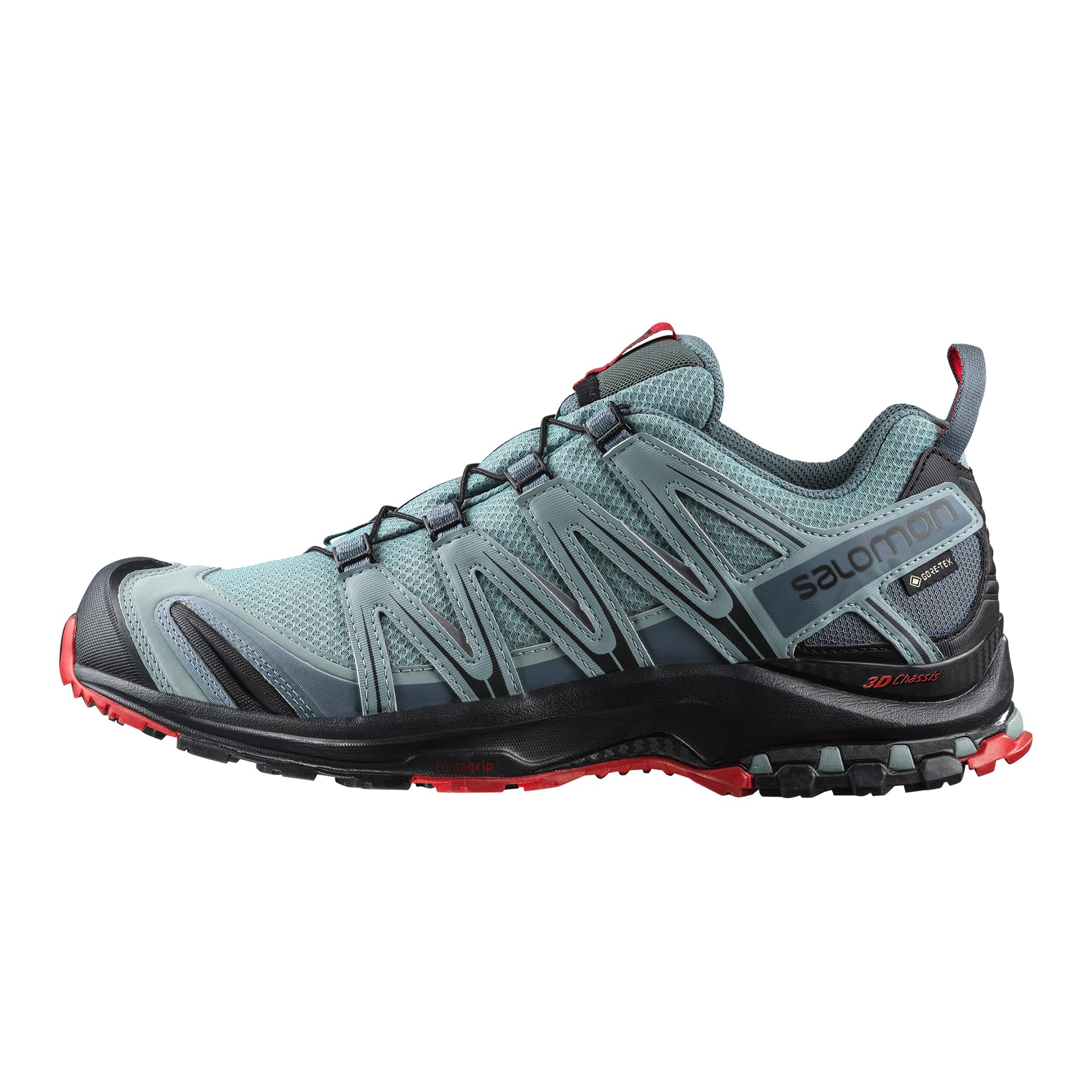


Best for Mixed Wet Trails
Salomon XA Pro 3D GTX
Key Features
- Fit: True to size
- Lacing: Quick-pull cord
- Waterproofing: Gore-Tex membrane
- Price: Premium
Gore-Tex, a reinforced upper and a pull-cord lacing system: the XA Pro 3D is the pair in this group we hand to someone whose run might turn wet halfway through. It’s built like a light hiking shoe, and that’s the point. There’s structure around the heel and under the arch, so a rocky descent doesn’t turn into a balancing act, and the cord laces cinch with one pull and stay where you set them. That last part matters more than it sounds when your hands are cold and the trail is running with water.
The fit is what we kept coming back to. It runs true to size with a supportive arch and a heel that holds the ankle, and nothing pinches across the top of the foot over a long day. We ended up wearing it well beyond running, for wet dog walks, muddy errands and a weekend of standing around outdoors, and it never felt like too much shoe for those jobs. That versatility is why it takes the top spot rather than any single figure.
Wear is the one reservation. On hard, rocky ground the sole can start separating after a few months of steady use, which is the sort of thing to watch for at the toe flex point if your mileage is mostly sharp stone. For mixed trail, wet grass and gravel we haven’t found a more dependable all-rounder in this set, and it’s the shoe we point to when someone wants one pair for whatever the weather does.
Pros
- Gore-Tex upper keeps feet dry on long wet runs
- Quick-pull cord laces stay put with cold, wet hands
- Supportive fit with reliable arch support
- Works as a hiking and everyday shoe too
Cons
- Premium price next to the Merrell and FENLERN picks
For wet, mixed trail running this is the pair we hand most people: a Gore-Tex upper that stays dry, quick-pull laces that hold, and a supportive fit for long, cold, muddy days.
Best for Soft Ground
Salomon Speedcross GTX
Key Features
- Fit: Narrow forefoot
- Lacing: Drawstring speed lace
- Waterproofing: Gore-Tex membrane
- Price: Premium
Mud, wet grass, loose dirt: that’s the ground the Speedcross GTX was built for, and it’s where this shoe separates itself from everything else here. The outsole bites and then clears instead of packing up, and on a churned-up field or a soft woodland climb it simply doesn’t slip. The moment the surface goes soft, we rate it the most sure-footed pick in this set.
The rest of the shoe keeps up. The Gore-Tex liner comes back dry from wet grass and standing water, the drawstring cinches tight in one pull and stays there, and it feels locked on from the first run with no break-in. That close hold is the whole design, so treat it as a shoe that wants to be cinched down rather than worn loose. Where it gives ground is wet rock and slick roots, where the grip that’s excellent in mud becomes merely adequate; if your running is mostly rocky hardpack, the XA Pro 3D is the better-balanced shoe.
Pros
- Outsole bites in mud and loose dirt
- Gore-Tex liner keeps feet dry in wet conditions
- Drawstring laces cinch in one pull
- Locked-on fit without a break-in
Cons
- Narrow forefoot, so size up if between
If your trails are mud, grass and loose dirt, we point you here: the outsole bites where others slide, and the sealed upper and drawstring laces keep a wet run simple.
Best for Light Trail Days
Merrell Nova 4 Waterproof
Key Features
- Fit: Runs small
- Build: Lightweight
- Waterproofing: Waterproof membrane
- Price: Midrange
The Nova 4 is the light one here. Where the Salomons feel armored, this feels closer to a road trainer, which is exactly what makes it good for the run that starts at your front door, crosses a mile of pavement and picks up a trail at the end of it. On a long day it’s the pair that disappears on your foot rather than announcing itself.
Comfort is the reason it earns a place. It’s soft underfoot, easy from the first mile, and it keeps feet dry in wet grass and shallow puddles without the clammy feeling some sealed shoes develop. We also like that it doesn’t look or feel like technical gear, so it works as an everyday shoe that happens to be waterproof, which is rarer in this group than you might expect.
One thing to know before you buy: the waterproof version fits smaller than the regular Nova 4, because the added membrane takes up room inside. If you have worn the standard shoe, go up half a size. Otherwise it’s the easy recommendation for anyone whose trails are gravel paths, forest tracks and the odd rooty section, and who wants one pair to cover the whole day.
Pros
- Light and easy on the foot for long days
- Keeps feet dry in wet grass and puddles
- Comfortable enough to wear as an everyday shoe
- Lower price than the Salomon picks
Cons
- Grip is modest on wet roots and rock
Our pick when you want one light, comfortable shoe for door-to-trail runs and everything after them, at a price well below the Salomons.
Best for Budget First Pair
FENLERN Waterproof Trail Shoe

Key Features
- Fit: Narrow in all widths
- Lacing: Quick-lace
- Waterproofing: Waterproof upper
- Price: Budget
The FENLERN sits at the bottom of this group on price, and that is the whole argument for it. If you want a first pair to find out whether trail running sticks, a spare for a wet commute, or something you won’t flinch at scuffing through a muddy winter, the money is hard to argue with.
Comfort is genuinely good for the money. It’s light, easy on the foot over a long walk or a full shift on your feet, and the quick laces work without fuss. The honest catch is the waterproofing: the upper is described as waterproof, but there’s no named membrane here of the kind the Salomons and the Merrell use, so plan on showers, wet grass and short muddy runs rather than a long day of steady rain.
Width is the other trap. A wide size here is not a wide fit, and the toe box pinches on longer walks. Order your usual size, expect a close fit, and spend more if you genuinely need room across the forefoot. Within those limits it does a useful job, which is why it stays in the guide.
Pros
- Lowest price in this set
- Light and comfortable on long walks
- Quick-lace system works well
Cons
- No named waterproof membrane
- Wide sizes do not fit wide
We rate it as the budget option worth trying if your wet runs are short and gentle: light and comfortable, though the waterproofing is the least certain thing about it.
How We Tested 12 Waterproof Trail Running Shoes
We started with spec sheets, narrowing the field by membrane construction, lug depth, claimed weight, drop, and whether a rock plate sat underfoot. From there we filtered by price and by size runs, dropping anything that only came in a handful of widths or topped out below a men’s 13. That left 12 pairs, which we bought ourselves and rotated through the same spring and early-summer testing cycle.
Each pair went onto wet, rooty singletrack, across a knee-deep creek crossing, and on rainy road-to-trail commutes, plus one long weekend run a week. To check water resistance properly, we stood each shoe in four inches of water for 30 minutes with a paper towel packed inside, then weighed it before and after to see how much it took on and where the damp crept in first.
Traction and grip got the same three-mile loop every time, including a steep clay slope and a set of wet rock slabs, with testers noting exactly where a shoe slid. We logged mileage on every pair and inspected lug wear at 100 and 200 miles to judge durability. For fit and arch support, testers with high and low arches tried each shoe in their normal size and a half size up, running once with the stock insole and once with a thin aftermarket one.
We also wore them off-trail — errands, dog walks, the airport — to see which ones looked like normal sneakers with jeans and which ones didn’t, and we tracked cost per mile as the miles stacked up. Value was rarely about the sticker; it was about which shoes still felt secure and looked intact after 200 wet miles.
How to Choose Waterproof Trail Running Shoes
A waterproof trail shoe is a compromise you choose on purpose: you trade breathability and a little weight for dry feet in mud, wet grass and cold rain, so the first decision is how wet your running really gets.
Membrane first, then the places water gets in
There’s a real difference between a waterproof membrane and a treated upper that sheds light rain. A membrane, like the Gore-Tex liners in the Salomon picks here, is a sealed layer bonded inside the upper; a treatment is a coating that wears away where the shoe flexes. For sustained rain, standing water and wet winter grass, you want the membrane.
Then look at the openings. The collar, the gusseted tongue and the lace loops are where water actually enters, so a low-cut shoe will let deep puddles in over the top no matter what the label promises. If your trails run through bog and standing water, plan for that rather than expecting the membrane to handle it.
Match the outsole to the ground you actually run
Lugs are a surface decision, not a quality decision. Deep, widely spaced lugs clear mud and grip wet grass, but on wet rock they perch on the tips and feel vague. A flatter, denser pattern puts more rubber on hardpack and slick rock but packs up in mud.
Buy for the surface you run most of the time and accept the rest as a compromise. The Speedcross GTX is the mud-first shoe in this group; the XA Pro 3D is the more balanced one for rock, gravel and mixed trail.
Fit: the waterproof version may not fit like the shoe you know
Adding a membrane changes the inside of a shoe. The waterproof Merrell Nova 4 runs smaller than the standard Nova 4, and the Speedcross line is cut narrow through the forefoot, so the size that works in one version may not work in another.
Try shoes late in the day with the socks you run in, leave a thumb’s width at the toe, and go up half a size if you’re between. Buy somewhere with easy returns; a waterproof trail shoe is not a good candidate for guessing.
Weight, protection and the heat penalty
More structure means more protection on rock and more weight to carry; less means a lighter, more flexible ride that lets you feel the trail. Neither is better in the abstract, and the light Merrell and the structured Salomons here simply serve different days.
What isn’t negotiable is heat. A waterproof upper traps sweat as effectively as it traps rain, so a membrane shoe is a cool-weather tool. If you run hot or run through summer, keep a breathable pair for dry days and save the waterproof one for the wet ones.
Frequently Asked Questions
Are waterproof trail running shoes worth it compared with regular ones?
Only if your feet actually get wet. For winter mud, wet grass, cold mornings and stream crossings, a membrane is worth the weight and the extra warmth. For hot, dry summer running, a quick-draining non-waterproof shoe is lighter on the foot and dries faster after a soaking, which is why most regular trail runners end up owning both.
How do I clean and dry them without wrecking the waterproofing?
Rinse in cold water, brush off mud with a soft brush, and stuff the shoes with newspaper to dry at room temperature. Keep them away from radiators, tumble dryers and direct sun, because heat softens the adhesives that hold the membrane and the sole in place. Skip detergent and skip the washing machine: the agitation is what breaks seams and delaminates a liner.
How long does the waterproofing last?
Usually longer than the tread, but not forever. It tends to go first at the flex creases across the toes and along the seams, and once water wicks through there instead of beading on the surface, a spray won’t bring it back. Test by standing in an inch of water in the bathtub, or simply notice where your socks get damp on a wet run.
Final Verdict
The Salomon XA Pro 3D GTX is the pair we recommend to most people running wet trails: the Gore-Tex upper keeps feet dry hour after hour, the quick-pull laces work with cold hands, and the supportive fit holds up on rocky, off-camber ground.
Choose the Speedcross GTX instead if your ground is soft, muddy and grassy and you want the sharpest grip there. Choose the Merrell Nova 4 if light weight and all-day comfort matter more than outsole bite and you want to spend less.