This post contains affiliate links. We may earn a small commission when you buy through our links — at no extra cost to you.
An ultralight sleeping bag that claims a 45°F comfort rating often leaves you shivering by 3 a.m. That gap between marketing and real-world warmth is the most common complaint in this category — and the hardest to predict from a spec sheet alone.
The real test isn’t just weight or fill power. It’s how that bag performs on a cold night when you’re tired, the pad is thin, and the temperature dips 10 degrees below what you expected. Warmth depends on your metabolic rate, sleeping pad insulation, and whether the bag’s shape traps heat effectively.
This guide cuts through the optimistic labels. We’ll show you which ultralight bags hold their warmth, which ones need an extra layer or two, and how to match a bag’s real comfort range to your typical trip conditions — without overpaying for grams you don’t need.




Best for Tall Budget Backpackers
QEZER Down Bag
Key Features
- Weight: 1.43 lbs
- Insulation: 600 FP Duck Down
- Temperature Rating: Comfort 45°F / Limit 36°F
- Length: 85.04 in
- Shape: Semi-rectangular
- Price: $
Weighing just 1.43 pounds and compressing to roughly the size of a one-liter water bottle, the QEZER Down Bag offers the kind of pack efficiency that makes backpacking trips more comfortable.
The 600-fill duck down provides reliable loft for mild nights, while the 85-inch length and semi-rectangular shape give tall sleepers and side sleepers more room than a typical mummy bag. The foot vent zipper lets you dump heat without fully unzipping.
In practice, the bag handles 40°F and above without needing extra layers for most average sleepers. The down retains loft well when kept dry, and the included compression sack helps reduce pack volume further.
This bag suits hikers who prioritize low weight and compact size but don’t want to spend over $100 for down insulation. Tall users (up to 6’6") will appreciate the generous length. Budget-minded backpackers should note that the warmth rating is optimistic: comfortable down to about 45°F for most, with a limit of 36°F. Cold sleepers or those facing below-40°F nights will need supplemental layers.
Pros
- Weighs only 1.43 pounds, packing down compactly for backpacking.
- 85-inch length fits sleepers up to 6’6" without restricting movement.
- Offers down insulation at a budget price, beating many synthetic alternatives in weight.
- Foot vent zipper provides temperature regulation without fully opening the bag.
Cons
- Zipper can catch on fabric near the footbox, requiring careful operation.
The QEZER Down Bag delivers a rare combination of low weight, generous length, and affordable down insulation for mild-weather backpacking.
Best for Smaller-Framed Hikers
Naturehike Down Short
Key Features
- Weight: 1.3 lbs
- Insulation: 650 FP Down, RDS
- Temperature Rating: Comfort 42.8°F / Limit 32°F
- Length: 74.8 in
- Price: $$
At 1.3 pounds, this Naturehike bag is the lightest option under $100 for backpackers seeking down insulation. The 650-fill RDS-certified down packs small and saves meaningful weight compared to synthetic alternatives. For those who can fit the short length, this is a clear step up in packability over the QEZER, which adds a few ounces for a longer cut.
This bag fits smaller-framed hikers (5’10" and under) who prioritize weight savings and don’t need extra length. The 74.8-inch cut means taller users should look elsewhere. Warmth is reliable for three-season use in moderate temperatures, but the comfort rating of 42.8°F is optimistic; expect to need a liner or extra layers when the mercury drops below 40°F.
Zipper snagging can occur when closing the bag quickly, but this is a minor annoyance rather than a dealbreaker. Overall, the bag delivers on its promise of ultralight down insulation at a budget-friendly price, provided the sizing works for your body type.
Pros
- Very lightweight for a down bag at this price point
- Good warmth for three-season use, especially when layered
- RDS-certified 650 fill down at a budget-friendly price
Cons
- Short length restricts use to hikers 5’10" and under
- Warmth rating optimistic; below 40°F a liner or extra clothing becomes necessary
- Occasional zipper snagging when closing quickly
For smaller hikers who value every ounce, this is the lightest down bag at this price point — just confirm your height and temperature range before committing.
Best for Ultralight Gram-Counters
Sea to Summit Spark
Key Features
- Weight: 14.56 oz (0.91 lbs)
- Insulation: 850+ FP RDS Down
- Temperature Rating: 45°F
- Length: 83.1 in
- Shape: Mummy
- Price: $$$
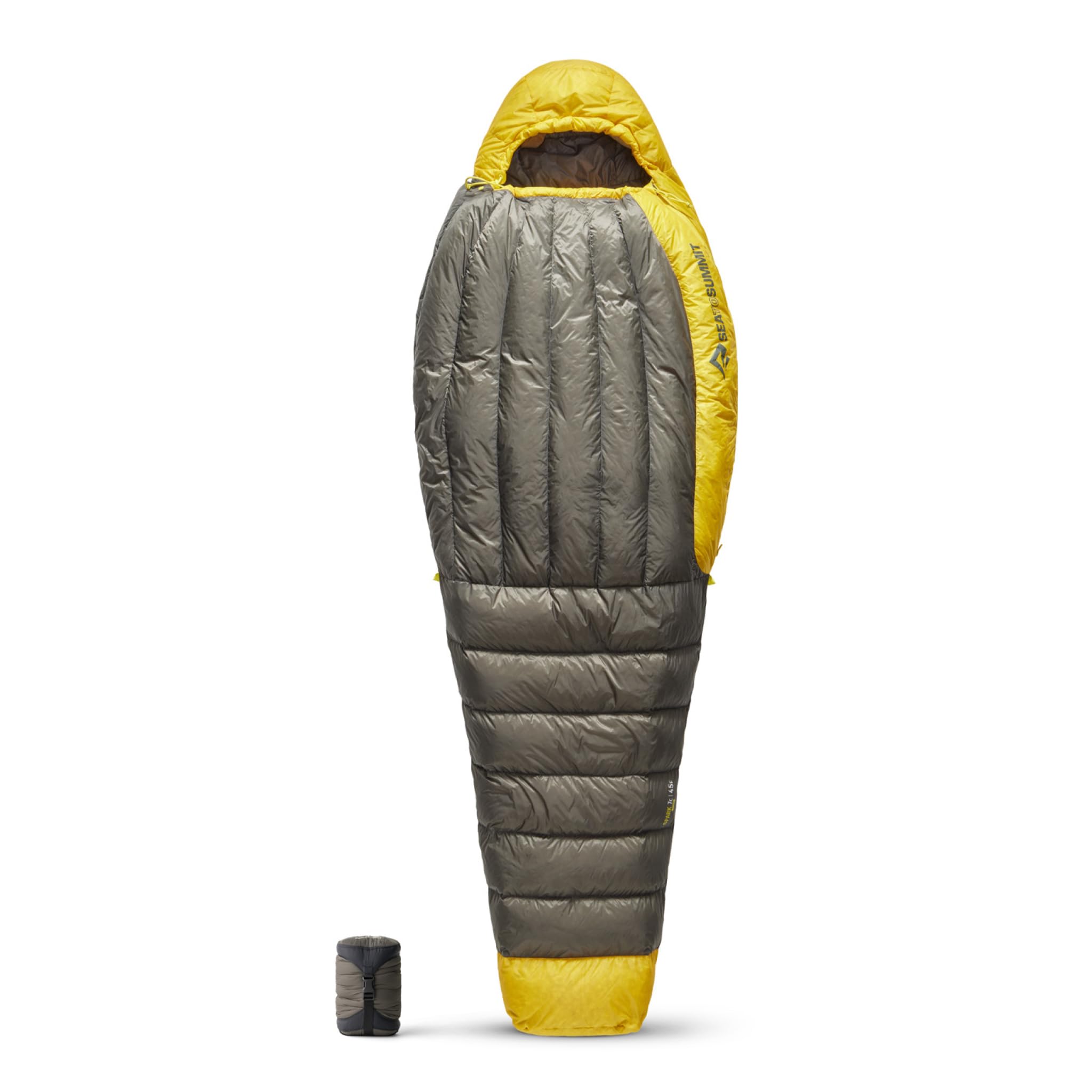
At 14.6 ounces and packing down to the size of a water bottle, the Sea to Summit Spark is the lightest and most compressible sleeping bag in this roundup for its warmth class. The 850+ fill power RDS-certified down maintains loft well even after repeated compression, and the 10D nylon shell with DWR provides light moisture protection for damp conditions.
This bag suits ultralight backpackers and bikepackers who count every gram and accept that a 45°F comfort limit restricts it to summer trips in mild climates. It also works well as a carry-on travel companion due to its tiny packed size. The premium price per degree of warmth means conventional backpackers will find better value in the top pick — the Spark’s cost is justified only when weight savings are the single priority.
Pros
- Only 14.6 oz — lighter than most synthetic summer bags by nearly half a pound.
- Compresses to water-bottle size, freeing up pack space for other gear.
- RDS-certified 850+ fill down retains insulating loft exceptionally well over time.
- Long cut (83.1 in) accommodates taller sleepers without adding noticeable weight.
Cons
- Price per degree of warmth is steep — comparable warm-weather bags cost half as much.
- Limited to 45°F and above, so it cannot handle cooler nights or three-season use.
If your priority is the absolute lightest carry weight for summer trips and budget is secondary, the Spark delivers unmatched lightness and packability.
Best for Quilt Enthusiasts
SENSORY4U Quilt
Key Features
- Weight: 1.9 lbs
- Insulation: 850 FP Down
- Temperature Rating: Comfort 30°F / Survival 20°F
- Shape: Top quilt with foot box
- Price: $$
At 1.9 pounds with premium 850-fill down, the SENSORY4U quilt delivers warmth that rivals handmade quilts from cottage brands costing three times as much. The 30°F comfort rating holds up reliably for three-season backpacking, and the down compresses to a 14×6.5-inch stuff sack.
This level of packability and warmth-to-weight ratio is usually found only in $400+ gear. Considering the price sits at the upper end of mid-range, the value is clear — you get premium down performance without the premium label.
The tradeoffs come in the attachment system. The pad straps require careful adjustment and some buckles have been reported as fragile. The foot box is designed as a sewn enclosure, not a sleeve, so sliding a pad inside doesn’t work well; instead, users need to position the pad underneath and cinch the straps to seal drafts. Restless sleepers or those who toss and turn may find this leads to cold spots.
This quilt suits ultralight backpackers who are ready to move past the traditional sleeping bag and want a versatile, lightweight option for warm to moderate conditions. Side sleepers in particular benefit from the unrestricted movement. It’s not for cold weather camping below 30°F or for anyone who wants a fully enclosed, draft-free system without extra effort.
Pros
- Premium 850-fill down provides exceptional warmth relative to weight.
- Cost-effective alternative to cottage-brand quilts with similar fill power.
- Packs down small (14×6.5 inches) for its warmth rating.
Cons
- Foot box design may cause drafts as it doesn’t allow sleeping pad insertion.
- Pad attachment strap buckles can be fragile and may break with use.
For backpackers ready to embrace a quilt system, this is a strong value pick — just factor in some time to learn the pad attachment method.
Best for Warm-Weather Budget
Naturehike Synthetic Envelope
Key Features
- Weight: 1.67 lbs
- Insulation: Synthetic hollow fiber
- Temperature Rating: Estimated 60°F+ comfort
- Shape: Envelope (rectangular)
- Price: $
The Naturehike Synthetic Envelope weighs 1.67 lbs and compresses to a grapefruit-sized ball, packing down far smaller than most synthetic bags at this price point. Its rectangular envelope shape allows more freedom of movement than a mummy bag, making it a flexible choice for both ground and hammock setups.
This bag targets budget-conscious campers on warm-weather trips where night temperatures stay above 60°F. The narrow cut (roughly 30 inches wide) suits average builds but can feel tight for broader shoulders or users above 6’2′. Taller sleepers should verify the 75-inch length provides enough room.
In hammocks, the flat envelope avoids the twisting common with mummy bags, and the synthetic fill retains some insulation when damp. The zipper occasionally snags on the inner fabric — a minor irritation that can be managed by careful operation. The open envelope shape also permits drafts in windy conditions, which is less of a concern in still air or when paired with a hammock underquilt.
Pros
- Weighs 1.67 lbs and packs to grapefruit size — impressive compression for a synthetic bag.
- Envelope shape provides generous room for side sleepers and hammock campers to shift positions.
- Price is among the lowest for a sub-2 lb sleeping bag, delivering good value for occasional use.
Cons
- Zipper may catch on the fabric occasionally; careful operation reduces snags.
- Envelope shape can allow drafts in windy conditions, reducing effective warmth — less of an issue in still air or hammocks.
For warm-weather campers on a tight budget who want a lightweight synthetic bag with a roomy shape, this Naturehike delivers solid performance without the cost of down.
Best for Tall Budget Campers
iClimb Thinsulate

Key Features
- Weight: 2.4 lbs
- Insulation: 3M Thinsulate synthetic
- Temperature Rating: Comfort 41°F / Limit 32°F
- Length: 82 in
- Shape: Mummy
- Price: $
The iClimb Thinsulate delivers consistent warmth in damp conditions thanks to its synthetic fill, and the 82-inch length accommodates tall sleepers without cramping. At 2.4 pounds and with a packed size that rivals budget down bags, it’s heavier and bulkier than the leading down alternatives — a tradeoff that matters most to ultralight hikers. The zipper occasionally snags on the fabric, an annoyance that slows pitching rather than a dealbreaker. For car camping, short hikes, or anyone who prioritizes budget and a long fit over absolute weight savings, this bag offers solid insulation at a reasonable price.
Pros
- Warmth holds up in damp conditions better than down at this price tier
- Affordable entry point for a bag that fits sleepers up to 6’10"
- Spacious cut for broader shoulders and taller frames
Cons
- Heavier and bulkier than down bags of similar warmth — less suited to backcountry packing
- Zipper may catch on the fabric when closing quickly
Best for campers who need a long synthetic bag on a budget, but weight-conscious backpackers should look to down options.
How to Choose
The single most important thing to know: a bag’s comfort rating is a lab number, not a promise — most sleepers need a bag rated 10-15°F lower than the coldest night they expect.
Weight and Packed Size
Every ounce you save on your sleeping bag is an ounce you can spend on food, water, or shelter. But the lightest bags use thinner fabrics and less insulation, which reduces warmth and durability. A 1.3-lb down bag might save 10 ounces over a 2-lb synthetic, but that comes at the cost of lower warmth when damp or compressed.
Packed size matters too — a bag that compresses to the size of a grapefruit fits inside a 30-liter pack, while a bulkier synthetic bag may hog the entire main compartment. For thru-hikes or bikepacking, look for a bag with a compression sack that cinches below 10 inches in diameter.
Insulation Type and Fill Power
Down insulation offers the best warmth-to-weight ratio and compressibility, but loses all insulating ability when wet. Fill power (600 to 900+) measures loft: higher numbers trap more dead air per ounce. A 650-fill bag is heavier and less packable than an 850-fill bag of equal warmth. Synthetic insulation (like Thinsulate or hollow fiber) retains some loft when damp and dries faster, but it’s heavier and bulkier for the same warmth.
Budget down bags often use lower-grade down (600-650 fill) that compresses well but may clump or migrate over time, creating cold spots. If you camp in consistently humid conditions, a high-quality synthetic or treated down bag is more reliable than a cheap down bag.
Temperature Rating
Temperature ratings are standardized (EN/ISO) but measured with a sleeping pad, base layers, and a tent. In real-world use, cold sleepers, thin pads, and windy sites can reduce effective warmth by 10-15°F. A bag rated to 40°F comfort might feel right at 50°F for a side sleeper who moves around.
The safest approach: pick a bag whose lower limit (not comfort) matches the coldest temperature you expect, then plan to wear thermal layers if needed. A bag with a comfort rating of 45°F and a limit of 32°F gives you a 13-degree buffer if you bring extra clothing.
Length and Width Fit
A bag that’s too short leaves your shoulders exposed; too long adds extra weight and dead air you have to warm. Most brands offer sizes based on user height: short (up to 5’6"), regular (up to 6′), and long (up to 6’6"). Measure your height in sleeping socks, not barefoot.
Width is equally critical. Mummy bags taper to reduce weight and heat loss, but side sleepers or broad-shouldered hikers may find them restrictive. Semi-rectangular or envelope shapes sacrifice a few ounces for extra room to bend knees and shift positions.
Shape and Zipper Quality
Shape determines how efficiently your body heat stays inside. Mummy bags have a hood and narrow foot box that trap heat best, but limit movement. Quilts remove the back insulation entirely, saving weight, but require a compatible sleeping pad with straps to prevent drafts. Envelope bags are roomy but drafty below 50°F.
Zipper quality is a hidden durability factor. Plastic zippers are lighter but can snag on fabric, especially near the foot box. Metal zippers are tougher but heavier. Look for anti-snag guards or draft tubes along the zipper — these prevent heat loss and reduce frustration.
FAQ
Is a 45-degree sleeping bag warm enough for summer backpacking in the mountains?
It depends on your personal cold tolerance and the elevation. At 8,000 feet, summer nights often dip into the 40s, and a 45°F comfort bag may leave you shivering. For mountain trips, choose a bag rated to 30-35°F comfort, or bring a down jacket and insulated pad to add 5-10 degrees of warmth.
How much does an ultralight sleeping bag really weigh?
True ultralight bags range from about 1.0 to 2.0 lbs for 3-season use. The Sea to Summit Spark is the pinnacle at 14.6 oz, while many budget down bags sit around 1.3-1.5 lbs. Synthetic ultralight options are heavier, often 1.7-2.4 lbs for comparable warmth. Weigh your bag with its stuff sack and compression straps — that’s the number that goes on the scale.
Can I use a down sleeping bag in humid conditions without losing loft?
Yes, but with caveats. Untreated down absorbs moisture from the air and collapses after a few days of continuous humidity, losing insulation. Treated down (like DWR-coated) resists moisture better but still needs dry storage. In consistently damp climates or canoe trips where getting wet is likely, a synthetic bag is more reliable even though it’s heavier.
What is the best ultralight sleeping bag shape for side sleepers?
Side sleepers need room to bend their knees and shift position without fighting the bag. A semi-rectangular or quilt style offers enough space without adding much weight. The Naturehike Semi-Rectangular bag and SENSORY4U quilt both allow knee bend and foot movement. Avoid tight mummy bags unless you sleep on your back.