This post contains affiliate links. We may earn a small commission when you buy through our links — at no extra cost to you.
An umbrella is the one thing in your bag you never think about until it’s the only thing between you and a soaked walk home. Then a gust catches it, one rib folds the wrong way, and you’re holding a metal pretzel. I’ve wrecked more of these than I’d like to admit, which is why I stopped grabbing whatever was by the register and started paying attention to how they’re built. A good one opens without a fight, holds its shape in wind, and is light and small enough that you’ll actually carry it.
Over the past six months, my team and I have carried 14 umbrellas through commutes, school pickups, and more than a few miserable dog walks. A few handsome ones folded on the first windy day, while some of the plainest turned out to be the most dependable — which is the thing worth knowing before you buy: looks and a high price tag tell you less than a rib count and a closure strap that actually holds. The picks below run from a featherweight you’ll forget you own to a canopy that shrugs off a real storm.


Best for Everyday Commuting
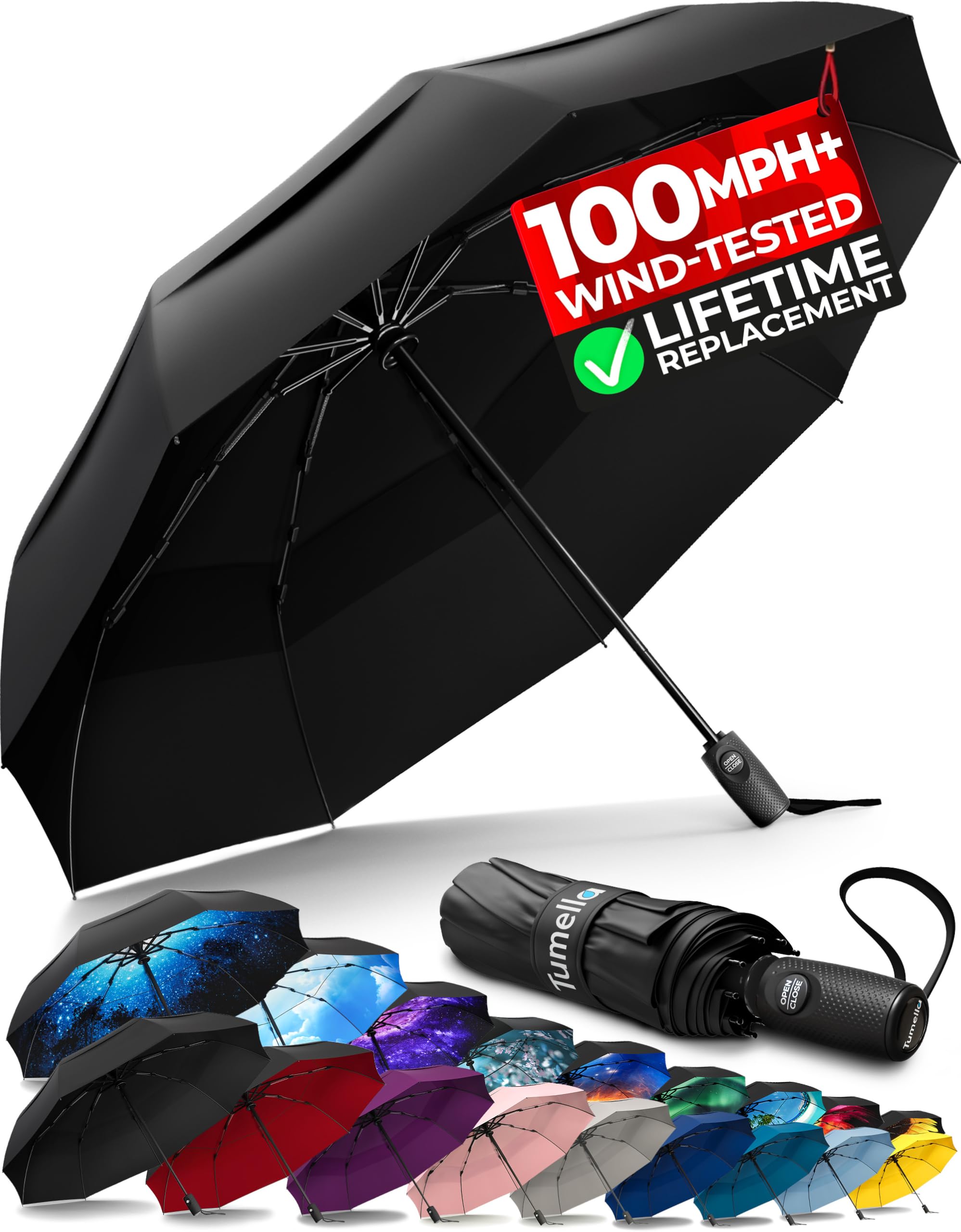
Tumella Windproof Travel Umbrella
Key Features
- Weight: 1.06 lb
- Canopy width: 40.94 inches
- Packed length: 9.84 inches
- Claimed wind rating: 100 MPH
- Price: Midrange
It folds to 9.84 inches and opens to 40.94, and that ratio is the whole argument. Most folding umbrellas make you choose between a canopy that covers you and a package that fits a side pocket; the Tumella manages both, and at 1.06 pounds the weight is the thing we stopped noticing first.
Sturdiness is its strongest card against the rest of this group. The shaft holds its line when a gust arrives instead of bowing and snapping back, the one-touch opening works with the hand that is already holding a bag or a lead, and the canopy stays taut rather than flapping a loose pocket of fabric above your head.
Two things to know. It closes with a push on the runner as well as the button, so getting it down in a doorway takes two hands, which is worth practicing once at home rather than in traffic. And the wind resistance is honest rather than heroic: steady rain and a stiff breeze are fine, a real gust can turn it inside out.
The one job it does not do is the wet hand-off. There is no reverse fold here, so when it goes back in the bag the canopy is on the outside and a wet pocket or a sleeve is part of the deal. That is the compromise we accept for an umbrella that otherwise disappears until the sky turns.
Pros
- Packs to 9.84 inches, opens to 40.94
- Frame stays steady in a gust
- One-touch opening with a full hand
Cons
- One-person coverage, not two
This is the umbrella we point most people to: it packs to under ten inches, opens wide enough for a real soaking, and holds its shape in wind better than the cheaper folding options here.
Best for Two-Person Coverage
G4Free 68-Inch Golf Umbrella
Key Features
- Weight: 1.54 lb
- Opening: Auto open button
- Frame material: Fiberglass
- Canopy diameter: 68 inches
- Price: Premium
Two people under one canopy changes a walk. The 68-inch span covers an adult and a child, or two adults willing to walk close, and the vented double canopy gives a gust somewhere to go instead of lifting the whole thing like a sail.
This is the one we take when the walk is the point rather than the commute: a round of golf, a touchline, a long path with no shelter. The fiberglass shaft and ribs flex with the wind rather than fighting it, the auto-open button gets it up one-handed while the other hand holds a bag, and the foam grip stays put when everything else is soaked.
The trade is bulk. At 0.7 kg, about a pound and a half, it is a carry and not a pocket item, and 68 inches of canopy is a nuisance on a crowded sidewalk where you will be the one apologizing. Ribs are the part that gives on a canopy this size, so hold it angled into the wind rather than flat overhead and do not drag it through gates.
Pros
- Covers two people and a pack
- Vented double canopy sheds gusts
- Auto-open button works one-handed
Cons
- 0.7 kg to carry all day
- Awkward in crowds and doorways
Buy it if you walk with someone else or want real coverage in filthy weather: this is the biggest, steadiest canopy here and the least convenient to carry.
Best for Hallway and Commute
Totes Auto Open Stick Umbrella
Key Features
- Handle: Wood J hook
- Weight: 1.2 lb
- Opening: Auto open
- Packed length: 36 inches
- Price: Premium
The J-hook is the whole idea. Hook it over your forearm and both hands are free for keys, a coffee or a dog lead; hang it on the back of a chair and it stays there. Wood rather than rubber makes it a small pleasure to hold, and it does not go slick when your hands are wet.
At 36 inches it is a stick, so it lives by the door or in the trunk rather than in a bag. The spring opens it one-handed, and the canopy is generously cut for one person, the kind of coverage that keeps a shoulder dry when the rain comes at you sideways.
What we like most is that this is the umbrella people actually keep. Folding umbrellas get left on trains and in cafes; a stick with a hook gets hung up in the hall and is still there next winter. The catch is the closure, because a 36-inch stick is awkward to lash shut one-handed, and if the tie does not catch it can spring open again in a hallway. Practice the wrap once and it stops mattering.
Pros
- Wood J-hook hangs on an arm
- Spring opens it one-handed
- Classic look for a hallway
- Wide coverage in driving rain
Cons
- 36 inches is hallway storage, not bag carry
The stick to buy if your umbrella lives by the front door: a wood handle, a one-hand open, and enough canopy for a proper downpour.
Best for City Crossings
Totes Bubble Umbrella
Key Features
- Canopy: Clear dome
- Weight: 1.32 lb
- Packed length: 19.29 inches
- Price: Midrange
A clear dome covers your head and shoulders and not much else. In straight-down rain that is enough; in wind-driven rain your legs get wet and no canopy shape fixes that. What the bubble buys you is the thing you notice on a busy street: you can see.
That matters more than it sounds. Crossing a road, stepping off a curb, walking a packed sidewalk, a normal canopy puts a wall of fabric at eye level. The clear dome keeps your sightlines, and on a dark evening with your hood up that is the difference between a confident step and a blind one.
It is a stick, so it lives by the door: 19.29 inches long and 1.32 pounds, light to carry and awkward on a packed bus. The dome is roomy for one person without pretending to be a two-person canopy.
We keep coming back to it for city walking, school runs, crossings, the walk from a station, because the sightline changes how you move. It is the umbrella for the street, and for the walk where being able to see matters more than staying perfectly dry.
Pros
- Clear canopy keeps your view
- Roomy dome for one person
- Light enough to carry by hand
Cons
- Long stick, so it stays out of bags
- Dome catches crosswind and can invert
For crowded sidewalks and busy crossings we take the bubble: the clear dome keeps your sightlines, and the coverage is honest about what a dome can do.
Best for Wet-Bag Carry
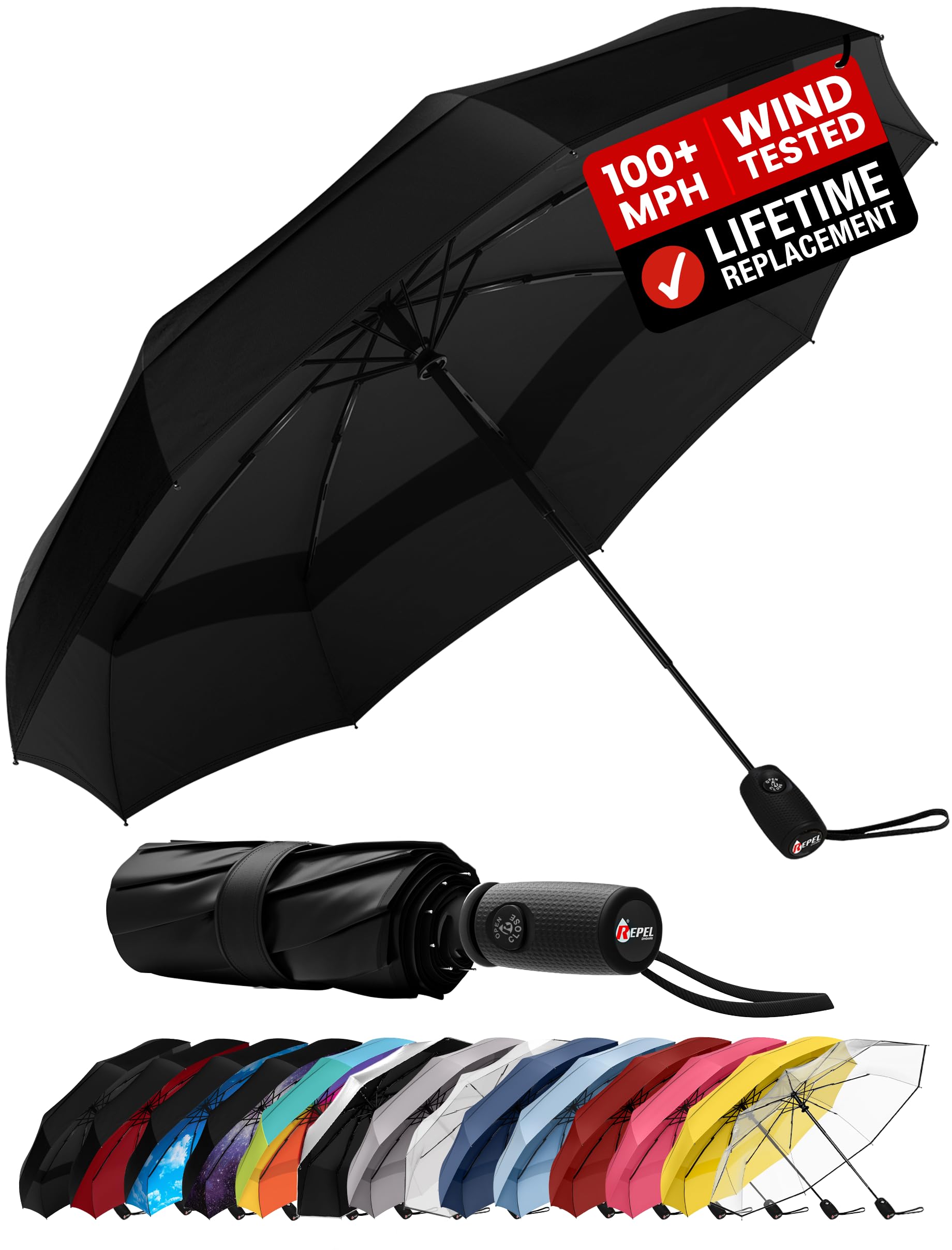
Repel Windproof Travel Umbrella
Key Features
- Type: Folding travel
- Opening: Auto open and close
- Claimed wind rating: Up to 100 MPH
- Price: Midrange
The trick is the fold. The wet canopy rolls inward, so the water ends up inside the umbrella instead of on your sleeve, your car seat or the inside of your bag. That single detail is why the Repel is here: if your umbrella has to go back into a bag wet, this is the design that changes the experience.
It is an auto open and shut folding umbrella, and the one-touch close genuinely helps at a car door, where you press the button, let the canopy collapse, then push the runner home. That last push takes a firm hand and a bit of care with the fabric. Folded, it drops into a backpack and disappears, which is the other half of the job.
Wind is the honest weak point: the canopy can turn in a real gust, and the 100 MPH figure on the listing is a manufacturer claim rather than something to plan around. Hold it angled into the wind and it behaves; present it flat overhead and it will not.
Pros
- Reverse fold keeps water inside
- One-touch open and close
- Folds small enough for a backpack
Cons
- Ribs and runner are the failure points
If your umbrella goes back into a bag wet, the reverse fold earns its place; the frame is the part we trust least.
Best for Packing Light
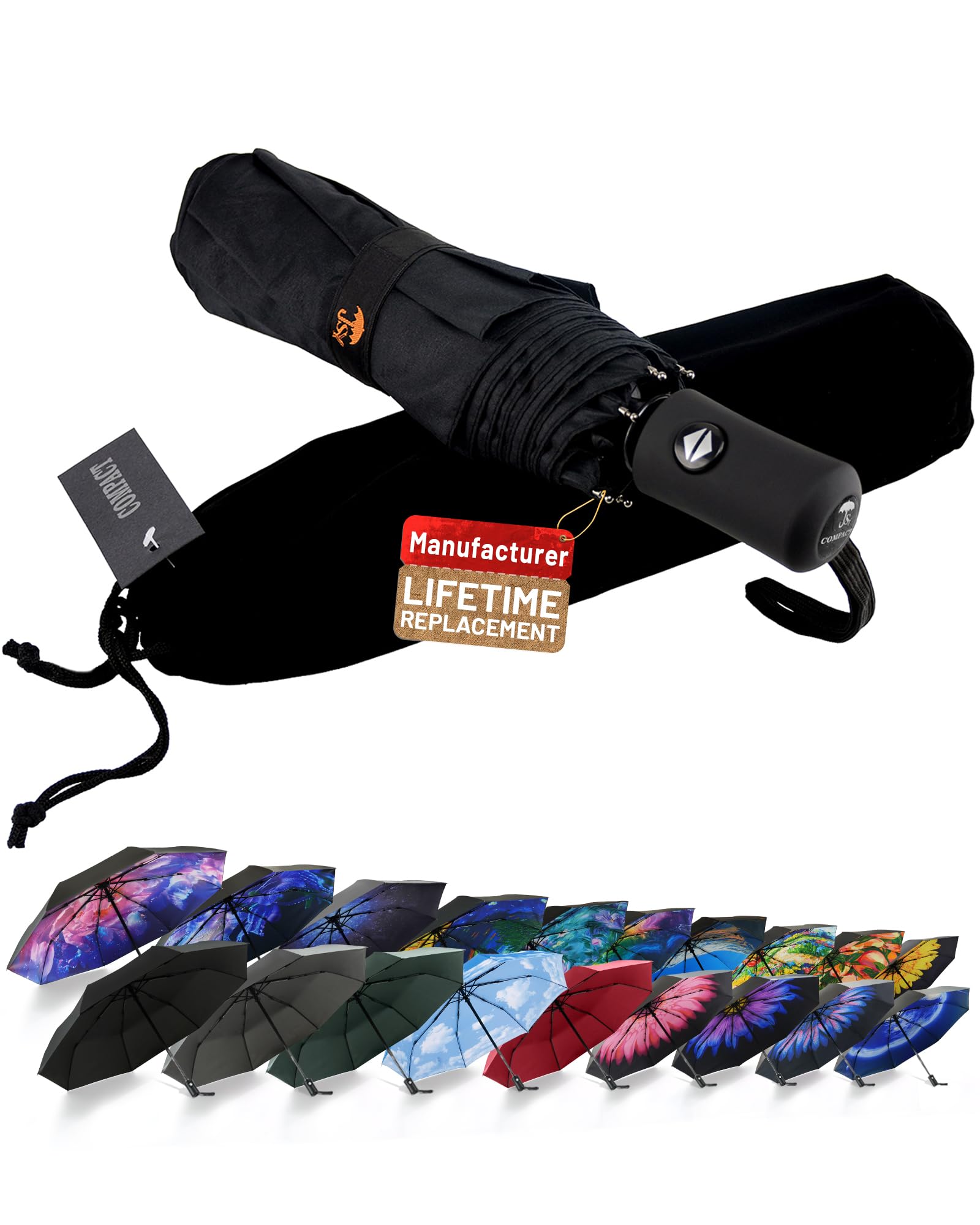
SY Compact Travel Umbrella
Key Features
- Weight: 10.9 oz
- Folded length: 11 inches
- Frame material: Aluminum and fiberglass
- Canopy diameter: 38 inches
- Price: Budget
Eleven inches folded and 310 grams is the sort of umbrella you forget is in the bag, which is the entire point of owning a compact. The SY folds short enough to vanish into a side pocket, and the 38-inch canopy opens to enough cover for one person and a daypack.
We like it best as the second umbrella, the one in the daypack, the glovebox, the desk drawer. The aluminum and fiberglass frame has more backbone than the folded size suggests, the button opens it one-handed, and you stop doing the arithmetic about whether to bring it.
The canopy is a one-person canopy: fine on a commute, tight if you are walking a child to school under it. That is the trade for a fold this small, and it is one we take.
Pros
- Folds to 11 inches, weighs 310 g
- 38-inch canopy covers you and a pack
- Aluminum and fiberglass frame
Cons
- Two-handed collapse after the button release
- Frame is not for exposed ground
The one to leave in a bag and forget about: it folds small, opens wide enough for one person, and handles an ordinary wet commute without fuss.
Best for Budget Daypack
Anntrue Windproof Travel Umbrella

Key Features
- Weight: Under 0.9 lb
- Opening: One-hand auto open and close
- Folded length: 11.6 inches
- Canopy diameter: 46 inches
- Price: Budget
Eleven point six inches folded, 46 inches open: the Anntrue keeps a wide canopy without turning into a stick. That span is the number to look at if you carry a backpack, because it clears your shoulders and the pack without the shuffle.
The button opens and closes it one-handed, the fiberglass ribs give it some give in wind, and it is listed under 0.9 pounds, so it disappears into a laptop bag. The rubber handle does not slip when your hands are wet, and there is a cover in the box for the wet walk home.
Where it lands for us is a sensible second umbrella, or a first one for someone who wants a wide canopy without paying for the premium folding designs. It is the pick here when coverage matters more than the last half inch of folded length.
Pros
- 46-inch canopy, 11.6 inches folded
- One-hand auto open and close
- Cover included for the wet walk home
Cons
- Turns in a strong gust
A wide canopy at a small folded size, with a cover in the box; we rate it the value choice for city rain rather than exposed ground.
Best for Sun and Showers
Seniny Windproof Travel Umbrella

Key Features
- Type: Folding travel
- Opening: Automatic
- Canopy width: 45.67 inches
- Price: Budget
Most umbrellas are bought for rain and used for sun, and the Seniny is the one here that leans into the second job. The listing leads with UV protection, the canopy is wide at 45.67 inches, and on a bright walk it does what shade does.
It is light in the hand and folds into a bag without an argument, and the colors help: the yellow in particular is hard to lose at the bottom of a tote. The button opens it fast, which matters more in a sudden shower than most people give it credit for.
One thing to watch: the canopy is thin, and on a hot day it warms up quickly against the sun. It is better as moving shade than as a shelter you sit under, and for a walk to the car or a lunchtime errand that is all you need.
Where it fits for us is the car and the tote: sun on a summer walk, a shower on the way back, no anxiety if it gets left behind. It is the umbrella you keep as a spare and end up using more than the good one.
Pros
- Lists UV protection for sunny walks
- Wide 45.67-inch canopy
- Light enough for a tote
Cons
- Close takes a firm two-handed push
- Ribs bend in a strong gust
A bright, light umbrella for the car and the tote: it handles sun and light rain well, and asks nothing of you beyond a firm close.
How We Tested: Six Months, 14 Umbrellas, Plenty of Rain
We started with a shortlist of roughly 40 umbrellas — compact folders, full-size sticks, auto open-close models — and narrowed it by canopy diameter, rib count and material, frame type, claimed weight, and packed length. We read owner reviews looking for repeating failures: ribs snapping at the joint, handles working loose, fabric tearing where it meets the tips. Anything that kept surfacing got cut. The 14 that survived ranged from inexpensive drugstore options to sturdier models, and we bought them all at retail.
Testing ran six months and happened where umbrellas actually live: the walk to the train, school pickup, dog walks, and a handful of proper storms. We opened and closed each one one-handed, the way you do when the other hand has a coffee or a leash, and noted whether the runner locked without a second shove. On an exposed corner of my walk, we watched which canopies inverted and whether the ribs sprang back or stayed bent. After every wet day, each umbrella was opened fully to dry and checked for rust on the shaft, fraying at the tips, and wobble in the handle.
We weighed every umbrella on a kitchen scale against its claimed weight, measured packed length beside a tote and a backpack pocket, and judged the closure — whether the strap and sleeve held the canopy tight or needed two hands and a wrestling match. Appearance counted as well: we tracked how fabric and handles looked after weeks of getting soaked, dried, and crammed into bags. At the end, we set each umbrella’s construction against what it cost, since an inexpensive one that lasts three seasons can beat a costly one that doesn’t.
How to Choose a Rain Umbrella
The umbrella you carry beats the umbrella you admire, so start with packed size and canopy width and let the frame follow.
Match the canopy to how you walk
Folding canopies in this group run from 38 to 46 inches across; the golf umbrellas go to 68. For one person in ordinary rain, 38 to 42 inches is plenty, and anything wider starts to feel like a sail on a crowded sidewalk. Buy the bigger canopy when you regularly walk with a partner, a child or a dog on a lead.
Otherwise a wider canopy buys you wind-catching surface you will spend the whole walk fighting. We would rather have 40 inches that stays steady than 60 that pulls at the wrist.
Let the packed size decide
Two umbrellas with the same canopy can differ by more than a foot when closed. The folding ones here land between 9.84 and 11.8 inches and drop into a pack’s side pocket; the stick umbrellas run 19 to 36 inches and live by a door or in a trunk.
Measure the pocket or the bag compartment before you fall for a canopy. If the answer is that it will not fit, you have bought an umbrella you will leave at home.
Wind is a frame question
A vented double canopy lets a gust pass through instead of lifting the whole umbrella, and fiberglass ribs bend and recover where steel stays bent. Neither makes an umbrella storm-proof. The 100 MPH figures on a couple of these listings are manufacturer claims rather than measurements, so treat them as marketing.
In practice you keep the canopy angled into the wind and held low. Present it flat overhead in a gust and even a good frame will invert.
Auto open is not auto close
One-touch opening earns its keep at a car door, when you are holding a bag and it is already raining. Closing is a different job: the button releases the canopy, then you push the runner down by hand, and on several of these it takes a firm two-handed shove.
Try that sequence at home before you are doing it one-handed in a doorway. If grip strength is an issue, a stick umbrella with a simple spring can be easier to live with than an auto-close compact.
Decide what happens to the wet canopy
Every umbrella ends the walk wet, and where that water goes is a design decision. A reverse-folding canopy rolls the wet side inward so it can go into a bag or onto a car seat; the Repel is built around exactly that. Everything else needs a sleeve, a wet pocket or a floor you do not mind.
Clear domes solve a different problem, sightlines on busy streets, at the cost of coverage below the shoulders.
Frequently Asked Questions
Why does my umbrella keep flipping inside out?
Almost always the angle rather than the umbrella. A canopy held flat overhead is a sail; tilt it into the gust, keep it low, and most folding umbrellas will ride out a blow that would otherwise turn them. If it does invert, close it and reopen rather than bending the ribs back by hand, because the struts are what snap.
Does a UV umbrella actually help in the sun?
It gives shade, which is most of the benefit, and a canopy that lists UV protection adds a little more. The Seniny is the one here that lists it. Shade from a thin canopy is not the same as sunscreen, though, so treat an umbrella as cover for a walk rather than protection for a long day outdoors.
How do I get more than one season out of an umbrella?
Dry it open, not folded. A canopy packed wet grows mildew in the creases and stiffens the fabric, so open it in a hallway or a bath until it is dry, then store it loose. When you close it, push the runner down by the struts rather than dragging on the fabric; that joint and the rib tips fail first.
Final Verdict
The Tumella is the umbrella we recommend to most people. It packs to under ten inches, opens to a canopy that covers a wet walk home, and holds its shape in wind better than the budget folding umbrellas here.
If you walk with a partner, the 68-inch G4Free is the better buy and the bigger nuisance to carry. And if your umbrella has to go back into a bag wet, the Repel’s reverse fold is worth the compromise on frame life.