This post contains affiliate links. We may earn a small commission when you buy through our links — at no extra cost to you.
A heavy-rain coat has one job, but the trade-off baked into the category is what makes it hard to buy: the fabrics that truly keep water out tend to leave you clammy inside, and the ones warm enough for a cold, driving drizzle can turn into a sauna two blocks in. What you’re actually after is a coat that sheds a downpour, moves with you when you’re wrestling an umbrella, and doesn’t trap your own body heat. Get that right and a bad forecast stops running your day.
I’ve owned coats that beaded water beautifully and still soaked through at the cuffs, and one that kept me bone dry and miserable because it felt like wearing a trash bag, which is why fit, weight, and style ended up mattering to me as much as waterproofing. Over six months, my team and I wore 12 different raincoats through commutes, dog walks, and a few genuinely foul weekends, and we paid close attention to sizing, since most of these are cut to layer over a sweater and your usual size can swallow you. The ones below earned their hook by the door.


Best for Hiking and Travel
The North Face Antora Jacket
Key Features
- Wind: Windproof
- Sizes: Standard and big sizes
- Lining: Uninsulated
- Waterproofing: Waterproof shell
- Price: Premium
The Antora is the jacket we reach for when the forecast is genuinely bad. In real rain its outer fabric darkens and slicks over while the layer underneath stays dry, which sounds like a small thing until you’ve spent an hour in a coat that soaks through at the shoulders. On the one question that matters most here, nothing else has a stronger claim to keeping you dry in sustained weather, and the conditions behind it — a rainy trip abroad, Pacific Northwest storm cycles — are exactly the ones we were judging on.
The cut is the pleasant surprise. There’s room for a fleece or a light puffer underneath without the jacket turning into a tent, the shoulders stay free when you reach forward, and the pockets are big enough to get a gloved hand into without a fight — a detail you appreciate every time you’re standing in the rain looking for keys.
It is a shell, not a coat, and warmth is where expectations split. The Antora makes no heat of its own: it blocks wind well, it’s light enough to forget you have it on, and it wants a midlayer under it when the temperature drops. Anyone hoping for a winter jacket will be disappointed; anyone building a layering system will find it does exactly what it should.
That’s what the premium price is buying — fabric and cut rather than features, since there’s no insulation to speak of and nothing fancy in the trim. Colors also read warmer in person than the product shots suggest, so pick the shade you can live with rather than the one that looks sharpest on screen.
Pros
- Best water resistance in this set
- Roomy cut for a fleece or puffer
- Pockets big enough for gloved hands
- Holds up in wind as well as rain
Cons
- Premium price compared with the rest of the set
- Sleeves run long for shorter arms
If heavy rain is the whole point, this is our pick: the most convincing waterproofing in the group, cut roomy enough to layer, though the premium price buys fabric rather than warmth.
Best for Wet Daily Commutes
LOMON Long Hooded Raincoat
Key Features
- Hood: Attached hood
- Sizes: S to XXL
- Length: Long, longer at the back
- Waterproofing: Waterproof
- Price: Midrange
A hem that reaches past your seat is the most underrated piece of rain gear design there is. This LOMON is a proper long coat — it drops below the hip and runs longer at the back — so rain that would otherwise run down your legs and into your boots lands on the coat instead. In weather that arrives sideways, that earns more than another layer of fabric technology.
It’s also the pick here with the most convincing record in day-after-day rain rather than a single soaking, which is the harder test. Water beads and runs off instead of soaking in, the hood is generous enough to pull over a hat, and the lining takes the edge off a cool morning without turning the coat into a sauna.
The thing to plan around is fabric weight. This is a light coat for its length, which is exactly why it works on a warm wet day and why it isn’t what you reach for in a cold snap — for that, the fleece-lined Outdoor Ventures does more. The cut is dressy enough for work, which is not something we can say about most of the jackets here.
Pros
- Long hem covers seat and thighs
- Kept dry through day-after-day rain
- Lined for cool spring mornings
- Generous hood that fits over a hat
Cons
- Runs small through the shoulders and hips
Our pick when you want coverage: a long, hooded, lined raincoat that keeps rain off your legs at a midrange price, provided you size up.
Best for Travel and Hiking
33,000ft Women’s Packable Jacket
Key Features
- Hood: Adjustable hood opening
- Packing: Packs into its own bag
- Venting: Underarm zip vents
- Waterproofing: Waterproof
- Price: Midrange
The bag is the point. This 33,000ft jacket rolls down into its own stuff sack and disappears into the bottom of a daypack, which makes it the one here you’re most likely to actually have with you when the sky opens. Packable coats usually ask you to give something up; this one keeps underarm vents, an adjustable hood opening and a full set of zippered pockets, including an internal one, and still rolls up small.
Waterproofing is better than the packable category usually manages. It has handled heavy storms and long bouts of rain with the inside staying dry, and the fabric dries quickly once the sun comes back — no clammy hour afterwards.
For travel and day hikes it’s the jacket we pack, and the sizing helps: it runs close to true with enough room through the shoulders for a midlayer, so order your usual size rather than going up just in case.
Pros
- Packs into its own stuff sack
- Handles heavy storms and long rain
- Underarm vents and zippered pockets
- Dries fast, not clammy afterwards
Cons
- No lining, so cold rain needs a midlayer
- Fiddly to refill the stuff sack
For a raincoat you can carry every day, this is the one: it packs into its own bag and still handles real storms, as long as you don’t expect warmth.
Best for Cold, Wet Days
Outdoor Ventures Fleece-Lined Raincoat
Key Features
- Length: Covers to the knee
- Lining: Fleece through body and sleeves
- Pockets: Zippered inside and out
- Waterproofing: Waterproof
- Price: Midrange
Fleece lining changes what a raincoat is for. Instead of a shell you add when it rains, this Outdoor Ventures coat is the layer itself: the fleece runs through the body and the sleeves, which is why it works on a wet fall morning with nothing but a shirt underneath.
The length is what keeps us coming back to it. It covers to the knee — longer than almost anything else in this group — and knee coverage plus a warm lining is the combination that makes it feel like a coat rather than a waterproof. Water beads and rolls off the surface instead of soaking in, and there are zippered pockets inside and out.
It is a lot of coat, though. For a wet day when you’re mostly standing around or walking the dog, that’s ideal; on a long hike in mild rain you’ll be carrying warmth you didn’t ask for and shedding it at the first stop.
Pros
- Fleece through body and sleeves
- Covers to the knee
- Water beads and runs off
- Zippered pockets inside and out
Cons
- Too bulky to pack for travel
Our pick for cold, wet weather: knee-length coverage, a warm fleece lining and water that rolls straight off, though it’s too much coat for a muggy day.
Best for Cycling and Running
baleaf Men’s Rain Jacket
Key Features
- Hood: Oversized hood
- Packing: Packable
- Visibility: Reflective detailing
- Waterproofing: Waterproof
- Price: Midrange
The hood on this one is bigger than you’d expect, and on a bike that’s the whole point: it stays out over your face when you turn your head to check traffic instead of folding back over your eyes at the worst moment.
The rest of the design follows the same logic. The back hem is longer than the front, which covers you in a riding position, there’s reflective detailing that shows up in headlights, and the cut is roomy enough for a layer without flapping like a sail. It handles light and moderate rain comfortably and rolls up small enough to live in a bike bag between showers.
Where it stops is an all-day soaking. This is a commuting and riding jacket rather than an expedition shell, and the Antora is the better choice when you’ll be out in it for hours. Sizing runs small through the chest, so order up if you’re layering a fleece underneath.
Pros
- Reflective detailing for low light
- Oversized hood stays out of your eyes
- Longer back hem for riding
- Packs small for a bike bag
Cons
- No pit zips for hard efforts
Our pick for riding in the rain: reflective detailing, a long back and a hood that stays where you put it, if you size up.
Best for Cold-Weather Hiking
33,000ft Men’s Fleece-Lined Shell
Key Features
- Hood: Adjustable hood
- Lining: Fleece
- Pockets: Zippered pockets
- Waterproofing: Waterproof
- Price: Midrange
If the fleece-lined Outdoor Ventures is a coat, this 33,000ft is a jacket: same idea — a waterproof shell with a warm lining — cut shorter and made for layering over a hoodie or under another jacket. It’s our men’s pick when the rain arrives with a cold wind.
The warmth is real. It traps heat well enough for a wet, cold day with a hoodie underneath, the seams and sewing are tidy, and the hood adjusts so it stays where you put it. In light rain and ordinary wet weather it keeps you dry without fuss.
Worth being clear about the waterproofing: the claim comes from the product name rather than a stated rating, and most of the wet weather behind this jacket is light rain rather than an all-day soaking. For hours in real rain, the Antora is the safer bet.
Pros
- Fleece lining traps warmth
- Tidy seams and solid construction
- Adjustable hood that stays put
- Roomy enough for a hoodie underneath
Cons
- Tight sleeves and no arm vents
The men’s pick for cold, wet days: a warm fleece-lined shell that handles light rain well, as long as you’re not planning to sweat in it.
Best for Everyday Showers
Diamond Candy Hooded Rain Jacket

Key Features
- Hood: Removable zip-off hood
- Cuffs: Adjustable cuffs
- Pockets: Zippered and covered
- Waterproofing: Waterproof
- Price: Budget
You can zip the hood off this one, and that turned out to be the detail we liked most: on a dry-but-threatening day it turns a rain jacket into an ordinary windbreaker you can wear anywhere without looking like you’re expecting a flood.
Underneath, it’s a light lined jacket rather than a technical shell. It beads water, blocks wind, and it’s the sort of coat you leave by the door for school runs and dog walks — light enough to forget you have it on, warm enough for a cool morning.
Sustained heavy rain is where it gives up ground to the picks above. It’s built for showers and steady drizzle rather than an hour of sideways rain, and we’d treat it as the jacket for the twenty minutes you’re actually outdoors.
What keeps it in rotation is the weight. It’s light enough to leave on indoors, which is more than you can say for most of the coats here, and that’s why it ends up being the one you grab on an ordinary wet Tuesday.
Pros
- Removable zip-off hood
- Light enough to forget you’re wearing it
- Beads water and blocks wind
- Flattering everyday cut
Cons
- Runs small through the shoulders
A good everyday rain jacket for showers and school runs, with a hood you can zip off, as long as you order a size up.
Best for Pack Backup
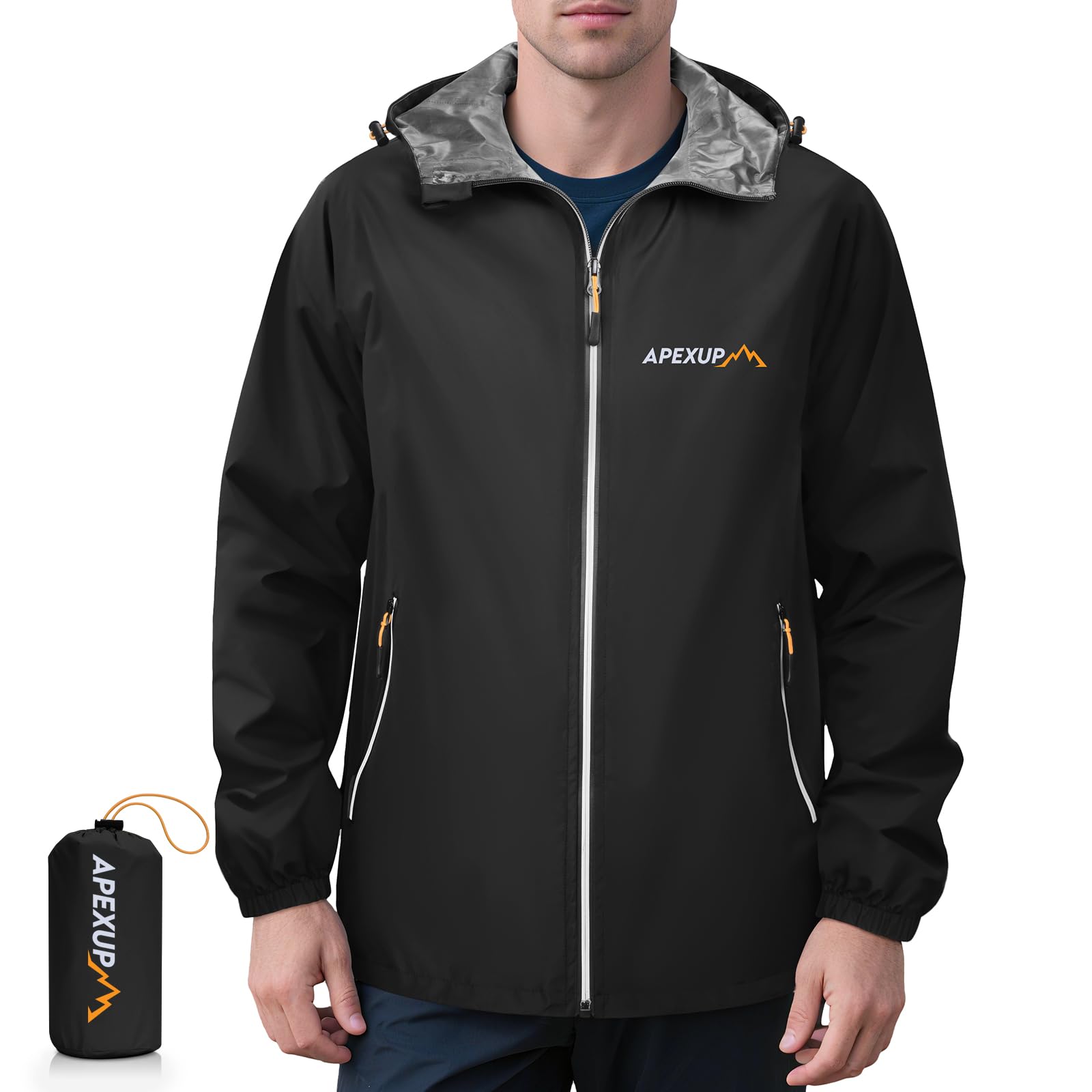
APEXUP Packable Rain Jacket
Key Features
- Fit: Roomy over a sweatshirt
- Packing: Folds into included bag
- Pockets: Zip pockets inside and out
- Waterproofing: Waterproof
- Price: Budget
Some raincoats are gear and some are insurance. This APEXUP is insurance: it folds into the bag it comes with, lives at the bottom of a pack or under a car seat, and gets you home when the weather turns.
For a jacket at this end of the range it does its job. Water slides off rather than soaking in on a normal commute, the hood and cuffs work, the zip pockets inside and out are a real bonus, and it’s roomy enough to pull on over a sweatshirt.
It doesn’t breathe, though. On a hard walk or a climb you’ll be as damp inside from sweat as you would have been outside from rain — this is a jacket for standing at a bus stop, not for working up a hill.
The size of it when packed is what earns the place: it folds down smaller than anything else here and disappears into a daypack, so you never think twice about carrying it. Just don’t make it your only coat for a wet week away.
Pros
- Folds into its own bag
- Keeps water out on a commute
- Zip pockets inside and out
- Roomy over a sweatshirt
Cons
- Wets through in an extended downpour
A budget jacket to keep in a pack: packable, roomy and genuinely waterproof on a commute, though it doesn’t breathe and won’t last a downpour.
How We Tested 12 Raincoats in Real Downpours
To build the shortlist, we started with the specs that actually predict performance: hydrostatic head rating, taped versus untaped seams, fabric weight, and how small each coat packed down. Anything without an adjustable, cinchable hood or a storm flap over the zipper got set aside. We kept a spread on purpose, from packable shells to longer parkas to a couple of insulated everyday coats, because a commuter and a dog walker are asking different things of a coat.
Twelve coats came home with us for six months. They went on 40-minute walks to the train, the school run, and evening dog walks in sideways drizzle, plus two all-day outdoor events in steady rain. Every coat stood in the shower for five minutes, hood up, while we checked the shoulders, the center chest, and the seam across the upper back for damp; we also pressed a soaked paper towel against the sleeve and watched whether the water beaded, spread, or sank straight in. Cuffs got extra attention, since that is where most coats give up first.
Fit came next. We wore each coat over a thin tee and again over a chunky sweater, reached overhead, and checked whether the sleeve rode up past the wrist when holding a phone or a leash. Sizing ran all over the place, and more than one coat we’d have sworn was our size swallowed us. To weigh warmth against breathability, we logged the same coat on a 45-degree damp morning and a 60-degree wet afternoon and noted whether the back felt clammy after 20 minutes of walking. Then the build details: zipper drag, seam tape that lifted at the corners, pockets that pooled water, fabric that rustled like a tarp. Style we judged the honest way, by whether we reached for a coat on a day with a 30 percent chance.
How to Choose a Raincoat for Heavy Rain
The most useful thing to know before you shop is that waterproof and water-resistant are different promises, and only one of them survives an hour of real rain.
Waterproof and water-resistant are not the same promise
A jacket that sheds drizzle can be a coated polyester shell with no membrane at all, and it gives up once the rain settles in. Waterproof means a membrane or coating rain can’t pass through, and the honest tell is in how the product describes itself: ‘water resistant’ and ‘great for light rain’ are warnings, not marketing fluff. Even a good waterproof shell wets out and darkens on the surface — that’s normal. What matters is whether the inside stays dry, which is the behavior that puts our top pick ahead of the rest.
Length is the cheapest upgrade you can buy
Rain doesn’t only land on your shoulders; it runs down. A hip-length shell is right for hiking and riding, where you’re generating heat and your legs are moving, especially with a hem that drops at the back. If you’re standing, commuting or walking the dog, a coat that covers your seat and thighs keeps more of you dry than any fabric upgrade at the same money. That’s the choice between the LOMON and the short shells here.
The hood has to adjust, and it has to stay put
A fixed hood is the most common failure on a raincoat: in wind-driven rain it slides forward until you’re looking at the inside of your own collar. Look for a drawcord at the back or at either side, and a bit of structure in the brim. There’s a test you can run before you commit — hood up, turn your head, look up. If the hood follows your eyes instead of staying where you put it, it will do the same thing on a hillside.
Venting is what keeps you dry from the inside
Waterproof fabric doesn’t breathe like a T-shirt, so a coat that keeps rain out can still leave you soaked from sweat on a climb. Underarm zips are the single most useful vent, with a two-way front zip next; if you run hot, buy the vents before the extra pocket. If you mostly stand around in cold rain, the reverse holds — a fleece lining is worth more to you than a pit zip you’ll never open.
Order for the layer you’ll actually wear
Sizing across this group is genuinely inconsistent, and several of these jackets run small through the chest and shoulders. Measure your chest and check the brand’s own chart rather than ordering your usual size, then leave room for the layer underneath — a fleece adds bulk at the shoulders, which is exactly where a shell starts to feel restrictive. A coat that’s slightly too big is the smaller problem: it flaps, but it keeps you dry.
Frequently Asked Questions
Is a rain jacket or a poncho better in heavy rain?
A jacket, for anything active. A poncho leaves your arms exposed and turns into a sail in wind, so it only works when you’re standing still — at a match, a festival or a trailhead. Sleeves, a hood you can cinch down and a zip that closes to the chin are the combination that keeps rain out when you’re walking or riding.
How do I get a raincoat repelling water again?
Wash it. Dirt and body oils are usually what stop water beading, so run it through a machine wash with a technical cleaner rather than ordinary detergent, skip fabric softener entirely, and tumble it on low — the heat reactivates the factory finish on most shells. If water still spreads flat instead of beading, apply a spray-on water-repellent treatment and let it cure overnight.
Can a raincoat replace a winter coat?
Not a shell. A waterproof shell blocks rain and wind but produces no heat, so in genuinely cold weather you want a fleece or a light puffer underneath and enough room in the shoulders to fit it. A fleece-lined raincoat covers the middle ground — wet days from fall into a mild winter — but below freezing you’re back to an insulated coat or serious layering.
Final Verdict
For heavy rain, the North Face Antora is the jacket we recommend: it has the cleanest record here of keeping water out in sustained weather, and it’s cut for the layers that make a shell useful in the cold. If coverage matters more than a technical shell, the LOMON is the better buy — a long, hooded coat that keeps rain off your legs for less money.
And when the rain arrives cold, the fleece-lined Outdoor Ventures for women or the 33,000ft shell for men is the more comfortable way to spend a wet day.