This post contains affiliate links. We may earn a small commission when you buy through our links — at no extra cost to you.
A mountain bike hip pack has one job: carry more than jersey pockets without the sweat of a backpack. The problem is that most feel fine in the parking lot, then ride up on descents, sag when loaded, or chafe over a shell. A good one sits low and quiet, holds a tube, tools, snacks, and a phone without ballooning, and stays comfortable whether you’re climbing or standing through a rock garden. That’s what I was looking for.
Over six months, my team and I rode with 12 hip packs on quick after-work laps and long backcountry days. The differences came down to fit and shape more than raw capacity: a snug 5-liter pack often swallowed more usefully than a floppy 8-liter one. The best were easy to grab and go, disappeared on the hips, and felt burly enough to trust. The picks below are the ones that stayed put, carried what we needed, and made a backpack feel unnecessary.


Best for Trail Hydration
Dakine Hot Laps 5L
Key Features
- Pockets: 2
- Capacity: 5 liters
- Reservoir: 2 liters
- Carry style: Waist or sling
- Price: Midrange
The Dakine Hot Laps 5L is the pack we reach for when a ride needs more than a phone and a multitool. Five liters of main-compartment space swallows a light shell, snacks, and tools, and the two-liter bladder means you can leave the frame bottle at home. The side compression straps matter more than they look: when the bladder is half empty, cinching them keeps the load from sloshing around.
We liked the Hot Laps most for its balance of capacity and waist carry. It sits low and close when the belt is firm, and the five-liter body carries weight better than a slim race pack. The magnetic hose clip is convenient, though the hose can swing free if you don’t route it under the belt; we tuck it against the hip strap before descents. The belt itself needs a firm cinch, and riders at the top of the size range should check the fit before committing.
The five-liter body is the right size for a half-day trail load: a shell, snacks, tools, and water, with room to cinch down when the bladder empties. It is not a backpack replacement for big days, but it is the pack we keep coming back to for rides where a full pack feels like overkill.
Pros
- Five liters of gear space plus a two-liter bladder
- Side compression keeps a part-full pack close
- Comfortable waist carry when cinched firmly
- Reflective pulls and a light loop for low light
Cons
- Not water resistant
We recommend the Dakine Hot Laps 5L for riders who want water and tools in one stable waist pack; it’s the best all-around trail default here.
Best for Phone-First Rides
Thule Rail Hip Pack 0.5L
Key Features
- Weight: 7.05 oz
- Pockets: 1
- Capacity: 0.5 liter
- Phone access: Behind-back zippered
- Price: Midrange
The Thule Rail Hip Pack 0.5L is built around one good idea: your phone should be reachable without stopping. The soft zippered pocket sits at the small of your back, and the one-handed access works because the pocket is structured rather than floppy. We think that makes it the phone-first pick here, especially for riders who use their phone for navigation or quick photos.
The rest of the pack is deliberately minimal. At half a liter, it holds a phone, keys, a snack, and maybe a small tool, but not a shell or a full water bottle. We found the side jersey pockets useful for gels or a bar, and the reflective details are a nice touch on evening rides. The phone pocket is narrow, though; a large phone in a thick case may not slide in, so check your case before you commit.
The belt is another place to check the fit. It runs short for larger riders, and the pack works best when it sits snug against the lower back. If you are near the top of the strap range, try it on before ordering. For everyone else, the Rail is the pack that makes a phone feel as reachable as a jersey pocket.
Pros
- Behind-the-back phone access without stopping
- Stable, low-profile carry
- Side pockets for snacks
- Reflective details for low light
Cons
- 0.5-liter capacity limits gear
We recommend the Thule Rail Hip Pack 0.5L for riders who want phone access without stopping; it’s the slim, stable choice for quick rides.
Best for Ventilated Premium Rides
EVOC Hip Pack Pro E-Ride 3
Key Features
- Capacity: 3 liters
- Waist belt: AIRO Flex
- Ventilation: Airflow Contact
- Bottle holder: Included
- Price: Premium
The EVOC Hip Pack Pro E-Ride 3 is the pack for riders who run hot. Its Airflow Contact back panel and AIRO Flex waist belt are designed to keep the pack close without sealing off your lower back, and the Venti Flap system adds another layer of ventilation. That matters on climbs and in humid weather, where a sweaty pack is the difference between comfort and distraction.
The bottle holder is the other feature that sets it apart here. You can carry a bottle on the hip instead of a bladder, which is easier to refill and easier to see how much you have left. The three-liter main body holds tools, a snack, and a light layer. Riders who need to carry a jacket, lunch, and a big camera should look at the five-liter Dakine instead.
We were impressed by how purpose-built the E-Ride feels: the waist belt is wide, the ventilation is real, and the bottle carry is integrated rather than an afterthought. The trade-off is the smaller capacity. If you ride hard in warm weather and want a bottle within reach, it earns its place; if you want maximum gear capacity, it does not.
Pros
- Airflow back panel and vented waist belt
- Integrated bottle holder
- Easy bottle refills versus a bladder
- Purpose-built waist belt
Cons
- Premium price for a three-liter pack
- Smaller capacity than five-liter options
We recommend the EVOC Hip Pack Pro E-Ride 3 for hot, technical rides where ventilation and bottle access are the priority.
Best for Minimal Under-Jersey
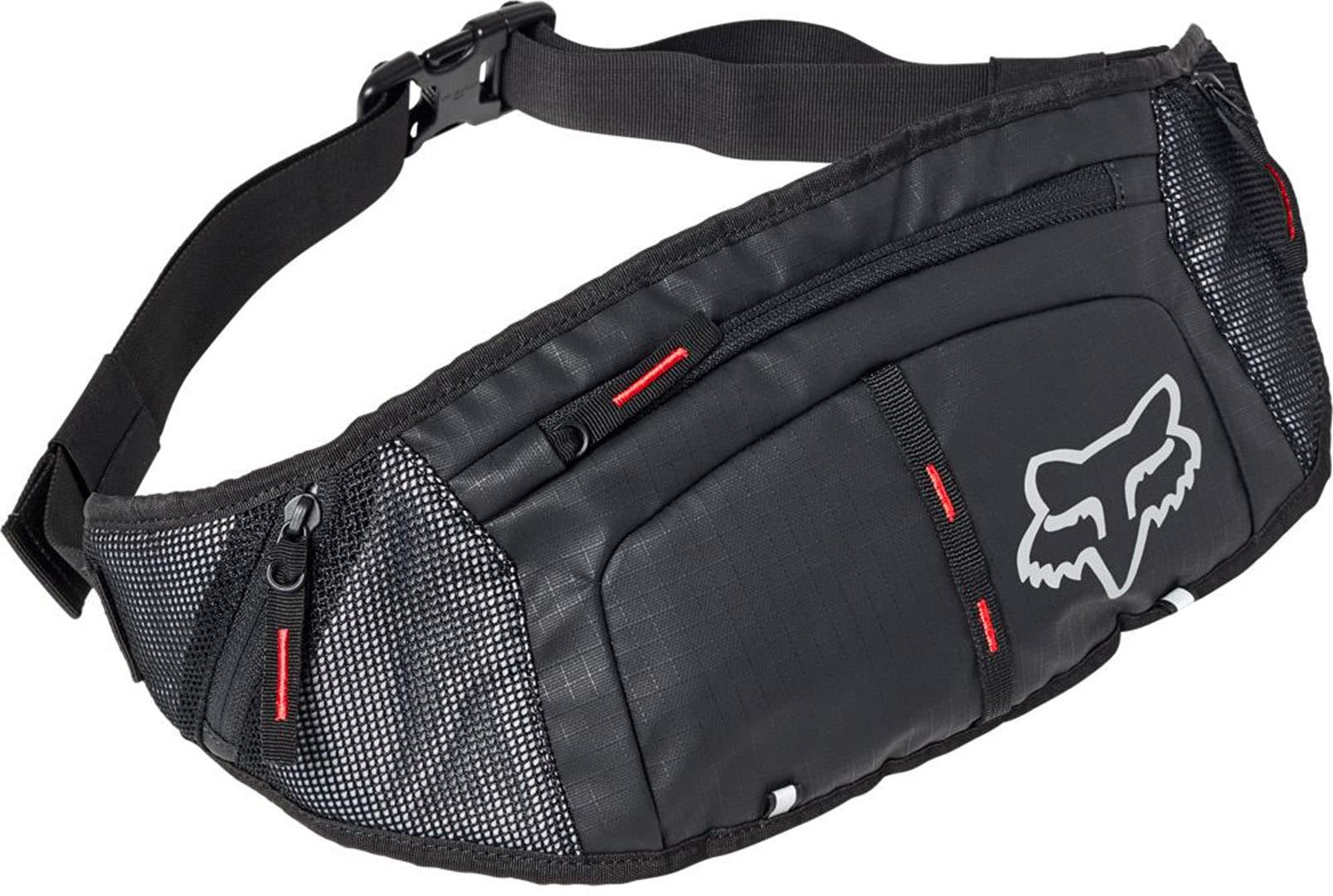
Fox Racing Hip Pack Slim
Key Features
- Fit: Low-profile under-jersey
- Weight: 5.6 oz
- Pockets: 3
- Waist length: 55 cm
- Price: Midrange
The Fox Racing Hip Pack Slim is for the rider who wants the pack to disappear under a jersey. At 5.6 ounces, it is a genuinely light pack, and the low-profile shape keeps it from bulging when you are bent over the bars. The divided main pocket and two secure hip pockets give you a place for a phone, keys, and a small tool without a jumble.
We found the slim shape refreshing on short rides. It holds a phone and a couple of small items close to the body, and the low-profile shape keeps the load tight and quiet when you are moving around the bike. The reflective details are a nice touch for dusk.
The divided main pocket is the part we use most: it keeps a multitool from rattling against a phone. The two hip pockets are easy to reach for keys or a gel, and the low-profile belt sits close without pressure points. It is a simple pack, but the layout is sorted.
Pros
- Light 5.6-ounce build
- Low-profile under-jersey fit
- Three pockets keep small items organized
- Reflective details for visibility
Cons
- Minimal capacity
- Waist length may be short over bulky layers
We recommend the Fox Racing Hip Pack Slim for minimalist riders who want a barely-there pack for phone, keys, and a multitool; it is the pack that stays out of the way.
Best for Light-Duty Rides
Dakine Hip Pack X Independent

Key Features
- Weight: 8 oz
- Waist belt: Adjustable
- Compartments: 2
- Sunglass pocket: Fleece-lined
- Price: Budget
The Dakine Hip Pack X Independent is the simplest and least expensive pack here, and we recommend it only for light, dry rides. It is a casual waist pack with two zippered compartments, a fleece-lined sunglass pocket, and a mesh back panel. For a short spin or a commute, that is enough to hold a phone, keys, and sunglasses without a fuss.
We liked the fleece pocket for sunglasses and the easy, uncomplicated access. The pack is light and comfortable for errands and around-town riding. It is not a technical trail pack: the simple two-compartment layout has no place to secure a bladder hose or compress a part-full load.
The mesh back panel is a small win on warm commutes, and the adjustable belt is easy to set. The dual zippers are easy to find and open when you stop. That is the whole point of this pack: light, simple, and inexpensive.
Pros
- Budget-friendly casual waist pack
- Fleece-lined sunglass pocket
- Light and comfortable for short rides
- Simple dual-zip access
Cons
- Not water resistant
- Main compartment runs small for tools
We recommend the Dakine Hip Pack X Independent for short, dry rides when phone, keys, and sunglasses are the whole load; it is the budget-friendly casual choice here.
How We Tested the Best Mountain Bike Hip Packs
We started by pulling together more than 30 hip packs sold for mountain biking, then narrowed the list by capacity, waist-belt adjustment, attachment style, storage layout, and price. We ruled out packs with fixed belts that wouldn’t fit over a shell, tiny compartments that couldn’t hold a tube and multi-tool, and zippers or buckles that looked likely to fail. That left 12 packs, which we rode for six months on local singletrack, bike-park laps, and longer backcountry days.
Each pack was loaded with the same kit—a tube, multi-tool, CO2, two snacks, phone, keys, and a light shell—then adjusted over both a jersey and a rain shell. On a familiar rocky descent, I noted whether the pack lifted off my lower back, rotated around my hips, or bounced enough to distract; on technical climbs, I checked for pressure points and whether the belt restricted breathing. We also wore each pack for a two-hour ride and at least one four-hour day, watching for chafing, sweaty back panels, and strap creep.
To judge capacity, we tried to add a water bottle after the standard load and noted whether the zipper closed without a fight or the pack bulged into my spine. For quality, we checked stitching, zipper pulls, and buckle teeth after repeated loading and tossing packs into a truck bed. Portability meant grabbing each by one strap, carrying it off the bike, and seeing whether it packed flat in a duffel; versatility meant using the same pack for a quick after-work lap and an all-day ride. Finally, we compared what each pack carried and how it held up against its price to sort out value.
How to Choose an Mtb Hip Pack
The right MTB hip pack disappears on the trail: it holds your phone, water, and tools close to your hips without bouncing or swinging when the terrain turns rough.
Capacity: Match the Pack to the Ride
Start with liters, but read them as a promise about volume, not a measure of comfort. A 0.5-liter pack like the Thule Rail is a phone-and-keys carrier; a 3-liter pack adds a light shell and tools; a 5-liter pack like the Dakine Hot Laps can take a fuller trail load and a two-liter bladder. If you routinely carry a jacket, lunch, and a camera, a hip pack is the wrong shape—move to a backpack. For most rides of a few hours, we think three to five liters is the sweet spot.
Fit and Stability Matter More Than Features
A hip pack only works if it stays put. We look for a wide waist belt, a body that curves around the hips, and compression straps that pull a part-full load close. The belt should sit low and snug, not ride up on your stomach. Check the stated waist range before ordering; the Dakine Hot Laps runs short for larger riders, and the Fox Slim’s 55-centimeter belt is worth measuring against your layers. A pack that shifts on smooth pavement will be worse on roots.
Bladder, Bottle, or Neither
Hydration is the biggest fork in the decision. A bladder pack keeps water on your back and leaves the frame free, but you have to clean and dry the reservoir; the Dakine Hot Laps includes a two-liter bladder. A bottle holder, like the one on the EVOC Hip Pack Pro E-Ride 3, is easier to refill and lets you see how much you have left, though a full bottle adds bulk at the hip. We prefer a bottle for short rides and a bladder for longer ones. If you run a frame bottle anyway, a slim pack with no hydration is lighter and simpler.
Access, Organization, and Weather
The best pocket is the one you can reach without stopping. A dedicated phone pocket with a soft lining protects the screen, and a divided main compartment keeps a multitool from scratching your glasses. Think about weather, too: most hip packs here are not water resistant, so we treat a zip-top dry bag for the phone as cheap insurance. Reflective pulls and a light loop help on evening rides. If you ride in mud and rain often, prioritize a pack with a covered zip or treat the whole pack as a fair-weather tool.
Straps, Zips, and Long-Term Wear
The failure points are the belt, the zipper, and the hydration hose. A magnetic hose clip is handy, but it can let the bite valve swing when the trail gets rough; route the hose under the belt or use the clip as a guide, not a lock. We check the warranty and the replacement cost of a bladder before we buy, because a cheap pack with a proprietary reservoir can cost more over time. A simple, repairable design is often the better long-term buy.
Frequently Asked Questions
What is the difference between a hip pack and a sling pack?
A hip pack wraps around your waist with a two-sided belt, so the load sits on your hips and stays centered. A sling pack crosses one shoulder and can swing when you move, which is why some packs, like the Dakine Hot Laps, can be worn either way. For mountain biking, waist carry is the more stable default; a sling is better for commuting or off-bike use.
How do I clean and dry a hydration bladder?
Empty the bladder after every ride, rinse it with warm water and a little mild dish soap, and use a soft bottle brush on the inside. Rinse thoroughly, then hang it upside down with the cap off so air can circulate; a dedicated drying rack helps but a clean dish towel over a hanger works. Store it dry and open, not sealed in a pack. Check the pack’s care label before machine washing—some hip packs are machine washable, but the bladder never is.
Final Verdict
For most mountain bikers, the Dakine Hot Laps 5L is the pack we recommend first. Five liters of gear space, a two-liter bladder, and side compression add up to a pack that carries a real trail load without the bulk of a backpack. It is not water resistant, and the belt needs a firm cinch, but those are manageable trade-offs for the capacity.
If your rides are short and your phone is the main thing you need to reach, the Thule Rail Hip Pack 0.5L is the better buy. It gives up almost all gear capacity, but the behind-the-back phone access and stable slim body make it the right pack for quick laps.