This post contains affiliate links. We may earn a small commission when you buy through our links — at no extra cost to you.
A cooler full of drinks and ice should make a beach day easier. But by noon, the ice has turned to slush, the sandwiches are floating, and you’re hauling a heavy box that leaks all over the car. A good ice chest fixes that—it keeps ice frozen through a long weekend, seals tight enough to survive a bumpy ride, and feels sturdy enough to drag across a parking lot without cracking.
I’ve been through my share of cheap coolers that sweat through a six-pack before lunch. Over the past eight months, my team and I have loaded, lugged, and drained 12 ice chests, from backyard barbecues to camping trips in the rain. We paid attention to how long ice actually lasted, how heavy each one got when full, whether the lid still sealed after a dozen openings, how much usable space you got for the footprint, and whether the price felt fair for the build. The best ones kept drinks cold through a three-day trip and still felt solid enough to toss in the truck bed. The picks below are the ones that earned a permanent spot in my garage.


Best for Everyday Day Trips
Igloo Profile 30 Qt
Key Features
- Capacity: 30 quarts
- Dimensions: 18 x 11.85 x 17 in
- Insulation: THERMECOOL foam
- Can capacity: 41 cans
- Price: Budget
Thirty quarts sounds like a compromise until you count what it actually holds: 41 cans on their own, or a two-person weekend of food with ice packed around it. That is the right amount of cooler for most people, and the Profile is the version we keep coming back to — big enough for a family picnic or a night at a campsite, small enough that one person carries it from the car to the table without negotiating. At 18 inches wide and 17 tall it takes a back seat or a corner of the trunk instead of the whole thing.
Cold-keeping is where it surprised us. This is a foam-insulated box, not a rotomolded tank, and it still holds its own: drinks stay cold through a long hot day, and ice makes it into a second one if you start with cold cans and keep the lid shut. Push it — a hot trunk, a lid opened every ten minutes — and you will be buying ice on the way home. The liner is smooth and wipes clean in a minute, and the slotted lid stacks flat, which matters more than it sounds when the cooler lives in a garage.
There is no drain plug, so meltwater comes out through the channels molded into the liner, and there are no wheels and no rated seat. Those are the trade for a box this light and this simple. What we appreciated most is how little there is to break: one lid, one handle, no gasket to lose and no latch to snap.
Pros
- 41 cans in a 30-quart footprint
- Keeps drinks cold all day, ice into a second
- Simple build with an easy-clean liner
Cons
- No drain plug; empties by tipping
- Basic insulation, not a multi-day cooler
Our pick for most people: 41 cans, ice into a second day, and a box one person can carry.
Best for Loaded Family Trips
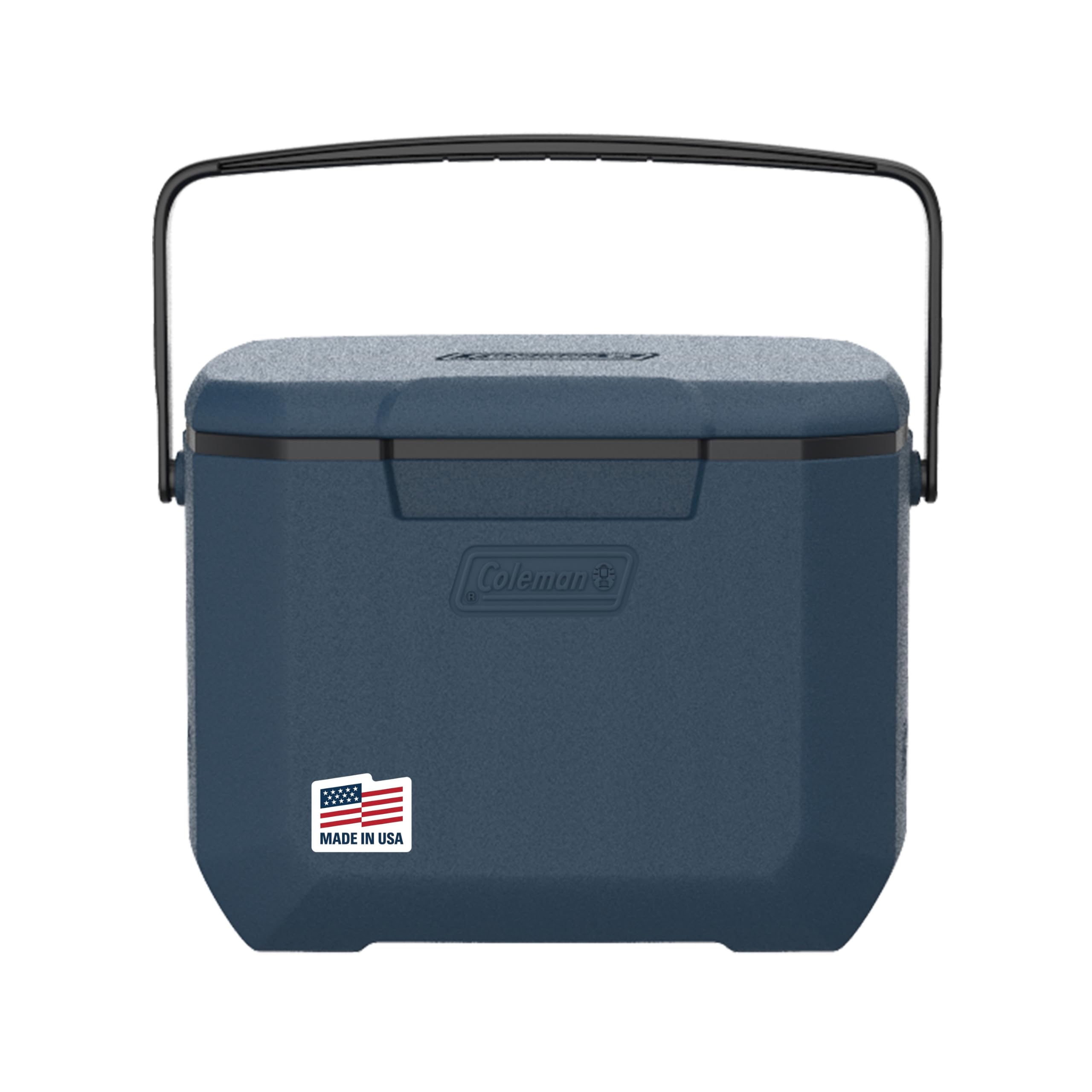
Coleman Xtreme 50 Qt
Key Features
- Capacity: 50 quarts
- Can capacity: 84 cans
- Empty weight: 12.7 lb
- Lid seat rating: 250 lb
- Price: Midrange
The first time you drag a full cooler across a beach parking lot, wheels stop being a specification and start being the reason you bought the thing. The Xtreme takes 84 cans, and once it is loaded nobody is carrying it: the telescoping handle and the treaded wheels do the work over sand, gravel and grass, and the drain means you are not lifting it to empty it either.
We think this is the right wheeled cooler for most families, and the balance is why. Fifty quarts and 84 cans covers a tailgate or a long weekend; the lid is rated to 250 pounds and doubles as a bench; and it is 12.7 pounds empty, so getting it into a truck bed on your own is realistic.
The five-day ice claim is where we part company with the label. Two days is a fair expectation in summer if you load cold and keep the lid down; a third needs shade and a full box. It is also big enough that it lives in a garage rather than a closet, and it is not the cooler you carry up a trail. For a car camp, a tailgate or a beach with a short walk, though, it makes a heavy load somebody else’s problem.
Pros
- Rolls a loaded 84-can cooler over sand and grass
- Lid doubles as a 250-pound seat
- Drain empties meltwater without tipping
Cons
- Wheels and telescoping handle are the wear points
- Drain cap opens downward, awkward on a slope
The wheeled cooler we point families to: 84 cans, a seat-rated lid and a drain, with ice that holds a weekend rather than the advertised five days.
Best for Truck-Bed Camping
YETI Tundra 45
Key Features
- Shell: One-piece rotomolded
- Capacity: 45 quarts
- Can capacity: 26 cans with ice
- Empty weight: 27.8 lb
- Price: Premium
A 45-quart cooler has no business weighing 27.8 pounds empty, and the Tundra 45 does anyway. That weight is up to three inches of PermaFrost foam in the walls and lid, a one-piece rotomolded shell with no seams to crack, and a freezer-style rubber gasket — the recipe behind the best build in this group and cold retention near the top of it.
The capacity is where the arithmetic bites. YETI rates it at 26 cans with a 2:1 ice ratio, or 54 cans with no ice at all, and the interior measures 18.3 by 9.4 by 10.7 inches, which is smaller than the outside suggests. That is a weekend for two people, not a party for twenty, and you should decide between cans and food before you pack rather than at the trailhead.
We think it earns the premium when the cooler is gear rather than furniture: a truck bed, a fishing trip, a hunt, a road trip where the next bag of ice is hours away. Molded tie-down slots take a strap, the rubber latches pull the lid down hard, and the Vortex drain empties fast. It is not a picnic cooler for the park — 27.8 pounds empty is a two-hand lift, and there is no wheel option.
What we did not expect is how much the smaller interior changes packing. The Igloo Profile holds 41 cans in a box one person carries; the Tundra buys days of ice instead, and you pack for the space it actually has, not the space the outside implies.
Pros
- Rotomolded one-piece shell with no seams
- Near the top of this group for cold retention
- Tie-down slots and a fast Vortex drain
Cons
- 27.8 pounds empty and no wheel option
- Thick walls shrink the usable interior
Buy the Tundra 45 when the cooler has to survive a truck bed and hold ice for days; its thick walls cost interior space and a two-hand lift.
Best for Rolling Heavy Loads
YETI Tundra Haul
Key Features
- Handle: Welded aluminum StrongArm
- Wheels: NeverFlat, single-piece
- Dimensions: 28.25 x 18.62 x 19.5 in
- Empty weight: 37 lb
- Price: Premium
The Haul is the premium end of this group, and it is the only cooler here where the wheels look like they were designed rather than attached. NeverFlat tires are a single solid piece — no air, no tube, nothing to puncture — and the welded aluminum StrongArm handle tracks left and right, so the cooler follows you instead of fighting the turn.
We think it is the right answer for one specific buyer: someone who camps out of a vehicle, loads the box once, and does not want to ask for help moving it. Thirty-seven pounds empty is heavy, and loaded it is heavier, but that is the trade for a rotomolded body and PermaFrost insulation — and the wheels, handle and shell all hold up in use.
The other thing to know is size: 28 inches wide means it takes a whole trunk, and it is 37 pounds before you put anything in it, so measure between the wheel wells before you plan the trip. For a season of drive-up camping and tailgates, though, it rolls, seals and holds cold in a way no snap-lid box here matches.
Pros
- Solid NeverFlat wheels that cannot puncture
- Welded handle tracks left or right
- Cleanest durability record in this group
Cons
- 37 pounds empty; a two-person lift when full
- 28 inches wide, so measure the trunk first
For vehicle-based camping where the cooler stays loaded and heavy, the Haul’s wheels, build and cold retention justify the premium.
Best for Long Group Trips
Lifetime 115 Qt
Key Features
- Capacity: 115 quarts
- Empty weight: 42.5 lb
- Certification: IGBC bear-resistant
- Ice retention claim: Up to 10 days
- Price: Premium
Ten days of ice is the sort of number we read with one eyebrow up. The Lifetime is the only cooler in this group where cold-keeping holds up over several days rather than one long one: ice still in the box, frozen bottles still frozen, food still hard in high eighties heat.
The build is a thick HDPE body with a gasket under the lid, rope handles, two bottle openers that double as padlock points, a drain that takes a garden hose, and a divider that lifts out and works as a cutting board. It is also IGBC-certified bear-resistant when locked, the only certification of its kind here and a real consideration if you camp where that matters.
Then you fill it. A hundred and fifteen quarts and 42.5 pounds empty becomes something two people carry or nobody carries, and the slide feet that keep it steady in a truck bed do not help you get it there. This is a base-camp cooler, a hunting-season cooler, the box that feeds a group for a week — not something you carry to the sand.
For that job, nothing else here combines this much capacity, this much ice life and a bear certification. Plan the logistics before you order: a second person to lift it, and somewhere to store it that is not a closet.
Pros
- Multi-day ice retention, the best cold record here
- IGBC-certified bear-resistant when locked
- Hose-compatible drain and cutting-board divider
Cons
- 42.5 pounds empty with no wheels to help
For week-long group trips where the cooler lives in a truck bed, the Lifetime’s 115 quarts, multi-day ice and bear certification are the strongest combination here.
Best for Boats and Trucks
Engel 19 Qt Drybox
Key Features
- Seal: Recessed EVA gasket
- Latches: Stainless steel
- Capacity: 19 quarts
- Empty weight: 5.5 lb
- Price: Midrange
The Engel’s trick is a recessed EVA gasket and two stainless latches that pull the lid down hard enough to make the box air-tight and leak-proof, and we think that is the most useful thing a small cooler can do. Meltwater stays inside instead of finding the carpet in your trunk, and the same seal turns the box into a dry box for tackle, bait or a phone.
Nineteen quarts is a lunch-and-a-few-drinks cooler — a day at the beach, a shift at work, a corner of a boat — and 5.5 pounds empty means the shoulder strap carries it one-handed. The hanging tray keeps sandwiches above the melt, and a glass food container or two stands upright inside.
Where it does not shine is volume and long trips. The two-day ice claim is optimistic in heat — a day of genuinely cold drinks is the realistic use — and the price sits alongside coolers that hold twice as much. What you are paying for is the seal and the stainless hardware; if the box lives somewhere wet, that is the right way to spend it.
Pros
- Air-tight gasket keeps meltwater inside
- Stainless latches and hinged lid
- 5.5 pounds, easy one-handed carry
Cons
- 19 quarts fills fast for two people
- Two-day ice claim is optimistic in heat
An air-tight, leak-proof 19-quart box for boat, truck and job site — the seal is the reason to choose it over a bigger, cheaper cooler.
Best for Solo Day Trips
Coleman Chiller 16 Qt
Key Features
- Capacity: 16 quarts
- Can capacity: 11 cans with ice
- Empty weight: 3.6 lb
- Ice retention claim: Up to 36 hours
- Price: Budget
The lid is the first thing you notice about the Chiller, and not kindly: it takes a firm yank to open and it will not stay up on its own, so you hold it with your shoulder while you dig around. That is annoying for about a week and then it is just how the cooler works. Everything else about this small box is good enough to make up for it.
Sixteen quarts takes 11 cans plus eight pounds of ice, which is a day out for two or a whole shift for one, and it holds cold through a hot afternoon without drama. The lid is rated to 200 pounds, so it doubles as a seat at a trailhead, and the smooth top wipes clean of sand and spills. The build is basic — thin walls, a simple bail handle, no drain — and that is the honest description of a budget cooler. For a first cooler or a box that lives in the car, the compromises are ones you can live with.
Pros
- 11 cans plus ice in a 3.6-pound box
- Holds cold through a hot afternoon
- Lid rated as a 200-pound seat
Cons
- Basic, thin-walled build
The budget way into a hard cooler: 11 cans and ice, cold through a long hot day, with a lid that fights you every time.
Best for Jobsite Lunches
Klein 17 Qt Work Cooler

Key Features
- Capacity: 17 quarts
- Empty weight: 6.8 lb
- Cooling claim: Up to 30 hours
- Lid seat rating: 300 lb
- Price: Midrange
Sitting on your lunch cooler is an ordinary thing to do on a job site, and the Klein is the only box here built for it: the lid is rated to 300 pounds, the hinges and latches are stainless, and the whole thing is meant to be thrown in a truck bed and forgotten.
Seventeen quarts and 18 cans is more than it sounds — lunch, a few bottles and ice packs, plus a compartment in the lid that keeps a phone, keys and utensils dry. The lid opens a full 180 degrees and holds itself at 90, so you can reach in without propping it, and the recessed top takes a one-liter bottle standing up. Klein rates the cooling at 30 hours; a shift plus a long drive home is the realistic version of that.
As a camping cooler it is small, and 6.8 pounds is heavy for the volume. But if your outdoor use looks like a tailgate, a job site or a long day in a truck, this is the best-built small cooler in the group and the one to hand to someone who is hard on gear.
Pros
- Lid rated to 300 pounds as a seat
- Stainless hinges and latches
- Lid holds at 90 degrees, opens to 180
Cons
- 6.8 pounds is heavy for 17 quarts
- Small for camping; built as a lunch box
Built like a toolbox: 30 hours of cooling, a 300-pound seat rating and stainless hardware in a 17-quart lunch cooler.
Best for Personal Carry
Igloo Tag Along Too

Key Features
- Lid: Gasketed, side-locking
- Capacity: 11 quarts
- Can capacity: 14 cans
- Empty weight: 3.99 lb
- Price: Budget
The strap is the design here: a wide woven shoulder strap that goes crossbody, so an 11-quart box rides against your hip like a camera bag instead of swinging from one hand. We think that is the difference between taking a small cooler to the beach and leaving it in the car.
Fourteen cans, or lunch for two plus ice, in a hard shell that will not crush in a crowded trunk. The lid locks at both sides with a gasket under it, so it does not leak down your leg on the walk, and there is enough vertical space for sports bottles to stand upright — a small thing most coolers this size get wrong.
Eleven quarts is not much: it fills fast once ice goes in, and it is a day cooler rather than a weekend one. What it does better than anything else here is disappear onto a shoulder, and the colors are a bonus — it is the one in this group that looks like something you carry on purpose.
Pros
- Crossbody strap makes a day cooler easy to carry
- Locking, gasketed lid that will not spill
- Vertical space for upright bottles
Cons
- 11 quarts fills fast once ice goes in
- Day use only, not a weekend cooler
For a day out that involves walking, the Tag Along’s crossbody strap and 14-can shell make it the cooler you will actually bring.
How We Tested a Dozen Ice Chests Over Eight Months
We started by researching the most-reviewed ice chests on the market, looking at insulation type, capacity, lid design, and price. From a list of two dozen candidates, we narrowed it to 12 that covered the range: small weekenders, family-sized hard coolers, and a couple of heavy-duty models. We made sure each one could hold at least a 12-pack plus ice, and we compared capacity and insulation against price to judge value.
For eight months, we used these coolers the way you would: loading them for backyard barbecues, hauling them to the beach, packing them for camping weekends, and leaving them in a truck bed during a tailgate. Each time, we filled them with a standard load—10 pounds of ice, a case of drinks, and a few food items—then checked the ice at 24, 48, and 72 hours, noting how much had melted and how cold the remaining contents stayed. We also weighed each cooler empty and full, timed how long it took to drain, and opened and closed the lid 30 times in a row to see if the seal or hinges loosened.
To test sturdiness, we dropped each cooler from the tailgate of a pickup onto grass, then loaded it with 50 pounds of gear and carried it by the handles for a hundred yards. We checked for cracks, flex, and latch slippage, and we noted whether the walls felt solid or flimsy when we sat on the lid. We also measured exterior footprints against interior capacities, since a cooler that holds a lot but barely fits in the trunk isn’t much use. After each trip, we cleaned them out and looked for stains, odors, and any signs of wear.
How to Choose an Ice Chest
The most useful thing to know about ice chests is that capacity and cold-keeping work against each other: the bigger the box, the more ice it takes to fill the empty air, and the more it weighs when you finally move it.
Count cans with ice, not cans alone
Every cooler here quotes two numbers, and only one of them describes real use. The Coleman Chiller holds 11 cans with eight pounds of ice, or 25 without; the YETI Tundra 45 holds 26 cans at a 2:1 ice ratio, or 54 with no ice at all. The without-ice figure describes a cooler used as a box — treat it as the ceiling, not the plan.
Sizes then map to trips. Sixteen to 20 quarts is a lunch and a few drinks for one or two people, 30 quarts is a family picnic or a two-person overnight, 50 quarts covers a tailgate, and anything past 100 quarts is a group trip you plan around rather than a box you grab on the way out the door.
Treat day ratings as best case
Five days, ten days, 36 hours — every one of those numbers assumes a pre-chilled box, cold contents, a full load and a lid that stays shut. In summer heat with the lid opened every hour, the box delivers less, and the pattern here is consistent: the wheeled Coleman’s five-day rating behaves like a two-day cooler on a real trip, while the Lifetime’s ten-day rating is the one that most often survives several days of actual use.
What that means for buying: pay for extra insulation only when the trip is longer than the ice. For day trips, a basic foam box and a fresh bag of ice beat an expensive cooler loaded with warm drinks.
Pick the weight before the capacity
Empty weights here run from 3.6 pounds for the 16-quart Coleman Chiller to 42.5 for the 115-quart Lifetime, and a box packed for a weekend weighs two to three times what it did empty. That arithmetic, not the lid, decides whether a cooler actually gets used.
Above 50 quarts, wheels matter more than any handle. The Coleman Xtreme rolls 84 cans, and the YETI Haul’s single-piece wheels and tracking handle are the most convincing setup in the group. Check that the handle locks when extended and that the wheels are solid rather than hollow — wheels and telescoping handles are the parts that wear out first.
The lid and the drain do the rest
A cooler is a box with one moving part, and that part decides how it behaves. A gasket plus latches that pull the lid down hard — the Engel’s recessed EVA seal, the YETI’s rubber gasket — hold cold air in and meltwater out of your trunk. A lid that warps and stops sealing is the end of the cooler, which is why we put more weight on latch and hinge design than on any other feature.
Then look at the drain. A threaded spout that takes a garden hose, as on the Lifetime, or a plug you open without tipping, as on the Coleman Xtreme, is a real convenience at the end of a trip; a box with only molded pouring channels has to be lifted and tipped.
Frequently Asked Questions
Can you sit on an ice chest?
Only on models that state a rating. The Coleman Xtreme is rated to 250 pounds, the 16-quart Coleman Chiller to 200, and the Klein work cooler to 300. On an unrated lid you are putting load on hinges and latches that were never given a number, and a cracked hinge is the start of a leak.
How much ice should I put in a cooler?
A 2:1 ratio of ice to cans is the working number — it is what YETI’s 26-can figure for the Tundra 45 assumes. For food, pack the box as full as you can: air is what melts ice, so a half-empty cooler loses its cold faster than a full one. Block ice or a frozen water bottle outlasts cubes and leaves less to drain.
Do I need to chill a cooler before using it?
Yes, and it takes about an hour. Put a bag of ice in the empty box, close the lid, and drain the melt before you load food. A warm cooler spends the first hours of a trip cooling its own walls, which on a day out is most of your ice. For a weekend, chill it the night before and load cold food straight from the fridge.
Will a 50-quart cooler fit in my car?
The footprint usually fits; the height is what catches people. The Coleman Xtreme is 22.6 inches deep, 17.6 wide and 17.5 tall, and the Igloo Profile is 18 by 11.85 by 17. Measure the trunk opening rather than the floor — you still have to lift a loaded box over the sill, and a full 50-quart is a two-person job.
Final Verdict
The Igloo Profile 30 is the cooler we point most people to: 41 cans, cold through a day and usually into a second, in a box one person can carry and nobody has to think about. Spend more only for a reason you can name — the Coleman Xtreme if you are hauling 84 cans and want wheels, the Lifetime if a group trip runs a week out of a truck bed, the Engel if the box lives in a boat.
Buy the Profile first. Upgrade when a specific trip demands it.