This post contains affiliate links. We may earn a small commission when you buy through our links — at no extra cost to you.
A good camping morning involves coffee, a dry tent, and ice that hasn’t melted. The bad version involves dragging a heavy box across gravel while the lid pops open and lunch rolls into the dirt. Wheeled coolers promise to fix the hauling, but mobility often brings a heavier body, fussier lids, or ice that quits early. What you want is a cooler that rolls over roots and gravel, sits still when you stop, and holds cold long enough to earn its trunk space. We’ve spent eight months with nine of these coolers, and the difference shows up fast.
When I pack, I care less about a spec sheet than whether the lid opens with one hand, the drain empties the last of the meltwater, and the wheels feel solid after a season. Size matters too: too big is a pain to lift into a truck bed, too small runs out of room for food and drinks. Value comes down to how many summers the hinges, latches, and lid gasket survive. The picks below made camp easier, not just more mobile.


Best for Family Camping Weekends
Ninja FrostVault 65qt
Key Features
- Capacity: 65 quarts
- Warranty: 5 year limited
- Dry storage: FrostVault dry zone
- Empty weight: 39.7 lb
- Price: Premium
The FrostVault’s dry drawer is the feature that changes how you pack for a family camp. It keeps sandwiches, cheese, and chocolate cold and dry, separate from the ice, so lunch isn’t a search through meltwater. The 65-quart tub holds 54 cans with ice or 97 without, which is a long weekend for two or a shorter trip for four.
At 39.7 pounds empty, it is not a cooler you toss into a truck bed one-handed. Once it is on the ground, the all-terrain wheels and sturdy handle do the work over gravel and grass. We also like the five-year limited warranty. Ice retention is strong, but no cooler keeps pace with a hot, frequently opened lid, so start with block ice and keep it shaded.
Against the RTIC, the Ninja gives up some lightness and adds the dry drawer and more capacity. Against the YETI, it is less compact but easier to justify for a family that packs food as well as drinks.
For most camping trips, that trade is the right one. We recommend the FrostVault as the default family cooler because it solves the messy part of camping food, not just the cold part.
Pros
- Dry drawer keeps food cold and dry
- 65-quart capacity for family weekends
- All-terrain wheels handle gravel and grass
- Five-year limited warranty
Cons
- Premium price against the rest of this set
The best all-around wheeled camping cooler for most families: 65 quarts, a genuinely useful dry drawer, and a five-year warranty, if you can lift 40 pounds empty.
Best for Lighter Premium Hauling
RTIC 52 QT Ultra-Light
Key Features
- Capacity: 52 quarts
- Warranty: 3 years
- Insulation: 2.5 inches closed-cell foam
- Empty weight: 28.5 lb
- Price: Premium
The RTIC is the premium cooler we pick when the campsite is a walk from the car. At 28.5 pounds empty, it is light enough for one person to lift into a hatchback, and the 52-quart body holds enough for two or three campers for a weekend. The aluminum handle and puncture-resistant wheels feel sturdier than the price-first coolers here.
The 2.5 inches of closed-cell foam is the reason to consider it over a cheaper box. Ice retention is good but not miraculous; in summer heat, block ice and a shaded spot matter more than the label. We appreciate the three-year warranty and the no-slam handle that stays put when you let go.
If you need a dry drawer or a bigger family capacity, the Ninja is the better call. If you move camp often or lift the cooler in and out of a vehicle alone, the RTIC’s lighter body is worth the trade.
Pros
- 28.5 pounds empty, manageable alone
- 52 quarts suits two to four campers
- Puncture-resistant wheels and aluminum handle
- Three-year warranty
Cons
- Ice retention trails the longest claims in heat
A lighter premium hauler for couples or small families: 52 quarts, easy-rolling wheels, and a three-year warranty, with ice retention that rewards block ice and shade.
Best for Compact Premium Trips
YETI Roadie 48
Key Features
- Handle: Retractable periscope
- Wheels: NeverFlat solid
- Capacity: 48 quarts
- Empty weight: 25.8 lb
- Price: Premium
The Roadie 48 is the premium compact choice. Its single-piece NeverFlat wheels and retractable periscope handle are the smoothest rolling setup in this group, and the 48-quart body holds 76 cans or 24.5 kg of ice. On a tight campsite or in the back of an SUV, that smaller footprint is a real advantage.
The 11.7 kg empty weight is light enough for two-handed carrying, and the periscope handle makes towing easy. Ice retention is strong for a compact box; summer heat and a frequently opened lid still shorten it. We like the non-slip feet on a boat deck or truck bed.
The Roadie makes the most sense for a couple or a solo camper with a small vehicle and a premium budget. If you need to feed a family or lift the cooler alone, the RTIC and Ninja are better values. That focus is the point: it is the best compact premium cooler here, not the best family box.
Pros
- NeverFlat wheels roll smoothly on rough ground
- 48-quart body fits tight vehicles
- Retractable periscope handle and non-slip feet
- Strong ice retention for a compact cooler
Cons
- Highest price in this set
- Heavy to lift when fully loaded
The premium compact pick for campers with a small vehicle: 48 quarts, the smoothest rolling hardware here, and strong ice retention for its size.
Best for Large-Group Basecamps
Igloo Maxcold Glide 110Qt
Key Features
- Handle: Telescoping
- Capacity: 110 quarts
- Insulation: THERMECOOL
- Empty weight: 25.4 lb
- Price: Midrange
A 110-quart cooler is a basecamp appliance, not a day-trip box. The Maxcold Glide holds 168 cans, which is enough for a large group or a long weekend with food and ice, and the long telescoping handle lets one person tow it across a flat site. The 25.4-pound empty weight is manageable; the loaded cooler is not.
Cooling performance is the reason it earns a place. Thermecool insulation and UV inhibitors help it hold cold in a sunny camp, and the stainless hinges and drain plug are practical touches. We recommend it for groups that stay put and have room to store it, because the size is the real commitment.
For a couple or a small SUV, the 65-quart Ninja or 52-quart RTIC will be easier to live with. For a scout troop or a long basecamp, the extra capacity is worth the space.
Pros
- 110 quarts holds 168 cans
- Long telescoping handle tows easily
- Thermecool insulation with UV protection
- Good value for the capacity
Cons
- Latches can loosen over time
The big-group choice: 110 quarts and 168 cans for basecamp, with a long towing handle and strong cooling for a large group.
Best for Budget Group Camping
Coleman Xtreme 50qt
Key Features
- Capacity: 50 quarts
- Ice claim: Up to 5 days
- Seat rating: 250 lb
- Empty weight: 12.7 lb
- Price: Budget
The Xtreme is the cooler we point to when the budget is tight and the group is not. It holds 84 cans, weighs 12.7 pounds empty, and rolls on all-terrain wheels with a retractable handle. That light empty weight matters: you can lift it into a car alone, which is not true of the big hard coolers here.
The five-day ice claim is a best-case number; pack block ice and keep the cooler shaded. The drain is simple but effective, and the seat-rated lid supports 250 pounds for a campsite bench. We also like the four molded cup holders, a small thing that keeps tumblers from sliding around.
For a weekend or a tailgate, it does the job for a fraction of the premium picks. If ice retention is the priority, the RTIC or Ninja is worth the step up.
Pros
- 12.7 pounds empty, easy to lift
- 84-can capacity for group weekends
- All-terrain wheels and retractable handle
- Seat-rated lid supports 250 pounds
Cons
- Lid can be hard to open one-handed
The budget camping cooler we point to first: light enough to lift, easy to roll, and big enough for a group, with a seat-rated lid for the campsite.
Best for Couples and Day Trips
Igloo Profile II 28qt

Key Features
- Handle: Locking telescoping
- Capacity: 28 quarts
- Can capacity: 42 cans
- Empty weight: 8.5 lb
- Price: Budget
Not every camping trip needs a 70-quart box. The Profile II is a 28-quart cooler with a 42-can capacity, which is right for a couple on a weekend or a family’s day trip. At 8.5 pounds empty, it is the easiest hard cooler here to lift, and the slim shape fits behind a seat or in a small trunk.
The wheels roll well on pavement and packed campground roads, and the locking telescoping handle makes it easy to pull behind you. The easy-clean liner and pouring channels simplify cleanup. We recommend it for couples and short trips, not for a week of food for four. If you need more capacity but still want a light lift, the Coleman Xtreme is the next step up.
Pros
- 28 quarts and 42 cans suit couples
- 8.5 pounds empty, easy to lift
- Fits in small trunks and back seats
- Easy-clean liner and pouring channels
Cons
- Telescoping handle can stick or stop short
The compact pick for couples and short trips: 28 quarts, 42 cans, and only 8.5 pounds to lift.
Best for Car Camping and Errands
INSMEER 50L Rolling Cooler

Key Features
- Shell: Soft
- Capacity: 50 liters
- Can capacity: 80 cans
- Empty weight: 5.3 lb
- Price: Budget
The INSMEER is a soft cooler and a folding hand truck in one. The bag detaches from the frame, so you can use it as a cooler at the campsite and the frame as a cart for gear or groceries. At 5.3 pounds empty, it is lighter than any hard cooler here, and 50 liters holds up to 80 cans.
The PEVA insulation and 900D exterior keep drinks and food cold for a day out, and the wipe-clean liner is easy to deal with after a picnic. The frame is light, so load it sensibly and keep an eye on the joints.
For grocery runs, beach days, and basecamp overflow, the detachable design is genuinely useful. We recommend it as a second cooler or a car-camping companion, not as the only box for a long trip.
Pros
- Detachable bag doubles as a hand truck
- 5.3 pounds empty
- 50 liters holds up to 80 cans
- Wipe-clean liner
Cons
- Not built for multi-day ice retention
- Short 30-day warranty
A clever lightweight option for car campers who also want a grocery trolley: 50 liters, 80 cans, and 5.3 pounds, with a detachable bag.
Best for Walk-In Day Trips
TOURIT 30L Rolling Cooler
Key Features
- Carry: Backpack straps and wheels
- Capacity: 30 liters
- Can capacity: 50 cans
- Empty weight: 5.14 lb
- Price: Budget
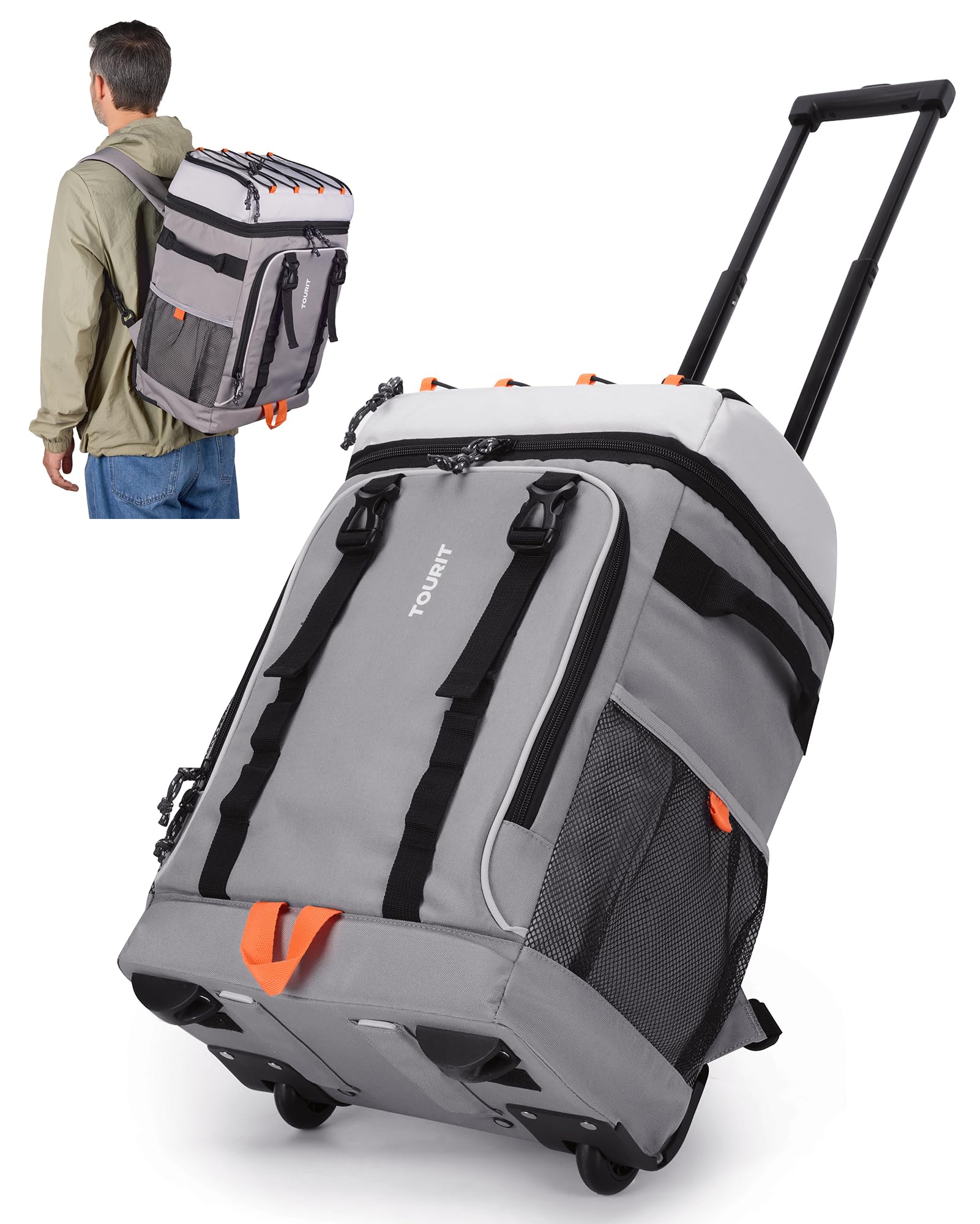
The TOURIT’s trick is the pair of shoulder straps. When the wheels hit sand, stairs, or a rough path, you can carry it on your back, which is more than any other cooler here offers. The 30-liter bag holds up to 50 cans and weighs 5.1 pounds empty.
It rolls well on smooth ground and the telescoping handle is sturdy. A full bag can lean forward when it is standing still; pack heavier items low and keep the top pocket light. That is a small adjustment, and it stays comfortable to pull on pavement or packed dirt.
The multi-pocket layout is useful for a day trip: a front zip pocket for utensils, side mesh pockets, and a leakproof EVA liner that wipes clean. It is not the cooler for a family’s week of food, but it is easy to live with for a hike-in lunch or a beach day.
We recommend it for campers who walk in and want one bag for food and gear. If you need to keep ice for days, go with a hard cooler; if you need to carry a cooler up a trail, this is the one we reach for.
Pros
- Rolling cooler with backpack straps
- 5.1 pounds empty
- 30 liters holds up to 50 cans
- Leakproof EVA liner
Cons
- Capacity runs smaller than the stated 30 liters
The day-trip choice for campers who walk in: a 30-liter cooler that rolls, carries like a backpack, and holds 50 cans.
How We Tested Wheeled Camping Coolers
We started with a shortlist of two dozen wheeled coolers, then narrowed it by capacity, wheel type, drain placement, lid design, and price to nine models that represent what you’ll find at outdoor stores and online. Over eight months, those coolers lived in car trunks, at drive-in campsites, on gravel paths, and in backyards for cookouts. We loaded each with the same mix of ice, water bottles, and food, then opened and closed them throughout the day the way a real camper would—one-handed grabs, tired late-night searches, and kids digging for snacks.
Ice retention got a simple visual check: how much ice remained after 24, 48, and 72 hours, and whether meltwater pooled around the food instead of draining away. We also noted lid accessibility—whether the lid stayed open on its own, whether latches lined up easily, and whether the gasket sealed without a fight. Durability and sturdiness got a more physical test: we rolled each cooler over gravel, grass, and pavement, lifted it into a truck bed by its handles, and sat on the lid to see if it flexed or creaked. After each trip, we checked hinges, wheels, and drain plugs for wobble or cracks.
Weight and size were judged in packing terms: we weighed each cooler empty and loaded, then timed how long one person took to move it from the car to the campsite. We compared usable capacity against exterior footprint, and factored price into the final call only after seeing how the wheels, lid, and ice held up. A cheaper cooler that loses a latch in month two isn’t a value.
How to Choose a Wheeled Camping Cooler
The best wheeled cooler for camping is the one you can move alone and trust to keep food cold through the trip, not the one with the biggest ice-day claim.
Match Capacity to People and Ice
Capacity is the first decision because it drives weight and vehicle fit. A 28-quart cooler like the Igloo Profile II suits a couple for a weekend; 50 to 65 quarts, as in the Coleman Xtreme or Ninja FrostVault, covers a small family. A 110-quart box is basecamp equipment for a group. Remember that ice takes up space: a cooler rated for 97 cans without ice holds far fewer once you add ice. Choose the trip size first, then check the empty weight.
Prioritize the Rolling Hardware
Wheels and a handle matter more on a camping cooler than on a tailgate box. Large, treaded wheels roll over grass, gravel, and packed sand; small hard wheels are fine for pavement and a car trunk. A long telescoping handle saves your back, but check that it locks at full extension and does not flex when loaded. The YETI Roadie’s NeverFlat wheels and the Ninja’s all-terrain wheels are the strongest setups here; the Coleman Xtreme is the budget example. Match the wheel to the ground you will actually cross.
Treat Ice Claims as Best-Case Numbers
Every maker quotes a heroic ice-retention figure, and every figure assumes a closed lid, a shaded cooler, and a lot of ice. A sealing lid and tight latches matter more than the number on the box. Pre-chill the cooler, use block ice or frozen bottles, keep it out of direct sun, and resist opening it for every drink. The RTIC’s 2.5-inch foam and the Ninja’s dry zone help, but neither rescues a lid that will not close. Check latch tension before you load up.
Plan for Weight and Vehicle Fit
Wheels help once the cooler is on the ground; they do not help you lift it into a truck. Check the empty weight and then imagine it full. A 39.7-pound Ninja FrostVault and a 25.4-pound Igloo Maxcold Glide are two-person lifts when loaded, while the 8.5-pound Igloo Profile II is not. Measure the cargo opening and height before buying, especially in an SUV or a truck with a tonneau cover. If you camp alone, favor the lighter RTIC or a smaller box.
Frequently Asked Questions
Can I sit on a wheeled cooler?
Only if the maker rates the lid for it. The Coleman Xtreme’s lid is rated to 250 pounds; most wheeled coolers here are not. Sit on a rated lid, not on the lid of a soft cooler or a box with a thin plastic top. A cracked or warped lid can ruin the seal, which costs you more cold air than the seat is worth.
How do I clean a camping cooler after a trip?
Empty the cooler, then wash the liner with mild soap and water. Rinse the drain plug and the lid gasket, and dry everything with the lid open before storage. Food residue and trapped moisture are what make a cooler smell. Avoid harsh cleaners on soft EVA liners; a damp cloth is usually enough.
How do I keep a rolling cooler from tipping?
Load heavy items low and centered, keep the top pocket light, and do not hang bags from the handle. On a slope, pull the cooler behind you instead of pushing it sideways. If a wheeled cooler still leans on flat ground, the wheel spacing or frame is the problem, not your packing. That is a reason to choose a wider-based model.
Final Verdict
Buy the Ninja FrostVault if you want one cooler for a family camping weekend. The dry drawer keeps food out of the meltwater, 65 quarts is enough for a long weekend, and the five-year warranty backs up the premium. If you lift the cooler alone or move camp often, the RTIC 52 QT is the better haul, and the YETI Roadie 48 is the premium choice for tight vehicles. The Coleman Xtreme remains the budget answer for a group that mostly rolls from the car to the site.