This post contains affiliate links. We may earn a small commission when you buy through our links — at no extra cost to you.
The scene is always the same: you load a cooler Friday afternoon, the ice looks generous, and by Saturday morning everything’s floating in lukewarm water. A cooler’s whole job is to buy you time — a second day, a third, a long weekend without a gas station ice run — and how much time it buys comes down to insulation, lid seal, and how you pack it. In August heat, those stop being spec-sheet details and start ruining lunch.
I’ve hauled a bargain-bin cooler up a trail and watched a good one hold ice for four days straight. Over the past eight months, our team has run 12 coolers — hard-sided, soft-sided, and wheeled — through weekend camping trips, tailgates, and a few 95-degree afternoons in a parked truck. We loaded them, weighed them, and opened the lids until it got annoying. One thing nobody tells a first-time buyer: pre-chilling the box and using block ice will do more for you than almost any upgrade. The picks below are the ones we’d load first.



Best for Drive-Up Family Camping
Lifetime 65 Quart
Key Features
- Capacity: 65 quarts
- Warranty: 5-year limited
- Empty weight: 25.5 lb
- Ice retention: Up to 8 days
- Price: Midrange
The Lifetime is the only cooler here certified bear-resistant, and that fact tells you most of what it is: heavy polyethylene walls, a lid clamped down by latches, and a shell built to be sat on, dropped, and left at a campsite. The IGBC rating holds up for an hour with padlocks through the lid holes, and the locks are not in the box — put two on your list if you camp where bears do. It is the cooler we recommend to most campers, because it pairs the longest published ice retention in this group with the toughest build.
Eight days is the claim, and the design backs it up: thick foam in the walls and lid, latches that pull the lid down evenly, and a body without the thin, flexing panels that give heat a way in. Pack it Friday morning and the ice question is settled until you break camp. Nothing else here promises that, including the coolers that cost several times more.
What you pay for it is weight and footprint. At 25.5 pounds empty and 28.4 inches wide, it takes two people to get it into a truck bed and it eats most of a back seat, and there are no wheels. For drive-up camping that is the right trade — four serviceable feet keep it off wet ground and it is not going anywhere in wind. For a walk-in site it is the wrong cooler entirely.
The details are the kind we notice after a few trips: rope handles with molded grips that do not cut into your hands, two bottle openers molded into the ends, a drain you can thread a garden hose onto so you are not tipping meltwater over your boots, and a 5-year limited warranty that goes well beyond the one-year cover on the Colemans.
Pros
- Up to 8 days of ice retention
- Bear-resistant and lockable when padlocked
- Heavy shell that survives being sat on
- Hose-threaded drain and 5-year warranty
Cons
- 25.5 pounds empty, with no wheels
- Wide 28-inch footprint fills a back seat
For drive-up camping this is the one we recommend: days of ice retention, a shell that takes punishment, and a price well below the premium brands.
Best for Wheeled Base Camp
YETI Tundra Haul
Key Features
- Handle: Welded aluminum StrongArm
- Wheels: NeverFlat solid tires
- Construction: Rotomolded
- Empty weight: 37 lb
- Price: Premium
Getting the Tundra Haul into a truck bed is a two-person job — 37 pounds empty, and a rotomolded tub that does not flex when you grab a corner. On the ground, though, the wheels do exactly what they promise: solid NeverFlat tires that cannot puncture, and a welded aluminum StrongArm handle that tracks left and right so the cooler follows behind you instead of crabbing sideways.
That combination, a genuinely armored cooler you do not have to carry, is what earns the Haul its place as the premium wheeled pick. The one-piece construction has no seams to crack, the foam is pressure-injected into the walls and lid, and cold-holding on this one sits near the top of the set alongside the Lifetime. It is a base-camp appliance: park, roll, open, close, roll back.
The caveats we minded are weight and interior volume. It is not a cooler you carry anywhere, and the inside is smaller than the outside suggests, so pack to a 2:1 ice ratio and do not plan on a case of bottles plus a weekend of food. What you are buying is a cooler that shrugs off tailgates and rolls over sand; if you only need ice to last a weekend, the Lifetime does that for a good deal less.
Pros
- NeverFlat solid tires that cannot puncture
- Rotomolded shell with commercial-grade foam
- Handle tracks left and right as you tow
Cons
- 37 pounds empty to lift into a truck
- Interior is smaller than the footprint suggests
If your camping never gets more than a hundred yards from the truck, the Haul’s rolling rotomolded build is worth the splurge.
Best for Couples and Small Families
Igloo BMX 52
Key Features
- Capacity: 52 quarts
- Warranty: 3 years
- Can capacity: Up to 83 cans
- Empty weight: 16.4 lb
- Price: Midrange
Sixteen and a half pounds against the Lifetime’s 25. That is most of the argument for the BMX: a 52-quart hard cooler one person can lift out of a trunk and carry to the tent, with room for 83 cans before ice goes in. For couples and small families it is the size we prefer, and it is the cooler we hand to anyone who does not want to plan around a two-person lift.
The build is a real step up from a basic plastic box: blow-molded shell, extra-thick foam in the walls and lid, rubberized T-latches that pull the lid down squarely, a triple-point grab handle with stainless steel reinforcement, and a threaded drain plug that takes a hose. The 3-year warranty also goes well beyond the one-year cover on the Colemans.
Ice life is where it gives ground, and it is worth being clear-eyed about it. A blow-molded cooler like this is a long-weekend tool, not a five-day one: start it cold, pack 2:1 with ice, keep it out of the sun, and it holds through a weekend. Open it every twenty minutes at a hot festival and it will not, which is true of everything here except the two rotomolded boxes.
Pros
- 16.4 pounds, light enough to carry alone
- 83-can capacity in a 52-quart box
- Rubber T-latches and a reinforced handle
- 3-year warranty
Cons
- Ice life falls short of the rotomolded coolers here
One person can carry this 52-quart Igloo and it still holds 83 cans, which makes it our pick for couples and small families.
Best for Budget Wheeled Trips
Coleman Xtreme 50 Quart
Key Features
- Capacity: 50 quarts
- Can capacity: Up to 84 cans
- Empty weight: 12.7 lb
- Ice retention: Up to 5 days
- Price: Budget
The Xtreme is the least expensive route to a wheeled cooler here, and the specification does not read like a compromise: 12.7 pounds empty, all-terrain wheels, a retractable telescoping handle, a leak-resistant drain, and a lid rated to double as a seat. Fifty quarts and up to 84 cans is a tailgate or a family weekend in one box.
We like the shape of the day this cooler suits. Pull it out of the car, roll it to the picnic table, sit on it while the coals get going, roll it back. The drain means you never lift a loaded cooler to empty it, and the wheels mean nobody carries 50 quarts across a field. For camping where the car is the base, that is the most useful combination in this price bracket.
Two things to know before you commit. The lid takes a firm two-handed pull to open, because the grip is shallow and there is no latch to release, and it is worse with cold hands. The five-day ice claim is also a best case that assumes a pre-chilled cooler, a 2:1 ice pack, shade, and a lid that is not opened every ten minutes. The wheels and telescoping handle are the parts built to a price, so pull it over curbs rather than dropping it off a tailgate.
Pros
- Wheels and a telescoping handle at a low price
- Lid doubles as a seat
- 84 cans in 50 quarts
- Drain empties without tipping
Cons
- Lid is stiff to open with cold hands
- Five-day ice claim does not survive summer heat
The Xtreme gives you wheels, a seat-height lid, and 84 cans of space on a budget, as long as you treat the handle gently.
Best for Day Trips for Two
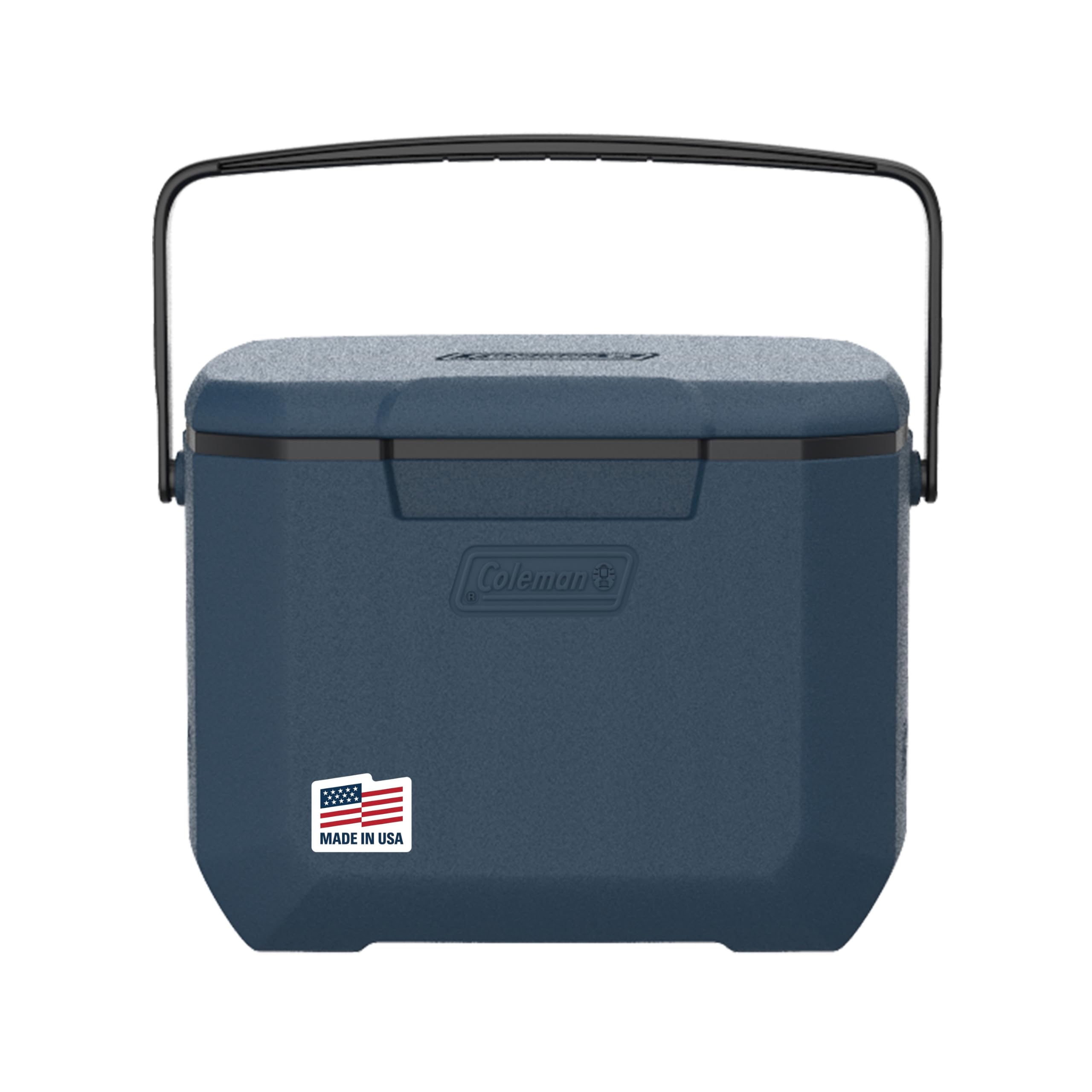
Coleman Chiller 16 Quart
Key Features
- Capacity: 16 quarts
- Empty weight: 3.6 lb
- Ice retention: Up to 36 hours
- Lid seat rating: 200 lb
- Price: Budget
Sixteen quarts is a two-person day, not a family week: a dozen cans and a bag of ice, or lunch for two plus drinks. The Chiller is the smallest hard cooler here and, we think, the easiest to live with — 3.6 pounds, one wide-grip bail handle, and a smooth lid that wipes clean after a sandy afternoon on the beach.
Two details make it more useful than its size suggests. The lid is reinforced and rated as a seat, so it works as a stool at the tent or a step at the tailgate, and the TempLock foam carries a 36-hour cold claim that is honest for a box this small. It also fits where bigger coolers will not: behind a seat, in a footwell, on a shelf in the shed.
The arithmetic is the catch. Sixteen quarts holds 11 standard cans with 8 pounds of ice aboard, or up to 25 cans with no ice at all, so this is a personal cooler — pack it with hard ice packs rather than loose cubes and it earns its keep on day trips, at the trailhead, and on the drive to the lake. If you are feeding four people, none of that matters and you want the Igloo or the Lifetime instead.
Pros
- 3.6 pounds with a one-hand bail handle
- Lid rated to 200 pounds as a seat
- 36-hour cold claim for a small box
Cons
- Only 11 cans once ice goes in
For solo trips and two-person days, the Chiller is the light, inexpensive cooler that fits in the footwell and cleans up in a minute.
Best for Walk-In Campsites
Maelstrom Cooler Backpack
Key Features
- Volume: 32 liters
- Capacity: 35 cans
- Dimensions: 12.87 x 8.97 x 18.72 in
- Empty weight: 15.2 oz
- Price: Budget
The case for a cooler backpack is the last hundred yards: the trailhead lot, the beach stairs, the walk to a tent site no wheeled cooler will reach. Slung on your back, it leaves both hands free for the duffel, the camp chair, and the dog.
Maelstrom’s version is the most organized soft cooler here: 32 liters split across a main compartment and a web of pockets, a bottle opener on the shoulder strap, a buckle sized to hold a wine bottle upright, padded straps and back panel, and a leakproof liner. At just over 15 ounces empty, it adds almost nothing to a load you are already carrying.
Our reservation is the main zipper. That long opening is what makes the pack easy to load, and it is also the part that can weep once meltwater starts sloshing around. Keep ice in sealed bags or a hard pack, stand the bag upright in the car, and it behaves. Treated that way it is a genuinely useful second cooler: the one that comes on the hike while the hard cooler stays at camp.
Pros
- Carries hands-free on the walk in
- Pockets for bottles, tools, and a phone
- Padded straps and a leakproof liner
Cons
- Main zip can weep with loose ice
Buy the Maelstrom if the walk in is the hard part: it carries like a daypack and keeps a lunch cold without a hard cooler to lug.
Best for Compact Premium Camping
YETI Tundra 45

Key Features
- Capacity: 45 quarts
- Construction: Rotomolded
- Empty weight: 27.8 lb
- Cans with ice: 26 cans
- Price: Premium
Forty-five quarts sounds generous until the ice goes in: 26 cans at YETI’s recommended 2:1 ratio, or 54 cans with none. The Tundra 45 is the smallest premium hard cooler in this group, and the gap between its footprint and its usable inside is the thing to understand before you buy it.
Everything else is the YETI pitch, and it holds up: one-piece rotomolded construction with no seams to crack, a freezer-style rubber gasket, up to three inches of PermaFrost foam in the walls, a Vortex drain, molded tie-down slots, and a dry goods basket. It behaves like a fridge and shrugs off being stood on or strapped into a truck bed.
Where it struggles is the comparison. At 27.8 pounds empty it is heavier than the 65-quart Lifetime, which costs less and holds 20 quarts more, and the interior is tighter than the outside suggests, so measure what you plan to pack rather than trusting the quart figure. What you are paying for is the shell, the seal, and a finish that looks better than a white plastic box.
So we see this as a cooler for a particular buyer: someone who wants YETI’s sealing and toughness in a box that fits a sedan trunk and does not need to feed a crowd. If capacity per pound is the thing you are optimizing for, the Lifetime wins that comparison outright.
Pros
- Rotomolded shell with a gasket seal
- 26 cans with ice in a compact box
- Vortex drain and molded tie-down slots
Cons
- 27.8 pounds with less room than its size implies
The Tundra 45 suits someone who wants YETI’s sealing and shell in a compact box and will trade capacity for it.
Best for Lunch and Day Hikes
Titan Zipperless 16 Can

Key Features
- Capacity: 12.68 quarts
- Warranty: Limited lifetime
- Can capacity: Up to 16 cans plus ice
- Empty weight: 2.3 lb
- Price: Budget
There is no zipper on the lid. The Titan’s flip-top opens one-handed and closes with a press, which matters more than it sounds at a campsite, where the alternative is a wet zipper that jams after a season of sand and sunscreen.
Inside is the other good idea: a removable HardBody liner with a shelf across the top, so sandwiches and fruit ride above the meltwater instead of in it, and the liner lifts out to be wiped. Add a padded Backsaver shoulder strap, 2.3 pounds of empty weight, and a limited lifetime warranty, and it is a well-considered small cooler.
The catch is ice. The claim is up to two days, and this is a soft cooler — foam walls, a radiant barrier, 12.68 quarts — so a warm afternoon and a lid that gets opened for every drink will cut into that. Plan on a hard ice pack rather than loose cubes, and treat it as a day cooler that happens to be very good at lunch.
The lid and the shelf are what you are buying here; the ice life is the part you accept. For day-length trips that is a fair trade, and it is a more capable cooler than 16 cans suggests, as long as nobody expects it to cover a weekend.
Pros
- Zipperless lid opens one-handed
- Raised shelf keeps food out of meltwater
- Padded strap on a 2.3-pound bag
Cons
- Two-day ice claim is optimistic in heat
- Mesh side pockets are the weak spot
For lunches, trailheads, and day trips, the zipperless Titan solves the one thing that breaks on soft coolers.
How We Tested the Camping Coolers on This List
We started with a shortlist of about 40 coolers — models from brands we’ve used for years plus the ones readers ask about most — then cut it to 12 based on capacity (we focused on 20- to 60-quart sizes), wall construction, warranty terms, and roughly what each one cost per quart. Testing ran for eight months, from late spring through a cold-weather tailgate, so nothing got crowned on the strength of one lucky weekend.
Each cooler was pre-chilled overnight, then loaded two-thirds with ice and drinks and left in the bed of a black pickup in direct sun. We took internal temperatures with a probe thermometer morning and night, noted when the ice turned to slush and when it turned to water, and weighed what was left. To mimic real traffic, we opened every lid 10 times a day, and we timed how long it took to fish out a can one-handed with the lid propped.
Leakage got its own test: we tipped each cooler on its side in the driveway for an hour and checked the seams, lids, and drain plugs for drips. Durability meant dragging them across gravel, dropping them off a tailgate, and carrying a loaded one a quarter mile. We also slid them into a trunk and a hatchback to see what actually fits, and took note of which ones looked decent enough to leave out on a picnic table. Value came last: how many days of ice each one bought, and what that cost.
How to Choose a Camping Cooler
The cooler that keeps ice longest is rarely the cooler that suits your trip, so we start with how far you have to carry it and work backward from there.
Start with how the cooler reaches the site
Drive-up camping, a tailgate, a festival: wheels or a big hard box with two handles, and weight stops mattering. Walk-in sites, boat launches, beach stairs: soft-sided or backpack, and everything else gives way to pounds on your back. Decide the walk first, then the capacity conversation follows.
The trap is buying a wheeled cooler for a site you cannot wheel into. All-terrain wheels roll over gravel, grass, and packed sand, not a quarter mile of roots and rocks — and a 37-pound empty cooler plus ice is a two-person lift into a truck bed no matter how good the tires are.
Insulation: rotomolded, blow-molded, or soft
Three builds dominate. Rotomolded shells are one piece with thick injected foam, and they hold ice for days; heavy polyethylene coolers like the Lifetime chase the same idea for less. Blow-molded boxes such as the Igloo BMX are lighter and cheaper, and a long weekend is their realistic ceiling. Soft coolers use foam panels and a leakproof liner — brilliant for a day, hopeless for three.
Every published day count assumes a shaded cooler packed 2:1 with ice and opened a handful of times. Pre-chill it, keep it out of direct sun, and add a block of ice rather than cubes if you want the number on the box to mean anything.
Quarts, cans, and the ice nobody counts
Can counts are quoted without ice, which flatters every cooler in the catalog. Add ice and the real numbers appear: the 16-quart Coleman Chiller takes 11 standard cans with 8 pounds of ice, and YETI’s 45-quart Tundra takes 26 cans at its recommended 2:1 ratio.
Pack to that 2:1 ratio for anything longer than a day, and size from meals rather than cans. A family of four eating three meals a day wants 50 to 65 quarts for a weekend; a couple on day trips is well served by 16 to 30.
Lids, latches, and drains
The lid is where cold escapes, so it is the part worth handling before you buy. A lid that seals flat, with latches you can flip one-handed, is worth more than an extra inch of foam. Hinges are the other weak point on cheaper boxes — a lid that warps never seals again.
Check the drain too. A threaded plug takes a garden hose and saves you tipping 50 quarts of meltwater over your boots; a recessed drain that opens underneath is a nuisance on uneven ground. If you want a seat, know the rated load: the Coleman lids here run 200 to 250 pounds.
Soft coolers and backpacks: pack for the walk
A soft cooler earns its place when you are the one carrying it: under a pound empty, hands free, and enough pockets to keep the bottle opener away from the sunscreen. What it will not do is hold ice for three days.
Its weak point is the main zipper, because the seal that makes it leakproof is also the part that jams and weeps. Use hard ice packs rather than loose cubes, keep it upright in the car, and treat a soft cooler as the second cooler rather than the only one.
Frequently Asked Questions
Should I pre-chill a cooler before loading it?
Yes, and it is the cheapest upgrade you can make. A warm tub spends its first bag of ice just getting itself down to temperature. The night before, fill the cooler with ice or a few frozen water bottles and leave the lid shut.
In the morning, dump the meltwater, load food straight from the fridge rather than the counter, and top up with ice. You will notice the difference by the second afternoon.
How do I keep food from sitting in meltwater?
Get the ice out of contact with the food. Frozen bottles or block ice go in the bottom, sealed bags and containers above, and something solid between the two layers — a basket, a shelf, or a rack.
Loose cubes melt fastest and turn a cooler into a soup bowl by day two. The Titan’s liner has a shelf built in for exactly this, and in a hard cooler a simple wire basket does the same job.
Can you sit on a camping cooler?
On some. The Coleman Chiller and Xtreme lids are rated to 200 and 250 pounds, and hard rotomolded boxes take a seated adult without complaint. Aim for the middle of the lid rather than an edge, and keep boots off it.
Skip it on soft coolers, backpack coolers, and any lid without a stated load rating — the foam and the hinges are not built for it.
Final Verdict
If your camping involves a vehicle, buy the Lifetime 65 Quart and stop there: it holds ice longer than anything else here, it is built to be sat on, dropped, and locked shut in bear country, and it leaves money on the table compared with the premium rotomolded names.
The moment the cooler has to travel, that answer changes. The Igloo BMX 52 is the 52-quart box one person can actually carry, the Coleman Xtreme puts wheels under 50 quarts for the least money in this group, and the Maelstrom backpack is the only sensible choice when the site sits beyond a trailhead.