This post contains affiliate links. We may earn a small commission when you buy through our links — at no extra cost to you.
A cooler is a simple thing until you’re standing in a parking lot watching the ice you paid for turn into soup. The tradeoff baked into this category is real: the heavy rotomolded boxes hold ice for days, but they cost a fortune and take two people to haul, while the light, cheap ones are easy to carry and give out by mid-afternoon. What most of us actually need sits somewhere in the middle — a cooler that gets drinks through a long weekend without wrecking your back or your budget.
Over the past eight months, my team and I have lived with 12 coolers, hard-sided and soft, through backyard cookouts, beach days, camping trips, and one very hot afternoon in the back of a pickup. Here’s what nobody tells a first-time buyer: a cooler packed full holds cold dramatically longer than one that’s two-thirds empty, and pre-chilling it the night before does more for ice retention than an extra hundred dollars usually will. The picks below are the ones that held their temperature, fit what we needed, and were priced honestly for what they do.


Best for Day Trips
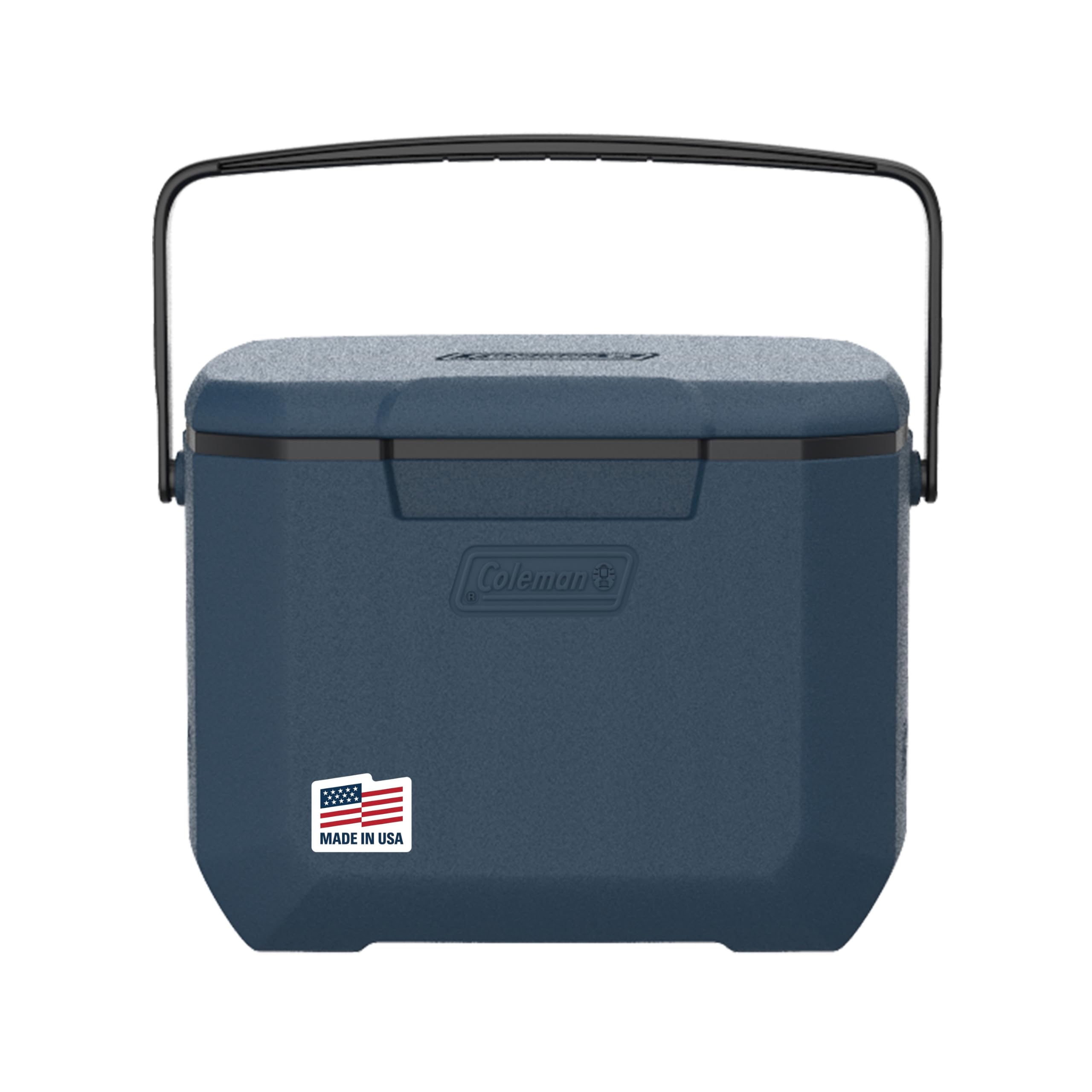
Coleman Chiller 16-Quart Cooler
Key Features
- Weight: 3.6 lb
- Capacity: 16 quarts
- Lid load: 200 lb
- Cans with ice: 11 cans plus 8 lb ice
- Price: Budget
The least expensive hard cooler in this group is also the one we hand most shoppers. Sixteen quarts holds eleven cans plus eight pounds of ice, or twenty-five cans with no ice at all, in a box 15.7 inches wide that tucks behind a car seat without blocking the rear window. Empty, it weighs 3.6 pounds — light enough that carrying it is never the reason it stays home.
What the money buys is a simple foam box with a smooth lid you can wipe clean after a sandy picnic, and that lid is rated to take 200 pounds, which turns the cooler into a camp seat, a step up to the roof rack or somewhere to rest a plate. TempLock insulation is rated to hold cold for up to 36 hours. Read that as a full cooler, lid shut, sitting in shade; a half-empty box in a hot trunk is a much shorter proposition, and packing it tight is the whole trick.
The bail handle is the piece we watch. It is one wide plastic grip carrying the entire load through two pivots, and on a box this inexpensive that is where wear shows first. If the cooler will live in a truck bed and get sat on daily, the Klein below is the sturdier buy. For picnics, tailgates and lake days, this one covers it.
Pros
- Holds 11 cans plus 8 lb of ice
- Lid is rated to seat 200 pounds
- 3.6 lb empty, easy one-hand carry
- Smooth lid wipes clean after sand
Cons
- Plastic bail handle carries the full load
- 16 quarts is a two-person box
We think the Chiller is the best value in hard coolers here: a seat-rated 16-quart box for day trips that costs the least and asks nothing of you.
Best for Job Sites
Klein Tools 55600 Work Cooler
Key Features
- Weight: 6.8 lb
- Capacity: 17 quarts
- Lid load: 300 lb
- Can capacity: 18 cans
- Price: Midrange
Three hundred pounds is the number that matters here. The lid on the 55600 is rated to hold a person, and the stainless hinge and recessed top are built around that: on a site, a cooler that doubles as a seat stops getting kicked around. Seventeen quarts takes 18 cans, or a lunch with a liter bottle standing upright in the recessed lid.
We rate this the most durable small cooler in the group, and the one we trust with a toolbox thrown on top of it. The lid swings a full 180 degrees and holds at 90 while you dig one-handed, and there is a compartment molded into the lid for keys, a phone and a wallet, which keeps them out of the meltwater. Klein rates it for 30 hours of cooling, and the thick walls make that believable.
Those walls are the trade. At 6.8 pounds empty it is the heaviest small box here, and loaded for a full shift it is a two-hand lift rather than a finger loop. The shoulder strap converts to a handle for the short haul from truck to site, which is the carry that actually matters.
Pros
- 300 lb lid doubles as a seat or step
- Stainless hinged lid opens to 180 degrees
- Lid compartment keeps phone and keys dry
- Holds 18 cans in a 17-quart body
Cons
- 6.8 lb empty, heavy once loaded
- No ice packs in the box
For work sites, truck beds and anywhere a cooler gets abused, we think the Klein is worth the step up: the toughest small box here, and the only one you can stand on.
Best for Road Trips
Titan Zipperless 16-Can Cooler
Key Features
- Weight: 2.3 lb
- Capacity: 12.68 quarts
- Warranty: Limited lifetime
- Can capacity: 16 cans plus ice
- Price: Midrange
There is no zipper on the lid. That is the whole idea: flip the top open with one hand, no seam to jam, no slider to break, no wrestling a bag open with wet fingers at a tailgate. The body is only 12.68 quarts and 2.3 pounds, so it slings over a shoulder and sits on a back seat, and 16 cans plus ice is a realistic day for two people.
The HardBody liner is rigid, leak-proof and removable, and the SmartShelf inside lifts hard items above soft ones so a sandwich does not end up under a water bottle. That shelf is the detail we appreciate most — it is the difference between a bag that organizes a lunch and one that becomes a lucky dip by noon.
Two cautions. The two-day ice claim describes a full, pre-chilled cooler with the lid mostly shut; in and out of it all afternoon, plan on a day. And the interior runs narrow, so wide meal-prep containers will not drop in — check your own containers against the liner before you commit.
Pros
- Zipperless flip lid opens one-handed
- Rigid leak-proof liner lifts out
- SmartShelf keeps sandwiches above the ice
- 2.3 lb with a padded shoulder strap
Cons
- Mesh side pockets are the first thing to tear
- Two-day ice rating needs a full, pre-chilled load
We recommend the Titan to anyone who opens a cooler twenty times a day: the zipperless lid is quicker than anything else here, and the rigid liner will not collapse when it is empty.
Best for Tailgates
Igloo Profile II 16-Qt Roller
Key Features
- Carry: Telescoping handle and wheels
- Capacity: 16 quarts
- Insulation: THERMECOOL foam
- Can capacity: 24 cans
- Price: Midrange
Twenty-four cans is the whole story. The Profile II is a 16-quart box on wheels rather than a weekend cooler, and that is exactly why we like it: 14 inches wide and 13.4 tall, it rolls through a doorway, fits a hatchback floor and does not need a second person to lift it into a truck.
We reach for it when the walk is paved — a tailgate lot, a beach parking area, a boat dock. Cool Riser lifts the body off hot asphalt, THERMECOOL foam handles a day of drinks, and the telescoping handle plus molded side handles give you two ways to move it. Work the handle up and down in the store before you buy; it is a two-stage tube pulling a full load, and that is the piece to check.
Against the backpack, it is the same idea with less effort: roll it where the ground allows. Where the ground does not — sand, stairs, a muddy field — the SPARTER goes on your back instead.
Pros
- 24 cans in a 14-inch footprint
- Telescoping handle plus molded side handles
- Cool Riser keeps the base off hot pavement
Cons
- 16 quarts holds drinks, not a family’s food
We think this is the right cooler for short, flat walks: 24 cans, wheels that fit a real footprint, and enough insulation for an afternoon of drinks.
Best for Hiking In
SPARTER 33-Can Backpack Cooler
Key Features
- Weight: 1.1 lb
- Capacity: 21 liters
- Can capacity: 33 cans
- Cold retention: Up to 20 hours
- Price: Budget
Sand, stairs, a trailhead gate: the places where a cooler gets abandoned in the car are exactly where a backpack earns its keep. SPARTER’s 33-can bag is 21 liters and 1.1 pounds empty, with two insulated compartments, a padded strap and a bottle opener on a lanyard that will probably be the first thing you lose.
The liner is seam-pressed PEVA and holds meltwater well; the zipper is not leak-proof, and no amount of foam changes that. Take it seriously: sealed ice packs, or a bag of ice inside a second bag, and never lay it down on a back seat. The thickened 8 mm foam is rated for up to 20 hours of cold, which is a long day out and back.
What we like most is the split between the two compartments: dry snacks and sandwiches up top, drinks and ice packs below, so nothing is soggy by lunchtime. Front and side pockets take a phone, keys and sunscreen, and for a beach walk or a hike in, it is the difference between bringing cold drinks and leaving them in the car.
Pros
- 33 cans in a 1.1 lb pack
- Two insulated compartments keep food dry
- Seam-pressed liner holds meltwater
Cons
- Zipper is not leak-proof, so skip loose ice
If you carry the drinks any distance, we think this is the backpack cooler to buy: light, roomy, and honest about the one place it leaks.
Best for Work Lunches
Carhartt Insulated Lunch Cooler
Key Features
- Care: Hand wash only
- Weight: 11.2 oz
- Capacity: 8 liters
- Compartments: 2
- Price: Budget
Eight liters is a lunch box, not a cooler, and this is the smallest thing we recommend here. We keep it on the list because nothing else in this group is built for a shift: two compartments, a sturdy shell and stitching that survives a bag of tools landing on it in a truck cab.
The layout is why it works. The top compartment takes a wallet, keys and a couple of snacks; the main bay holds containers upright alongside an ice pack; the adjustable shoulder strap leaves both hands free. At 7 by 10 by 9 inches it slides under a desk or into a locker, and the interior cleans up with a hand wash.
Cold through a 12-hour day is a fair expectation with one good ice pack, and that is the thing to buy alongside it — the insulation is not doing the work on its own. Where it stops is a family picnic or a beach day for four, anything that needs more than one person’s lunch.
Pros
- Two compartments keep food and gear apart
- Rugged shell and stitching for site use
- Shoulder strap frees both hands
Cons
- 8 liters feeds one person only
- Hand wash only
For a working lunch that has to survive a truck cab, we think the Carhartt is the one to buy: tough, well organized, and cold from clock-in to clock-out.
Best for Group Camping
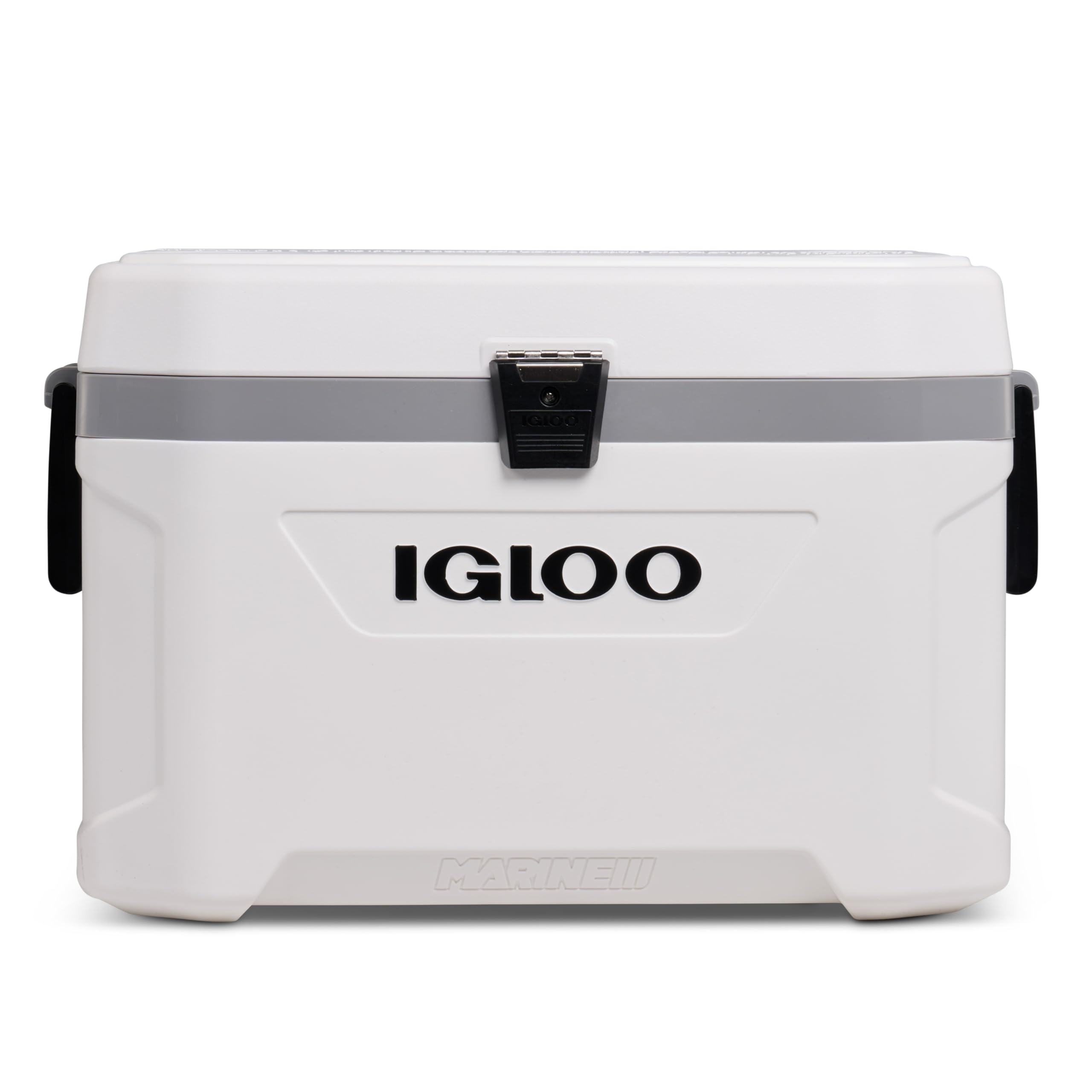
Igloo Marine 54-Quart Cooler
Key Features
- Weight: 5 lb
- Capacity: 54 quarts
- Hardware: Stainless hybrid latch
- Can capacity: 85 cans
- Price: Midrange
White plastic, a stainless hybrid latch, Riteflex hinges and UV inhibitors in the shell: this is a boat cooler that happens to be the cheapest route into serious capacity. Fifty-four quarts holds 85 cans, and it weighs 5 pounds empty, which is remarkable for a box this size.
Capacity for the money is the argument. It lands in the same price band as the small soft coolers here and holds several times as much, so for a party, a hunt camp or a week at a rental it does the work of two smaller boxes and takes up one patch of floor.
The footprint is what to check first: 26.4 inches wide and 15.5 deep, fine across a truck bed and tight on a back seat. Empty it is light; loaded with 85 cans and ice it is a two-person lift, so plan to leave it where you parked. Stock on this one comes and goes, which for a box this size is worth waiting out.
We point big-group buyers here rather than at a premium rotomolded box, because the job is volume for a weekend, not a decade of abuse. That is the trade that makes sense for a party or a camp, and it is why the Marine stays on this list at the price it sells for.
Pros
- 85 cans in a 54-quart body
- 5 lb empty despite the size
- UV-treated shell and stainless hybrid latch
Cons
- Hinge and latch hardware can fail early
- 26.4 inches wide — measure the back seat
For parties, hunt camps and rental weeks, we recommend the Marine: 85 cans, 54 quarts, and more capacity for the money than anything else here.
How We Tested the Best Coolers for the Money
We started by pulling every cooler we could find in the $40 to $300 range and comparing the claims on the box against the numbers that matter: stated ice retention, capacity in quarts, exterior footprint, empty weight, and price per quart of usable space. Anything whose price didn’t square with its capacity got cut early, which left us with 12 models spanning soft-sided bags to roto-molded hard coolers. We then bought them at retail and used them the way you would.
Each cooler was pre-chilled, packed with the same two-to-one ratio of ice to cans, and parked in a hot garage and a truck bed for up to three days. At 24, 48, and 72 hours we opened the lid and looked at how much ice was left, how cold the meltwater felt, and whether anything floating in it had soaked through its packaging. We also noted how much of the stated capacity survived once ice was in the mix — a cooler that claims 24 cans but only fits 12 with ice is a smaller cooler than it looks.
To check construction, we filled each one and tilted it toward the seams and drain plug, looking for drips on the pavement, then opened and shut the lid a few dozen times to watch what the hinges and latches did. Loaded coolers got carried up porch stairs, across grass, and over sand by whatever handle the manufacturer gave us, and we wrote down where the weight landed and whether the grip bit into our hands.
How to Choose a Cooler That’s Worth the Money
Quarts tell you the volume of the box; what separates a good value from a bad one is how much of that volume survives ice, a hot trunk and a walk from the car.
Shop in cans plus ice, not quarts
Every capacity figure is quoted as volume, but ice takes up about as much room as the drinks do. The Coleman Chiller’s 16 quarts is 11 cans with 8 pounds of ice or 25 cans without — same box, two very different trips. Work backwards from the load you actually carry, then check the interior height if you pack bottles upright. The Klein’s lid is recessed to take a liter bottle; most soft bags make you lay it down.
Ice-life claims describe a best case
Thirty hours, two days — those ratings assume a full cooler, contents already cold, the lid shut and the box out of the sun. A half-empty cooler is mostly air, and air warms fast, so fill the gaps with extra drinks, a towel or a frozen bottle. We plan a day out of a day-rated box and treat longer figures as the ceiling. If you need ice to survive a weekend, buy capacity you can fill completely rather than the biggest number on the label.
Handles, hinges and latches fail before the shell does
A bail handle carries the entire load through two plastic pivots; a telescoping tube does the same in bending; hinges and latches take a hit every time the lid closes. Lift the cooler loaded before you commit, look at how the hinge pin is held in place, and work the latch a few times. The Klein’s stainless hinge and 300-pound lid are exactly that kind of insurance, and they are most of what the extra spend buys.
Match the carry to the walk
Distance decides more than insulation does. A backpack like the SPARTER is the only sensible choice for sand, stairs or a mile of trail; a roller like the Profile II wins on pavement, parking lots and boat docks; a hard box belongs in a truck bed or a campsite where it stays put. The trap is buying wheels for a beach. Small casters dig in, and you end up carrying the cooler anyway.
Decide where the meltwater goes
A leak-resistant liner only holds water if the opening does too. Soft bags seal at the zipper, and zippers are not watertight, so sealed ice packs beat loose cubes every time. Hard boxes hold water fine but need emptying, and a drain plug saves you tipping the whole thing at the car. Whatever you buy, dry it with the lid open before it goes into storage.
Frequently Asked Questions
Can I put warm drinks or raw meat straight into a cooler?
No on both counts. Warm cans burn through ice fast, so chill drinks in the fridge the night before, and raw meat belongs in a sealed container at the bottom, below anything you plan to eat without cooking. Once perishable food has sat above 40°F for more than two hours — one hour on a hot day — throw it out. A cooler slows warming; it does not stop it.
How do I clean a cooler so it doesn’t smell?
Empty it the same day, wipe the interior with mild soap and water, and rinse thoroughly. A diluted baking soda solution handles stains and odors on hard liners, and soft liners need a full air-dry rather than a quick towel. Store it open. A closed, damp cooler is exactly where the smell comes from.
Will a big cooler fit in my car?
Measure the opening, not the floor: trunk lips and door frames are narrower than the space behind them. For scale, the Igloo Marine is 26.4 inches wide, the Coleman Chiller 15.7 and the Profile II roller 14. A 54-quart box fits across a truck bed or a wagon and rarely across a compact back seat.
Final Verdict
The Coleman Chiller is the cooler we recommend to most people. It is the least expensive hard box here, it seats an adult, and 16 quarts covers a picnic, a tailgate or a day at the lake. Spend more on the Klein if the cooler lives on a job site, or on the Igloo Marine if you are feeding a crowd — 54 quarts at roughly what the small soft bags cost is the best capacity deal in this group.