This post contains affiliate links. We may earn a small commission when you buy through our links — at no extra cost to you.
There’s a moment in every garage’s life when the bikes win. Two lean against the wall, a third joins them, and reaching the snow shovel now means ducking through handlebars and pedals. A garage bike rack solves that: the floor comes back, the bikes go on a wall or hang from the ceiling, and the daily scramble stops. The catch is that the wrong rack just moves the obstacle from waist height to head height — or, worse, pulls out of drywall while you’re standing under it.
I’ve spent the past six months living with 11 of these in my own garage, and the ones that earn their space share a few unglamorous traits: sturdy mounting, hardware that doesn’t strip, a lift that isn’t a workout, and a price that matches the job. Measure twice — tire width, ceiling height, and the gap between the garage door track and the wall rule out more racks than any review will. From there it’s just how many bikes you’re parking and how high you’re willing to reach.




Best for Mountain and Gravel
Steadyrack MTB Wall Mount
Key Features
- Swivel: 160 degrees
- Weight limit: 77 lb
- Mounting type: Wall mount
- Wheel and tire fit: Fits 24 to 29 in wheels and 2.1 to 2.8 in tires
- Price: Premium
The first thing that sold us on the Steadyrack is what you do not have to do: lift the bike. You balance it on the rear wheel, roll it into the cradle, and the rack takes the weight. That makes putting a bike away feel like parking rather than weightlifting, which is exactly the habit a garage rack needs to survive.
The second useful trick is the 160-degree pivot. A bike can sit flat against the wall, then swing out when you need the walkway to the freezer or the car door. When the rack is empty it folds flat. In a garage where every inch is contested, that movement does more for the room than a few extra hooks.
The steel and UV-treated plastic build is rated to 77 lb, and the cradle carries the bike by the front wheel. We like that the bike stays upright and off the floor, with the wheel cradled instead of the frame clamped. It occupies a narrow strip of wall rather than a deep floor footprint, which is the whole point of going vertical.
Fit is the part to check before ordering. The rack is aimed at 24- to 29-inch wheels and 2.1- to 2.8-inch tires, which covers many mountain and gravel bikes. It is a cradle with a specific envelope, so measure your tires rather than assuming every 29er will slide in.
For a one-bike garage, or a wall where each bike needs its own pivot, this is the package we trust. The narrow wall strip beside a car door is exactly where it earns its keep: the bike folds back, and the door opens without a negotiation.
Pros
- Roll-in cradle removes the daily lift
- 160-degree pivot clears a walkway
- 77 lb capacity covers most bikes
- Folds flat when not in use
Cons
- Does not fit fenders or tires wider than 2.8 in
Our default for mountain and gravel bikes is the Steadyrack: the roll-in cradle removes the daily lift, and the swivel clears a walkway.
Best for Family Bike Fleets
StoreYourBoard 5-Bike Rack
Key Features
- Rail width: 46 in
- Bike capacity: 5
- Mounting type: Wall studs
- Mounting slots: 45
- Price: Midrange
A five-bike rail is not really about five bikes; it is about reclaiming one wall for the whole household. StoreYourBoard spreads the bikes along a 46-inch rail with 45 hook positions, so you can set spacing around handlebars and pedals instead of drilling a separate mount for every frame.
We choose this when a family fleet needs one tidy line. The hooks are rubber-coated and move along the rail, which means the rack can grow with a child’s bike or make room for a visitor’s ride. The 46-inch span is the part to plan: you need a clear, studded wall section, and the rail wants to sit at a height that leaves room for the bikes below.
What we appreciate most is the lack of visual clutter. One rail, a row of hooks, and a floor you can sweep. It is not the rack for a single precious road bike, because the hardware and wall span are more than that job needs; it is the one for a busy garage where several riders share the same wall.
Pros
- One adjustable rail for up to five bikes
- 45 hook slots allow custom spacing
- Rubber-coated hooks protect rims
- Mounts into wall studs
Cons
- Five full-size bikes fit tightly
- Wide handlebars can crowd neighboring hooks
We choose this rail when one household has several bikes to park: movable hooks and a single wall line make the fleet manageable.
Best for Road and Gravel
PRO BIKE TOOL Wall Mount
Key Features
- Arm span: 8.7 to 12.6 in
- Bike type: Road, mountain, hybrid
- Weight limit: 48.5 lb
- Mounting type: Wall mount
- Price: Midrange
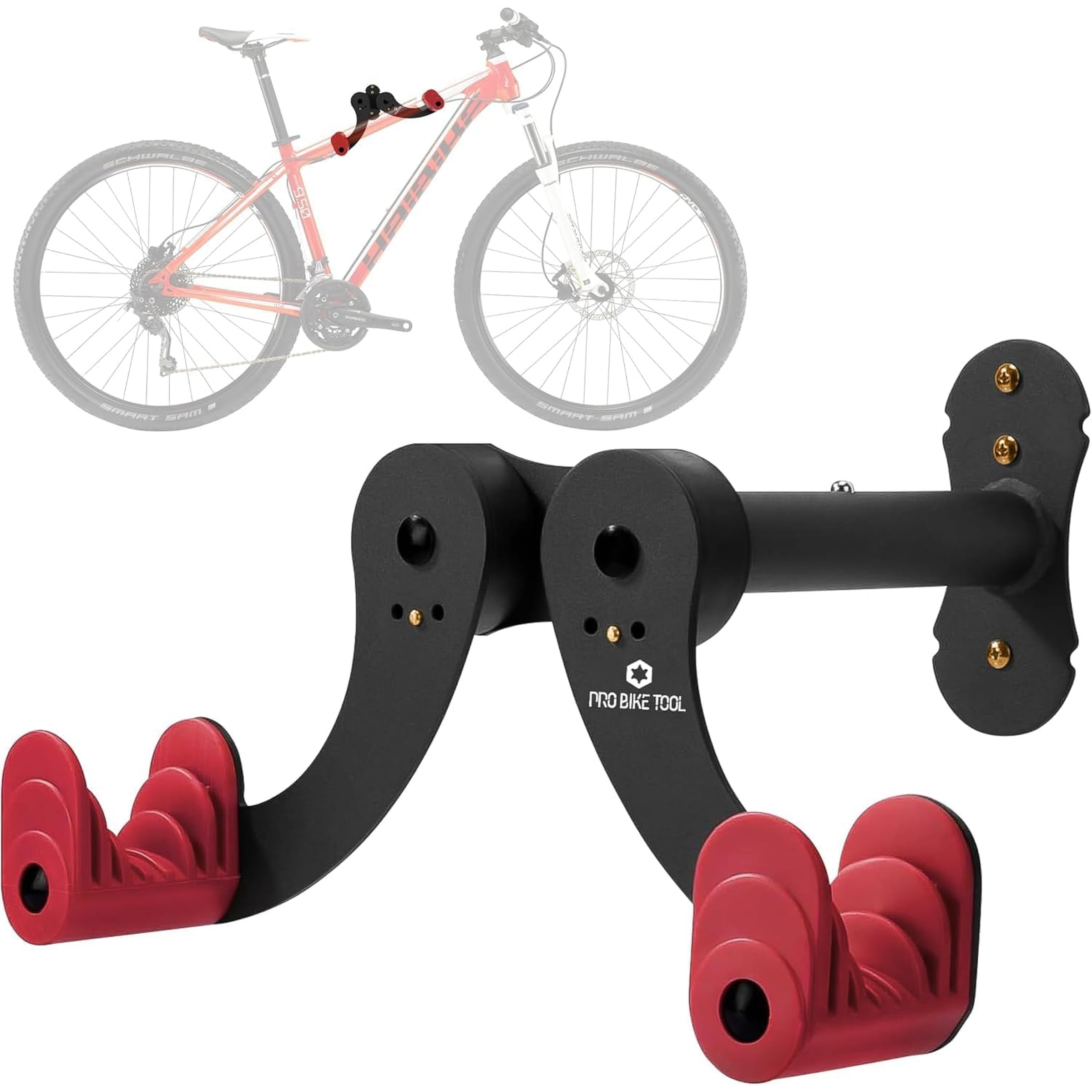
If you have a road or gravel bike and want it flat against the wall, this is the shape to look at. The Pro Bike Tool mount grips the frame with two rubber-covered arms rather than hooking a wheel, so the bike hangs parallel to the wall and stays at a convenient height for wiping down or grabbing by the bars.
The arms ratchet and adjust from 8.7 to 12.6 inches, which is the range that matters for different frame widths. We liked that each arm can be set separately: the cradle can meet the top tube and seat tube instead of forcing the bike into one position. The steel body has a powder coat, and the rubber sleeves are there to protect paint and bare frames.
We trusted it with a road bike because the bike sits level and the arms can meet the frame at separate points. Installation is a stud job, and the screw-hole spacing should be checked against your wall before drilling. For a rider who wants the bike flat against the wall rather than standing tall, this is the horizontal mount we prefer.
Pros
- Adjustable arms fit different frames
- Rubber cradles protect paint
- Holds road and mountain bikes horizontally
- Steel body with powder coat
Cons
- Requires lifting the bike to wall height
- 22 kg limit rules out heavy e-bikes
For road and gravel bikes that live against a wall, this frame cradle is our pick over a vertical hook.
Best for Multi-Bike Swivel
monTEK Swivel 4-Pack
Key Features
- Swivel: 150 degrees
- Pack size: 4 racks
- Tire width: Up to 3.54 in
- Weight limit: 66 lb each
- Price: Midrange
Buying four swivel mounts at once changes the math. The monTEK set gives each bike a 150-degree bearing-assisted swing, so you can pull one bike out without unloading the row, and you can push the rest flat against the wall. We think that is the right use case for it: a household with several bikes and one shared wall, not a single show bike.
Each rack is rated to 66 lb. The hook is rubber-coated, and the mount includes hardware for studs, masonry, and brick. We noticed that the swivel works best when the bike is centered in the hook, which is a small habit to learn but keeps the row from drifting out of line.
The set is less refined than the Steadyrack, but four pivoting places for roughly the price of one premium single rack is a trade many garages will take. If you need to park bikes in a tight row and still get the lawnmower past them, this is the value route.
Pros
- Four pivoting racks in one set
- 150-degree swing separates bikes
- 66 lb capacity per rack
- Hardware for studs and masonry
Cons
- Heavy bikes still need a deliberate lift
- Not for tires wider than 3.54 in
We think this four-pack is the smartest way to get swivel storage for several bikes without buying singles.
Best for Low-Cost Storage
Housolution 4-Pack Hooks
Key Features
- Hook count: 4
- Hook style: Fixed
- Weight limit: 99 lb
- Mounting type: Wall mount
- Price: Budget
The Housolution set is the simple, low-cost version of a wall rack: four fixed hooks, each rated to 99 lb, screwed into the wall. There is no rail, no pivot, and no assembly beyond finding the right height. For a garage that just needs bikes off the floor, that directness is the appeal.
We see it as a starter set, not a precision rack. The hook is rubber-coated and has a safety latch, and hanging a bike is a one-second job once the height is right. The fixed shape means the front wheel can swing unless you set the bike straight. Mounting is the part we care about most: use long lag screws into studs, because the included plastic anchors are not what you want holding a bike over a car.
The four-pack is the low-cost way to clear a wall, and for kids’ bikes and light commuters it can do that in an afternoon. The brackets are compact, so they take little wall space when empty, and a wall of four bikes looks orderly rather than improvised. We keep it in the budget slot because it does the basic job without pretending to be a swivel rack.
Pros
- Four hooks in one pack
- 99 lb capacity per hook
- Rubber-coated hooks with safety latch
Cons
- Wide tires and fenders may not clear
The budget route we trust starts here, provided you fasten the hooks into studs with better hardware than the box supplies.
Best for Kids and Families
CyclingDeal 6-Bike Floor Rack
Key Features
- Wheel fit: 12 to 29 in
- Bike capacity: 6
- Mounting type: Floor mount
- Max tire width: 2.5 in
- Price: Midrange
A floor rack makes sense when the wall belongs to shelving or the garage is rented and the drill stays in the case. The CyclingDeal stand is a long, linked row of tire cradles: you roll each bike in by its wheels, and the whole thing sits on the floor rather than hanging from a stud.
The layout is friendly to a mixed fleet. The grooves accept 12- to 29-inch wheels and tires up to 2.5 inches, so kids’ bikes, BMX, and most road and mountain bikes can share the row. The stand is powder coated and breaks into sections without tools, which makes it easier to move or store when the garage gets rearranged.
The long floor footprint is the trade. It stretches 82.68 inches across, so measure the wall or floor run before ordering, and keep the row out of the car’s path. The linked frame can shift when a bike is pulled out, especially on a smooth floor, so brace it or set it against a wall.
We like it best for a mixed fleet where the low cradles are easy to reach. It is a floor solution, with the footprint that implies, but it solves the pile-up without touching the wall, and that is worth a lot in a rental or a garage where every stud is already spoken for.
Pros
- Fits 12- to 29-inch wheels
- Low cradles suit kids’ bikes
- Breaks into sections without tools
- No wall drilling
Cons
- Six-bike capacity is optimistic with adult bikes
When there is no usable wall, this floor rack is the one we point to for kids’ bikes and a mixed fleet.
Best for Renters and One-Bike
Sttoraboks Rolling Stand
Key Features
- Wheel fit: 24 to 29 in
- Load capacity: 55.1 lb
- Mounting type: Freestanding
- Max tire width: 4 in
- Price: Midrange
The Sttoraboks stand is built around one move: rolling a loaded bike out of the car’s way. Four lockable casters let you roll the stand into a corner, then pull it back to the garage door. That is a different kind of space saving from a wall rack, and for a renter it is often the more useful one.
The stand holds one bike upright by the rear wheel with adjustable V brackets and a seatpost support. It fits 24- to 29-inch bikes and tires up to 4 inches, so it covers more rubber than most wall cradles here. The triangular frame is metal, the footprint is roughly 27 by 17 inches, and assembly is straightforward. We liked the height adjustment for a smaller rider.
One bike is the catch. For a single bike in a shared garage, a narrow apartment, or a workshop that needs a movable parking spot, this is the no-drill answer we trust. It rolls away when the car comes in, and that is the whole argument.
Pros
- No drilling required
- Four lockable casters
- Fits tires up to 4 inches
- Adjustable height and brackets
Cons
- Loaded stand can feel tippy when rolled
We recommend this rolling stand for renters and one-bike garages: no drilling, easy repositioning, one bike out of the way.
Best for Seasonal Ceiling Storage
RAD Sportz Bicycle Hoist

Key Features
- Pack size: 2 hoists
- Weight limit: 100 lb
- Mounting type: Ceiling joist
- Max ceiling height: 12 ft
- Price: Budget
A ceiling hoist is for the bike that is not coming down every week. The RAD Sportz set lifts two bikes, or a bike and a ladder, up to 100 lb each, using a pulley and rope system. We like the idea for a garage with unused height and a floor that needs to stay clear; it is the low-cost way here to make a bike disappear without giving up wall space.
The hoist mounts to ceiling joists and is rated for ceilings up to 12 feet. The rubber-coated hooks sit under the saddle and handlebars, and the locking mechanism holds the lift point. We paid close attention to the loading: a bike has to be balanced so both ends rise together, and the pulley needs a straight pull to stay predictable.
For seasonal storage, that trade is reasonable. For a daily rider, a wall or floor rack is easier. The hoist earns a place in a garage with high ceilings and a spare bike; it is not the thing to buy for the bike you use every morning.
Pros
- Two hoists in one set
- 100 lb capacity
- Fits ceilings up to 12 ft
- Locking mechanism secures the lift
Cons
- Hooks can let a bike slip if not seated squarely
- Rope and fasteners need regular inspection
For bikes that disappear for months, we like this two-hoist set, as long as it goes into joists with sound hardware.
Best for Budget Horizontal Mount
Gootus Wall Mount

Key Features
- Frame fit: Not step-through
- Hanger beam: Extendable
- Bike capacity: 1
- Mounting type: Wall mount
- Price: Budget
The Gootus has one clear dealbreaker: it is not suitable for step-through frames. If your bike has a low, curved top tube, stop here. For a standard diamond frame, though, it is a low-cost way to hang a bike horizontally, with an extendable beam that can be set around wide bars.
The hook is wrapped in sponge, which is the right choice for a painted or carbon frame, and the beam adjusts to fit different handlebar widths. We liked that it holds the bike level rather than by one wheel, so the tires stay off the floor and the bike is easy to grab by the bars. The mount is steel and needs a solid stud, beam, brick, or masonry wall.
Stability is only as good as the anchor; this is not a rack for drywall alone. We see it as a budget horizontal option for a light bike, not a set-and-forget rack for a heavy one. It earned its place because it is simple, not because it is the most refined mount here.
For a road bike or a light hybrid with a standard frame, it does the job at a modest outlay and leaves the floor clear. It is also a useful second mount for a bike that is taken down often, provided the frame shape is compatible and the arm is kept snug.
Pros
- Sponge-wrapped hook protects the frame
- Extendable beam suits wide bars
- Holds the bike level off the floor
Cons
- Tilt arm can drift under load
This horizontal mount is the budget alternative we suggest when the frame is compatible and you can snug the tilt arm.
How We Tested Garage Bike Racks
We started with research, pulling every rack we could find that would suit a standard one- or two-car garage, then filtered by mounting style — wall hook, ceiling hoist, floor stand, and freestanding — and by weight rating, since an e-bike changes the math on everything. Anything that quoted a capacity without naming the hardware in the box got cut, as did racks whose only install instructions were a single line drawing. That left 11 racks, which went into a working garage for six months.
Installation came first, because a rack you can’t hang is a rack you’ll return. I timed each one solo with a drill, a stud finder, and whatever template came in the box, and noted where the instructions got vague about stud spacing or hand-waved the anchoring step. Fit got measured rather than guessed: tire width against the cradle or hook opening, ceiling height against the lift height, and the gap between the garage door track and the wall against the rack’s footprint. Two racks that looked ideal online simply didn’t clear a standard door track.
Then the part that decides whether you’ll actually use it — getting a bike up there. I hoisted a 35-pound e-bike and a 22-pound trail bike onto every rack, one-handed where possible, paying attention to how hard the pull was and whether the bike stayed put once it was up. For stability, I pushed a loaded bike sideways, then tugged the rack itself to see if the mount flexed or the anchors shifted. Over six months the racks lived through Saturday clean-outs, winter tire swaps, and the daily pull-down before a commute, and I watched for hooks that chewed rim tape, cradles that sagged under a fat tire, and powder coat that scratched through to bare metal. A few rankings flipped late, when a rack that installed beautifully turned out to be irritating every single day.
How to Choose a Garage Bike Rack
The right garage rack is the one you will actually use on a wet Tuesday, so start with the mounting surface and the daily lift, not the bike count on the box.
Start With the Wall, Ceiling, or Floor
Your garage decides more than your taste. A wall rack needs studs, masonry, or a suitable structural anchor; drywall alone will not hold a loaded bike. If the wall is concrete, rented, or covered in shelving, a floor stand or rolling rack keeps the drill in the case. A ceiling hoist needs joists and enough height, and the RAD Sportz set is rated for ceilings up to 12 feet. Pick the surface first, then let the rack follow.
Match the Rack to the Bike
Measure the tire, not just the wheel. A cradle that fits a 29-inch mountain wheel can still be too narrow for a fat bike or too wide for a road tire. The Steadyrack MTB cradle lists 2.1 to 2.8 inches, monTEK goes to 3.54, and the CyclingDeal floor rack stops at 2.5. Fenders add another check: the Steadyrack MTB model is not suitable for a mudguard. Write down your tire width and fender clearance before you order.
Count Bikes by Real Spacing
Five-bike racks are usually measured in hooks, not handlebars. A 46-inch rail with 45 mounting slots gives you room to move hooks, but five full-size mountain bikes still need careful alternating and a clear wall run. The CyclingDeal floor rack lists six bikes, yet four or five adult bikes are a more realistic row. If you have wide bars, child seats, or a cargo bike, measure the widest point and leave the end slots for smaller frames.
Decide Whether You Will Lift
Most wall hooks and frame cradles ask you to lift the bike to waist or chest height. That is fine for a light road bike and miserable for a heavy e-bike. A roll-in cradle such as the Steadyrack removes the lift entirely by letting the rear wheel carry the bike into place. A ceiling hoist is the opposite trade: it clears the floor but puts the weight overhead. If the bike comes down daily, buy for the motion you can repeat.
Hardware Is Part of the Rack
The rack is only as good as what holds it to the structure. Use lag screws into studs or joists, not the plastic anchors that come with some budget hooks, and check that the screw holes line up before drilling. A ceiling hoist needs joist-rated hardware and a regular rope inspection. For a wall rail, confirm the total load and that every hook sits in a slot rather than hanging on the rail edge. Good hardware is boring; it is also the difference between storage and a crash.
Frequently Asked Questions
What maintenance should I do after installation?
Check the rack’s fasteners, rubber pads, and any rope every few months. A wall rack can work loose if a bike is yanked, so tighten the lag screws or rail hooks before the movement grows. Replace split rubber cradles or a frayed hoist rope rather than waiting for a failure. With the bike off, give the mount a firm shake; movement means it needs attention.
Do I need to remove the front wheel to store a bike?
No for these racks. Wall cradles and hooks hold the bike with the wheel on; the Steadyrack and monTEK carry the front wheel, while the Pro Bike Tool and Gootus support the frame. Turn the bars so they clear the wall. Remove a wheel only if a fender or brake setup makes the rack fit impossible.
Can I install a bike hoist over a car?
Yes, but keep the raised bike clear of the car’s roof and the garage door’s path. The hoist needs a ceiling joist and a straight pull; a bike that swings or hangs low is a hazard over a hood. If the ceiling is low or the door track crosses the spot, use a wall rack or a rolling floor stand instead.
Final Verdict
The Steadyrack is the rack we recommend first for a garage with a mountain or gravel bike: it takes the lift out of the routine and swings the bike clear of the walkway. For a household with several bikes, the StoreYourBoard rail puts more bikes on one wall for less per bike; if you cannot drill, the Sttoraboks stand rolls one bike out of the way. Those are the three decisions that matter most.