This post contains affiliate links. We may earn a small commission when you buy through our links — at no extra cost to you.
A bike stand proves itself the first time you don’t have to flip your bike upside down on the driveway to fix a rear derailleur. The trouble is that the thing holding your bike has to do two jobs that pull against each other: stay planted while you lean on a seized bottom bracket, and fold flat enough to disappear into the corner of a garage. Get the clamp wrong and you’ll be babying a carbon top tube; get the legs wrong and the whole rig walks across the floor mid-job. What you’re really buying is a steady second pair of hands, so both of yours stay on the tool.
I’ve wrenched on my own bikes for years, and my team and I have spent the past eight months living with 12 stands, from simple clamp-to-post models to full tripod rigs. The pattern that emerged surprised me: the clamp matters more than the base. A stand with a padded, quick-release clamp that grips a seatpost without crushing it will outwork a heavier stand with a fiddly one, and a stand that takes two hands and a foot to set up tends to stay folded in the garage. Below you’ll find the ones that earned their floor space.
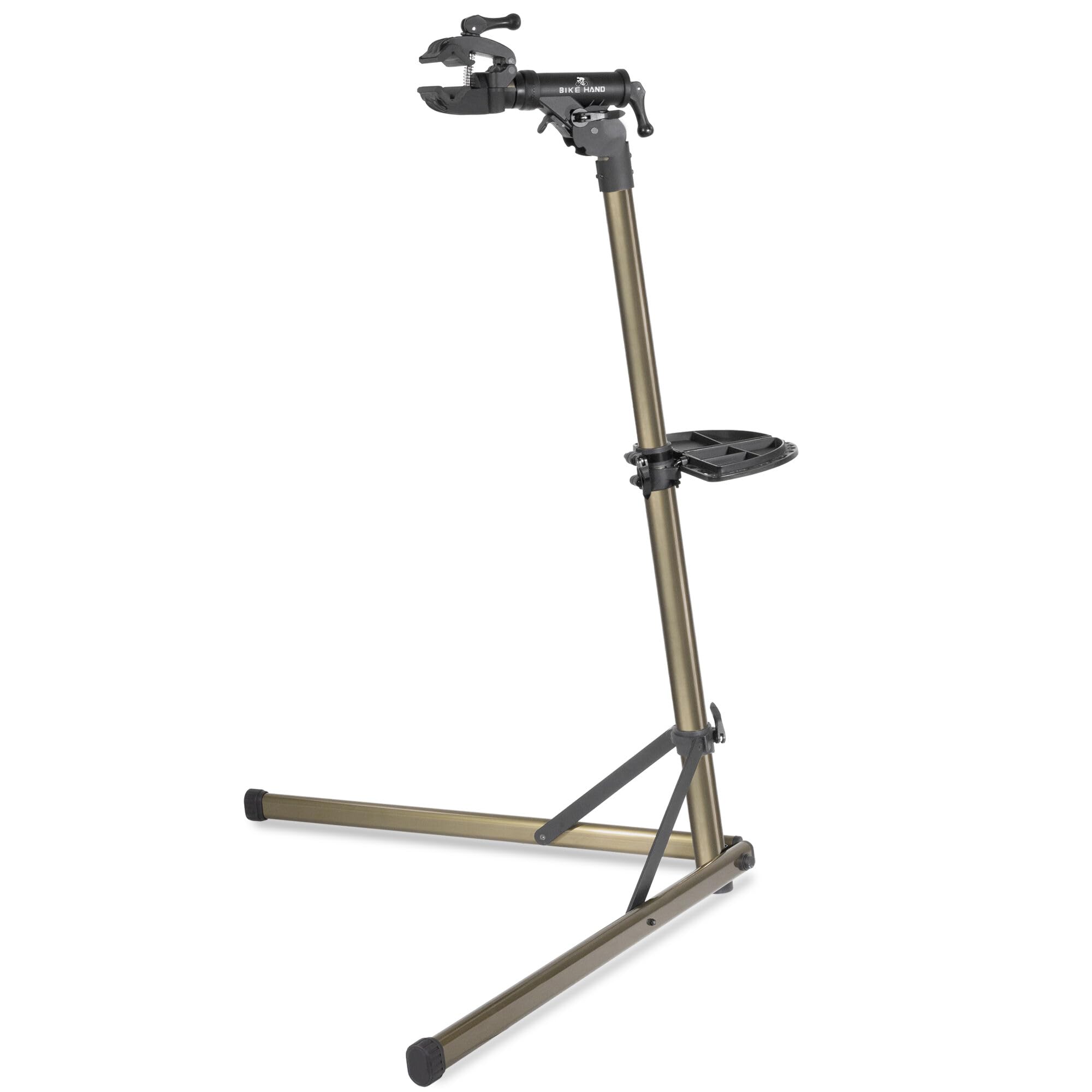


Best for Home Tune-Ups
BikeHand Repair Stand
Key Features
- Base: Folding tripod
- Height range: 39 to 59 inches
- Load capacity: 55 lb
- Clamp rotation: 360 degrees
- Price: Midrange
A folding tripod and a clamp that swings the bike toward you are the two reasons the BikeHand earns the default spot. The legs splay into a stable triangle, then fold back into a package that stores like a camera tripod. The head rotates 360 degrees, so you can spin the frame to reach the drivetrain, brakes, or bottom bracket without walking around the stand. Height runs from 39 to 59 inches, which puts most road and mountain bikes at a comfortable waist-to-chest working height.
We kept coming back to it because setup is genuinely quick: no tools, no wrestling with a loose clamp, and the magnetic tool plate gives bolts and small parts somewhere to land. The padded clamp holds the seatpost without drama, and the stand feels planted when you lean into a stubborn bottom bracket. Our reservation is the plastic head and collars, which are the parts we worry about over years of use. That is the trade-off for a stand this light and easy to move.
Where it beats the budget stands is the combination of light weight and a base that does not skitter when you push a pedal around. The tool plate is a small thing, but it keeps bolts off the floor and makes a chain swap less of a scavenger hunt. If you have a dedicated shop and a heavy e-bike, the Park Tool is the safer spend; for everything else, this is the stand we reach for first.
Pros
- Folds into a compact tripod
- 360-degree head reaches every side
- Quick, tool-free setup
- Magnetic tool plate keeps parts together
Cons
- 55-pound capacity rules out heavy e-bikes
We recommend the BikeHand as the default home workstand: it folds into a corner-friendly tripod, lifts the bike to a comfortable height, and holds steady for routine tuning.
Best for Budget Home Repairs
Yaheetech Repair Stand
Key Features
- Material: Alloy steel
- Height range: 42.5 to 74.8 inches
- Load capacity: 66 lb
- Clamp rotation: 360 degrees
- Price: Budget
The Yaheetech’s pitch is simple: a 66-pound capacity and a 42.5-to-74.8-inch height range for the least money in this group. That combination makes it our budget pick, and we mean that as a real recommendation rather than a consolation prize. The steel legs and wide base give it a planted feel, and the tall extension means taller riders can work without stooping.
The height range is the spec that matters most day to day. At 42.5 inches collapsed and 74.8 fully up, it covers a wider spread than the BikeHand, and the 360-degree swivel clip lets you turn the frame to get at the rear derailleur. The folding legs make it easy to clear out of the garage between jobs. We found the tool tray useful for keeping hex keys and a chain tool within reach, though it is not the place for a heavy parts bin.
The plastic collars are the part we trust least. They are doing real work on a stand that can hold 66 pounds, and the feel at the joints is not as reassuring as the steel legs suggest. The stand still earns its place because the core structure is sound and the price leaves room for a decent chain tool. If you are rough on equipment or plan to leave a heavy bike clamped for long stretches, the BikeHand or Park Tool is the more reassuring buy.
Pros
- Tall 42.5–74.8-inch height range
- 66-pound capacity
- Folding steel frame stores easily
- Tool tray keeps small parts close
Cons
- Rotation clamp needs firm tightening to hold
We see the Yaheetech as the budget stand to beat: it reaches taller and carries more than the BikeHand for less money, and it folds away between jobs.
Best for Heavy E-Bikes
Park Tool PCS-9.3
Key Features
- Design: Folding
- Construction: All steel
- Load capacity: 80 lb
- Price: Premium
All-steel construction and an 80-pound capacity are the reasons the Park Tool PCS-9.3 sits at the premium end of this group. The teardrop-shaped tubing and locking support yoke are built to take a heavier bike than the lighter tripods here, and the folding frame still collapses for storage. For a home mechanic with an e-bike or a long-travel mountain bike, that extra margin is the whole point.
The clamp is the part that decides whether a stand feels like a tool or a wrestling match. This one cinches tight and holds the bike at the angle you set, and the locking support yoke adds confidence when you are pushing a stubborn bottom bracket. The folding frame is a genuine convenience in a garage, even if this is not a stand you carry far.
We choose the PCS-9.3 for the rider who wants one stand for a heavy bike and does not want to think about capacity again. It is the most substantial stand here, and the steel frame gives it a planted feel that the lighter tripods do not match. The BikeHand remains the easier daily pick for a 30-pound trail bike; the Park Tool is the one for the 60-pound e-bike and the rider who wants to buy once.
Pros
- 80-pound capacity handles e-bikes
- All-steel frame feels planted
- Folds for garage storage
- Locking support yoke adds security
Cons
- Clamp action is not the smoothest
For a heavy e-bike or a rider who wants a buy-once stand, we point to the Park Tool PCS-9.3: all-steel, 80-pound rated, and folding when the work is done.
Best for Wall-Mounted Shops
ROCKBROS Wall Mount

Key Features
- Mounting: Wall or bench
- Height range: 17.13 to 21.65 inches
- Clamp opening: 2.36 inches
- Load capacity: 55 lb
- Price: Budget
The ROCKBROS is not a freestanding workstand; it is a 17.13-to-21.65-inch telescoping arm that bolts to a wall or bench and holds up to 55 pounds. Mounted at the right height, it puts the bike in front of you without taking up floor space, which is exactly what a one-car garage or a basement corner needs.
We like it for the narrow job it does: a permanent perch for chain cleaning and derailleur tweaks when floor space is the constraint. The 2.36-inch clamp with silicone padding opens wide enough for most seatposts and frame tubes, and the arm rotates 360 degrees so you can angle the bike toward the light. The catch is holding power. The arm can creep under a heavier bike, and the rotation joint needs a firm hand to stay put, so we keep this for road and hybrid bikes rather than a loaded e-bike.
Installation is the other half of the decision. You need a solid wall, bench, or vertical surface and the discipline to anchor it properly; this is not a stand you move from corner to corner. The support arm folds or removes when the job is done, which is a real advantage in a shared garage. If you have the floor space, the BikeHand is the more flexible stand and the safer default; the ROCKBROS makes sense when the wall is the only real estate you have.
Pros
- Frees up floor space
- 360-degree rotating clamp
- Fits tubes up to 2.36 inches
- Arm folds or removes for storage
Cons
- Short 17–21-inch reach limits mounting height
The ROCKBROS is the one for a wall or bench with no floor space to spare; we like its compact arm, but it is not a substitute for a full freestanding stand.
How We Tested Bike Repair Stands
We started with roughly 40 stands on the market and cut anything with an all-plastic clamp, no height adjustment, or a base narrow enough to tip. That left 12 stands spanning budget to mid-range, which we bought ourselves and used for eight months.
Every stand went through the same jobs on real bikes: a steel commuter, a carbon road frame, a 50-pound e-bike, and a kid’s 20-inch. We replaced cassettes, bled brakes, trued wheels, and swapped a bottom bracket on each one. We timed setup solo from folded to holding a bike, then pushed hard on the saddle and pulled on a pedal to see whether the legs lifted, the feet slid, or the whole stand crept across the concrete. With a bike loaded, we spun the clamp through a full rotation and checked whether the frame stayed where we put it or drifted under its own weight.
For durability, we left each stand loaded overnight, folded and unfolded it more than 30 times, and hauled a few in a trunk to a friend’s driveway. We checked clamp pads for scuffs on a carbon seatpost and marked whether quick releases slipped after a few weeks of use. The stands that survived all of that are the ones below.
How to Choose a Bike Repair Stand
The right workstand is the one that holds your bike still at the height where you actually work, with a clamp you trust and a footprint your space can live with.
Put clamp security first
A stand is only as good as its clamp. The frame and legs can be sturdy, but if the jaws slip or the rotation joint creeps, you will spend the job chasing the bike instead of fixing it. Look for a clamp that opens wide enough for your seatpost and frame tubes, with padding that grips without crushing. We would rather buy a modest stand with a predictable clamp than a heavier one that needs two hands to keep still.
Match capacity and height to the bike and the rider
A 55-pound rating is plenty for most road and trail bikes; e-bikes and cargo bikes push into the 80-pound class. Height matters just as much: a stand that tops out at 59 inches suits many riders, but a taller mechanic will appreciate the Yaheetech’s 74.8-inch reach. The wall-mounted ROCKBROS only extends 17.13 to 21.65 inches, so it depends on mounting height. Check the bike’s weight and the height you actually work at before choosing.
Stability is a floor-and-base question
A tripod spreads load over three feet; a wall mount transfers it into the structure. Neither is automatically steadier. On a smooth garage floor, rubber feet and a wide triangle matter; on a crowded bench, the anchoring matters more. We would not work on a heavy bike on a loose surface or on a mount that is only screwed into drywall. Set the stand on firm, level ground, and check the feet or anchor before you load it.
Choose folding or fixed by where the stand lives
Folding tripods earn their keep in shared garages because they disappear into a corner. The BikeHand and Park Tool both fold; the Yaheetech’s legs fold too. A fixed wall or bench mount is better if you have a dedicated bay and want the floor clear permanently. Assembly is usually a one-time job, but check whether the stand arrives ready to use or needs a hex key. The best stand is the one you can set up without clearing the car out first.
Frequently Asked Questions
Can I clamp a carbon bike frame in a repair stand?
Clamp the seatpost rather than the frame, and use only enough pressure to stop the bike moving. Carbon tubes can be crushed by an over-tightened clamp, and some bike makers specify a clamp area or advise against clamping the frame at all. Check the seatpost limit too. A padded jaw helps spread the load, but it does not make a carbon tube safe to crush.
How do I stop the bike from swinging when I pedal?
Clamp the bike near its balance point, then use a front-wheel stabilizer rod if the stand has one. Without a rod, a strap from the down tube to the stand’s upright keeps the bars from swinging while you pedal. Set the clamp so the bike hangs slightly nose-up; that puts a little weight on the rear wheel and makes the front end easier to control. If the whole stand walks, fix the floor before blaming the bike.
What maintenance does a workstand need?
Wipe the clamp pads after dirty jobs and keep the telescoping tube free of grit. Check the leg pivots, quick releases, and plastic collars for looseness or cracks before you clamp a heavy bike. A drop of light oil on the folding joints once in a while is enough; keep oil off the clamp pads because they need friction. If a collar cracks, replace it rather than tightening harder.
Final Verdict
For most home mechanics, the BikeHand is the stand we recommend first. It folds into a corner, sets up without tools, and puts the bike at a comfortable height for routine tuning. The 55-pound rating is the boundary: if you own a heavy e-bike, the Park Tool PCS-9.3 is the better buy, and the Yaheetech is the budget choice when you need more height and capacity for less. The ROCKBROS only makes sense if a wall or bench mount is the only space you have.