This post contains affiliate links. We may earn a small commission when you buy through our links — at no extra cost to you.
For years my bike repairs happened upside down on the garage floor, the bike balanced on saddle and bars, shifters one slip away from a scratched faceplate. Then a friend lent me a proper stand for an afternoon and I never went back: the pedals spun freely, the rear wheel sat at eye level, and I could actually watch what the derailleur was doing. That’s the whole promise of a repair stand — it turns a brake adjustment from guesswork into something you can see happen, and it makes a drivetrain tune take twenty minutes instead of an afternoon.
Over the past six months we’ve had 11 stands set up in the garage, on the driveway, and briefly in my bike-leaning living room, from folding tripods to heavy shop-style models, and the same lesson keeps surfacing: the clamp decides everything. A stand that shudders when you lean on a pedal, or that grips so hard you wince for your carbon seat tube, leaves you holding the bike with one hand and the wrench with the other. Foldability matters nearly as much if your workspace doubles as a parking spot. The picks below are the ones I’d happily leave set up.
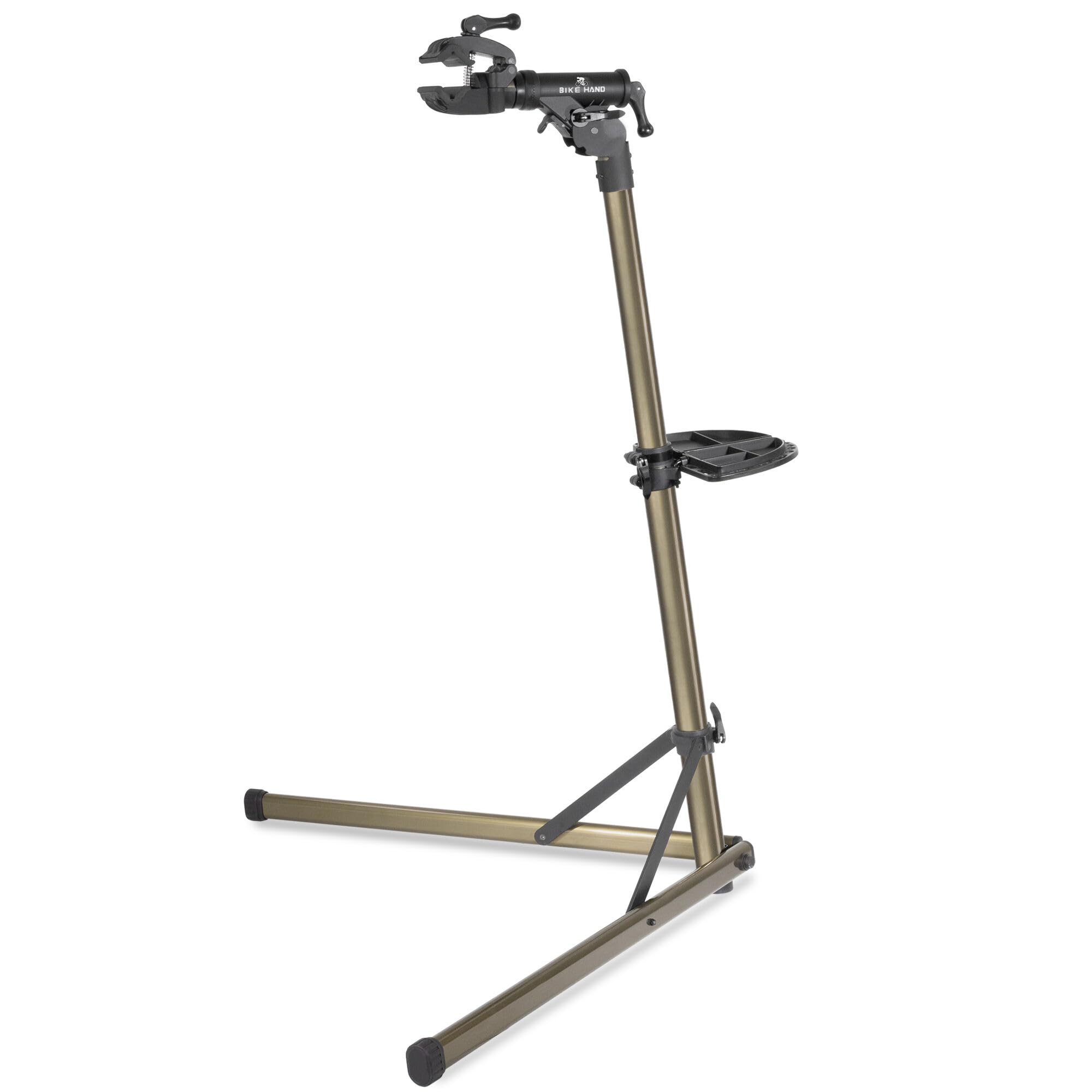


Best for Most Home Mechanics
BikeHand YC-100BH
Key Features
- Clamp: 360-degree rotating head
- Tool plate: Folding, magnetic
- Height range: 39" to 59" (1 to 1.5 m)
- Load capacity: 55 lb
- Price: Midrange
The moment a stand has to prove itself is the one where you are leaning on a bottom bracket tool with both hands and the bike decides whether it wants to stay put. On the BikeHand it stayed put. The legs splay into a wide tripod, the head rotates a full 360 degrees so you can spin the frame to reach an awkward bolt without unclamping and starting over, and the height runs from 39 to 59 inches, which put the drivetrain at chest level for us rather than somewhere near our knees.
That steadiness, at a price well below the shop-grade stands in this group, is why it is our top pick. Chain swaps, brake bleeds, derailleur tweaks — the jobs most of us actually do — happen without the bike shifting under the wrench, and 55 pounds of capacity covers a road bike, a hardtail, or a loaded commuter with room to spare. It also folds into a tripod-sized bundle you can stand in a corner, which is more than the bolted-down mounts can say.
The folding magnetic tool plate is the detail we did not expect to lean on as much as we did. Bolts, cable ends, and the small springs that escape every other repair stay where you put them instead of rolling under the workbench, and the plate lifts off when you want the surface clear.
The one boundary worth knowing is weight: at 55 pounds it stops short of most e-bikes, and a 60-pound cargo bike needs the Park Tool instead. Everything else in a normal garage sits comfortably inside the rating. What surprised us most is how little the stand asks of you before you can start working — no assembly, no tools, no ritual.
Pros
- Holds a bike steady under real torque
- Folds to tripod size for corner storage
- Magnetic tool plate keeps bolts in place
- Ready to use with no assembly
Cons
- Plastic clamp head and collars are the wear points
Our default pick: it holds a bike steady under real torque, folds into a corner, and costs far less than the shop-grade stands here — as long as your bike isn’t electric.
Best for E-Bikes, Fat Bikes
Park Tool PCS-10.3
Key Features
- Weight: 19.8 lb
- Bike fit: Fat bikes, most e-bikes
- Load capacity: 80 lb
- Price: Premium
Eighty pounds of rated capacity is the reason the PCS-10.3 exists, and it is the reason it earns a place here. Park Tool builds this stand for a wide range of bikes, fat bikes and most e-bikes included, and holding a 60-pound e-MTB steady while you pull a crank is a different job from steadying a 22-pound road bike. For that job, this is the stand we reach for.
The rest of the package is deliberate rather than clever. A triangular tripod base, a powder-coated finish, and 9 kg of stand sitting on the floor like something that expects to stay there. Setup means opening the legs and putting the bike in the clamp; there is nothing to build first.
Where it separates from the cheaper tripods is headroom. Twenty-five pounds of extra rating over our top pick sounds abstract until your bike weighs 62 pounds and you are asking a clamp to hold a number it has already passed. The rating and the weight are both published rather than implied, which is not true of every stand in this group.
The trade is portability. At 9 kg it is heavier than the Yaheetech, the Feedback Sports, and the PRS-25, so this is a stand that lives where you work rather than one that travels to a race. For a home shop with an e-bike parked in it, that is a fair exchange.
Pros
- 80-pound capacity covers fat bikes and most e-bikes
- Powder-coated tripod base plants under a heavy bike
- Stated capacity and weight, both published
Cons
- Heaviest stand here at 9 kg
If your garage holds an e-bike, a fat bike, or anything over 55 pounds, this is the stand to buy: 80 pounds of rated capacity and a base that stays put.
Best for Tight Budgets
Yaheetech YT-424
Key Features
- Clamp: 360-degree swivel
- Weight: 14.1 lb
- Height range: 42.5" to 74.8"
- Load capacity: 66 lb
- Price: Budget
The Yaheetech is the cheapest full-size stand in our picks, and its specification sheet does not apologize for it: 66 pounds of capacity, a clamp that swivels a full 360 degrees, a telescoping mast reaching 74.8 inches, and a tool tray with brackets. That is more capacity and more height than our top pick for a good deal less money.
In use, it is the stand we point at when someone wants to spend as little as possible and still work upright. The 74.8-inch maximum is the tallest reach here, which matters if you are tall or you like brake work at eye level, and the folding frame stows against a garage wall without a fight. Assembly takes minutes — the pieces pop into place and the stand is ready before you have found your hex keys.
The rest of the package earns its keep. The wide legs give a solid base even with the mast extended, the tool tray holds the tools you are actually using rather than the whole drawer, and the frame folds flat enough to lean against a wall. For a rider doing two tune-ups a year and a brake bleed when the pads wear out, it covers everything without a second thought.
Pros
- 66 pounds of capacity at the lowest price here
- Tallest working height in this group at 74.8 inches
- Tool tray keeps the tools you are using to hand
Cons
- Plastic clamp and rotation collar are the wear points
The stand we recommend when budget is the deciding factor: 66 pounds of capacity and the tallest working height here for less than any other full-size stand.
Best for Small Spaces
ROCKBROS Bench Mount
Key Features
- Weight: 3 lb
- Mount type: Bench or wall
- Clamp opening: 30 mm to 75 mm
- Load capacity: 44 lb
- Price: Budget
If your garage is also a laundry, a stroller park, and the place the holiday decorations live, a tripod stand is one more thing to move twice a year. The ROCKBROS bolts to a bench or a wall, holds the bike out in front of you at working height, and flips back against its mount when the bike goes back on the road. That is the whole appeal, and it is enough to earn a place here.
The clamp decides whether a bench mount is worth having, and this one is better than its price suggests. It opens from 30 mm to 75 mm, with soft silicone jaws that hold a seatpost or a frame tube without chewing the paint, and the arm rotates so you can present the bike from either side. Rated to 44 pounds, it covers a road bike, a hardtail, and most commuters.
What it is not is a replacement for a floor stand. A mount is only as rigid as what is behind it, so plan on framing or a plywood backer rather than drywall anchors — we noticed the difference immediately between a bare shelf and a proper backer, same stand both times. Expect a bike with a heavy front end to swing a little until you find its balance point.
For a small garage, a shed with a plywood wall, or a workbench that already has a vise bolted to it, that trade is a good one: hands-free work at a height you choose, nothing to trip over, and the cheapest way into a proper clamp.
Pros
- Frees up floor space completely
- Silicone jaws open 30 mm to 75 mm
- Cheapest stand in this group
Cons
- 44-pound rating rules out e-bikes and cargo bikes
Buy it when floor space is the problem: a solid 44-pound clamp you bolt to a bench or wall, then flip out of the way.
Best for Apartment Storage
Feedback Sports Sport-Mechanic
Key Features
- Weight: 12.6 lb
- Clamp height: 42" to 65" (107 to 166 cm)
- Clamp opening: Up to 1.9" (4.8 cm)
- Load capacity: 65 lb
Twelve and a half pounds is a number you notice when the stand has to come up a flight of stairs and the only workspace you have is a balcony. That is the Sport-Mechanic, and at 12.6 pounds it is lighter than the Yaheetech and both Park Tools, which is the difference between a folding stand and a piece of gym equipment you dread moving.
Feedback Sports builds it from alloy steel and aluminum with a rubber-coated clamp that opens to 1.9 inches — wide enough for the fattest frame tubes — and a head that rotates a full 360 degrees. Clamping height spans 42 to 65 inches on knobs rather than a quick-release lever, which is slower to set and stays where you leave it. The spinner knob that closes the jaws gives you a feel for the pressure instead of a guess.
The balance is what sells it. It is lighter and more compact than the Park Tool PCS-10.3, its clamp is a more careful piece of work than the budget tripods manage, and 65 pounds of capacity covers a loaded touring bike or a mid-weight e-bike. If the stand has to disappear into a closet between jobs, this is the one we keep.
Set against our top pick, the extra money goes on a lighter package and a more precise clamp rather than more capacity. Set against the PRS-25, you give up 35 pounds of rating and shop-grade tubing — which only matters if your bikes keep getting heavier.
Pros
- Lighter than the other full-size stands here
- Rubber-coated clamp with a pressure-feel spinner knob
- Clamp opens to 1.9 inches for fat frame tubes
- Folds small enough for a closet corner
Cons
- Bike can rotate if it is not centered in the jaws
Worth the step up if your stand has to disappear between jobs: it folds into a closet corner and the clamp is one we trust on painted frames.
Best for Travel and Events
Park Tool PRS-25
Key Features
- Weight: 13 pounds (6 kg)
- Clamp height: Up to 60 inches
- Folded length: 47 inches
- Load capacity: 100 pounds (45.4 kg)
- Price: Premium
Forty-seven inches and 13 pounds: that is what the PRS-25 folds to and weighs, and those two numbers explain the price better than any list of features. This is a stand designed to travel to races and set up on grass, not one that lives in a garage and never moves.
The construction is where the money goes. Park Tool’s hex-shaped aluminum tubing is shaped to resist flex and rotation, the clamping height adjusts to 60 inches, and the rated capacity is 100 pounds — the highest here, and enough for a downhill bike or a heavy e-MTB. Aluminum leg straps keep the parts moving together so it opens in one motion.
We think it is the right stand for a narrow but real buyer: someone who wrenches at races, runs a small repair sideline, or wants to buy one stand and never think about it again. It holds a heavy bike without the frame wandering, folds flat enough to lie in a trunk, and the micro-adjust clamp closes in small increments rather than one big squeeze.
The reservation is money, and it is a real one: this costs more than every other stand in this article, and most home mechanics will never wear out a stand that costs a fraction as much. Where the PRS-25 earns its keep is the third time in a month you load it into a car.
Pros
- 100-pound rating, the highest in this group
- 13 pounds and folds to 47 inches
- Hex aluminum tubing resists flex and rotation
- Micro-adjust clamp closes in fine increments
Cons
- Costs more than every other stand here
For racers and shop-grade home mechanics only: 100 pounds of capacity, 13 pounds of stand, and a fold that fits a trunk — at a price that reflects all three.
Best for Trailside Repairs
Handlebar Jack V3

Key Features
- Weight: 1.5 oz
- Packed size: 6.6 x 2 x 2 inches
- Ground offset: 3.7 inches
- Load capacity: 50 lb
- Price: Budget
The scenario is a rear flat four miles from the trailhead with no convenient log and no interest in laying your bike down on its derailleur. The Handlebar Jack is a pair of folding nylon props, 1.5 ounces for both, that strap to your handlebars and lift the front end 3.7 inches off the ground. It is a repair stand in the sense that it holds the bike while you work, and in no other sense.
We keep a pair in the pack for exactly that job: front wheel and tube work, brake pad swaps, anything that gets easier with the bars off the dirt. The three legs click into detents so they do not fold under load, the two jacks snap together magnetically when packed, and the pair disappears into a jersey pocket.
It is not a garage stand. There is no clamp, so the bike still has to be balanced, the props walk if the bike gets bumped, and drivetrain work at chest height is out of the question. The hook-and-loop straps are the part to watch: they hold best on a straight section of bar and can slip on a swept or tapered one.
As a second stand that lives in a pack, it earns its place here; as the only stand you own, it does not. For the money it is the cheapest way to keep a wheel off the ground when you are nowhere near a bench, and the 50-pound rating covers more than the bikes most people ride.
Pros
- 1.5 ounces for the pair, fits a jersey pocket
- Lifts the bars 3.7 inches off the ground
- Legs click into detents under load
Cons
- No clamp, so it is not a substitute for a workstand
Carry it for trailside flats, not for the garage: two 1.5-ounce props that lift the bars and save your derailleur from the dirt.
How We Tested the Best Bike Repair Stands
We started with spec sheets and owner reviews for every stand sold by the brands that turn up in bike shops and online, then cut anything with a vague weight rating, a plastic clamp head, or no way to buy a replacement part. That left 11 stands, which stayed with us for six months while we did real work on them: chain swaps, brake bleeds, bottom bracket replacements, wheel truing, and the Saturday pre-ride wash.
Sturdiness failed the way it fails at home, so that’s how we tested it. I’d clamp a bike, grab a pedal, and push down with my full weight while watching the tripod legs and joints for flex, then shove the saddle sideways mid-repair to see whether the whole stand walked across the floor. For clamping and secure attachment, the same alloy bike and the same carbon bike went into every stand, mounted by the seatpost where it was accessible and by the frame tube where it wasn’t; we noted whether the bike rotated under torque, whether the jaws scuffed the tube, and whether we could open the clamp one-handed while the other hand steadied the bike.
Ease of use came down to small motions: how many turns of a knob to raise the mast, whether the clamp head spun a full circle without the bike clouting a leg, whether the tool tray held anything heavier than a tire lever. We set up and folded each stand half a dozen times and carried them up and down a flight of stairs. Foldability drove the footprint comparisons — the gap between a stand that tucks against a wall and one that owns half the garage. On durability and value, two stands sat outside overnight for a month and we rechecked for rust and wobble, and we weighed whether the price bought a serviceable clamp and parts you can actually replace.
How to Choose a Bike Repair Stand
The stand you want is the one that holds your heaviest bike still while both your hands are busy — everything else is a detail layered on top of that.
Start with the clamp, not the capacity
The clamp is the stand. A quick-release jaw that closes in one squeeze is faster to work with; a screw knob lets you feel how hard you are gripping, which is what you want on a painted or thin-walled frame. Then check the opening range against your actual bike: the bench mounts here run from 30 mm to 75 mm, and the Feedback Sports clamp takes tubes up to 1.9 inches.
Jaw material matters more than jaw shape. Soft silicone or rubber coatings are what keep a seatpost or a frame tube from coming out scarred, and every stand here that earns a recommendation has some form of it. A bare metal jaw on a painted frame is a scratch waiting to happen.
Decide where the stand will live before anything else
Freestanding tripods go anywhere and cost you floor space; bench and wall mounts cost you none and need something solid to bolt to. If you have a workbench against framing or a plywood backer, a mount is the tidier answer and the cheapest route into a real clamp. If you rent, move the stand around, or work in a driveway, a tripod is the only sensible choice.
The trap with mounts is the surface behind them. Four screws into drywall hold the bracket and nothing else, so budget for a backer or a bolted post before you order. We noticed the difference between a bare shelf and a plywood backer immediately — same stand, two entirely different tools.
Match the rating to the heaviest bike in the house
Ratings across these picks run from 44 pounds to 100, and the gap exists for e-bikes, cargo bikes, and downhill builds. We treat the figure as a ceiling rather than a target: if your bike lands within a few pounds of it, buy the next stand up, because a bike hanging off the end of an arm puts more leverage on the base than its weight alone suggests.
A 55-pound stand is plenty for a road bike, a hardtail, and a loaded commuter, and not enough for a 60-pound e-MTB. Be honest about the heaviest thing you will ever clamp, not the bike you own today.
Height, posture, and where it goes when it is not in use
Working height varies more than most shoppers expect: 39 to 59 inches on the BikeHand, 42.5 to 74.8 on the Yaheetech, 42 to 65 on the Feedback Sports. Tall riders, and anyone who likes brake work at eye level, should lean toward the taller mast.
Then think about the other end of the day. A folded tripod fits a corner, a bench mount folds flat against the wall, and the stands built for travel fold to around 47 inches and weigh about 13 pounds. Measure the corner, the closet, or the trunk before you decide which of those you are actually buying.
Expect the plastic to be what wears out
Stands rarely fail at the tubing. The parts that go are the clamp head, the rotation collar, and the leg joints, and those are usually plastic even on stands with steel or aluminum frames. That is not a reason to avoid them — it is a reason to think about how hard you will use the stand and for how long.
A stand that sees a tune-up twice a year will last years. If you will be wrenching weekly, buy the one with the fewest plastic load-bearing parts you can afford, and store it somewhere dry rather than in a damp shed.
Frequently Asked Questions
Do I really need a repair stand for basic maintenance?
Not for fixing a flat or oiling a chain — that happens on the ground. You need one once the job takes both hands and a clear view: derailleur adjustment, brake bleeds, bottom brackets, cable replacement. A stand gets the bike to chest height and stops it moving, which is most of the difference between a chore and a quick job.
If space rather than budget is the obstacle, a bench or wall mount solves the same problem for less money and no floor space.
Why does my bike swing when I tighten a bolt?
Mass. A bike clamped by the top tube hangs with most of its weight on one side of the jaws, and the rotation lock is absorbing all of that torque. Clamp nearer the bike’s balance point, set the arm so the heavier end sits below the clamp, and snug the rotation lock before you pull on a wrench rather than after.
Can I clamp a carbon frame in a workstand?
Clamp the seatpost where the bike maker allows it, and use the soft jaws or rubber coating every stand here provides. Tighten only until the bike stops rotating, and never use the workstand clamp as a vise for a seized bottom bracket or a stuck seatpost. If the seatpost is carbon too, follow the maker’s guidance on clamping — the stand clamp does not measure force for you.
Final Verdict
Buy the BikeHand if your heaviest bike is human-powered and you want one stand that holds steady, folds into a corner, and leaves money in the tool budget. It wins because it does the ordinary jobs — chains, brakes, derailleurs — without the bike shifting under the wrench, and the magnetic tool plate turns out to matter more than it sounds.
Change one requirement and the answer changes with it. An e-bike, a cargo bike, or anything over 55 pounds moves you to the Park Tool PCS-10.3. A garage with no floor to spare moves you to the ROCKBROS bench mount, provided you have something solid to bolt it to.