This post contains affiliate links. We may earn a small commission when you buy through our links — at no extra cost to you.
The pebble that ends a run is rarely the one you see coming. Mine was a chip of granite that found its way into my left shoe on a loose descent past mile 12, and I spent the next twenty minutes stopping to shake it out while everyone else disappeared down the switchbacks. Gaiters look like a fussy accessory until you’ve had that day; what they fix is simple, closing the gap between shoe collar and ankle so dust, scree, and the odd twig stay out.
The catch is fit. A gaiter in the wrong size or tensioned wrong will bunch at the ankle, creep down over your heel, or rub you raw past mile five, and most come in sizes that assume one calf shape. My team and I have run in a dozen pairs over the past eight months, through dust, mud, and rock, and the gap between a good one and an annoying one almost never comes down to fabric. It’s attachment and tension. The picks below are the ones that stayed put, with notes on which shoes and calf sizes each one suits.


Best for All-Round Trail Running
Kahtoola RENAgaiter Low
Key Features
- Fabric: 90% stretch-woven nylon, 10% polyurethane, DWR
- Weight: 3.17 oz
- Closure: Side YKK Vislon zipper, locking slider
- Instep strap: DuraLink TPU
- Price: Premium
A low gaiter gets judged in two places: at the trailhead, crouched over a shoe with cold hands, and ten miles in, when a worn strap starts slapping your heel. The Kahtoola RENAgaiter holds up at both. Its side zipper opens the whole gaiter with a locking slider, so a partial unzip is enough to get a shoe on or off, and the drawcord at the top sets the seal with one pull.
The underfoot strap is where most low gaiters give up. Thin elastic stretches, frays, and pulls out of its buckle, and you spend the rest of the run tucking it back in. Kahtoola uses a solid TPU DuraLink strap instead, and adjusting it is a set-and-forget job rather than a running repair. We paid close attention to that detail because it decides how often the gaiters actually come out of the pack.
The fabric is 90% stretch-woven nylon with 10% polyurethane and a DWR finish, which is the right answer for wet grass, cold dew and light rain: water beads and rolls instead of soaking through, and it stays breathable over a thin summer sock. The listed weight is 0.09 kg, light enough that we stopped noticing them and started noticing the mornings we left them in the car.
What it is not is a boot gaiter. It sits low over the laces and closes around the ankle, and it will not stretch over a chunky mid-cut hiking boot — that is a different product, and if you split your time between running shoes and boots, buy two pairs. Rinse the zipper after muddy days; grit in the teeth is what ends a zip’s life early.
Pros
- Side zipper gets shoes on and off fast
- TPU instep strap holds its adjustment
- DWR fabric sheds wet grass and dew
- Low, unobtrusive cut for trail shoes
Cons
- Priciest gaiter in this set
For most trail runners this is the pair we hand over: a locking side zipper, a TPU instep strap that holds its setting, and a DWR finish for wet grass.
Best for Budget Trail Runs
OrrinSports Trail Gaiters
Key Features
- Fabric: Nylon and spandex
- Weight: 2.12 oz
- Attachment: Four-point fixed system, front hook
- Bottom band: Hypalon rubber
- Price: Midrange
If the Kahtoola’s price is what is standing between you and a pair of gaiters, start here. OrrinSports does the same job with a different attachment: the Hypalon rubber band under the shoe is fixed to the gaiter, so there is no strap end to feed back through a buckle every time you pull them on. Hook the front to the laces, cinch the top, and go.
That simplicity is why these are our value pick. Sand, gravel and thorn heads stay on the outside on desert runs and gravel hikes, and the stretch nylon has enough give to sit over a mid-height hiking boot when the run turns into a walk back. The four-point hold keeps everything seated, and there is nothing hanging loose to catch on brush.
The thing to know before ordering is that this is a pull-on fit. Over a high-volume shoe or a thick winter sock it is a wrestle, and if you sit between two sizes, go up rather than down. Over a standard trail shoe they go on in a couple of seconds, which is the entire point of a low gaiter.
Pros
- Fixed under-shoe band needs no re-threading
- Keeps sand, gravel and thorns out
- Fits over a mid-height hiking boot
- Strong value for the protection
Cons
- Underfoot rubber band wears through on rock
Our value pick: a fixed under-shoe band that needs no re-threading, stretch that clears a low hiking boot, and debris protection that holds up.
Best for Mud and Obstacles
Salomon Trail Gaiters Low
Key Features
- Weight: 4.1 oz
- Dimensions: 9 x 7 x 1 inches
- Ankle closure: Velcro strap
- Price: Midrange
Mud is the test that separates low gaiters, and the Salomon Trail Gaiters Low are the pair we reach for when the course is going to be wet. Coverage over the lace area is the most convincing in this set — rocks, gravel, sand, mud and snow all stay out — and the low cut sits under the ankle bone, so there is nothing flapping when you pick through roots.
The closure is a Velcro strap around the ankle, which adjusts over a thin sock or a thick one and leaves the laces reachable if you need to retie mid-run. At a listed 4.1 ounces they are the heaviest pair here, which is a pack weight rather than a foot weight, but it is the reason we leave them home on fast, dry days.
Where they earn their place is a specific job: mud, obstacle races and wet winter trails, where coverage matters more than grams. For that, they are still the shape we trust most here. Wear them through a season of wet weekends and the wide lace coverage is what you notice; the weight only registers when you are packing.
Pros
- Keeps mud, gravel and snow out of shoes
- Proven choice for mud runs and obstacle races
- Low cut clears the ankle bone
Cons
- Sizing runs big; order a size down
- Ankle Velcro can work loose mid-run
If your trails mean mud and river crossings, this is the coverage we trust most: the most convincing lace-area protection in this set.
Best for Packing Light
Frelaxy Ultralight Trail Gaiters
Key Features
- Fabric: Stretch Lycra, rubber sole strap
- Weight: 2.29 oz
- Included: Storage pouch
- Attachment: Four-point hold: drawstring, front hook, bottom strap, rear belt
- Price: Budget
At 2.29 ounces, the Frelaxy pair is the one that goes into the pack even when the forecast is dry. It rolls into the storage pouch it ships with, small enough for a vest pocket, and the four-point hold is more thought than the weight suggests: a drawstring at the top, a hook at the front of the laces, a strap under the sole and an anti-slip belt at the back.
On the trail it does the simple job properly. Pebbles and small stones stay out of the shoe, the stretch Lycra keeps the ankle cool on a hot climb, and there is nothing stiff to rub. The rubber sole strap is the piece doing the hard work, so rinse it and check it after rocky days. For dry summer trails, travel and fastpacking, this is our pick: a lot of protection for very little weight.
Pros
- 2.29 ounces, easy to forget on the foot
- Four-point hold keeps it seated
- Packs into its own stuff sack
- Keeps pebbles out on trail runs
Cons
The pair that disappears into a vest pocket: 2.29 ounces, a four-point hold, and enough protection for dry summer trails.
Best for Evening Runs
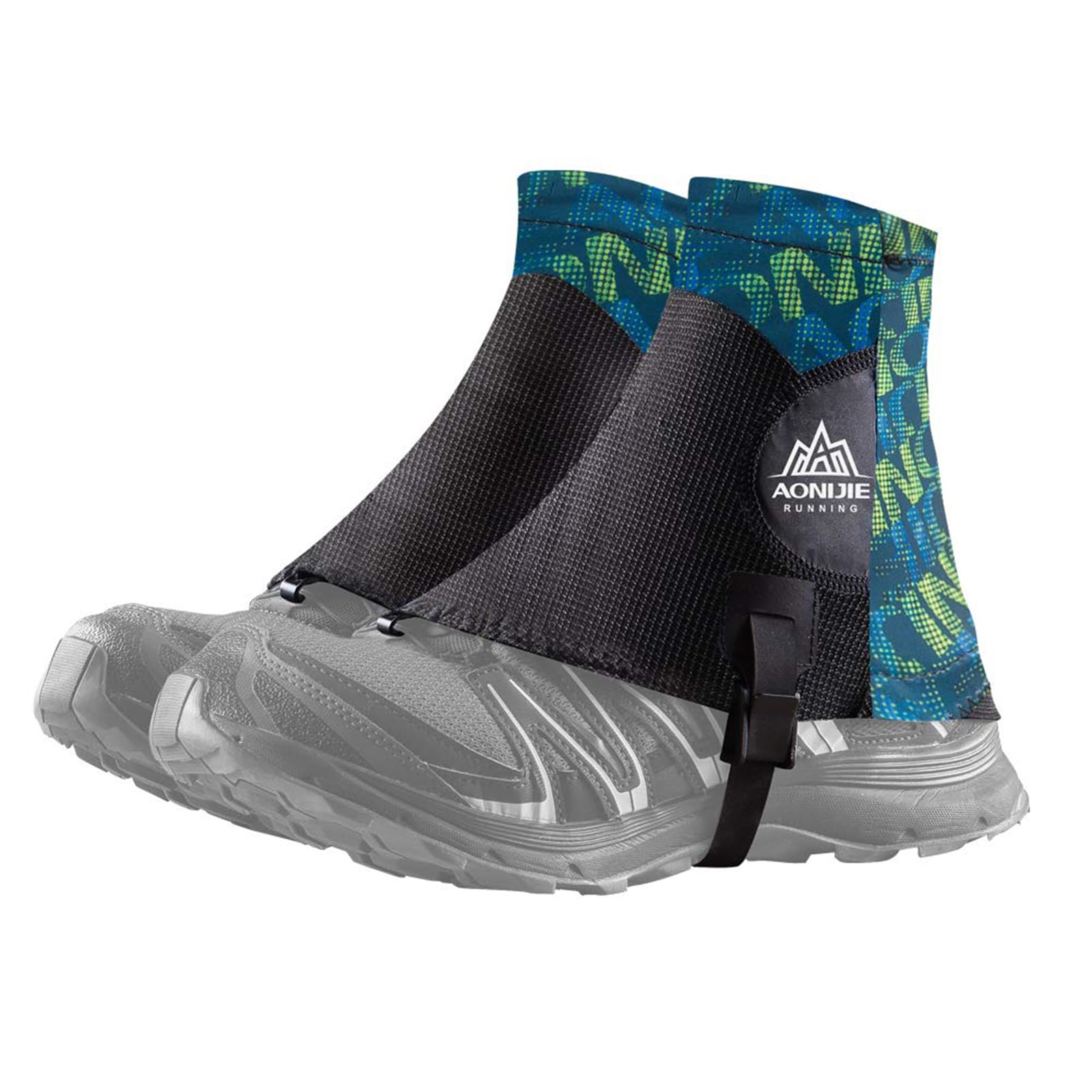
AONIJIE Trail Gaiters
Key Features
- Size: Free size
- Fabric: Nylon
- Weight: 2.4 oz
- Visibility: Reflective
- Price: Budget
Reflective thread at ankle height is a small thing that changes a run: on an evening or winter outing, the AONIJIE pair catches headlights exactly where a driver looks last. That is the detail we like most, and it sits on a gaiter that otherwise does the standard job — sand, gravel and pine needles stay out, and the stretch fabric pulls over a shoe without a fight. For a first pair, or a spare set to keep by the door, it is the one we point to.
Setting the top is a two-second job: pull the drawstring over the cuff of your sock rather than against bare skin and the elastic does the rest. They pack down to about the size of a fist, which is the other reason to keep a pair in the car, and they make a sensible experiment if you are not yet sure gaiters are for you.
Pros
- Reflective fabric for low-light runs
- Stretch fabric pulls over the shoe
- Keeps sand and gravel out
Cons
- One free size, so fit depends on the drawstring
One of the cheapest pairs here, and our pick for evening runs: reflective at ankle height, stretchy over the shoe, and easy to live with.
Best for Altra Shoe Owners
ALTRA Trail Gaiter

Key Features
- Sizes: S/M
- Shoe fit: Altra models with heel patch
- Attachment: Heel Velcro patch, front lace hook
- Price: Midrange
Altra owners get something no other gaiter here offers: a gaiter made for the Velcro patch on the back of the shoe. The rear anchors to that patch, the front hooks to the laces, and there is no underfoot strap to wear through or re-thread when you stop. It is the fastest attachment in this article by a distance.
It also has to be said that this is a one-brand product. Without that heel patch there is nothing to anchor to, and an unanchored low gaiter works its way up over the ankle instead of sitting still. If you run in Lone Peaks or Olympus, that is a non-issue; if you do not, it is disqualifying.
Fit is the second thing to know: the cut is generous, and on a slim ankle the top can sit loose enough to gape, so sizing down is often right. What convinced us is how completely the gaiter disappears into the shoe — you put it on once at the trailhead and stop thinking about it, which is rarely true of a gaiter with a buckle under the sole.
Pros
- Anchors to Altra’s heel patch in seconds
- Keeps rocks and mud out over long days
- Light enough to forget you are wearing it
Cons
- Fabric tears where it rubs the ankle
If you run in Altras, this is the fastest attachment we have found here — heel patch, lace hook, no under-shoe strap; on other shoes it has nothing to hold on to.
Best for Topo Shoe Owners
Topo Performance Trail Gaiter

Key Features
- Size: Large-X-Large
- Fabric: Lightweight stretch nylon
- Weight: 2.08 oz
- Attachment: Three hooks, no under-shoe strap
- Price: Midrange
The Topo Performance Gaiter solves the weakest part of every other gaiter here by deleting it. There is no strap under the shoe: three hooks grab the attachment points Topo builds into the heel of its shoes, and the laces stay reachable for adjustments mid-run.
On the right shoe it is the neatest system in the article. Nothing rubs under the sole, nothing wears through on rock, and there is no strap to thread with cold fingers at the start of a winter run. The gaiter becomes part of the shoe rather than an accessory strapped to it.
Sizing is the trap. The chart runs small — a women’s 10.5 lands in the S/M range on paper and does not fit it, and a men’s 12.5 runs past the top of L/XL — so order up if you are anywhere near a boundary, and check the chart against the shoe you run in rather than your street size.
At 0.9 ounces per gaiter it is also the lightest attachment here, and it is machine washable, which counts after a muddy spring. Our view is simple: for Topo wearers this is the gaiter to get, and for everyone else it is not an option worth working around.
Pros
- Three-hook system, no under-shoe strap
- Laces stay reachable mid-run
- Keeps sand and rocks out on long trips
Cons
- Only fits Topo shoes with rear attachment points
Our pick for Topo wearers: three hooks, no under-shoe strap, and nothing under the sole to wear out.
Best for Hiking and Walking
Azarxis Trail Gaiters

Key Features
- Care: Hand wash only
- Fabric: Nylon Lycra
- Bottom strap: Hypalon rubber
- Price: Budget
The Azarxis gaiters are the soft ones. Nylon Lycra with plenty of stretch, no stiff panel over the ankle bone, and a top that cinches down without leaving a mark — if you run in shorts and hate the feel of a seam against your leg, that counts for more than any specification.
They keep debris out, too. Sand, gravel, twigs and the fox tails that end up in socks stay on the outside, through gravel roads, desert and forest, and they do it without the boxy feel of a heavier gaiter.
The attachment is where the character shows. A Hypalon rubber belt runs under the shoe with a buckle, and it is short enough that threading it under a thick sole takes patience — not a job to start with cold hands at a trailhead. Thread it once at home with the shoes off and leave it threaded; the gaiter wraps the lace area on its own, so the belt is backup rather than the thing holding it up.
Where they fit best is hiking and fast walking, where a couple of minutes of setup disappear into the day. They are hand wash only, so mud means a bucket rather than the machine, and near the bottom of this list’s price range they are an easy way to find out whether gaiters suit your trails.
Pros
- Soft stretch fabric against bare ankles
- Keeps sand, gravel and twigs out
Cons
- Underfoot rubber belt wears through on rock
A soft, comfortable gaiter that keeps the grit out, and our choice for hikers and fast walkers shopping near the bottom of the price range.
How We Chose and Tested a Dozen Pairs of Trail Gaiters
We started by pulling every trail-specific gaiter we could find and sorting them by attachment style: under-shoe hook-and-loop, velcro straps around the ankle, and lace hooks. Anything that came in only one size, or couldn’t be matched to a mid-calf trail shoe, got cut. That left a dozen pairs, which we’ve been running in for eight months across weekly long runs, midweek hill repeats, and two races.
Every pair went out on the same dry, decomposed-granite fire road first, because fine dust is the hardest thing to keep out. Afterward we emptied each shoe onto a tray and looked at how much grit had made it past the collar, which told us more about debris protection than any spec sheet. Fit got checked at the trailhead, standing, in a hurry, with cold hands: we timed how long each pair took to get on and off without sitting down, then compared the size chart against the calf circumference we’d actually measured. Muddy spring singletrack handled stability, with steep descents, high knees through brush, and a deliberate look at whether the gaiter had crept up the calf or slipped off the heel by the bottom.
Durability came out of repetition, the same pairs over abrasive rock, through brush, and through repeated washes, watching the stitching at the hook points and whether the straps stretched out or lost their grip. We also weighed what each pair cost against how many of our shoes it actually fit, since a gaiter that works with exactly one shoe is a poor bargain no matter how well it performs. The pairs that held up were the ones that stayed tensioned, not the ones with the most fabric.
How to Choose Trail Running Gaiters
The gaiter that works is the one that anchors to the shoe you actually run in, so start at the heel and work forward.
Start With the Back of Your Shoe
Every low gaiter here hooks its front to your laces. What differs is the heel: some run a strap under the sole, some use a cord, and two picks rely on a system built into a specific shoe — Altra’s heel patch and Topo’s three rear hooks. Those are the fastest to put on and the least universal. Look at the back of your running shoe before you order anything. No patch or hook there means you want an under-shoe strap, and the brand-specific designs drop off your list entirely.
Sizing deserves the same attention. Charts in this category run both small and large, so order by the shoe you run in, with your running socks on, and go up rather than down when you sit between two sizes.
The Under-Shoe Strap Is the Part That Fails
Almost every low gaiter is held down by a strap under the sole, and that strap sees more abrasion in a mile than the rest of the gaiter sees in a season. Thin elastic stretches and frays; rubber and TPU last longer but still meet rock. Two designs reduce the risk. A fixed band, as on the OrrinSports pair, removes threading and buckles entirely, while an adjustable TPU strap like the Kahtoola’s lets you set tension once and leave it.
Check the strap after rocky days, and retire the pair when it starts separating from the body rather than waiting for it to go mid-run.
Getting Them On and Off
The gaiter you wear is the one that goes on quickly, and that comes down to the trailhead. A side zipper is the fastest: open the side, slide the shoe in, zip up, and the gaiter stays seated. Hooks and pull-on designs are slower, especially over a thick sole. Leave the underfoot strap threaded once you have set its length, so putting them on becomes a two-second job instead of a crouch and a fiddle. Practice at home before a race morning, because the pair that takes a minute per foot tends to stay in the car.
Coverage, Weight and Wet Weather
A low gaiter covers your laces and the opening of the shoe. It does not cover your heel, your ankle bone, or the top of a mid-cut boot, and cinching harder will not change that. If your runs mean wet grass, look for a water-resistant DWR finish — the Kahtoola fabric beads water instead of soaking it — but do not expect a low gaiter to keep a soaking run dry. It handles splash and dew, not puddles.
Weight in this set runs from 0.9 ounces per gaiter to a listed 4.1 ounces, and the difference is mostly strap hardware and fabric thickness. On dry, fast runs, take the lightest pair that stays put.
Frequently Asked Questions
Do I actually need gaiters for trail running?
If you finish a run with grit between your toes or seed heads in your socks, yes — that is the problem a low gaiter solves. If your usual route is smooth singletrack, road or mown grass, you gain very little.
Run your normal loop once and count how often you stop to shake out a shoe. More than once and a gaiter earns its place in your kit.
How do I keep a gaiter from sliding down my ankle?
Seat the heel anchor first, then set the top drawcord over the cuff of your sock rather than against bare skin — the sock gives the cord something to grip. Tighten with two fingers, not a fist; over-cinching pulls the gaiter up and away from the shoe.
If it still slips, the gaiter is probably too big or the heel anchor has loosened. Fix the anchor before you blame the size.
How should I wash trail gaiters?
Hand wash in cool water with a little detergent and hang them to dry. That is what hand-wash-only models such as the Azarxis pair expect, and it is kinder to elastic and to any DWR finish.
Machine washing is fine only when the maker lists it — the Topo pair is machine washable. Skip the dryer either way; heat is what kills stretch fabric and water repellency.
Final Verdict
The pair we recommend first is the Kahtoola RENAgaiter Low. The deciding advantage is the side zipper: you get a shoe on and off without undoing anything, and the TPU strap under the sole holds the tension you set, which is where cheaper gaiters give up.
When price is the constraint, the OrrinSports pair removes the under-shoe threading altogether and still keeps the grit out. When the season is mud, the Salomon’s lace-area coverage is the most convincing here.