This post contains affiliate links. We may earn a small commission when you buy through our links — at no extra cost to you.
A good pair of gaiters is cheap insurance for your socks, your boots, and your mood. They keep mud, snow, sand, and trail grit out of your footwear, but the wrong pair can bunch, slip, or trap sweat until you resent every step. I’ve watched a flimsy closure fail halfway up a snowy approach, and I’ve worn a pair so stiff it rubbed my calves raw. The right gaiters disappear on your legs: they seal out water and snow, stay put through brush and scree, and don’t make you fight the zipper when your hands are cold.
Over eight months, we tested 12 pairs of backpacking gaiters across muddy trails, late-season snow, dusty desert sections, and off-trail brush. We compared quality and value, paid close attention to fit and sizing, and noted whether each closure and zipper held up after repeated use. One thing I’ve learned: fit and closure matter more than a fancy fabric name—if the top won’t stay cinched or the zipper jams, water resistance is academic. The picks below are the ones that kept our socks dry and our tempers intact.



Best for Backpacking, Full-Length
Frelaxy Leg Gaiters
Key Features
- Size: Medium
- Fabric: 900D Oxford
- Weight: 7.68 oz
- Coverage: Full lower leg
- Price: Midrange
Gaiters fail at the fit before they fail anywhere else, and this is the pair that takes that risk off you. Frelaxy builds four sizes instead of the usual one or two, and backs the choice with a free size exchange that doesn’t require mailing the first pair back — the single most practical thing we found in this category. Order wrong and you lose a week, not a gaiter.
The gaiter itself is a full-length 900D coated Oxford shell that runs from below the knee to the boot, with a wide hook-and-loop front panel, elastic sections and drawcords at the top. Mud, wet snow and trail grit stay on the outside of your pants, which is the whole job on a three-season backpacking route. At 7.68 ounces it isn’t the lightest thing here, and we’re at peace with that: coverage and a shell that shrugs off brush matter more on a loaded trip than a couple of ounces in the pack.
Getting them on is the part we appreciate most. The front opens flat, so you wrap it around a booted foot and close it rather than threading your foot through a tube — quick with gloves on, in the dark, at a cold camp. The instep strap is a three-layer rubber band with metal buckles, which is the right place to spend money; that strap grinds against tread and rock all day, and thin plastic is what gives out first.
Where this one stops is the fast-and-light end. If your summer trips are trail shoes, shorts and long miles, a two-ounce low gaiter does the job with less fabric flapping around your calves. For everything else — wet snow, boggy ground, scratchy regrowth — the extra coverage is the whole point.
Pros
- Four sizes plus a free size exchange
- Open-flat hook-and-loop front goes on fast
- Three-layer rubber instep strap with metal buckles
- 900D Oxford handles brush and wet snow
Cons
- Buckles and top bungee are the wear points
Four sizes, a free size exchange and the fastest on-off of the full-length pairs here make this the one we hand most backpackers.
Best for Rugged Brush Trips
Unigear Leg Gaiters
Key Features
- Size: Medium
- Fabric: 1000D nylon
- Weight: 9.52 oz
- Closure: Buckle and hook-and-loop
- Price: Budget
Thousand-denier nylon is the heaviest shell in this group, and it changes what the gaiter is for. Where the 600D pairs here are built to keep mud and seeds off your pants, this one is built to be pushed through things: blackberry, deadfall, sharp scree, the kind of brush that files holes in soft fabric. The upper is a lighter Taslon panel that lets sweat vapor out, with the heavy nylon doing the work around the ankle and shin.
We reach for this pair when the route is overgrown rather than snowy. It’s the one here we trust against thorns, and it costs less than the premium pairs without asking you to baby the shell. What it asks in return is patience with sizing: the calf runs small, and the gap between the size the chart suggests and a comfortable fit over pants is real. Measure at the widest point and go up rather than trusting the label.
Everything else is conventional and sound. A buckle-adjusted top strap cinches the cuff, a lace hook anchors the front to your boot, and a reinforced hook-and-loop panel runs the length of the shin over an ankle-curve cut. Set both straps at home rather than on a windy ridge, and check the front seam where the panel meets the shell before your first trip — that’s the join to know about.
Pros
- 1000D shell handles thorns and scree
- Breathable Taslon upper panel
- Lace hook and buckle keep the cuff anchored
Cons
- Calf sizing runs small; size up
- Hook-and-loop can lift from the shell stitching
We point backpackers here when the route is thorns and scree rather than snow, with one condition: measure your calf and size up.
Best for Budget Backpacking
TRIWONDER Leg Gaiters
Key Features
- Size: Small
- Fabric: 600D Oxford
- Weight: 4.59 oz
- Waterproof rating: 6000 mm
- Price: Budget
A stated 6,000 mm waterproof coating at the bottom of this group’s price range is the headline, and it’s a real number rather than an adjective: it describes how much water pressure the coating holds before it leaks. The fabric underneath is 600D Oxford — mid-weight, tear-resistant, and light enough that the pair folds into a pack pocket at 0.13 kg.
The cut is a three-point system: a drawstring around the calf, a TPU strap under the instep, and a metal lace hook at the front to stop the whole thing sliding up your shin. A 3D ergonomic cut follows the ankle and boot, which closes off the gaps where grit gets in. The pair we looked at is the small, so the chart is worth a careful read rather than a glance.
For a first pair, a loaner, or a trip where the pack-weight budget is already blown, this is the sensible buy: snow and mud stay out, it packs down small, and the money has gone into the coating rather than the trim. It’s also the pair we hand to someone who isn’t sure gaiters are worth the fuss. If you hike a handful of muddy trips a year, it does everything the expensive pairs do above the ankle.
Pros
- Stated 6000 mm waterproof coating
- Folds small and packs light
- Snow and mud stay out on real trips
Cons
- Small sizing runs tight over pants
- Thinnest instep strap in this group
We send budget-minded backpackers here: a full-length gaiter with a stated waterproof coating for less than anything else in this group.
Best for Wet, Brushy Trips
Kenetrek Hunting Gaiter
Key Features
- Size: Large
- Closure: Hook-and-loop with cinch cord
- Membrane: Stormblocker
- Instep strap: Hypalon rubber
- Price: Premium
The most expensive pair here is also the loudest, and that tells you what it was built for. Kenetrek makes this gaiter for hunters: the fabric has a crinkle that carries in still air, and if you stalk close to game that matters. For backpacking the noise is the least interesting thing about it — the construction is what justifies the money.
Under the nylon sits a Stormblocker membrane, a different proposition from the coated fabrics most gaiters use. A coating keeps out snow and splashes; a membrane is there for sustained wet — slushy snow all day, rain that doesn’t stop, brush that soaks your legs every few hundred meters. That’s the trip type this pair exists for, and it’s why the fabric feels heavier in the hand than the budget shells.
The rest is built the same way: Hypalon rubber instep straps, a fitted front opening with hook-and-loop, and an adjustable top cinch cord. Hypalon is the material the better low gaiters here use under the sole, and it’s the reason this pair doesn’t chew through straps the way plastic ones do. Made in the USA or imported, in a loden color that reads quiet in the brush.
Cold, wet, brushy backpacking is the case for it, and on those trips the membrane and the Hypalon straps are the two things that justify the premium over a coated Oxford gaiter — neither is a marketing claim you have to take on faith, because both are visible the moment you pick it up. For summer dust and seeds, it’s more gaiter than the job needs.
Pros
- Stormblocker membrane for sustained wet
- Hypalon rubber instep straps
- Adjustable cinch holds the calf
Cons
- Crinkly fabric carries in still air
- Snug cut over big calves and bulky boots
For cold, wet, brushy backpacking where one pair has to last, we think the membrane and Hypalon straps justify the premium.
Best for Trail Shoes, Fast
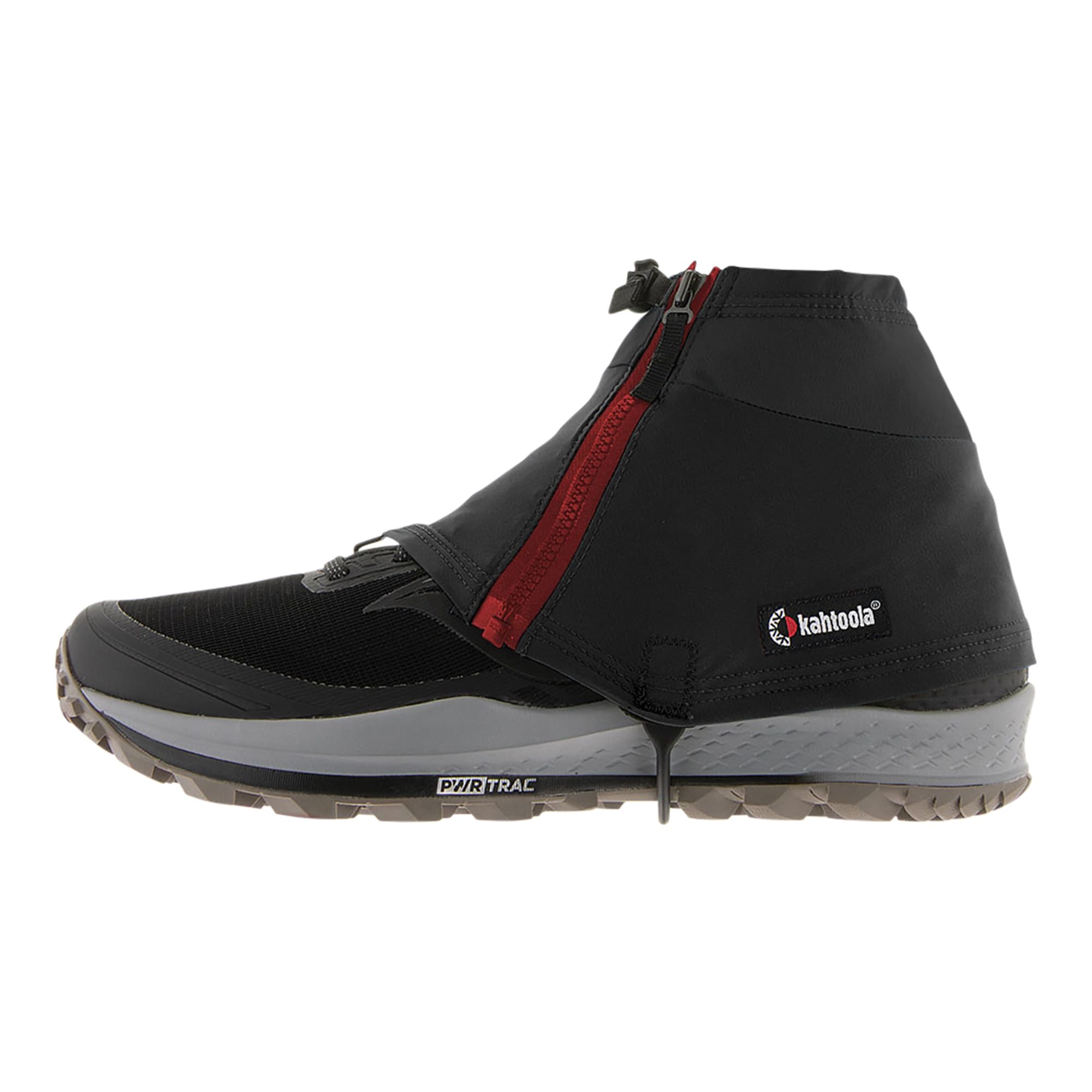
Kahtoola INSTAgaiter Low
Key Features
- Size: Small|Medium
- Entry: Asymmetrical YKK zipper
- Material: Stretch-woven nylon, DWR
- Instep strap: DuraLink rubber
- Price: Premium
A zipper instead of hook-and-loop is the whole idea here, and it’s the reason we keep coming back to these for trail shoes. The asymmetrical YKK Vislon zip runs up the outside of the ankle, so there’s no stiff panel pressing on the front of your foot and nothing for mud, pine needles and seed heads to weld themselves to. Pull it up and the gaiter is closed.
The fabric is an 84/16 stretch-woven nylon and polyurethane blend with a DWR finish — light, abrasion-resistant, and it moves with the ankle instead of fighting it. Underneath, the DuraLink instep strap has symmetrical pull tabs and a rounded profile that sits between the tread blocks rather than across them, which is what stops the familiar under-sole rub. A stretch band at the top adjusts without digging in.
The zip is the part to look after. A zipper under tension is fiddly to close, and it’s the first thing to fail if grit works into the teeth; rinse them after a muddy trip and they last far longer. Given the price, that bit of maintenance is part of the deal rather than an optional extra.
Pros
- Zipper entry beats muddy hook-and-loop
- Stretch fabric moves with the ankle
- DuraLink strap resists under-sole rub
Cons
- Low cut leaves the boot cuff exposed in snow
We choose these for trail shoes and fast, dusty miles; if your trips mean snow over the boot cuff, you need a full-length pair instead.
Best for Budget Trail Shoes
OrrinSports Trail Gaiters
Key Features
- Size: Medium
- Weight: 2.12 oz
- Closure: Hook-and-loop
- Instep strap: Hypalon rubber
- Price: Midrange
The bottom band on these is fixed in place, and that single detail is why they’re here. Most low gaiters ask you to re-thread or re-tension a strap under the sole somewhere on the trail; this one is anchored front and back, with a hook at the toe and an anti-slip belt at the heel, so the shape holds when you pull it on. Four points of contact, no mid-hike fiddling.
We hand these to people who have already lost a strap somewhere on a descent. The Hypalon rubber band is the same class of material the premium low gaiters use, the upper wraps the entire lace area, and the whole thing is light enough to forget about. Gravel, sand, pine needles and dust stop at the shoe — that’s the job description for a low gaiter, and these do it without drama.
What you give up is refinement. The upper is thin, the band is the part that will wear out, and this is working gear rather than a decade-long purchase. For three-season trail-shoe hiking — desert dust, gravel roads, summer mud — that’s a fair trade at this price.
Pros
- Fixed four-point hold needs no readjusting
- Hypalon rubber underfoot band
- Wraps the whole lace area
Cons
- Snug fit fights high-volume boots
We give these to trail-shoe hikers who are tired of re-threading an underfoot strap mid-hike, and they cost less than the premium low pairs.
Best for Smaller Calves
Azarxis Hiking Gaiters
Six hundred denier Oxford is the middle of the range here, and it’s the part of this gaiter that holds. Scratches, thorns, blackberry canes and the rough, dusty ground you get on volcanic trails are what this shell is for — it takes the damage so your pants and shins don’t. The drawstring top and TPU instep belt seal the two openings that matter.
The closure is a full-length hook-and-loop panel with a drawstring at the calf, easy to align on your own leg and easy to open with cold hands. The one we looked at is the small, and small is the operative word: it’s cut for a slim calf and a low-volume shoe, and over a big boot or heavy pants the panels barely meet. Try them on before you commit to a long trip.
Where it earns its place is abuse. This is a gaiter for scratchy regrowth, dusty ground and thorny approaches, and the shell takes that punishment without tearing or breaking down. It isn’t a snow gaiter; within that limit it’s one of the more durable shells here for the least fuss.
Pros
- 600D Oxford stands up to thorns and brush
- Drawstring top and TPU instep belt
- Light enough to carry at 7.04 oz
Cons
- Small cut barely clears bigger boots
We like the 600D shell for thorny, dusty trails; check the size chart carefully, because the pair we looked at is the small.
Best for Ultralight Fastpacking
Frelaxy Ultralight Trail Gaiters

Key Features
- Size: Medium
- Fabric: Stretch Lycra
- Weight: 2.29 oz
- Instep strap: 3-layer rubber
- Price: Budget
At 2.29 ounces a pair, these are light enough that the decision stops being about weight. The storage pouch is small enough to live in a hipbelt pocket rather than at the bottom of the pack, which is the difference between bringing gaiters on a fast summer trip and leaving them in the car.
The design wraps the whole lace area rather than just the ankle: a stretch Lycra upper, a three-layer rubber sole strap, a front shoe hook, a rear anti-slip belt and a drawstring at the top. Four points of contact is what stops the low-profile versions from sliding down into a bunched ring around your ankle halfway through the day.
The catch is getting them on. The Lycra doesn’t stretch much in the direction you need, so pulling the whole thing over a high-volume shoe is the awkward part of the routine; on a low-volume trail runner it goes on in one pull. The pair we looked at is the medium, and a wide foot pushes the limit of what it will cover.
Dust, sand, seeds and the small stones that end up in a mesh shoe by mile three — that’s the job, and they do it without you noticing them. They are not a snow gaiter and not the pair for a heavy pack and a boot; that’s the full-length end of this list. As a gram-counting accessory for dry, fast trips, they earn the pocket space.
Pros
- 2.29 oz a pair, packs to a pocket
- Four-point hold keeps it off the ankle
- Wraps the whole lace area
Cons
- Underfoot strap wears before the upper
We take these fastpacking and leave them home for snow; nothing else here disappears into a pocket like they do.
How We Tested the Best Gaiters for Backpacking
We started with a shortlist of gaiters sold for backpacking, filtering by stated materials, calf sizing, closure type, and price, then narrowed it to 12 pairs that reflected what shoppers actually choose between. Over eight months, each pair went on at least three outings: a muddy post-rain trail, a late-season snow approach, a dusty desert stretch, and a brushy off-trail section.
On those hikes, we checked whether the top stayed cinched after a mile of uphill, whether the closure could be adjusted with gloves on, and whether the zipper snagged on grit or caught fabric. We walked through wet grass and shallow puddles, then felt socks and boot liners for damp spots; in snow, we deliberately postholed and looked for any white stuff creeping in at the top. We tried each pair over different boot sizes and with rain pants and shorts, noting calf fit, sizing quirks, and whether the gaiter twisted or slid down.
Durability and value got the same treatment. After every outing, we inspected the heel and lower edge for abrasion, re-tested the closures and zippers, and kept wearing the pairs until we had a clear sense of what wore out first. Functionality came down to three plain questions: did debris stay out, did the gaiter stay put, and did we forget we were wearing it? The pairs that failed usually failed at the closure or the fit—not the fabric.
How to Choose Gaiters for Backpacking
The gaiter that fails on the trail is almost never the one with the wrong fabric — it’s the one that doesn’t fit your calf or won’t stay hooked to your boot, so start there and treat everything else as secondary.
Full-Length or Low: Start With Your Footwear
Match the gaiter to the shoe and the season, not to the label on the box. Full-length gaiters run from just below the knee down to the boot, and they’re the right call for boots, pants, wet snow, boggy ground and scratchy regrowth because they seal the gap where debris drops into a boot cuff. Low gaiters wrap the shoe and ankle, cover the lace area, and suit trail shoes and fast summer miles.
The trap is mixing the two. A low gaiter cannot stop snow falling into a boot cuff, and a full-length shell over a mesh trail shoe is fabric you never needed. Look at your footwear first; the choice follows.
Fit Is Decided at the Calf
The calf measurement makes or breaks a gaiter. Run a tape around the widest part, then add room for the pants you actually hike in — a gaiter that just closes over a bare leg won’t close over a fleece layer. Sizing runs small across several of the pairs here, where the size matching your shoe is a step tighter than the size matching your leg. Between sizes, go up.
A gap at the top lets snow and grit in, and a cuff that pinches stays in the closet. A free size exchange is worth more than a fancier fabric, which is why the Frelaxy pair leads this list.
What Keeps a Gaiter on Your Boot
Three things hold a gaiter in place: a strap under the instep, a hook on the laces, and a cinch around the top. The underfoot strap is the highest-wear part of any gaiter, so its material matters more than the shell’s. Rubber and Hypalon bands with metal buckles outlast thin plastic and TPU, which is exactly where the cheaper pairs cut corners.
A fixed, pre-anchored bottom band saves you re-threading a strap halfway up a climb. Set the top cinch snug before you start walking: a loose cuff slides down, and a gaiter bunched at the ankle protects nothing.
What the Fabric Can and Cannot Do
Denier describes abrasion resistance, not waterproofing. A 1000D shell resists thorns; the coating or membrane behind it is what keeps water out, and a stated hydrostatic rating tells you how much pressure that coating withstands. Coated Oxford in 600D, 900D or 1000D is the workhorse for cold and wet trips, but it doesn’t breathe, so sweat builds on a warm climb.
A membrane costs more and handles sustained rain better. Stretch-woven nylon with a DWR finish is the light, breathable choice for dry, dusty, high-output days; it sheds a shower and little more. Choose by the weather you actually hike in, not the worst weather you can imagine.
Frequently Asked Questions
Do I still need gaiters if my boots are already waterproof?
Waterproofing stops water coming through the boot; it does nothing about what comes over the top. Snow, mud, dust and seeds enter at the cuff where your pants meet the boot collar, and that’s the gap a gaiter closes. If your hikes are dry and hard-packed, skip them — with any boot, on wet, dusty or brushy trails, a gaiter earns its place.
Do gaiters keep ticks and grass seeds off your legs?
They cover the sock line and lower calf, which is exactly where burrs, grass seeds and questing ticks collect, so they cut exposure — they don’t make you tick-proof. Wear the cuff snug or tuck your pants inside, treat the fabric with a permethrin spray and let it dry fully, and still do a check at camp. Low gaiters cover the ankle and shoe; full-length models cover more leg.
How do I clean and re-waterproof gaiters?
Rinse off mud with cool water and a soft brush, and skip detergent and fabric softener — the residue stops water beading. Air-dry away from heat. When water starts soaking in rather than running off, spray on a water-repellent treatment made for synthetic fabric and let it cure before your next trip. While they dry, inspect the instep strap and its stitching, since that’s what fails first.
Are gaiters worth it for summer backpacking?
For dust, sand, seeds and gravel, yes — a light low gaiter keeps a mesh shoe usable and costs you almost nothing in weight. For a summer route that’s hard-packed and clean, they mostly add heat. Use your last trip as the test: if you stopped to shake grit out of your shoes or pick seeds off your socks, they’re worth it. If you didn’t, save the weight.
Final Verdict
Most backpackers should start with the Frelaxy gaiters. Four sizes, a free exchange if the fit is wrong, a front panel that opens flat when your hands are cold, and rubber instep straps where cheaper pairs use plastic — that combination solves the two things that actually go wrong with gaiters.
If your trips are thorny bushwhacks rather than snow, the Unigear’s 1000D shell takes more abuse for less money, as long as you size up. And if you hike in trail shoes, the Kahtoola INSTAgaiter Low beats any full-length pair here: you don’t need calf coverage to keep gravel out of a mesh shoe.