This post contains affiliate links. We may earn a small commission when you buy through our links — at no extra cost to you.
Camping is a series of small negotiations with the dark: the walk to the bathroom, the tent zipper at 2 a.m., the dog that slips off the moment the fire dies. A good flashlight ends those negotiations without drama, which matters more than you’d think when it’s 40 degrees and you’re standing in socks. A bad one — dim, heavy, dead by the second night — turns a 30-second job into a 20-minute ordeal. What you’re really buying is the confidence to leave the lantern back at the tent.
I keep one in the car door, one in the cook kit, and a small one clipped to my pack, so I’ve gotten particular about which is which. Brightness is the headline, but what actually separates these lights is whether they survive a drop on granite, whether the low setting is dim enough to read by in a tent, and how much they weigh once you’ve carried one for a few miles. My team and I spent the past six months living with 14 of them, and a couple of inexpensive models embarrassed lights that cost three times as much. The ones below are the keepers.



Best for All-Around Camping
GearLight S1000
Key Features
- Size: 6.1 inches
- Modes: 5 modes
- Battery: 3 AAA per light, not included
- Brightness: 1040 lumens
- Price: Midrange
A two-light kit is the right shape for camping: one S1000 can live in the tent pocket and the other in the pack. We make the GearLight S1000 our default because it delivers a genuinely bright, zoomable beam and keeps the controls familiar. The listed 1040 lumens is far more than a tent needs, which is why the lower settings matter for close work, while the wide end throws enough light to walk a trail or find the washroom block. It runs on three AAA cells, so resupply is easy from a camp store or a spare set in the car.
The 6.1-inch aluminum body is large enough to hold with a fist but still slips into a jacket pocket. The included holder and strap make it easier to keep track of, and the zoom head twists from a tight hotspot for a sign to a broad wash for the ground around your feet. It is water-resistant, not a dive light, so rain and splashes are fine; a soaked tent floor is not the place to test it.
Power is the one bit of planning. The kit needs three AAA cells per light and none are in the box, so add them before the first trip. On a multi-night outing, pack spares and lean on the lower modes for camp chores. That is a small price for two lights, common batteries, and a beam that can go from reading a map to lighting the path ahead. Two lights and an adaptable beam are worth more at camp than a single light with a bigger number.
Pros
- Two lights for useful redundancy
- Bright 1040-lumen output
- Zoomable spot-to-flood beam
- Common AAA power
Cons
- Batteries not included
For most campers, we make the GearLight S1000 the default because two bright, zoomable lights, common AAA power, and an easy kit cover tent, trail, and car duty.
Best for Simple Night Walks
GearLight TAC
Key Features
- Size: 5.31 inches
- Modes: Single mode
- Battery: 3 AAA per light, not included
- Brightness: 1040 lumens
- Price: Midrange
There is no mode carousel to click through on the GearLight TAC: press the button and you get one bright setting, press it again and the light goes off. For camp use, that simplicity is a feature. Cold hands, a dog on a lead, or a tent zipper you are trying to find at 2 a.m. are not moments for cycling past strobe to reach the light you want. The TAC is the pick for anyone who wants a flashlight to behave like a flashlight.
We also like the TAC’s build for the same reason: fewer controls mean less to fumble. The aluminum body feels solid, the belt clip is useful on a pack strap, and the included AAA holders let you run it on common cells. The beam zooms from a tight spot to a broad wash, and the 1040-lumen headline is enough to light up a whole campsite clearing. It is water-resistant and sized at 5.31 inches, so it sits between a pocket light and a full-size torch. Our judgement is straightforward: this is the one we hand to someone who does not want to read a manual in the dark.
The trade-off is that you get only one brightness level. In a tent, the TAC is too much for reading or digging through a bag without bouncing light off the ceiling; a low mode is the missing piece for tent reading. If you mostly need a bright walk-to-the-bathroom light and a backup in the pack, those are easy concessions. If you want one light that can dim down for camp chores, choose the S1000 instead.
Pros
- One-mode switch is easy in the dark
- Rugged aluminum body with belt clip
- Bright 1040-lumen zoom beam
Cons
- Only one brightness level
- No batteries in the box
The GearLight TAC is our pick for anyone who wants one bright beam, one switch, and no mode cycling in the dark.
Best for Rechargeable Weekends
Blukar K9132
Key Features
- Size: 4.45 inches
- Battery: 1800 mAh, USB-C
- Runtime: Up to 16 hours
- Brightness: 2000 lumens
- Price: Budget
USB-C charging in a body that weighs 85 grams is the Blukar’s best argument for camp. You can top it up from a power bank, a car socket, or the same cable as your phone, and you do not have to hunt for AAA cells at a camp store. The listed 2000 lumens is a big number for such a small light, and on a dark trail it throws a strong beam with a focused hotspot and a wide wash.
The 1800 mAh cell is built in, which keeps the body compact and sealed, and the four modes cover high, low, strobe, and SOS. The zoom works by sliding the head, and the aluminum shell is built for pack life. It is water-resistant, not submersible. For a weekend car-camping trip, charging from a power bank is convenient enough that we rarely think about spare batteries.
Where it loses ground is field service. A built-in battery cannot be swapped when it runs flat, and the one-button sequence makes you pass through strobe and SOS before you reach off. Neither is a dealbreaker for a light you charge at home, but it matters on a long trip with no outlet. We rate it as the rechargeable pick for campers who already carry a power bank and want to travel light; for a remote trip, the AAA-powered S1000 is the safer default.
Pros
- USB-C rechargeable convenience
- Compact 85-gram body
- Bright zoomable beam
- Long runtime claim
Cons
- Built-in battery cannot be swapped
- Mode cycle passes through strobe and SOS
We reach for the Blukar when USB-C charging and a pocket-size body matter more than carrying spare batteries.
Best for Basecamp and Car
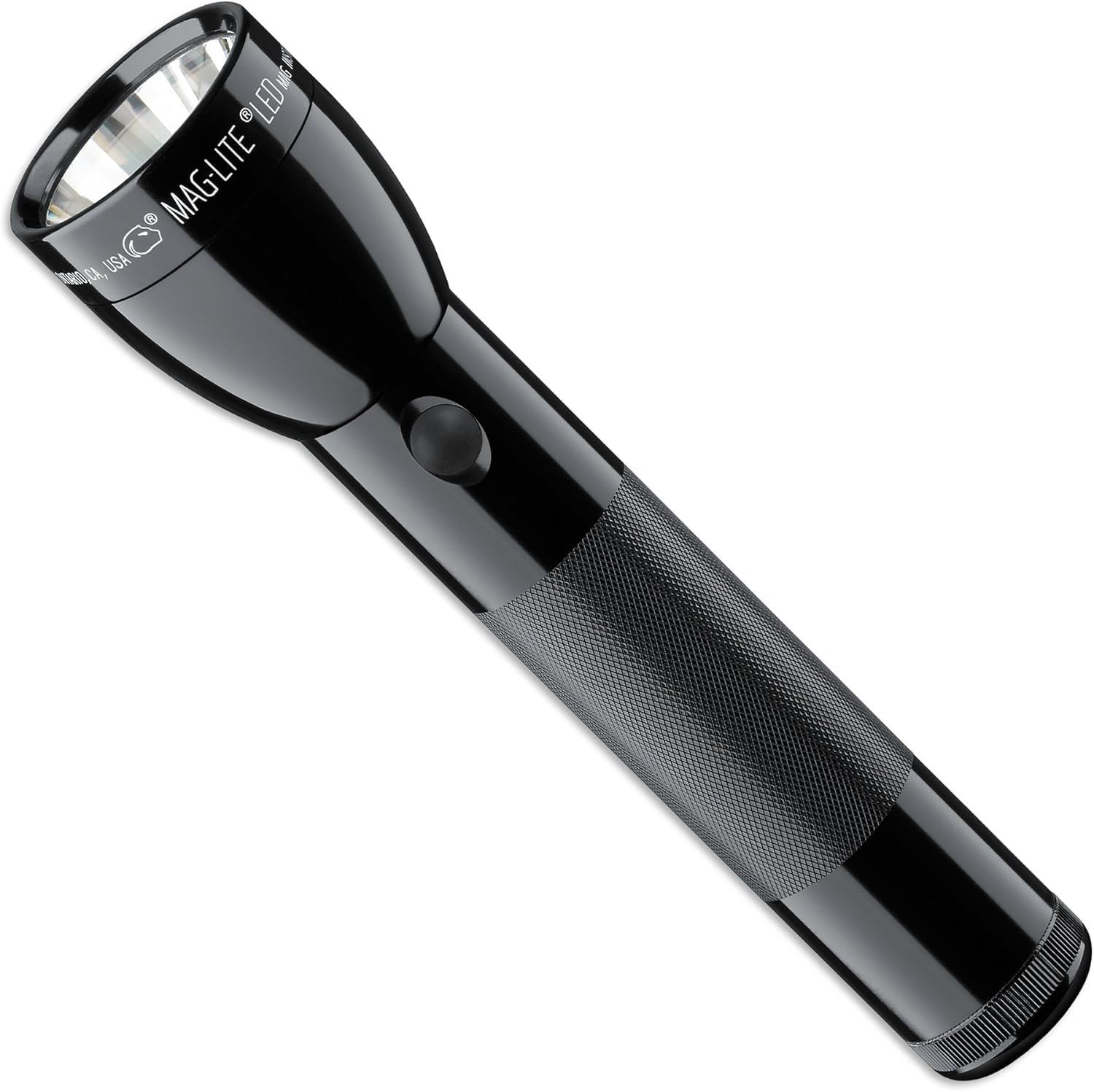
MagLite ML300L
Key Features
- Battery: 2 D batteries
- Runtime: Up to 260 hours on Eco
- Brightness: 487 lumens
- Beam distance: 323 meters
- Price: Premium
The ML300L’s 260-hour Eco runtime is the number that earns it a place here: this is the light we leave by the cabin door, keep in the truck, or set on the basecamp table for a week without a battery change. That is why it is our long-runtime choice. At 487 lumens it still has a serious high setting, with a beam that reaches 323 meters.
The 2D body is long and substantial, and its weight is the price of that runtime. It feels like a tool rather than an accessory, with a focusing head that twists from spot to flood and four activity-based mode sets. The interface takes a few minutes to understand, but once set it is predictable. We like it for car camping and power cuts more than for backpacking, where the size and D-cell weight are hard to justify.
Water resistance is IPX4, so rain is manageable, and the anodized aluminum body is built for rough handling. High mode runs for about six and a half hours, which is plenty for a night of camp use; Eco mode is for the long tail of a trip. You will want to keep a set of D cells in the car, because this is not the light to discover empty at the trailhead.
The case for the ML300L is durability and time between battery changes. We keep coming back to it for the scenarios where a flashlight is part of the camp’s infrastructure rather than a pocket tool. If you are carrying everything on your back, it is too much light and too much metal. If your camp has a vehicle or a cabin, the D cells are the price of admission and the runtime is what you get back.
Pros
- Up to 260 hours on Eco
- 487-lumen beam reaches 323 meters
- Rugged anodized aluminum body
- Four activity-based mode sets
Cons
- Too large and heavy for backpacking
We keep the MagLite ML300L in the basecamp-and-car role because its long Eco runtime and 323-meter beam outlast lighter lights.
Best for Budget Family Kit
HAUSBELL A100
Key Features
- Pack: 2 lights
- Extras: Glow-in-dark ring
- Battery: 3 AAA or rechargeable
- Brightness: 1000 lumens
- Price: Budget
The glow-in-the-dark ring around the HAUSBELL’s head is a small thing that turns out to matter at camp: a flashlight you can find by touch on a dark table is easier to live with than one that disappears into the duffel. The A100 comes as a two-pack, each with a lanyard, and the aluminum body feels more substantial than its budget standing suggests.
The beam is bright enough for camp chores, with five modes and a zoom head that goes from spot to flood. The output story is a little muddled: the headline claims 2000 lumens, while the white-light figure is 1000. We treat it as a 1000-lumen light, which is still plenty for walking a trail or lighting a picnic table. The dual-power design lets you run on three AAA cells or a rechargeable battery, though neither is included. That combination is the reason this pair earns a budget recommendation.
What we do not love is the mode sequence. Five modes means more clicking than necessary, and the strobe sits in the rotation. The glow ring and the second light are the reasons to choose this pair; they make a good kit for a family or for keeping one in the car and one in the tent. If you want the simplest possible switch, the GearLight TAC is the better fit.
Pros
- Two lights with glow-in-dark rings
- Bright 1000-lumen beam and zoom
- AAA or rechargeable power options
Cons
- Muddled 2000/1000 lumen claim
- Five-mode cycle includes strobe
We recommend the HAUSBELL pair for families who want two bright camp lights, a glow ring, and dual battery options in a budget kit.
Best for Cabin Backup
EverBrite E000056

Key Features
- Pack: 6 lights
- Battery: 18 AAA included
- Brightness: 20 lumens
- Beam distance: 59 feet
- Price: Midrange
A six-pack of colored mini lights is not trying to be the best flashlight on a dark trail. The EverBrite set is for the other jobs: a kid’s first camp light, a bedside light in a rental cabin, a glovebox spare, or a power-cut kit that can hand everyone their own color. Each light takes three AAA batteries, and the set arrives with 18 cells, so they are ready to use.
Output is the limitation. These are 20-lumen lights with a 59-foot beam, which is enough to find the tent zipper or walk a flat path, and not enough to pick out a route across a field. The plastic body is light and impact-resistant, with a textured grip and a wrist lanyard. For children, that low output is easier to manage than a 1000-lumen torch; for an adult heading into real darkness, it is a backup, not a primary.
The practical move is to open the pack and test all six before a trip. The set is inexpensive enough to keep as a family kit, and the colors make it easy to assign one to each person and spot who left theirs on the table. Our judgement is that it earns a place as the backup pack, not as the light you rely on for navigation. If you need one serious beam, the S1000 is the better use of pack space.
Pros
- Six lights with batteries included
- Color coding for family use
- Lightweight pocketable body
Cons
- Only 20 lumens
We treat the EverBrite six-pack as a family backup kit, not a primary trail light, because its low output suits tents, drawers, and kids.
Best for Rechargeable Pairs
TrixHub TH005

Key Features
- Pack: 2 lights
- Battery: USB-C rechargeable
- Display: LCD battery display
- Brightness: 700 lumens
- Price: Midrange
The TrixHub’s LCD battery gauge is the sort of detail that makes a rechargeable light easier to trust: you can see how much charge is left before you put it in the pack, instead of guessing from a dimming beam. The pair arrives with two USB-C cables, and each light has five modes and a zoom head.
At 700 lumens, the beam is bright enough for camp use, and the aluminum body has a solid feel. The display is the standout feature; it turns charging into a deliberate part of packing rather than an emergency. The pair format also means one can stay in the car while the other goes in the tent.
The weak point is the telescoping zoom head. These lights can take a knock, but the sliding section is the part to protect, and a drop onto rock is the wrong kind of test. Battery life depends heavily on the mode and the age of the cell. Neither issue makes the TrixHub a bad buy; it makes it a light to keep in a padded pocket or a car console rather than loose in a pack.
For a couple or a family that wants rechargeable lights with a clear battery readout, the TrixHub pair is easy to recommend. It is less proven than the S1000 and less simple than the TAC, but the display solves a real camping annoyance: not knowing whether the light will last the night. Carry a small AAA backup on a long trip.
Pros
- LCD battery display
- USB-C rechargeable pair
- Bright 700-lumen beam
- Aluminum body with zoom
Cons
- Telescoping zoom head is a weak point
- Battery life varies by mode and cell age
We recommend the TrixHub pair when a visible battery gauge and USB-C charging make a rechargeable light easier to trust.
How We Picked and Tested Camping Flashlights
We built the shortlist from spec sheets first, comparing claimed runtimes and beam distances, then filtered out anything with a battery type we wouldn’t want to manage at a campsite — no oddball rechargeables, nothing that needs a proprietary cable you’ll lose in a tent. From there we bought 14 flashlights, ranging from pocket-size AAA models to full-size multi-battery lights, and tested them over six months.
Most of that testing happened where these lights actually live: a backyard fire pit for baseline comparisons, three weekend trips, a night hike on unfamiliar trail, and one very wet week of car camping. At each spot we swept the beam across a field to see how far it genuinely threw, and checked whether the lowest setting was dim enough to read in a tent without waking a sleeping partner.
Battery claims got timed instead of trusted — we ran each light on high until it dimmed or cut out, then repeated on low, noting which ones quietly stepped down to a lower output. Durability meant drops from waist height onto driveway concrete and granite, a five-minute dunk in a basin, and a night left out in the dew. We weighed each light with batteries in, carried them in jacket pockets and hip-belt pouches, and worked every switch with cold, wet hands and with gloves on. Value came down to measured runtime and build quality rather than sticker price. Reliability got the last word: after six months of that, did it still light on the first click?
How to Choose a Camping Flashlight
Start with how you will carry and power the light; brightness is easier to compare than either.
Match the beam to the camp task
A camping light has two jobs that pull in opposite directions: a wide wash for the ground around your feet and a tighter spot for looking ahead. A high lumen number helps with the second and gets in the way of the first. We look for a genuine low or medium setting and a beam that widens enough for tent chores. The GearLight S1000’s zoom covers both, but a fixed wide beam with a good low mode can be easier to live with than a zoom that only goes narrow.
Choose a power plan you can repeat
AAA and AA cells are the simplest camp power: they are sold in small stores, easy to share, and replaceable when a cell dies. A USB-C light such as the Blukar saves weight and avoids disposable cells, but its built-in battery cannot be swapped in the field. Match the choice to the trip. For a weekend with a power bank, rechargeable is tidy; for a remote week or a cold-weather backup, common cells and a spare set are the more forgiving plan.
Carry size and switching matter after dark
Size is not just a packing question. A light that is too small disappears in a glove box; one that is too large stays in the car. The 5.31-inch GearLight TAC is an easy hand-filling size, while the 2D MagLite ML300L is a basecamp tool rather than a pocket light. Switching matters just as much: a single-mode light is instant, but a five-mode light that starts with strobe is a nuisance. Check the sequence before a trip, and learn the lockout.
Treat water resistance as splash protection
Camping throws rain, dew, and splashes at a light, but few handhelds are meant for submersion. An IPX4 rating is enough for rain and a wet table; it is not a promise for a dropped-in-the-lake recovery. Look for sealed ends and a good O-ring, and dry the battery compartment if water gets in. The same caution applies to charging ports: a covered USB-C port is more reassuring in wet weather than an exposed one.
Buy for redundancy, not one perfect light
Camp lights get lost, left on, and borrowed. A two-pack such as the GearLight S1000 or HAUSBELL A100 gives you a spare without doubling the packing problem, and a family pack such as the EverBrite set lets everyone have a light for tent chores. We prefer two modest lights to one precious one. Test each one at home before the trip.
Frequently Asked Questions
Why carry a flashlight when my phone has one?
A phone light is a floody emergency beam that drains the device you may need for maps, messages, and a weather check. A dedicated flashlight keeps that battery separate, sits in the hand better, and can run on common cells or a USB-C charge. For camp, a small AAA light in the pack is cheap insurance even if you mainly use a phone.
How do I keep a flashlight from switching on inside my pack?
Use the lockout if the light has one, or unscrew the tail cap about a quarter turn so the battery breaks contact. On lights without a tail cap, remove one cell and store it beside the light. Press the switch before you pack it to confirm the light is off, and repeat the check when you repack after a night walk.
Should I remove batteries between camping trips?
Yes for alkaline cells if the light will sit for months. Leakage can ruin the contacts and turn a working light into a cleanup job. Remove the cells, store them dry, and check the compartment before the next trip. Rechargeable lights should be topped up and kept in a dry place, not left flat for the season.
Final Verdict
For most campers, the GearLight S1000 is the easiest recommendation: two bright, zoomable lights, common AAA power, and a body that packs without fuss. It covers tent, trail, and car duty, and the second light is useful rather than filler.
Choose the Blukar if USB-C charging matters more than field-swappable batteries; choose the TAC if you want one switch and no modes; choose the ML300L if the light lives at basecamp and runtime matters more than weight.