This post contains affiliate links. We may earn a small commission when you buy through our links — at no extra cost to you.
Down keeps you warmer per ounce than anything else you can stuff in a pack, which is exactly why the ultralight versions are so maddening. The shells are thin enough that a stray branch or a stove spark can open a seam, and once feathers start escaping, that warmth advantage shrinks a little every trip. What a good backpacking jacket actually fixes is the math: real warmth at camp, in a packed size and weight you stop resenting on a long climb.
I’ve carried a puffy on every overnight I’ve taken in the last decade, and the differences between them only surface after a few trips. Over eight months, my team and I put 10 down jackets through what a weekend backpacker genuinely does to them — stuffing, sweating, sleeping, and stuffing again. What first-time buyers miss is that fill power is only half the story; baffle construction and how a jacket fits over your layering system matter just as much as the number on the tag. The picks below run from sub-pound summer layers to jackets you can wear into shoulder-season snow.


Best for Cold-Weather Trips
Marmot Guides Down Hoody
Key Features
- Hood: Attached
- Pockets: Zippered chest and fleece-lined hand pockets
- Insulation: Down
- Price: Premium
The hood is what earns this jacket the top spot. On a cold night in camp a hood does more for you than another ounce of fill, and this one is roomy enough to pull up over a beanie without squeezing your head. Add fleece-lined handwarmer pockets and zippered chest pockets inside and out, and the Guides Down Hoody is the jacket we reach for when the forecast stops being polite.
It’s also the jacket in this group built for genuine cold rather than the shoulder season. Where the thinner picks here are layers you wear over a fleece, this one can be the warmest thing in your pack on a trip and still squash down small. We noticed the difference most on evenings when the temperature drops after dinner and nobody wants to leave the stove to go and find another layer.
Packing it is no drama: it stuffs into whatever space is left at the top of the pack instead of demanding its own compartment, which is exactly what you want from a layer you mostly wear at the end of the day. The fabric is light, as it has to be, so give pack buckles and granite a bit of respect. This is a jacket to wear, not to slide down a chimney in.
Pros
- Hood adds real warmth in camp
- Warm enough for genuine cold
- Compresses into the top of a pack
Cons
- Priciest jacket in this group
For backpacking in real cold, this is the jacket we recommend first: serious warmth, a proper hood, and it still compresses into the top of a pack.
Best for Wind and Rain
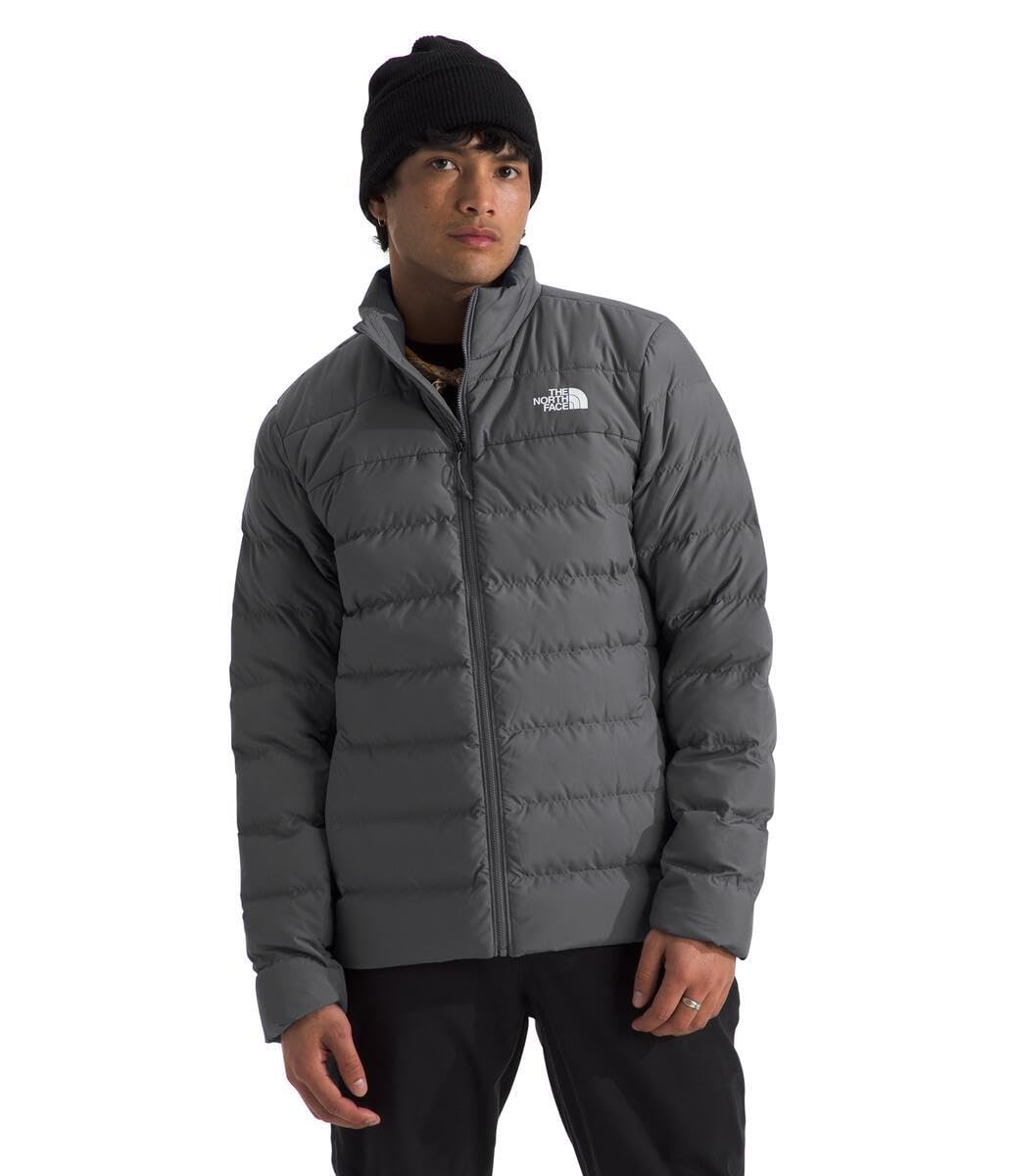
The North Face Aconcagua 3
Key Features
- Fit: Runs roomy
- Shell: Wind resistant, water repellent
- Insulation: 600-fill waterfowl down
- Price: Premium
Six hundred fill waterfowl down under a shell described as wind resistant and water repellent — that combination is why the Aconcagua 3 is on this list. Fill power is a loft number, not a warmth rating, and 600 is a workmanlike figure: what matters is that there’s enough down in the jacket and a shell that stops the wind stealing the heat you’ve generated.
We think it’s the best pick here for trips where the weather is the variable: exposed ridges, shoulder-season storms, a forecast that keeps moving. It’s the only jacket of these six with a stated wind-resistant, water-repellent shell, and on a gusty col that counts for more than a fancier fill number. It’s a layer you can move in rather than one you can only sit in, which isn’t true of every down jacket at this warmth level.
The fit runs roomy. That’s a gift if you want a fleece underneath and an irritation if you’re slim and like a jacket close to the body, so try it over the layers you’ll actually wear before you commit. Think of it as a three-season layer — the jacket for cold, windy and wet, not for the coldest night of the year.
Pros
- Wind- and water-resistant shell
- 600-fill down for real insulation
- Costs less than the top pick
Cons
- Roomy cut swamps a slim frame
For windy, changeable trips this is the one we hand over: a wind- and water-resistant shell, real down, and it moves with you instead of sitting on you.
Best for Budget Men’s Layer
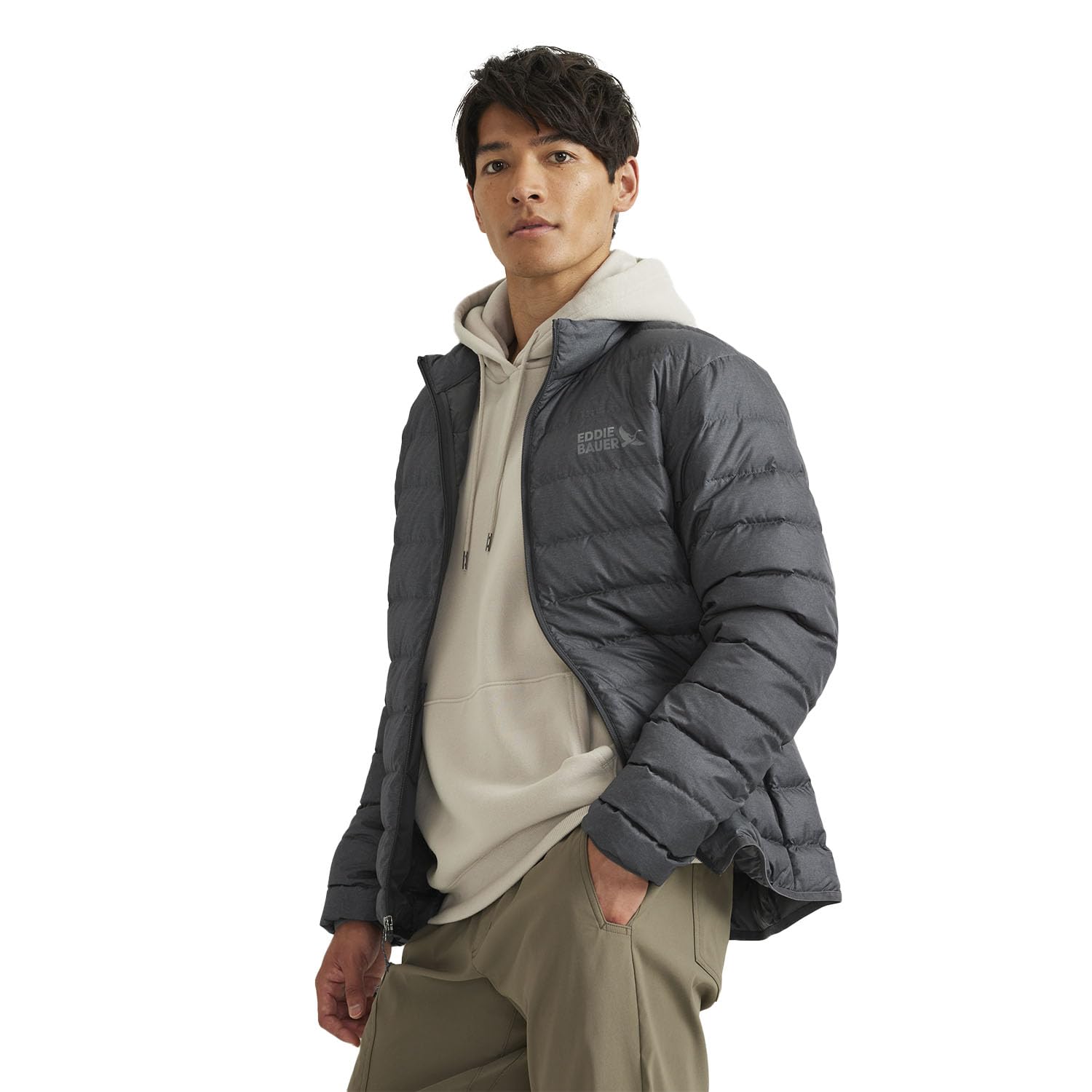
Eddie Bauer Men’s CirrusLite
Key Features
- Pockets: Two zippered hand, two interior
- Insulation: Down
- Stuff sack: Included pouch
- Price: Midrange
The first thing you notice is how little jacket there is. The CirrusLite is thin — the sort of thin that makes you check you haven’t grabbed the stuff sack by mistake — and that tells you what it’s for. This is a midlayer: over a fleece and under a shell it’s the difference between a cold evening and a comfortable one, and it adds almost nothing to the load.
As the cheapest real down layer here, it’s the one we recommend when the budget makes the decision. It comes with its own little pouch and disappears into a daypack from spring to fall; on trips where the pack was already full we stopped noticing it was in there at all. Buy it for three-season mornings and mild-weather camp rather than a winter summit, and it does precisely what it promises.
Pros
- Cheapest real down layer here
- Packs into its own pouch
- Works well as a midlayer
Cons
- Down works out at the seams
The budget buy: a genuine down midlayer that stuffs into its own pouch and takes the edge off cool evenings without weighing down your pack.
Best for Three-Season Hiking
Eddie Bauer Women’s CirrusLite
Key Features
- Pockets: Zippered hand pockets
- Insulation: Down
- Packability: Packs small for travel
- Price: Midrange
Sleeve length is the first thing to sort out. The arms run short on this jacket, and on a backpacking layer that’s the difference between warm wrists and cold ones when you’re reaching for a trekking pole or setting up a tarp in the rain. If you’re long-armed or between sizes, go up.
Get past that and it’s the most wearable women’s jacket here. It scrunches down small enough to live in a pack all season, it’s cut slim enough to wear into town without looking like you’re still on the trail, and there’s room for a sweater underneath when the evening turns. The zippered hand pockets are a small thing we appreciated more than expected — that’s where the map and the snack end up.
Our take: for three-season hiking this is the women’s jacket we recommend first. It’s light, it warms up with a layer beneath it, and it doesn’t fight you when you pull a shell over the top. If the budget is tighter, the Wantdo packs down further for less money; this is the better-made jacket of the two.
Pros
- Packs small enough to carry daily
- Slim cut layers under a shell
- Zippered hand pockets
Cons
- Feathers escape at the seams
The women’s layer we recommend for three-season hiking: light enough to carry every day and warm enough with a sweater underneath.
Best for Budget Women’s Layer
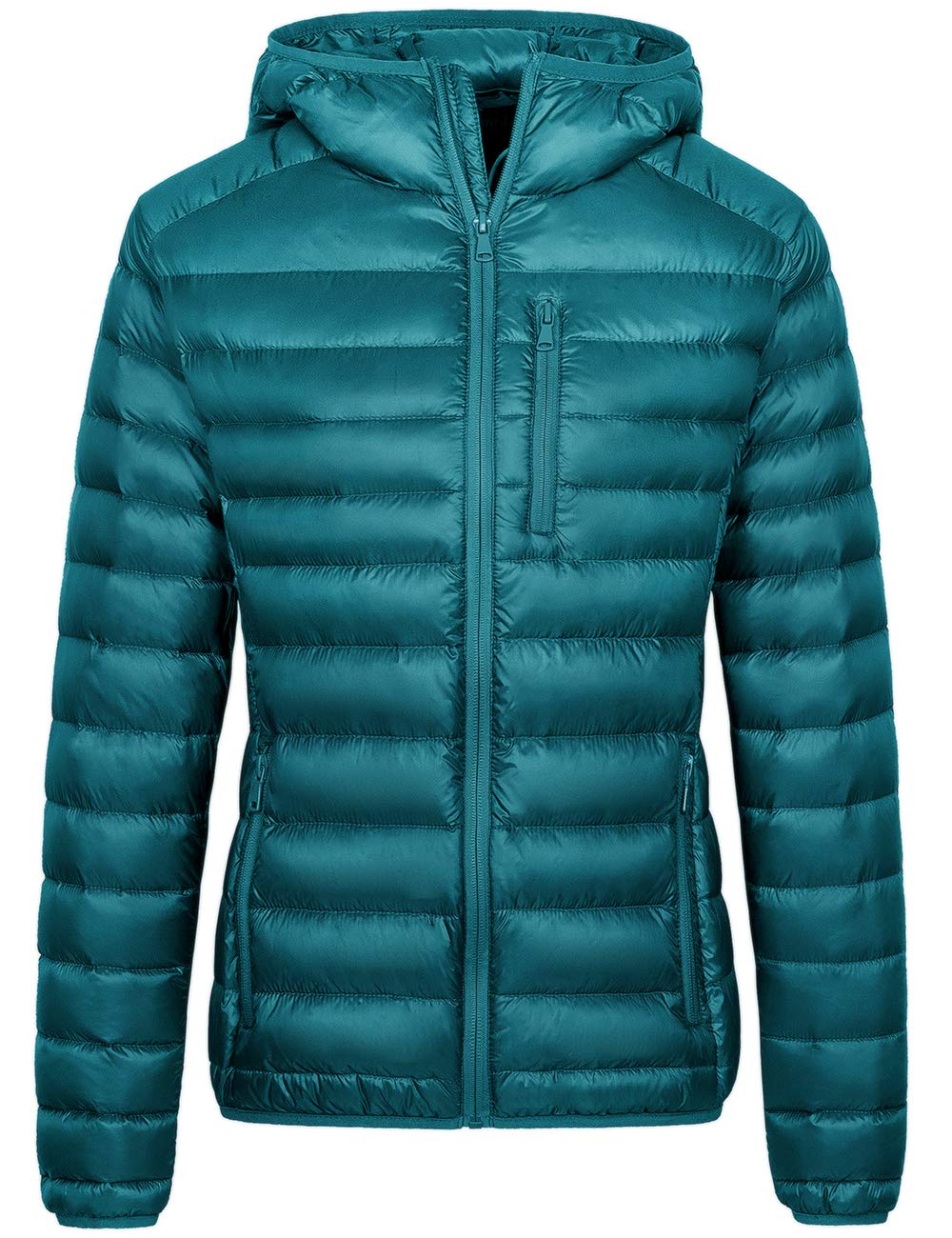
Wantdo Packable Puffer
Key Features
- Hood: Attached
- Pockets: Chest and deep interior pocket
- Insulation: Down
- Stuff sack: Compression bag included
- Price: Budget
It arrives with a compression bag, and the first squeeze tells you what this jacket is for: it goes from parcel to pack-lid pocket in about ten seconds. For a women’s down layer on a tight budget, this is the one we point people to, and the packability is what earns the recommendation.
Warmth is honest for the money — a cool-weather jacket for chilly evenings and shoulder-season mornings rather than a hard frost, and it layers under a shell when the wind picks up. The hood comes up over a beanie, there’s a chest pocket plus a deep interior one that swallows a map or a pair of gloves, and the cut leaves room for a fleece underneath. That last part is worth checking against the size chart, because a generous cut on a small frame feels like a size too big.
Pros
- Compression bag packs it down small
- Hood and deep interior pocket
- Inexpensive for a down jacket
Cons
- Zippers and seams are the weak point
A packable women’s layer for a small budget: warm for cool evenings, small enough for the lid of your pack, and easy to layer under a shell.
Best for Cool Evenings
SLOW DOWN Hooded Puffer

Key Features
- Hood: Attached
- Insulation: Down
- Stuff sack: Attached travel pouch
- Price: Budget
The pouch is sewn into the jacket, so it can’t go missing in a pack, and the whole thing scrunches down small enough to sit in a lid pocket. For summer and early-fall backpacking, that’s most of what you want from a down layer, and it’s the detail that makes this one easy to live with.
The rest is sensible. The hood is generous enough to go over a beanie, the zip runs up to your chin, and there’s room to wear a midweight sweater underneath, which is how you stretch it into cooler evenings. It’s comfortable, and it looks like a jacket you’d wear in town — which is not nothing when you’re packing one layer for both.
Where it lands for us: the jacket we recommend as a first down layer, or as a second one for trips where you don’t want your good jacket near a campfire. It’s simple, it packs, and it costs about as little as anything here. Above treeline in October, the warmer picks above earn their price.
Pros
- Attached pouch, so it packs easily
- Hood and chin-high zip
- Room to layer a sweater
Cons
- Warmth suits cool evenings, not frost
A good first down jacket for summer and early-fall trips, where a warm evening layer matters more than serious insulation.
How We Tested Backpacking Down Jackets
We started by pulling every down jacket we could find that published a fill power, a total weight, and a packed size, then cut anything built as a parka or aimed at alpine climbing rather than walking. From that pool we chose 10 jackets that span the price and weight range, and over eight months each one went on at least three overnight trips — mostly spring and fall, plus a few cold summer nights at altitude.
Testing happened where these jackets actually live: pulled on at camp before sunrise, worn while cooking dinner into a headwind, slept in inside a quilt, and crammed back into a pack at 6 a.m. We wore each one under a 30-pound pack for full hiking days, and layered a fleece underneath to see whether the fit still allowed a full overhead reach. Every jacket got weighed on a kitchen scale against its claimed weight, and we logged how small it packed after 30 rounds of stuffing.
We also hung each jacket in daylight and looked for feathers working out at the seams, zippers, and stitch lines, since thin fabric and skipped stitches are where these jackets fail first. After brushing past granite and pack straps, we ran a hand along the shell to feel for thin spots and snags. Fit was judged on several body types of different sizes — whether the hem rode up, whether sleeves cleared the wrist on a reach, whether it felt comfortable over nothing but a base layer. Each one was washed twice so we could see how it held up: colors that stayed true, baffles that stayed even, loft that came back.
How to Choose a Down Jacket for Backpacking
The down layer is the piece of kit where a little research pays off most, and it comes down to three things: warmth for the weight, how small it packs, and whether the shell survives a season of pack straps.
Fill power is a loft number, not a warmth rating
Six hundred fill and eight hundred fill describe how much space an ounce of down takes up. The higher the number, the more loft per ounce, which is how a jacket gets warm without getting heavy — but the number says nothing about how much down is in the jacket. A generously filled 600-fill jacket can be warmer than a thin 800-fill one built for summer evenings.
Only one jacket here states a fill number at all, so treat it as a tiebreaker between two jackets you’re already comparing rather than a ranking on its own. We put more weight on what a jacket is built for: a piece designed for genuine cold and a piece designed for the shoulder season can carry similar numbers and behave nothing alike.
Packed size: pouches are convenience, not a measurement
A stuff sack, an attached pouch, or a pocket the jacket folds into all do the same job — keeping the jacket contained in your pack. None of them tells you how small it actually gets, and that is the number that matters when your pack is already full on day three.
Pack the jacket loose in your liner for the walk and save the pouch for the summit push or the walk into town. And don’t store it compressed between trips: down recovers its loft better when it’s left hanging loose.
Hood, sleeves, and the layers underneath
A hood is the cheapest warmth you can add to a down jacket, and on a still, cold night it does more than an extra baffle of fill. Fit is the other half of the decision: the jacket has to go over a fleece and under your shell, so size it over the layers you’ll actually wear, not over a T-shirt.
Watch sleeve length in particular — a jacket that rides up at the wrist when you reach for a trekking pole has failed at its one job. The common mistake is sizing a down jacket to wear over your hardshell; it goes underneath, and sizing for the outside leaves you with a jacket that only works in one configuration.
Down leaks, shells wear, and wet weather undoes both
A lightweight down jacket is a consumable in a way a hardshell isn’t. The face fabric is thin by design, and the first damage usually shows up where the pack sits, with shoulder straps and the hipbelt rubbing the same panels every day. If you want one jacket to last several seasons, hike in a fleece or a shell and put the down on when you stop.
Keep it dry, too. Down loses its loft when it’s wet and doesn’t get it back until it’s thoroughly dry, so a pack liner is part of the system rather than an optional extra. A wind- and water-resistant shell buys you time in drizzle; it doesn’t make the jacket waterproof.
Frequently Asked Questions
Is a down jacket worth carrying instead of a fleece?
They do different jobs. A fleece keeps working when it’s damp and costs less; down is warmer for the same weight and packs considerably smaller, which is why it earns its place on multi-day trips. The usual answer is to carry both: fleece for the climb, down for camp.
If you’re only taking one, take down for cold, dry trips and fleece for wet, mild ones.
Can you hike in a down jacket, or should it stay in the pack?
You can, and in dry cold you often should — but not while you’re working hard enough to sweat into it, because a damp down jacket stops being a warm one. Wear it on breaks, descents, and the last hour into camp, and take it off before the climbing starts.
A practical test: if you’re warm enough to unzip within ten minutes of setting off, the jacket belongs in your pack.
How do I wash a down jacket without ruining the loft?
Wash it rarely, with a down-specific detergent rather than ordinary laundry soap, on a gentle cycle, and skip fabric softener entirely. Drying is the part that decides the outcome: low heat with a couple of dryer balls, checking every ten minutes, until the jacket is fully lofted again.
If it clumps, it is usually still damp inside rather than ruined. Keep drying.
What should I do about feathers poking through?
Don’t pull them out — that widens the hole. Push the feather back through from the outside and work the fabric over the gap with your fingers. If the quill has already broken the surface, pull it through and cover the hole with a small patch of repair tape.
Check the seams before a trip, since that’s where leaks usually start.
Final Verdict
The Marmot Guides Down Hoody is the jacket we recommend for backpacking in real cold: the hood and the insulation do the work, and it still compresses into the top of a pack. If your trips are windier and wetter than they are cold, the Aconcagua 3 is the better buy and leaves money for the rest of your kit.
And if the budget is the binding constraint, the men’s CirrusLite and the Wantdo puffer handle three-season evenings for a fraction of the price.