This post contains affiliate links. We may earn a small commission when you buy through our links — at no extra cost to you.
A puffer is a simple idea — hold a layer of warm air next to your body and let your own heat do the rest — and yet two of them can behave nothing alike. One leaves you sweating on the walk to the car, another leaves you shivering at the bus stop, and a third makes you feel like you’re driving in a sleeping bag. The right one keeps you warm through a genuine cold snap, looks sharp enough for a weeknight dinner, and packs small enough to leave in the car.
Something I wish I’d known sooner: fill power gets the credit, but the baffles do the work. How the insulation is stitched in place decides whether you get cold stripes down your sides. Twelve jackets have been in rotation for six months now, thin everyday ones and heavier cold-weather ones, and the standouts weren’t the priciest — they shared a zipper that doesn’t catch, pockets where your hands actually land, and a cut that leaves room for a sweater. The picks below are the ones I kept reaching for.
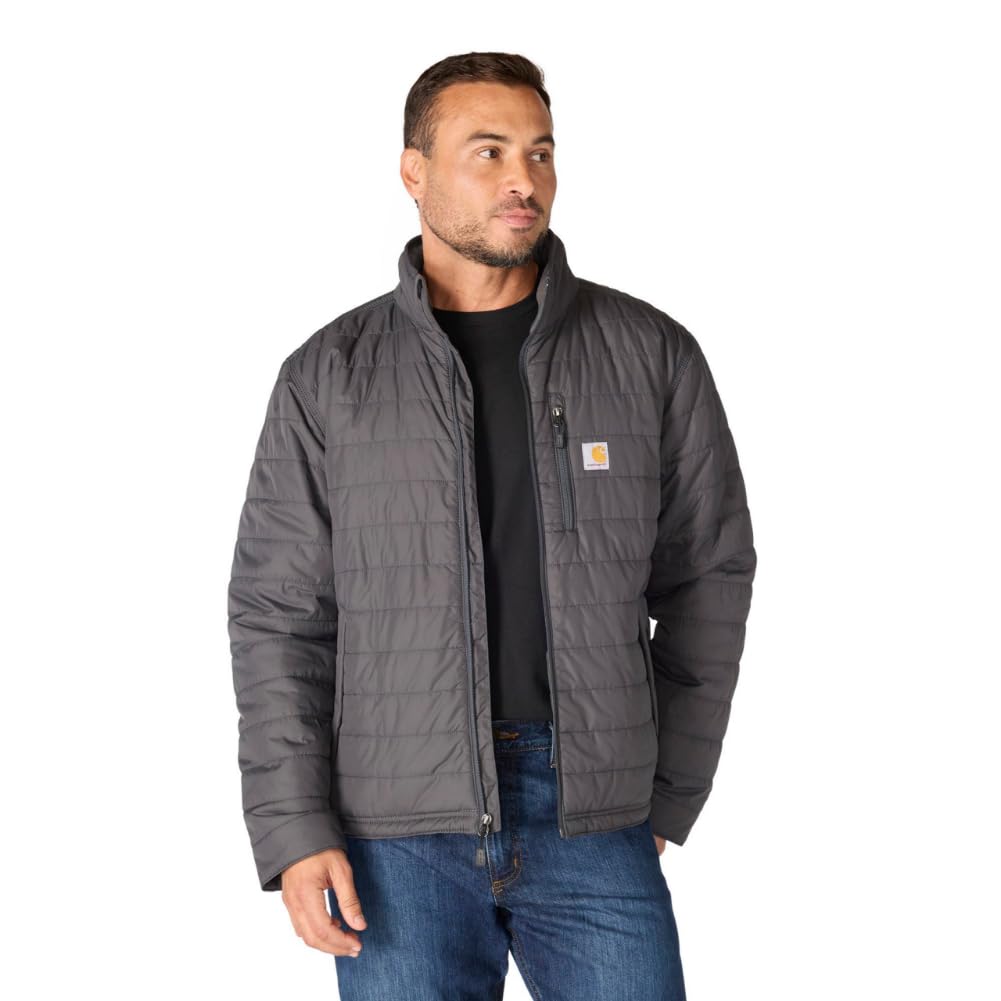


Best for Cold, Wet Days
Carhartt Gilliam Jacket
Key Features
- Fit: Relaxed
- Package weight: 1.2 lb
- Weather resistance: Wind- and rain-resistant
- Price: Premium
Cold is only half the problem. A puffer that blocks wind and sheds a drizzle is worth far more on a blustery afternoon than one that’s merely thick, and the Gilliam is the pick in this group that does both. We wore it through gusty, damp weather that cuts straight through a softer shell, and it kept the heat in without turning clammy the moment we stepped inside. Warm to around the low 40s, windproof, and happy in light rain — that combination is why it takes the top spot.
It’s also lighter than a jacket this warm has any right to be. The listing puts it at 1.2 pounds, and on the body it reads closer to a heavy sweatshirt than a coat, which is why it became the one we grabbed on ordinary days rather than saving it for a trip. The cut is relaxed, so a hoodie fits underneath without the shoulders going tight — but it runs big, and if you want a clean silhouette rather than a layering shell, size down.
The details mostly earn their keep. There are plenty of pockets, all of them secure, and adjustable tabs at the cuffs let you seal out drafts without fumbling for gloves. The exception is the hand pockets, which sit open rather than zipped — fine for warming your hands, less good for a phone on a wet walk. It costs more than most of the jackets here, and it’s still the one we reach for when the forecast is genuinely uncertain.
Pros
- Handles wind and light rain, not just cold
- Very light for the warmth it holds
- Roomy enough to layer a hoodie underneath
- Secure pockets and adjustable cuffs
Cons
- Best to about the low 40s, not deep winter
- Hand pockets are open, not zippered
This is the jacket we point most buyers to first: it handles wind and light rain as well as cold, and it stays light enough to wear all day.
Best for Packable Everyday Layer
Amazon Essentials Packable Puffer
Key Features
- Hood: Attached
- Packability: Packs into stuff sack
- Water resistance: Water-resistant shell
- Price: Budget
There are jackets on this list that cost several times as much and don’t do much more for a cool morning. This is the one that lives in a backpack or a car trunk and gets pulled out when the day turns — and because nothing about it is precious, you stuff it into a daypack without a second thought.
Warmth tops out somewhere around 40 to 60 degrees, so treat it as a three-season layer rather than a winter coat. Inside that range it’s better than it has any right to be: the shell cuts wind, the fill holds heat, and it rolls into its own stuff sack small enough to forget about. We expected a jacket at this price to feel like a compromise, and instead it became the layer we stopped noticing we were wearing, which is the nicest thing you can say about something this cheap.
What it doesn’t have is structure. The shell is thin, there’s no weight to the fabric, and it drapes rather than holding a shape, so it looks like what it is: a light layer rather than a coat. That’s the trade for a jacket that disappears into a bag, and most of the time it’s the right trade.
Pros
- Packs into its own stuff sack
- Barely there on the body
- Good warmth for spring and fall
Cons
- Runs large; size down for a closer fit
We think this is the best value in the group: it packs down small, weighs almost nothing, and covers the 40-to-60-degree days most of us actually face.
Best for Budget Winter Wear
Amazon Essentials Heavyweight Puffer
Key Features
- Hood: Attached, fleece-lined
- Build: Heavyweight
- Pockets: Fleece-lined zip pockets
- Price: Budget
The detail that sells this coat isn’t the fill — it’s the fleece. The hood is lined, the hand pockets are lined, and on a raw morning that’s the difference between a coat you tolerate and one you’re glad to pull on. It’s the sort of thing that never shows up in a product photo and shows up every single day between November and March.
Elsewhere it’s a straightforward heavyweight: thicker than the packable jackets here, with a shell that turns wind and a hood that stays up. The build is plain and the fit is roomy enough for a sweater underneath, which is what you want from a coat you’ll wear over everything from a t-shirt to a hoodie.
For us this is the practical answer for anyone shopping on a budget who needs one coat for a real winter rather than a cold snap. It won’t win a style contest against the Calvin Klein, but it looks like the photo, the zip runs smoothly, and there’s money left over for gloves. The packable jackets are for the shoulder seasons; this is the one for the months that actually hurt.
Pros
- Fleece-lined hood and hand pockets
- Warm enough for a real winter
- Well made for what it costs
Cons
- Small hand pockets; no inside pocket
- No drawcord to cinch the hood
The coat we recommend when the ask is simply a warm winter jacket that doesn’t cost much: fleece where your hands go, and a hood that stays warm.
Best for Travel and Layering
Tommy Hilfiger Ultra Loft
Key Features
- Fill: Ultra Loft
- Sizing: Standard and Big & Tall
- Packability: Packs into travel bag
- Price: Midrange
Wadding a puffer into a drawstring bag and pulling it out creased and flat is one of travel’s small disappointments. The Ultra Loft doesn’t do that — it compresses, and it comes back looking like a jacket again. That’s what makes it the one here we pack for a trip rather than the one we leave hanging in the hall.
Warmth is moderate, and that’s the point: this is a layer for cool, dry days and for the cold snap at the end of a sunny trip, not a coat for a hard freeze. It takes the chill off, it slips under a shell when the weather turns, and it doesn’t wrinkle while it’s in there. The standard-and-big-and-tall sizing is a real plus — tall sizes in a packable jacket are not as common as they should be, and the tall cut fits a tall frame rather than just adding sleeve length.
Two things to know before you buy. The zip is the least convincing part of an otherwise nicely finished jacket, and the shell is thin enough that rough use will tell on it. Neither is a reason to skip it for what it’s for — a smart, packable jacket that lives in a carry-on — but if you want one coat to take a beating for five winters, the Carhartt is the safer place to spend.
Pros
- Packs into its own travel bag
- Comes out of the bag without creases
- Standard and Big & Tall sizing
Cons
- Zip feels like the weak link
- Thin shell can tear with rough use
The travel jacket in this group: it rolls into its own bag, comes out uncreased, and looks sharp enough for a city evening.
Best for Cold, Damp Weather
Tommy Hilfiger Sherpa Lined
Key Features
- Lining: Sherpa fleece
- Package weight: 2.31 lb
- Water resistance: Water-resistant
- Price: Premium
Sherpa lining sounds like a marketing line until you pull the jacket on over a t-shirt on a raw morning. The fleece takes the shock out of a cold coat, and the first thirty seconds — usually the worst part of going outside — aren’t cold at all. It’s the sort of comfort you notice every time, not just once.
The rest is well judged too. It’s midweight, so it’s warm without the bulk of the wantdo, and the shell sheds light rain, which is what turns a puffer from a dry-day jacket into one you can wear through a drizzly commute. We kept it on for a few minutes indoors more than once without overheating. For the money you get the comfort of a much heavier coat, and that’s why it’s our pick for wet cold rather than dry cold.
The gap is packability. It’s listed at 2.31 pounds packed, roughly twice the weight of the packable jackets here, and it takes up real room in a bag, so this is a coat you wear rather than carry. If you want something for a trip, the Ultra Loft is the better companion; if you want to be comfortable standing at a bus stop in February, this is the one.
Pros
- Sherpa lining is warm from the first minute
- Water-resistant shell handles drizzle
- Warm without a parka’s bulk
Cons
- Heavier and bulkier than the packable picks
Our pick for cold, damp weather: sherpa inside, a water-resistant shell outside, and enough warmth that we stopped reaching for a heavier coat.
Best for Dressing Up
Calvin Klein Down Puffer
Key Features
- Fill: Down
- Closure: Full zip
- Pockets: Three zippered pockets
- Price: Midrange
Most of the jackets in this group are built for a backpack. This one is built for a mirror. The full-zip cut, the high collar and the matte shell make it read as a coat rather than a puffy layer, and it looks more expensive than it is — which, if you’re buying a Calvin Klein, is more or less the point.
Warmth is honest for a moderately cold winter: it takes a cold commute and an evening out, and the collar zips right up under the chin, which is where a lot of puffers leave an annoying gap. The fit is trimmer than the Carhartt or the Amazon Essentials coats, so if you plan to wear a thick sweater underneath, go up a size.
There’s a third zippered pocket, the cuffs are neatly designed, and the whole thing is light enough to forget you’re wearing it. Small things, but they’re the difference between a coat you wear twice and a coat you wear out.
The one caveat is the fill. The listing calls this a down puffer, but in the hand the fill feels more like a synthetic sheet than a lofted down jacket. It’s warm and it drapes well; it just isn’t the fill you’d expect at this price. As a smart, warm everyday coat for someone who wants to look put together, it’s the one we reach for.
Pros
- Looks like a proper coat, not a layer
- Collar zips up under the chin
- Warm enough for a cold commute
- Third zippered pocket
Cons
- Fill feels synthetic rather than down
The best-looking jacket here: it wears like a proper coat, zips to the chin, and still handles a cold commute.
Best for Very Cold Weather
Wantdo Hooded Winter Coat

Key Features
- Hood: Attached
- Build: Thick, heavyweight
- Model: ZH604
- Price: Midrange
Order this one by measurement, not by habit. It runs very large — large enough that sizing is easily the weakest part of its story — and the body is cut long and loose, so going down a size is usually the right call and two down isn’t unreasonable if you’re slim. Get that right and you have a lot of coat for the money.
What you get for putting up with the fit is a genuinely thick jacket. This is the heaviest build in the group: quilted, hooded, and warm the way a sleeping bag is warm. Warmth is where it beats jackets that cost more, and it’s the reason we kept it in the roundup despite the sizing.
Durability is the other thing to know. Seams and pockets have given way soon after purchase, which is a risk rather than a certainty, and it’s why this sits in our also-consider tier rather than higher up. Buy it as a cheap coat for brutal cold that you won’t baby and it makes sense; buy it as the last winter coat you’ll ever need and you’ll be disappointed.
Pros
- Genuinely warm in deep cold
- Thick, substantial build
- Cheap for the warmth on offer
Cons
- Seams and pockets can give way early
The warmest coat here for very little money, if you get the size right — it runs enormous, and the stitching is a gamble.
How We Tested a Dozen Puffer Jackets Through Six Months of Cold
We started with roughly 40 jackets pulled from manufacturer specs, retailer best-seller lists, and puffers our own staff already owned. Anything without a full size run, with a shell thin enough to snag on a backpack strap, or priced past what most people would spend on a winter coat got cut. That left twelve, which three other editors and I wore for six months — the first cold mornings of late fall through the wet, windy end of winter.
Every jacket got the same rotation: the walk to the train, morning dog walks, weekend hikes, and a lot of shoveling and standing around in parking lots. We judged warmth standing still rather than moving, noting which ones had us reaching for the zipper by the time we hit the platform and which left cold patches across the shoulders. Each was weighed on a kitchen scale, then stuffed into its own pocket or stuff sack to see how much room it ate in a daypack.
Fit got the most argument. Testers from a small to a double extra large tried each jacket over a t-shirt, a sweater, and a hoodie, reaching for a steering wheel and bending to tie a boot to see whether the shoulders pulled or the hem rode up. We zipped every one with gloves on and counted how often fabric caught in the teeth, dropped a phone in each pocket and bent over to see if it stayed put, and washed two per their care labels to check for clumped fill and wandering seams. Then we wore the finalists somewhere with a mirror and asked the blunt question: does this look like a coat, or like gear? Price came last, weighed against the fill, the shell, and how the stitching held up by month six.
How to Choose a Men’s Puffer Jacket
Most puffers on the shelf are 40-to-60-degree jackets wearing a winter-coat label, so match the jacket to the conditions you’ll actually meet and the rest of the decision gets much simpler.
Match the jacket to the temperature, not the name
Lightweight, midweight and heavyweight are the only categories that really matter. A packable lightweight is a three-season layer: it takes the edge off a cool morning, disappears into a bag, and suits most people’s actual use. A heavyweight coat is for standing still in January.
If you want one jacket to do both, buy the heavier one and accept that you’ll carry it through September. If the jacket lives in a backpack, buy light and plan to layer a shell over it.
Sizing is where puffers go wrong
Sizing is the least consistent thing about this category. Two jackets here run noticeably large, one is cut close, and one you’d want to size down twice. A puffer with no room to layer is a puffer you can’t wear in the coldest week of the year, but a puffer with too much room is one you won’t wear the rest of it.
Measure your chest over the thickest layer you’ll wear underneath, check the returns window before you order, and treat any sizing advice as brand-specific rather than universal.
Down, synthetic, and what the label tells you
Down gives more warmth per ounce and packs smaller. Synthetic keeps more of its warmth when damp and costs less. Neither is better without a use in mind.
What’s worth watching is a listing that says down when the fill feels like a synthetic sheet — the Calvin Klein here is the example — because fill is the one thing you can’t judge from a photo. If fill quality matters to you, buy from a maker that states it plainly.
Wind and rain change what warm means
A thin jacket that blocks wind is warmer than a thick one that doesn’t. Look for a wind-resistant shell and at least water-resistant treatment, and remember that water-resistant is not waterproof: it handles drizzle and the walk to the car, not an hour of steady rain.
If you’ll be out in weather, a hood that adjusts and cuffs that cinch matter more than another ounce of fill.
Packability has a cost
A jacket that stuffs into its own sack is a jacket you’ll actually carry, and that’s worth a lot. The trade is structure and durability: very light shells are thinner, and repeated stuffing doesn’t do the fill any favors.
If a jacket will spend months compressed in a bag, air it out and shake the loft back into it before you wear it.
Frequently Asked Questions
Can I wash a puffer jacket in a washing machine?
Yes, in most cases. Use a front-loading machine or a gentle cycle with cold water and a small amount of mild detergent, then tumble dry on low with two or three clean dryer balls to break up clumps of fill.
Skip fabric softener, and skip the dry cleaner — aggressive heat and a top-loading agitator are what flatten the loft.
Why is my puffer jacket losing feathers?
Small amounts of down escaping at seams is normal; finding quills on your shirt after every walk is not. That usually means the shell fabric is too thin or the seam stitching is too loose, and patching doesn’t fix either.
Before buying, run a thumb along an inside seam. A tight weave and dense stitching are what keep fill where it belongs.
Can I wear a puffer under a rain shell?
Yes, and it’s one of the most flexible combinations you can build — a light puffer plus a shell handles more weather than either does alone.
Size the puffer so it fits underneath without compressing the fill. A squashed puffer insulates far less than a loose one.
Final Verdict
The Carhartt Gilliam is the jacket we recommend to most people. It does what a puffer is actually for — holding warmth in wind, shrugging off a shower, and staying light enough that you forget you have it on — and it does it at a price that’s reasonable for a coat this versatile.
If the budget is tight, the Amazon Essentials packable is the better first jacket and covers most of the year. If comfort in wet cold is the priority, the sherpa-lined Tommy Hilfiger is the one to look at.