This post contains affiliate links. We may earn a small commission when you buy through our links — at no extra cost to you.
The 8×42 binocular is the Goldilocks of optics: enough magnification to pull a warbler out of a canopy, enough light-gathering for dawn, and not so much weight that you dread carrying it. But that sweet spot is crowded. Two pairs with identical specs can feel different in the field—one snaps into focus with a flick, the other grinds like a rusty gate. Over eight months, I’ve lived with a dozen pairs, from budget to near-alpha glass, and the differences come down to a few things you can’t read on a spec sheet.
Weight shows up first—how it hangs on your neck after a three-mile walk. Then clarity: whether edges stay sharp or smear, and how the view holds in fading light. Focusing matters more than most shoppers expect; a stiff or overly fast wheel can cost you a bird while you fiddle. Field of view separates the scanning-friendly from the tunnel-visioned. I ranked these by how they perform for birding and general use, with value in mind—paying more makes sense only if you see the difference.


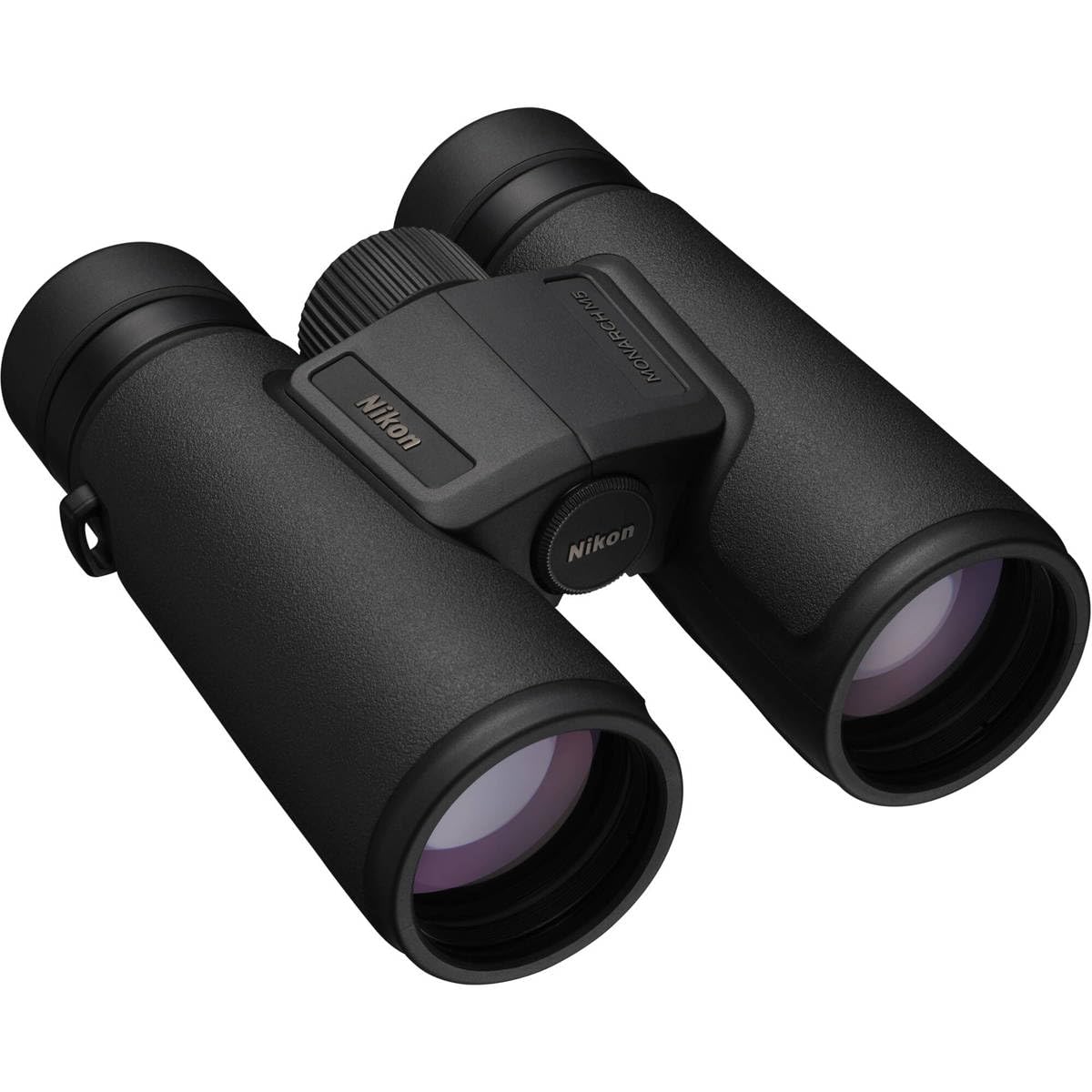


Best for All-Day Birding
Nikon ProStaff P3 8×42
Key Features
- Weight: 1.3 lb
- Warranty: Limited lifetime
- Eye relief: 20.2 mm
- Field of view: 377 ft
- Price: Midrange
The reader we kept thinking about during testing wears glasses on the trail and doesn’t want to take them off every time something moves in the hedge. The ProStaff P3 answers that: 20.2mm of eye relief is the longest figure in this group, and the turn-and-slide eyecups hold where you set them, so the whole 377-foot field comes through with your glasses on. At 1.3 pounds it’s also the lightest full-size pair here, which is the specification that decides whether a binocular goes in the pack or stays in the car.
Optically it gives away a little to the Monarch M5 and the Diamondback, and that’s the right trade for most people. Multilayer coating and a silver-alloy prism coating produce a bright, neutral image; the gap against ED glass shows up as a thin colour fringe on a bird backlit against a bright sky — rarely, and mostly at the edge of the frame.
Two practical notes from living with it. The focus wheel is smooth and quick enough to follow a bird through branches, and the diopter ring has enough friction to stay where you set it, which isn’t true of everything here. The objective caps, though, are the loose plastic type that come off in a bag; a strip of tape inside each one saves you a scratched objective.
Where it gives ground is the last of the light. In the minutes either side of sunset the M5 shows a little more detail, and the colour fringe on a backlit bird is slightly more visible than through the premium glass. Neither turned up in ordinary daylight birding — it’s the argument for spending more only if you’re a dawn-and-dusk birder.
Pros
- 20.2mm eye relief, the longest in this group
- 1.3 lb, the lightest full-size pair here
- Bright, neutral image from multilayer and silver-alloy coatings
- Limited lifetime warranty
Cons
- Narrower view than the Vortex pairs
We recommend the ProStaff P3 to almost everyone: the longest eye relief here, the lightest body, and a mid-range price that still leaves room for a harness.
Best for Serious Birders
Vortex Diamondback HD 8×42
Key Features
- Warranty: Unlimited lifetime
- Eye relief: 17 mm
- Field of view: 393 ft
- Prism coating: Dielectric, argon purged
- Price: Premium
If the ProStaff P3 is the sensible answer, the Diamondback HD is the one that explains why people spend more on glass. Same 8×42 formula, but Vortex adds dielectric prism coatings, a 393-foot field — the second widest here after the Athlon — and argon purging in place of nitrogen. What we noticed first was the edge of the frame: it stays sharp much further out than on the cheaper pairs.
What you’re paying for is the whole package rather than one number. The focus wheel moves with real precision, the eyecups click firmly through their positions, and the warranty is unlimited and unconditional — a different promise from a limited lifetime one. For an instrument you’ll keep for a decade and probably drop at least once, that’s the argument.
The 17mm eye relief is comfortable without glasses and workable with them, but it’s 3mm short of the P3’s, and if your glasses sit well forward on your face you’ll feel the difference. Weight is the other honest note: this is a substantial pair, and the GlassPak harness in the box is the reason it doesn’t matter — it carries the load across your chest instead of on your neck.
Close focus is the detail that surprised us most. It snaps into sharp focus at a few feet, near enough to work a feeder from an armchair, which turns a binocular you’d think of as a field glass into one you keep by the window.
Pros
- 393-foot field with sharp edges
- Unlimited, unconditional lifetime warranty
- GlassPak harness included instead of a plain strap
- Dielectric coating and argon purging
Cons
- 17mm eye relief is tighter than our top pick’s
- A substantial pair to hang around your neck
Our pick for birders who want the sharpest all-round view here and a warranty that never asks what happened.
Best for First Real Pair
Vortex Crossfire HD 8×42
Key Features
- Weight: 1.5 lb
- Warranty: Unlimited lifetime
- Eye relief: 14 mm
- Field of view: 390 ft
- Price: Midrange
Fourteen millimeters of eye relief is the number that decides this one. If you bird or hunt with glasses on, 14mm is short — you’ll either press the eyecups into your lenses or lose the edge of the field — and no amount of optical quality fixes that. Everyone else can read the rest as good news.
Because at 390 feet of field, with HD glass and the same unlimited lifetime warranty as the Diamondback, we rate the Crossfire the value pick of this group. The two pairs feel like family: the same roof-prism layout, the same quick centre focus, the same rubber armor. Where they part is the prism coating — dielectric on the Diamondback, not here — and that’s the sort of difference you notice in the last twenty minutes of light rather than at noon.
So this is the pair to put in the hands of someone buying a first serious binocular, or a second one to leave in the truck. The 1.5-pound body sits steady, the focus is quick, and the armor takes a knock without drama. The glasses wearer in the family should get the Diamondback instead.
Pros
- 390-foot field for far less than the Diamondback
- Same unlimited unconditional lifetime warranty as the Diamondback
- HD glass and rubber armor at 1.5 lb
Cons
- 14mm eye relief rules out most glasses wearers
- No dielectric prism coating at this price
Choose the Crossfire if you don’t wear glasses: it delivers most of the Diamondback’s view for a good deal less money.
Best for Moving Birds
Athlon Midas UHD 8×42
Key Features
- Optics: ED glass, dielectric coating
- Weight: 1.6 lb
- Eye relief: 17.2 mm
- Field of view: 8.1 degrees
Eight point one degrees is the widest angle of view in this group, and on a moving bird it isn’t a statistic. It’s the difference between picking up a warbler on your first swing and hunting for it in the canopy while it works its way out of sight. The Midas UHD backs that up with ED glass and a dielectric prism coating, the two things that most reliably clean up colour fringing and lift contrast.
The rest of the specification is just as serious. Argon purging, fully multi-coated lenses, 17.2mm of eye relief, and a lifetime warranty that transfers if you sell the pair on. Close focus is short enough for feeder work and butterflies, and the eyepiece adjustment is straightforward enough to set once and leave alone.
Bulk is where it asks for something back. At 1.6 pounds it’s heavier than the P3 and the M5, and a wide field puts more glass out at the ends of your hands; over a long climb we felt it. This is the pair here where the tripod mount earns its keep — brace it on a rock and the weight stops being your problem.
Set against the premium Nikon, it’s the easier recommendation for a birder who works hedgerows, woodland edges and scrub, where the extra degrees find birds a narrow view never shows you at all. If your birding happens across open water or from a car window, the width buys less and the Nikon’s glass buys more.
Pros
- 8.1 degrees, the widest view in this set
- ED glass and dielectric prism coating
- Transferable lifetime warranty
- Short close focus for feeders and insects
Cons
- 1.6 lb and a broad body show on long climbs
For woodland and hedgerow birding, the Midas UHD’s 8.1-degree view finds birds that nothing else here picks up as fast.
Best for Low Light
Nikon Monarch M5 8×42
Key Features
- Optics: ED glass, dielectric coating
- Weight: 1.4 lb
- Eye relief: 19.5 mm
- Field of view: 335 ft
- Price: Premium
The Monarch M5 is the pair we reach for when the light is going. ED glass and a dielectric prism coating are what separate it from everything cheaper here, and the payoff is an image that stays clean and neutral rather than turning soft and purple as the sun drops. If your birding happens at dawn, at dusk or under heavy cloud, that’s worth paying for.
The rest of the design is built for long sessions. 19.5mm of eye relief and click-stop eyecups mean glasses stay on and the settings don’t drift, and the 1.4-pound body carries like the P3 rather than like the Celestrons. The closed-bridge housing feels like one piece in the hand, which is not something we can say about every pair at this price.
The trade is field of view, and it’s a real one. At 335 feet the M5 has one of the narrowest views here — only the budget Hontry is tighter — and you feel it exactly where birds are hardest: something moving through branches. You find it, you lose it, you find it again. Over water, across a valley, on a sitting animal, you’ll never notice.
That makes it a specialist’s binocular, and we point most first-time buyers at the P3 instead: same brand, wider view, a good deal less money, and the same body weight. The M5 earns its price between dusk and dark; if that isn’t when you go out, it’s money you don’t need to spend.
Pros
- ED glass and dielectric coating for difficult light
- 19.5mm eye relief with click-stop eyecups
- 1.4 lb and a rigid closed-bridge body
Cons
- Narrowest view of anything here above the budget tier
- The most expensive pair in this group
Pay for the Monarch M5 if you’re out at dawn and dusk; its ED glass holds detail when the cheaper pairs have gone soft.
Best for Backyard Birding
Celestron Nature DX 8×42
Key Features
- Prism: Phase-coated BaK-4
- Weight: 1.8 lb
- Eye relief: 17.5 mm
- Field of view: 388 ft
- Price: Midrange
A feeder thirty feet from a kitchen window is where most binoculars spend most of their lives, and the Nature DX handles that job as well as anything here. The 388-foot field is nearly as wide as the Diamondback’s, the phase-coated BaK-4 prisms give you the contrast that matters against foliage, and the fully multi-coated lenses hold up in flat overcast light.
What makes it the safest mid-price pick is the combination: phase coating, full multicoating, nitrogen purging, a limited lifetime warranty and a wide view, with nothing important missing from the package. This is the pair we suggest to someone who wants to buy once, stop researching and get on with watching birds.
Two things to know, and neither is a dealbreaker. At 1.8 pounds it’s the heaviest of the mid-price pairs here, so plan on a harness rather than the included neck strap for long days. And the objective caps sit loosely enough to fall off in a bag; a strip of tape inside each one fixes it permanently.
Pros
- 388-foot field with phase-coated BaK-4 prisms
- Fully sealed, nitrogen-purged body
- Limited lifetime warranty
- Wide view at a genuinely mid-range price
Cons
- 1.8 lb is heavy for long days
- Objective caps come off easily
Our safe mid-price recommendation for backyard and trail birding: wide, phase-coated, weather-sealed and hard to fault.
Best for Beginner Kit
Gosky 8×42
Key Features
- Eye relief: 15 mm
- In the box: Phone adapter and tripod
- Field of view: 110 meters
- Waterproofing: IPX7
- Price: Budget
The box is the pitch. Binoculars, a phone adapter, a small tripod, a tripod adapter, a bag and a strap, all in one purchase — and for someone who wants to photograph what they’re looking at without buying a spotting scope, that bundle is the reason this pair exists.
The adapter works the way clamp-on adapters do. You seat the phone over the eyepiece, line the camera up once, and it holds; the first alignment takes patience and a steady hand, and every one after that takes seconds. On the little tripod it’s steady enough for video of a feeder or a shoreline.
Optically we put it a genuine step below the Nikon and Vortex pairs and a step above the cheapest thing here. BaK-4 prisms and full multi-coating give a bright, sharp centre; the edges soften, and the field of view is mid-pack. In good light, at a feeder or on the water, that’s plenty.
The body is the part to keep an eye on. The housing is plastic and it feels it, and while IPX7 is a real rating rather than a marketing one, plastic and rubber only stay married for so long. Treat this as a binocular that lives in a bag rather than one that lives on a rock.
Where it earns its place is the price of admission. It’s the cheapest way here to get 8×42 optics, a properly sealed body and a working phone adapter in one order, and for a beginner, a gift, or a boat bag that’s the whole argument. Buy it to learn on rather than to hand down.
Pros
- Phone adapter and tripod included
- IPX7 waterproofing at a budget price
- Bright centre from BaK-4 prisms and full multi-coating
Cons
- Plastic housing feels its price
- Edges soften at the frame
For a first pair with photography built in, the Gosky bundle is the cheapest complete kit here and it genuinely works.
Best for Tight Budgets
Celestron Outland X 8×42

Key Features
- Weight: 1.8 lb
- Coatings: Multi-coated, BaK-4 prisms
- Warranty: 2 year
- Eye relief: 17.8 mm
- Price: Midrange
Focus is the thing to check on the Outland X. The wheel can arrive stiff or inconsistent, so buy from somewhere with an easy return and spend ten minutes with it indoors before a trip, rather than discovering it at a trailhead.
Give it a good one and there’s plenty we like. At 17.8mm its eye relief is the third most generous here, which is enough for glasses; the 1.8-pound body sits steady in wind; and the rubber-armored, nitrogen-purged housing takes weather without complaint. BaK-4 prisms and multi-coating deliver a clean image for the money.
Where it lands is a step below the Nature DX. Same brand, more money for that step up, and you get phase coating and a wider field for the difference. The Outland X is the pair to buy when the budget is fixed and you still want a proper warranty behind the glass.
Pros
- 17.8mm eye relief, third longest here
- Nitrogen-purged, rubber-armored body
- Name-brand optics on a tight budget
Cons
- Focus wheel can arrive stiff or inconsistent
A dependable budget binocular with a real warranty behind it — the one to buy when the Nature DX is out of reach.
Best for Boat and Truck
Hontry 8×42

Key Features
- Weight: 1.6 lb
- Eye relief: 15 mm
- Field of view: 318 ft
- Waterproofing: IPX6
- Price: Budget
At 318 feet the Hontry has the narrowest field of view here by a clear margin, and that single number explains who should buy it. Narrow means slower: a bird crossing a gap takes a beat longer to find, and in thick cover you’ll lose it more often. Point it at a lake, a hillside, a whale or a stadium, and none of that matters.
What you get in exchange is a well-made budget binocular. The rubber body feels solid rather than hollow, the eyecups twist up for glasses, the focus is smooth, and the middle of the frame is bright and sharp. The 15mm eye relief is workable rather than generous, and IPX6 covers rain and spray but not a dunking.
Note what isn’t in the box: no harness, no phone adapter, no tripod, and a basic bag. That’s fair at this price, but if photographing what you see matters, the Gosky bundle costs a little more and includes all of it.
So this is the glovebox pair, the boat pair, the one you hand a kid without wincing. It’s the cheapest binocular we’re recommending and it doesn’t feel like it, which is the nicest thing you can say about a budget optic.
Pros
- Solid rubber body at the lowest price here
- Twist-up eyecups that work with glasses
- Bright, sharp centre for the money
Cons
- 318-foot field is the narrowest in this group
- IPX6 only, not rated for immersion
The glovebox binocular: narrow-viewed but well made, and the least expensive pair here we’re happy to recommend.
How We Tested the Best 8×42 Binoculars
We started by researching the most promising 8×42 models from established optics brands, then narrowed the list by price tier—budget, mid-range, and premium—and by specs like waterproofing and eye relief. That left us with 12 pairs to test over eight months. Each one went through the same routine: a morning at a local wildlife refuge scanning for warblers and hawks, an evening at backyard feeders as light faded, and at least one long hike where we carried it around our neck the whole way.
Focusing got the most attention, because it’s where cheap binoculars betray you. We turned each wheel from close focus to infinity and back, noting if it was smooth, precise, or too fast to settle on a moving bird. Weight we judged by neck strain after three miles, not by the spec sheet. Field of view we compared by counting how many fence posts we could see across a familiar meadow at 1,000 yards. Clarity we checked at dawn and dusk, looking for edge sharpness, color fringing, and how long the view stayed usable as light dropped.
Finally, we weighed value: did the pricier pairs show a visible improvement, or were we paying for a logo? The dozen pairs that made the list are the ones that stayed comfortable, focused cleanly, and let us identify birds without squinting. We’ll keep using them through migration season and update if anything changes.
How to Choose 8X42 Binoculars
Almost any 8×42 here will show you a bird in good light; what separates them is how wide the view is, whether your glasses fit behind the eyecups, and how much of the frame stays sharp when the light goes.
Field of View Is a Speed Measurement
Field of view is quoted as a width at 1,000 yards, and it decides how quickly you get on a moving bird. The widest pair here is the Athlon at 8.1 degrees; the narrowest is the Hontry at 318 feet, and in thick cover that gap is the difference between following a warbler and losing it. Buy width for woodland and hedgerows, and don’t pay for it if you mostly watch open water.
The trap is assuming wider is always better. A wide field that goes soft at the edge is harder to use than a narrower sharp one, which is why the Diamondback’s 393 feet reads as more useful than the figure alone suggests. Look at the edge of the frame, not just the middle, before you commit.
Eye Relief Decides Whether Your Glasses Stay On
Eye relief is how far your eye can sit from the lens and still see the whole field. Under about 15mm, glasses wearers lose the edges; 17mm and up is comfortable; the ProStaff P3’s 20.2mm is the most forgiving here. The Crossfire’s 14mm is the number that rules it out for spectacles, whatever else it does well.
Eyecup design matters as much as the figure. Click-stop cups hold their position; friction cups drift between settings. Set the cups down and check the full field with your glasses on before you buy — a binocular whose edges you can’t see is one you’ll stop carrying.
Weight and How You Carry It
The pairs here run from 1.3 to 1.8 pounds, and half a pound stops being abstract around hour four. Balance matters more than the number: a heavier pair that settles into your hands is easier to live with than a light one that won’t steady.
The real fix is a harness rather than the neck strap in the box. A harness carries the weight across your chest, and it’s the first accessory to budget for if you plan on full days. It’s also what makes the 1.8-pound Celestrons practical.
What the Coatings and Prisms Buy
Fully multi-coated means every air-to-glass surface is coated; multi-coated may mean only some, and you’ll see the difference in flat light. BaK-4 prisms beat cheaper glass, phase coating lifts contrast in roof prisms, and dielectric prism coatings push more light through — the Diamondback and the Monarch M5 have them, the Crossfire does not.
ED glass is the last step, and it’s what removes the purple fringe on a bird against a bright sky. None of this is compulsory. Decide which one you’re giving up and pay for the rest.
Sealing, Warranty and the Box
Waterproof and fogproof mean nitrogen or argon purging with O-ring seals, but check the rating: IPX7 survives a dunking, IPX6 only survives spray. Warranty is the quiet specification — Vortex’s unlimited, unconditional cover and Athlon’s transferable lifetime cover are worth more than a two-year term if you keep one pair for a decade.
Then do the bundle maths. A phone adapter and a small tripod bought separately cost more than the gap between the Gosky and the next budget pair, so if you want to photograph what you find, buying them in the box is the cheaper route.
Frequently Asked Questions
Are 8×42 binoculars better than 10×42?
For most people, yes. An 8×42 gives a 5.25mm exit pupil — 42 divided by 8 — which is forgiving at dusk and easy to hold steady, and the wider view makes it quicker to find a bird. A 10×42 shows more detail at long range and suits open country and western hunting.
Pick 8x for woodland, gardens and all-day carrying. Pick 10x only if you glass across valleys and don’t mind bracing against something.
Are 8×42 binoculars good for hunting?
They’re the standard prescription for eastern woodland and still hunting, where a wide view and a steady image beat magnification. The Athlon Midas at 8.1 degrees is the one here that picks up movement in cover fastest.
Out west, glassing miles of open slope, most hunters step up to 10×42 or 12×50. The 8×42’s advantage is close range and hand-holding, not reach.
How should I clean the lenses?
Brush or blow off dust first — grit is what scratches coatings — then wipe with a microfiber cloth in a gentle circle, starting at the centre. Breathe on the glass for moisture, and skip paper towels, tissues and shirttails.
For anything stubborn, put a drop of lens cleaner on the cloth rather than on the lens. Clean before a trip rather than after, and the coatings will last the life of the pair.
Final Verdict
Buy the Nikon ProStaff P3. It’s the pair that fits the most people: 20.2mm of eye relief so glasses stay on, 1.3 pounds so it goes in the pack, a 377-foot view wide enough to find a bird quickly, and a lifetime warranty behind it.
Change one requirement and the answer changes with it. If you’re out at dusk and want the cleanest image here, the Nikon Monarch M5 is the step up, provided you can live with the narrowest view above the budget tier. And if you wear glasses while birding, the Vortex to buy is the Diamondback, not the Crossfire — 14mm of relief won’t work.