This post contains affiliate links. We may earn a small commission when you buy through our links — at no extra cost to you.
A one-person tent is a negotiation: every ounce you shave off usually comes out of living space, and every extra inch of headroom costs you on the climb. That’s why the best solo shelters feel like a small miracle — light enough to forget on the trail, roomy enough to change clothes without elbow damage, and tough enough to shrug off a night of rain. What you’re really buying is a dry, quiet place to sleep after a long day, plus a morning that doesn’t start with a wrestling match against a wet stuff sack.
I’ve spent the past eight months sleeping in 12 one-person tents, from ultralight models to sturdier freestanding designs. I pitched them in the dark, in the rain, on windy ridges, and on lumpy patches of roots. What separated the keepers wasn’t a single spec but how the whole package held up: packed weight, floor size, ease of setup, water resistance, and stability after a long night. The picks below are the ones I’d trust for a solo night out, and the ones that earn their price.




Best for Most Solo Campers
Clostnature 1P Backpacking Tent
Key Features
- Floor Size: 86.6 x 31.9 in
- Peak Height: 35.8 in
- Packed Weight: 4 lb (1.8 kg)
- Rainfly Rating: PU 5000 mm
- Price: Midrange
The 5000 mm figure on the Clostnature’s rainfly and floor is the highest water-resistance rating in this group, and it’s the reason this is the tent we point most solo campers toward. You can go lighter, and you can buy with a longer warranty, but nothing else here combines that much weather protection with a floor long enough for a six-footer at a midrange price.
The rest of the spec sheet backs it up. The interior runs 86.6 by 31.9 inches with 35.8 inches at the peak, the whole package comes in at 4 lb (1.8 kg), and the two aluminum poles cross at the top with the body clipping on rather than threading through sleeves — the difference between a pitch you can manage in the dark and one you can’t. A D-shaped zipped door, mesh panels up top, and a fly that buckles down at the corners round it out.
Thirty-one point nine inches is narrow, and that’s where this tent asks something of you. Sleep on your back with your arms in and it’s plenty. Roll around a lot or want your pack on the floor beside you, and the 39-inch GEERTOP is the better call — there’s no give in a tent wall at two in the morning.
What we kept noticing on our own nights out was the small stuff: two interior pockets at head height, a floor that stayed where we put it, and a fly that tensioned without a fight. None of that shows up in a spec table, and all of it is the difference between a tent you tolerate and one you reach for.
Pros
- 5000 mm fly and floor, the highest rating here
- 86.6-inch floor fits a six-footer
- Aluminum poles and a quick clip-on pitch
- Midrange price for premium-grade waterproofing
Cons
- Around 4 lb is mid-weight, not ultralight
- Just one door, so one way in and out
Buy this one unless you’re broad-shouldered or counting every ounce: it’s the most weatherproof solo tent here at a price that doesn’t sting.
Best for Long-Term Ownership
ALPS Mountaineering Lynx 1
Key Features
- Warranty: Limited lifetime
- Floor Size: 90 x 32 in
- Packed Weight: 4 lb 1 oz
- Rainfly Rating: 1500 mm
- Price: Premium
A limited lifetime warranty is an unusual thing to find attached to a tent, and it’s the first line we noticed on the Lynx 1’s spec sheet. It sits alongside construction that explains the confidence: a factory-sealed 75D rainfly, a 2000 mm coated floor, aluminum poles and aluminum stakes rather than the fiberglass and steel that turn up at this level, and a 90 by 32 by 36-inch interior at 4 lb 1 oz.
This is the tent we recommend to someone who wants to buy once and stop thinking about it. It carries the highest rating in this group, and nothing in its record points at the failures that actually end trips — splintered poles, dead zips, seams that give up in the second season. On top of that you get a warranty that covers the years when a cheaper tent would already be landfill.
The trade is weight. At 4 lb 1 oz the Lynx 1 is a few ounces heavier than the Cloud Up and the GEERTOP, and on a long approach you feel it. It’s also a snug 32 inches across, which suits a back-sleeper and gets old fast for anyone with wide shoulders. For everyone else, this is the calm, unexciting purchase that keeps you dry for a decade.
Pros
- Limited lifetime warranty on a solo tent
- Factory-sealed fly and a 2000 mm floor
- Aluminum poles and stakes, not fiberglass
- Highest buyer rating in this group
Cons
- 1500 mm fly is the lowest rating here
- 32-inch floor is snug for broad shoulders
The one to buy if you want to stop shopping for tents: sealed construction, aluminum throughout, and a warranty that outlasts most camping phases.
Best for Backpacking Light
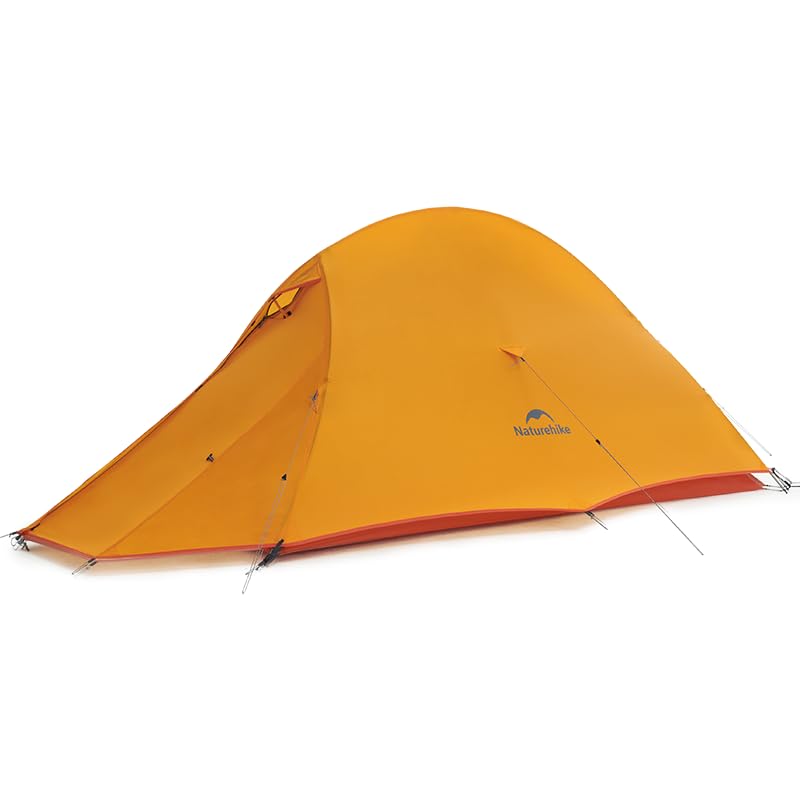
Naturehike Cloud Up 1
Key Features
- Floor Size: 82.7 x 35.4 in
- Packed Size: 15.3 x 5.1 in
- Peak Height: 43.3 in
- Packed Weight: 3.7 lb
- Price: Premium
Fifteen point three inches long, five wide, 3.7 lb. The Cloud Up 1’s packed size is about the footprint of a two-liter bottle, and that’s the whole argument: on a trip where the shelter has to live inside your pack rather than strapped to the outside, this is the one that disappears into it.
It isn’t a stripped-down bivy. The floor runs 82.7 by 35.4 inches with 43.3 inches at the peak, enough to sit up and pull a jacket on, and there’s a ventilation window above the door — the detail that stops a single-door tent from becoming a wet box overnight. The 210T fly is rated PU 3000 mm and the poles are 7075 aluminum.
Of everything here, this is the tent we take when the plan involves miles rather than a parking space. Weight, packed volume, and weather protection all point the same direction, and it’s the tent in this group we’d hand to someone doing their first multi-day route without a second thought about the shelter.
What gives us pause is the price, which sits at the top of the midrange here and within reach of the premium picks. Set against that, a footprint comes in the box — the floor protection that usually costs extra is already accounted for.
Pros
- Packs to 15.3 x 5.1 inches
- 3.7 lb with 43.3 inches of headroom
- PU 3000 mm fly and 7075 aluminum poles
- Footprint included with the tent
Cons
- Premium price for a solo shelter
- Light build rewards careful handling
Our pick when the tent rides in a pack rather than a trunk: 3.7 lb, a bottle-sized stuff sack, and headroom you can actually sit up in.
Best for Gear-Heavy Trips
Bessport 1-Person Backpacking Tent
Key Features
- Doors: 2
- Floor Size: 87.8 x 33.5 in
- Vestibules: 2
- Packed Weight: 4.4 lb
- Price: Budget
Two doors and two vestibules on a one-person tent sounds like overkill until you’ve had to climb out over your own pack at two in the morning. The Bessport gives you an entry on each side, which is why it’s the one we suggest to anyone who wants their gear out of the sleeping area but still under cover.
The interior measures 87.8 by 33.5 inches with 43.3 inches at the peak — sitting-up room and a floor long enough for most adults — and the mesh body runs most of the way up, so warm nights vent properly. Seams are taped, four pockets take the small stuff, and the fly buckles over the top rather than relying on a single skin.
Two doors also buy you options. You can turn the tent so the leeward door faces the weather and still have a sheltered way in and out, and the vestibule on the windward side becomes a place for wet boots. For a short approach, a bike trip, or a base camp you return to for several nights, that’s a better night than a lighter tent gives you.
Pros
- Two doors and two vestibules for gear
- 43.3-inch peak with sitting-up room
- Taped seams and a 5000-rated floor coating claim
- Lowest-priced two-door option here
Cons
- Heaviest of the backpacking picks at 4.4 lb
Buy it if you want your pack out of the sleeping area: two doors and two vestibules make this the most liveable budget solo tent here.
Best for Side Sleepers
GEERTOP Ultralight Solo Bivy
Key Features
- Floor Size: 84 x 39 in
- Peak Height: 36 in
- Packed Weight: 3.7 lb
- Rainfly Rating: PU 2500 mm
- Price: Midrange
Thirty-nine inches across. That’s wider than any other backpacking tent here, where most stop around 32, and it’s the difference between a shelter you lie in and one you can turn over in without your shoulder finding nylon.
We like it for side sleepers and for anyone who has given up on the narrow-solo-tent feel. Two doors and two vestibules mean you’re not swivelling to get out, the double-wall build vents through two windows, and at 3.7 lb it carries as well as the Cloud Up. The PU 2500 mm fly sits a step below the 5000 mm tents here and a clear step above the 1500 mm one.
The compromises are modest. Its 36-inch peak is lower than the Cloud Up’s 43.3 inches, so you sit up rather than sprawl upright, and it’s a three-season tent rather than a snow shelter. Neither undercuts what the extra width buys you over a long night.
Pros
- 39-inch floor, the widest backpacking option here
- Two doors and two vestibules
- 3.7 lb with a PU 2500 mm fly
- Double-wall build with two vent windows
Cons
- Vestibules hold boots, not a pack
For side sleepers and anyone done with mummy-tight solo tents: a 39-inch floor, two doors, and only 3.7 lb to carry.
Best for Tall Sleepers
Camppal 4-Season Solo Tent
Key Features
- Seasons: 4 season
- Floor Size: 8.2 x 2.95 ft
- Peak Height: 2.95 ft
- Rainfly Rating: 3500-4000 mm
- Price: Midrange
The Camppal is an A-frame: a single aluminum ridge pole, taped seams at the zip and corners, one guy line, and a long body that looks like a tent from a different decade. For anyone over six foot, that shape is the point — the interior runs 8 feet 2 inches, longer than anything else we’re recommending.
Pitching is one pole and four corners: unfold, run the ridge pole through, stake it down, tension the guy line. Three minutes is realistic once you’ve done it once, and there’s nothing to lose in the dark. The fly carries a 3500 to 4000 mm rating, and there are two interior pockets and a vestibule at the head end for boots.
If you’re 6 foot 2 and tired of waking up with your head pressed into wet nylon, this is the tent to buy — the length is worth more than the ounces you save elsewhere. It’s also the closest thing here to a four-season shelter at a midrange price. Just don’t expect it to ventilate like a mesh dome on a still August night; with the fly closed it traps air.
Pros
- 8-foot-2 interior, the longest floor here
- 3500-4000 mm fly with taped seams
- One-pole pitch in a few minutes
- Four-season build at a midrange price
Cons
- Narrow 2.95 ft floor at the shoulders
- Ridge-pole frame leans on firm staking
The tall sleeper’s tent: 8 feet 2 inches of interior, a taped high-denier fly, and a pitch that takes one pole and three minutes.
Best for Cold-Weather Camping
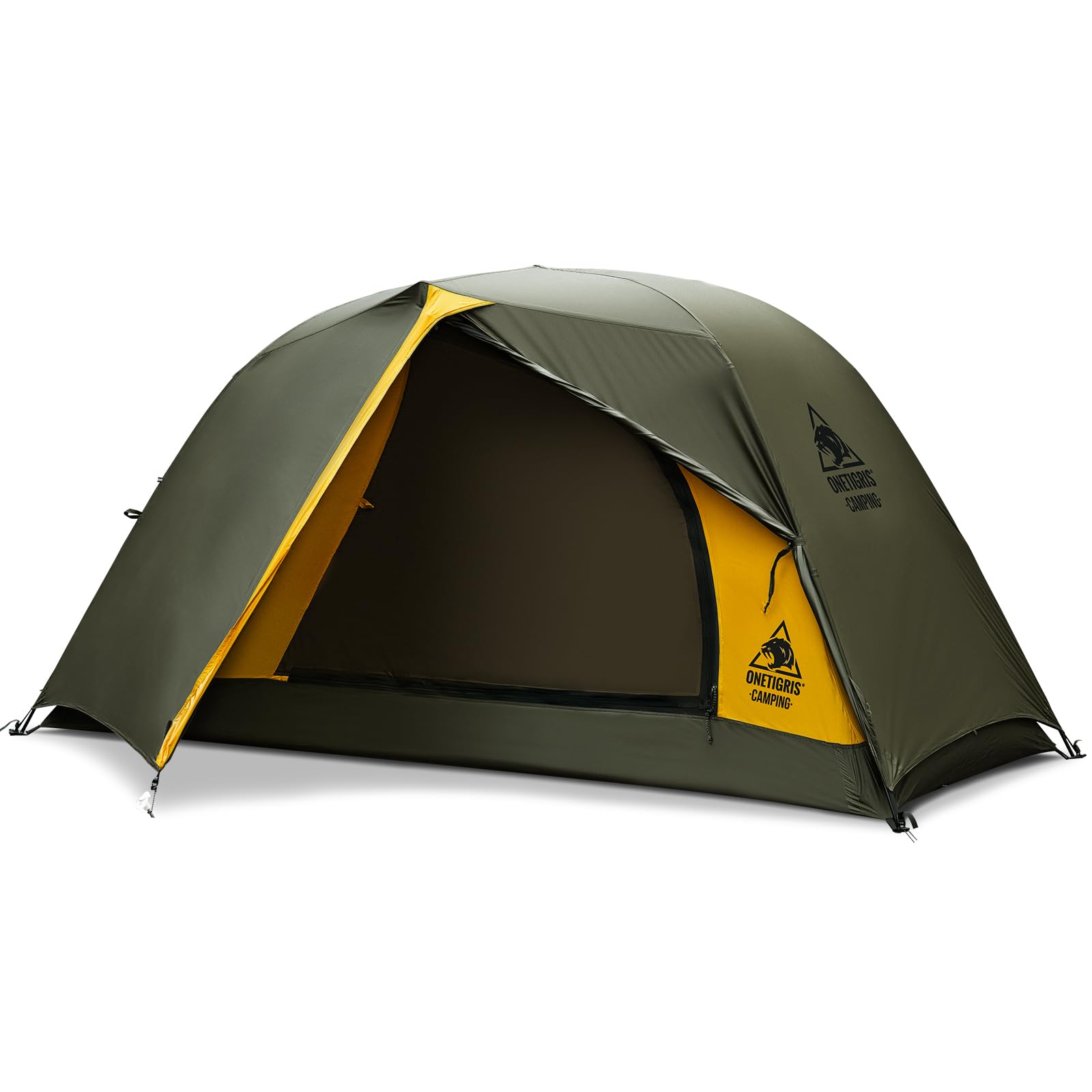
OneTigris Stella
Key Features
- Floor Size: 6.9 x 4.1 ft
- Peak Height: 3.7 ft
- Packed Weight: 4.2 lb (1.9 kg)
- Rainfly Rating: 3000 mm
- Price: Premium
Twenty-denier nylon with a silicone coating, a 3000 mm rating, and a removable blackout outer that turns the whole shelter into a dark, warm box. The Stella is built from materials that are unusual in this group, and it’s the only tent here genuinely aimed at cold nights rather than just tolerating them.
Setup is a four-pole dome that crosses at the top, and the package measures 6.9 by 4.1 feet with a 3.7-foot peak and 4.2 lb in the bag. That 4.1-foot width is generous for one person — the listing calls the tent a two-person, which is optimistic, but as a solo shelter it leaves room for a pad and a pack without a fight.
Where the Stella earns its money is in the cold. It holds heat noticeably better than the mesh-heavy three-season tents here, and the silicone-treated fabric sheds rain instead of absorbing it. The cost is airflow: with the blackout outer on in mild weather, condensation builds on the inner wall, and a warm night turns muggy in a way a mesh tent never does.
At the top of the price range, this is a tent you buy for a reason — winter camping, shoulder-season trips, or sleeping past sunrise in a bright, busy camp. If your camping is mostly summer, the Cloud Up does the same job with less weight and less money, and the Stella’s advantages never get a chance to show.
Pros
- Removable blackout outer holds heat and blocks light
- 20D sil-nylon with a 3000 mm rating
- 4.1-foot width is roomy for one
- Four-pole dome that goes up fast
Cons
- Condensation with the outer on in mild weather
- Top of the price range for a 4.2 lb tent
Buy it for cold nights and late sunrises: sil-nylon fabric and a removable blackout outer that hold warmth better than anything else here.
Best for Fast Pitch
Night Cat Pop-Up Tent

Key Features
- Floor Size: 7.7 x 3.3 ft
- Packed Size: 21 x 21 x 2 in
- Peak Height: 2.95 ft
- Packed Weight: 3.3 lb
- Price: Midrange
You throw it on the ground, spread the two halves of the pole, and it’s up. Not up in three minutes — up in the time it takes to read this sentence, which is a different category of convenience from everything else on this page.
Inside you get 7.7 by 3.3 feet with 2.95 feet at the centre, long enough for a twin air mattress and low enough that you’ll be dressing sitting down. The single skin is polyester with a 2000 mm coating, there’s a zipped mesh door, and at 3.3 lb it’s the lightest tent we’re recommending.
The fold-back is the fiddly part. Night Cat’s revised method folds the tent in four circles rather than three, which gets the package down to 21 by 21 by 2 inches but takes practice, and the first few attempts are not elegant. Budget a couple of rehearsals in the yard before you try it in front of a campsite.
What it isn’t is a wet-weather shelter. A single skin with no separate fly gathers condensation from breath alone and gives up in sustained rain, so this is a summer tent: festivals, car camps, overnighters where you arrive late and leave early. For those, the speed is worth more than the specification.
Pros
- Pitches in seconds with no pole assembly
- Lightest tent here at 3.3 lb
- Fits a twin air mattress inside
Cons
- Single skin wets out in sustained rain
- Folds into a flat 21-inch disc
For festivals, car camps, and late arrivals: nothing here pitches faster, as long as you’re not expecting it to handle a wet weekend.
How We Tested One-Person Tents
To build the shortlist, we started with the specs that matter most for a solo shelter: packed weight, floor area, peak height, number of poles, and price. I read through spec sheets and customer reviews, then narrowed the field to 12 tents that covered a range of budgets and styles — ultralight trekking-pole shelters, freestanding dome tents, and a few semishelters. I left out anything that was too heavy for a weekend pack or too cramped to sit up in.
Testing ran for eight months, mostly on weekend backpacking trips and a handful of overnighters close to home. I pitched each tent alone, timed the setup from stuff sack to standing, and did it again in the rain and once after dark to see how the process held up when I was tired. I weighed every tent on a kitchen scale before the first trip and again after packing it down wet, then measured floor dimensions and peak height with a tape. On windy nights I paid attention to whether the poles bowed or the stakes pulled; on wet nights I checked for condensation and water sneaking through seams, zippers, and the floor.
After each trip I stuffed the tent back into its sack to judge foldability and packed size, and I inspected stitching, pole joints, and zipper pulls for wear. The best values weren’t always the lightest — they were the tents that set up quickly, kept me dry, and still felt stable enough to sleep through a gust. I’ll keep using these and update this list as they wear.
How to Choose a One-Person Tent
Three numbers — packed weight, floor length, and fly rating — settle most of this decision, and a fourth question settles the rest: are you carrying the tent or parking next to it?
Weight Only Counts If You Carry It
The spread here runs from 3.3 lb to 4.4 lb, which sounds like nothing until it’s on your back at mile eight. For backpacking we treat roughly 4 lb as the working target and anything under 3.8 lb as a genuine saving. If you drive to camp, take the extra pound and spend it on interior room instead — the Bessport’s 4.4 lb buys you two doors and a taller ceiling.
Packed volume is the figure listings bury, and it matters as much as mass. A tent that folds into a flat 21-inch disc is compact in the sense that it fits a car trunk; it does not slide into a pack’s side pocket the way a 15-inch stuff sack does. Check the packed dimensions against your pack, not the word "compact" in the title.
Floor Length First, Then Width
Interior length decides whether you sleep or curl. Add about six inches to your height to allow for bag loft and a pillow: a 6-foot sleeper wants 78 inches or more, and at 6 foot 2 we look for 84 and up. The Camppal’s 8 feet 2 inches is the outlier here and the reason to consider it at all.
Width separates a back-sleeper’s tent from a comfortable one. The 32-inch floors here suit someone who stays put; 35 to 39 inches lets you turn over and keep a water bottle beside you. Peak height is measured at a single point — a 43-inch peak on the Cloud Up or Bessport means you can sit up in the middle, not at the ends.
What a Waterproof Rating Covers
Hydrostatic head runs from 1500 mm to 5000 mm across these tents, and the label describes the fabric before anyone has sewn it. Above 3000 mm is a sensible three-season target for a tent you’ll use in real rain. At 1500 mm, treat it as a fair-weather shelter and plan on sealing the seams yourself.
Two things matter as much as the coating: whether the floor is coated at all, and whether the fly touches the inner. A fly that rests against the inner tent wicks moisture straight into your bag on a damp night, whatever the number on the tag. Pitch tight, use the guy lines, and keep a gap between the two layers.
Poles, Pitch, and Doors
Fiberglass poles are the cheapest way to stand a tent up and the part most likely to splinter; aluminum costs more and survives more seasons. Every tent we recommend here uses aluminum. Pitch time follows the frame: two poles that clip to the body go up quickly, while a single ridge pole is simpler still but leans on good staking to stay put.
Doors and vestibules decide how you live in the thing. One door means one exit and one place for boots; two doors let you turn the tent out of the wind and still get in. Vestibules of around 2 square feet hold footwear and a filter, not a pack — if you want your bag under cover, check the vestibule figure before you buy.
Frequently Asked Questions
Do I need a footprint under a one-person tent?
It’s the cheapest way to extend the tent’s life. A footprint takes the abrasion from roots, grit, and gravel that otherwise wears through the floor coating, which is the failure you can’t repair at camp. The Cloud Up ships with one; for anything else, a cut-to-size sheet of Tyvek does the same job.
Trim it a couple of inches inside the floor’s outline. A footprint that sticks out past the edge channels rain under the tent instead of away from it.
Can two people share a one-person tent?
Not for a night you’d repeat. Solo floors here run 32 to 39 inches wide, which is one sleeping pad plus a pack; two pads need 40 inches minimum with no room left over. A one-person tent used by two is a damp, cramped night no matter what the listing suggests.
If you camp as a pair even occasionally, buy a two-person shelter and split the weight between two packs. It ends up lighter per person than squeezing into one.
How do I keep condensation from soaking my sleeping bag?
Vent more than feels necessary. Leave the mesh panel zipped and the fly vent open, and pitch with the low end into the wind so moist air is pushed out the high end. Single-skin tents need this most and get it least — the Night Cat will bead up on a still night even in dry weather.
A small microfiber cloth for the walls is worth more than a fancier tent. Wipe down before you pack, and dry the shelter fully at home before it goes back in the bag.
Are one-person tents only for summer?
Most of these are three-season shelters, which covers spring through early fall comfortably. Below freezing you want a four-season design with a solid inner or a removable blackout layer, like the Stella, or a taped high-denier fly like the Camppal’s.
The tent holds heat; it doesn’t make it. Pair a four-season shelter with a pad rated below the ground temperature you expect, because the cold comes up through the floor.
Final Verdict
The Clostnature is the tent we point most people to, and the reason fits in one line: the highest water-resistance rating in this group, on a floor long enough for a six-footer, at a price in the middle of the pack. For three-season solo camping it asks the fewest compromises.
If the tent spends more time on your back than in a trunk, the Naturehike Cloud Up 1 earns its premium with a smaller pack and less weight. Over 6 foot 2, the Camppal’s 8-foot-2 floor settles the argument before anything else gets a hearing.