This post contains affiliate links. We may earn a small commission when you buy through our links — at no extra cost to you.
The reward at the end of a long day on the trail is a hot meal, and the cook set is the only piece of kitchen you get to carry. A bad one rattles against your back for ten miles, tips the second the ground isn’t perfectly level, and hands you a handle hot enough to leave a mark. A good one nearly disappears into your pack and then does exactly what you need when you’re too tired to fuss with it.
That balance — light enough to forget, sturdy enough to trust — is what I’ve been chasing for years, and I have the burn scar on one thumb to prove it. Over the past eight months my team and I have cooked on 12 different sets, from bare-bones two-piece setups to full kits with bowls and a stove, and the differences are not subtle. One thing first-timers rarely check: the lightest sets are usually thin aluminum, which is exactly where scorched oatmeal and warped lids come from. The weight printed on the box is a starting point, not the whole story.


Best for Two-Person Backpacking
Fire-Maple Feast
Key Features
- Base: Finned heat exchanger
- Material: Hard-anodized aluminum, stainless steel
- Capacities: 1.5 L pot, 0.8 L kettle, 0.7 L frypan
- Packed weight: 1.7 lb
- Price: Premium
The bottom of the Feast’s 1.5-liter pot isn’t flat. It’s a ring of fins that drops down around the burner flame, and Fire-Maple rates the design at 30 percent less boiling time than a plain pot. That number is the manufacturer’s, not ours. What we can tell you is that the shape makes sense the moment you watch it work: more metal sits in the flame, so less fuel goes into getting water to a boil, and fuel is the one thing in your pack that gets heavier as the trip goes on. That is why this is the set we recommend first.
Everything nests inside that pot — the 0.7-liter frypan, the 0.8-liter kettle, both lids — and the bundle comes in at 1.7 pounds. In practice you get a pot that feeds two, a kettle that pours about two camp cups, and a small nonstick skillet for eggs, a reheat or a sauce. The insulated handle locks in place, so you can pour off pasta water one-handed instead of hunting for a bandana.
The nonstick skillet is the piece to look after. It is a coating, and coatings wear first: soft utensils, moderate heat, and no scraping at it with a titanium spork. The rest is hard-anodized aluminum and stainless steel, and it has the solid, slightly serious feel of gear built for a lot of breakfasts rather than one summer.
Pros
- Finned base cuts boiling time and fuel use
- Pot, kettle and pan nest into one bundle
- Insulated locking handle stays cool to pour
- 1.7 lb for three cooking vessels
Cons
- Highest price in this group
- 0.7 L skillet is small for two
The set we pack when two of us are cooking properly: three vessels in one 1.7-pound bundle, and a finned base that stretches every canister further.
Best for Solo Ultralight Trips
TOAKS Titanium 750
Key Features
- Nests: 110 g canister, 450 ml cup, 32 oz bottle
- Weight: 3 oz (86 g), 3.6 oz (103 g) with lid
- Capacity: 750 ml (760 ml to rim)
- Material: Uncoated titanium
- Price: Budget
Eighty-six grams. That is the pot before the lid goes on, and it is less than a third of what the stainless MSR pot in this guide weighs. On a trip where you are counting ounces, that number decides whether the pot comes at all.
The nesting is what sold us. A 110-gram fuel canister drops in with room left for a small stove, a lighter and a few tea bags; the pot swallows a 32-ounce Nalgene, and a TOAKS 450 ml cup nests alongside it. There are gradation marks inside in milliliters and ounces, which sounds like a small thing until you are rehydrating dinner in the dark and do not want to guess at the water line. For solo trips where the pot is also the bowl and the mug, this is the one we reach for first.
Bare, uncoated titanium is a boiler, not a frying pan. Food sticks and scorches if you look away, so we use ours for water, noodles, rice and coffee, and stir more than we ever do at home. That is not a fault in the pot; it is the nature of uncoated metal, and it is the reason the thing weighs so little. Buy it to boil and you will never think about it again.
Pros
- 86 g pot, 103 g with the lid
- Swallows a canister, stove and cup
- Gradation marks in milliliters and ounces
Cons
- Lid rests on top without locking
- Handles get hot over a live burner
For a solo hiker who mostly boils water, this is the pot we hand over without hesitation: 3 ounces, a canister-sized nest and no coating to fail.
Best for Cooking for Two
MalloMe 17-Piece Mess Kit
Key Features
- Pieces: 17
- Coating: Nonstick
- Material: Hard-anodized aluminum
- Capacities: 1.7 L pot, 1.15 L kettle, 7 in pan
- Price: Midrange
The contents list is the pitch: a 1.7-liter pot with a lid, a 1.15-liter kettle, a 7-inch frying pan, two stainless cups and utensils, seventeen pieces in all. That is a kitchen for two rather than a pot for one, and it is why we hand this kit to couples heading out for a weekend.
It nests into a single bundle in a mesh bag, and the kettle is the piece we did not expect to use as much as we did — coffee in the morning, hot water for a dehydrated dinner at night, one less pot to scrub. The nonstick wipes clean with a splash and a scrape, which on a trip where water is rationed matters more than any figure on the box.
For the money, this is the most complete set here, and for two people it covers boiling, frying and drinking without bolting on a single extra item. We think that is the right trade for most couples: you swap the minimalism of one pot for the ability to actually cook, and the pack still closes.
If your priority is ounces, the titanium TOAKS pot is the lighter carry and the better companion for fast trips. If it is two people eating properly for three days, this is the kit we point to.
Pros
- Seventeen pieces cover two people
- Nests into one bag with a kettle
- Nonstick wipes clean with little water
Cons
- Handles work loose with hard use
- Nonstick surface dulls over time
For two people who want to cook rather than rehydrate, this is the complete kit we recommend: pot, kettle, pan and cups in one small bundle.
Best for Campfire Cooking
MSR Alpine Stowaway
A hinged handle flips over the lid and pins it down, so the Stowaway closes like a lunchbox: lid on, handle over, contents stay put. Inside a pack, that small mechanism is the difference between a pot you trust with a stove and a lighter and one you wrap in a shirt.
Stainless is the point. This is the pot we take when the heat might come from coals or a fire ring rather than a canister, because it takes direct flame with no coating to ruin and it does not care what you stir it with. Nothing about it is clever, and nothing about it is fragile.
Between trips it doubles as a storage tin; ours holds a folding stove, a lighter and a bandana so nothing rattles loose in the pack. It is the least fashionable piece of gear in this guide and the one least likely to give you a reason to replace it.
Pros
- Stainless takes coals and direct flame
- Hinged handle locks the lid shut
- Doubles as a storage tin
Cons
- 9.5 oz for a 475 ml pot
- Capacity suits one person only
When the heat comes from coals or a fire ring, this is the pot we pack: stainless shrugs off direct flame and the hinged handle locks the lid down.
Best for Budget Solo Trips
REDCAMP 10-Piece Mess Kit
Key Features
- Pieces: 10
- Weight: 15.4 oz
- Material: Hard-anodized aluminum
- Capacities: 1 L pot, 0.4 L pan
- Price: Budget
This is the least expensive set here, and it buys ten pieces: a 1-liter pot, a 0.4-liter pan, two bowls, a spork, a rice ladle, a sponge and a mesh bag, weighing 15.36 ounces together.
What we appreciated on a wet morning is how little there is to unpack: pot, pan, bag, done. The pan doubles as a lid, the bowls are plastic and stay light, and the bundle hangs off a pack strap when the inside of the pack is already full. For one person cooking one pot of something hot, that is the whole job.
We think of it as a starter kit with honest limits — the sort of set you buy to find out what you actually use, then upgrade around. For a solo hiker who wants hot food at the end of the day, it does the job without a single piece you will resent carrying.
Pros
- Ten pieces under a pound
- Everything nests into the carry bag
- Lowest price of the sets here
Cons
- Pot and pan sized for solo one-pot meals
For a solo hiker on a budget, this is where we point: a liter pot, a small pan and utensils that weigh less than a pound between them.
Best for First Camp Kitchen
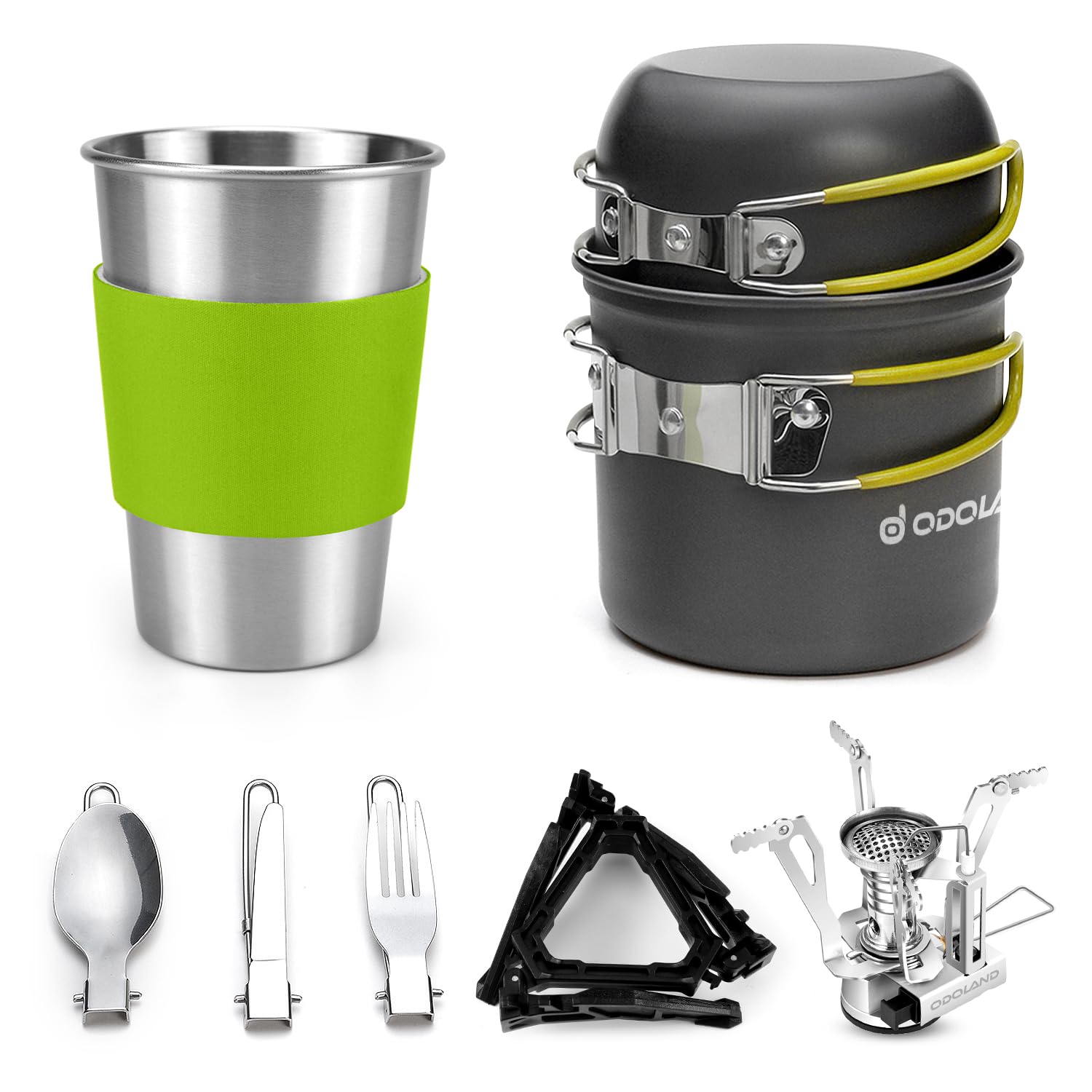
Odoland 11-Piece Set
Key Features
- Pots: Two nonstick aluminum pots
- Stove: Folding canister stove included
- Pieces: 11
- Weight: 1.41 lb
- Price: Budget
This is the only kit here that brings its own stove. Eleven pieces — a folding canister burner, two nonstick pots, a 16-ounce stainless cup and three utensils — and you can hand it to someone who has never cooked outside and say, that is everything. We think that is worth a lot for a first set: one purchase, one bag, no parts to match up.
The burner folds flat and the pot handles fold in, and the whole thing nests into a mesh bag at 0.64 kilograms. The igniter lit first time on every evening we used it, and the smaller pot did most of the work — instant coffee, a rehydrated dinner, water for washing up.
What you give up is refinement: the utensils are basic, the small pot is really a two-cup pot, and this will not be the last cook set you buy. For a first season, a bug-out bag or a car kit that occasionally walks into the woods, that is a fair trade.
Pros
- Folding canister stove included
- Two pots, cup and utensils in one purchase
- Nests into a mesh bag at 0.64 kg
Cons
- Pot support arms flex under a full pot
For a first set, or one bag that covers a stove and pots together, this is the kit we hand over: everything matches and nothing is missing.
Best for Group Camp Dinners
ALOCS 7-Piece Cookware

Key Features
- Pan: 7.5 in
- Pieces: 7
- Weight: 2.1 lb
- Capacities: 2.2 L, 1.2 L, 1 L pots
- Price: Midrange
Three pots — 2.2, 1.2 and 1 liters — plus a 7.5-inch frying pan. That is more cookware than most backpackers carry, and that is the point: this is the set you split across three or four people, one pot for rice, one for the stew, one for water.
The handles are welded on rather than riveted, with silicone grips that fold in, and the whole thing nests into a bundle that weighs 2.1 pounds — a bit over half a pound per person if there are four of you. That is the arithmetic that makes this set worth carrying.
Cooking with it is a different exercise from a one-pot kit. We found the aluminum spreads heat evenly enough for a simmer rather than a scorch, and a second pot means a sauce and a pot of pasta can happen at the same time. The nonstick is the weak point: cook dry or hot and food welds itself to the pan, so carry a little oil and keep the flame low.
For a group who share the load, this is the set that makes a proper camp dinner possible rather than a rotation of rehydrated bags. On your own it is three pots too many and two pounds you will resent carrying.
Pros
- Three pots plus a 7.5-inch pan
- Welded handles with silicone grips
- 2.1 lb split across three or four
Cons
- Handle welds can fail under a heavy pot
- Nonstick needs oil and a low flame
For three or four people splitting the load, this is the set we recommend: three pots and a pan that turn a camp dinner into an actual meal.
How We Tested Backpacking Cookware Sets
We started with spec sheets: packed weight, nested dimensions, pot capacity, material and coating, and whether a set came with a stove, bowls, or a scraper. That filtered a long list down to 12 sets, which we weighed on a kitchen scale with and without the stuff sack, then packed into a 50-liter pack alongside a sleeping bag and a bear can to see how much room they really stole.
Testing ran for eight months, mostly across weekend trips and a couple of longer ones, with plenty of lunches boiled on a picnic table when the weather refused to cooperate. Each set boiled two cups of water on the same canister stove while we timed it, simmered a pot of rice, then took a deliberate bump to see whether the pot held its seat on the burner arms or slid off. We scrambled eggs in the coated pots and scraped them with a metal spoon on purpose, then washed everything in cold water with a scraper.
Handles got their own round of abuse: bare-handed lifts at a rolling boil, then again through a bandana, noting which pots made us improvise. Fit and finish counted as much as the scale did — whether lids seated without rattling, whether the small pot nested without grinding against the big one, and whether the whole set went back in the bag the same way it came out. Eight months in, we looked for dents, loosened handles, and coating starting to lift, and we set what each set included against what it cost.
How to Choose a Backpacking Cookware Set
Start from the meal you actually cook on the trail, not the piece count on the box — that decision sets your pot size, your weight budget and whether you need a pan at all.
Match capacity to mouths, not to piece count
A liter is the practical solo size: enough water for a packet of ramen plus a hot drink, and the pot doubles as a bowl. Two people sharing one pot want 1.5 liters or more. For three or four, two or three pots beat one big one, because you can cook two things at once — that is exactly the case the ALOCS set makes.
Piece counts are marketing. A 10-piece kit and a 17-piece kit can both feed two people, and one of them leaves noticeably more room in the pack. Count vessels, not items.
Decide what the weight buys you
Titanium is the lightest and the priciest per pot: the TOAKS 750 comes in at 3 ounces, and it takes a beating. Aluminum spreads heat more evenly, which matters if you fry, and it costs less. Stainless is heaviest — the MSR pot here runs about three times the titanium pot’s weight for 475 milliliters — and it is the only one of the three you can drop in a fire without a second thought.
Our rule: titanium for boiling, aluminum for cooking, stainless for fire. The trap is buying a set sold as backpacking gear that turns out to be a basecamp kitchen; if the bundle needs two hands, it is not going on your back.
A pot boils; a pan cooks
Every set here boils water. The real difference is whether you can fry, simmer or finish a sauce. A 7-inch nonstick pan turns a dehydrated dinner into something you would choose to eat, but coating is always the first thing to wear: soft utensils, moderate heat, no scrubbing with sand.
If you only ever boil, a bare titanium pot is lighter and has no coating to peel. If you cook, accept that the pan is a consumable and buy accordingly.
Check the nest, the lid, and how the pot meets the stove
A good set earns its place by what it swallows: a fuel canister, a folding stove, a lighter, a scrubber, so nothing rides loose in your pack. A lid that sits on rather than locking is fine in camp and annoying in a pack.
Then watch the interface. Three thin folding arms under a wide, full pot is a wobble waiting to happen, and a heat-exchanger base wants flame spread across the whole finned ring rather than a narrow jet in the middle.
Frequently Asked Questions
Will a 110 g fuel canister fit inside the pot?
Usually, if the pot is wide enough. The TOAKS 750 lists 3 3/4 inches of internal diameter and 4 3/8 inches of height, and a 110 g canister drops straight in with room left for a stove and a lighter. Use those two figures as your test on any other pot: narrower than about 3 3/4 inches inside, and the canister travels loose.
What else do I need to buy with a backpacking cook set?
Fuel, a lighter or matches as a backup, a small scrubber or half a sponge, and a bandana or pot grip for hot handles and lids. If the set gives you one pot and one cup, add a folding bowl if you like to eat out of something other than the pot.
That is the list. Most of what a big kit includes beyond pots, pan and a cup stays in the car.
Can I cook inside my tent if it is raining?
No. Canister stoves produce carbon monoxide, and a closed tent or vestibule can concentrate it to a dangerous level quickly. Cook outside, using a tarp or a rock wall for shelter if you can. If the weather rules that out, eat cold and boil water at the next stop.
Final Verdict
Start with the Fire-Maple Feast. It is the only set here built around a heat exchanger, it nests into a 1.7-pound bundle, and it gives two people a pot, a kettle and a pan without a second bag. If you hike alone and count ounces, the TOAKS 750 is the better companion; if your heat comes from coals rather than a canister, take the stainless MSR Stowaway and stop worrying about the coating.