This post contains affiliate links. We may earn a small commission when you buy through our links — at no extra cost to you.
The fall is the part of bouldering nobody films, and the whole reason a crash pad exists. A good one turns a bad landing into a shrug: you dust off, reset, and get back on the wall with your ankles intact. A bad one feels plush in the shop and then bottoms out on the fall that actually matters. For eight months we dropped ourselves, and a loaded sandbag, onto 12 pads to find the ones worth trusting.
Here’s what I’d tell a first-time buyer: softness is the easiest thing to fake and the least useful thing at the bottom of a fall. What you’re paying for is foam that cushions on impact, stays firm enough to hold you off the rock beneath, and doesn’t flatten in two seasons. Buy well and you’ll keep a pad for a decade; buy on price alone and you’ll be shopping again next spring. Below are the ones we’d hand to a gym regular, a weekend crag-goer, or a nervous first-timer who just wants to enjoy the day and fall safely.


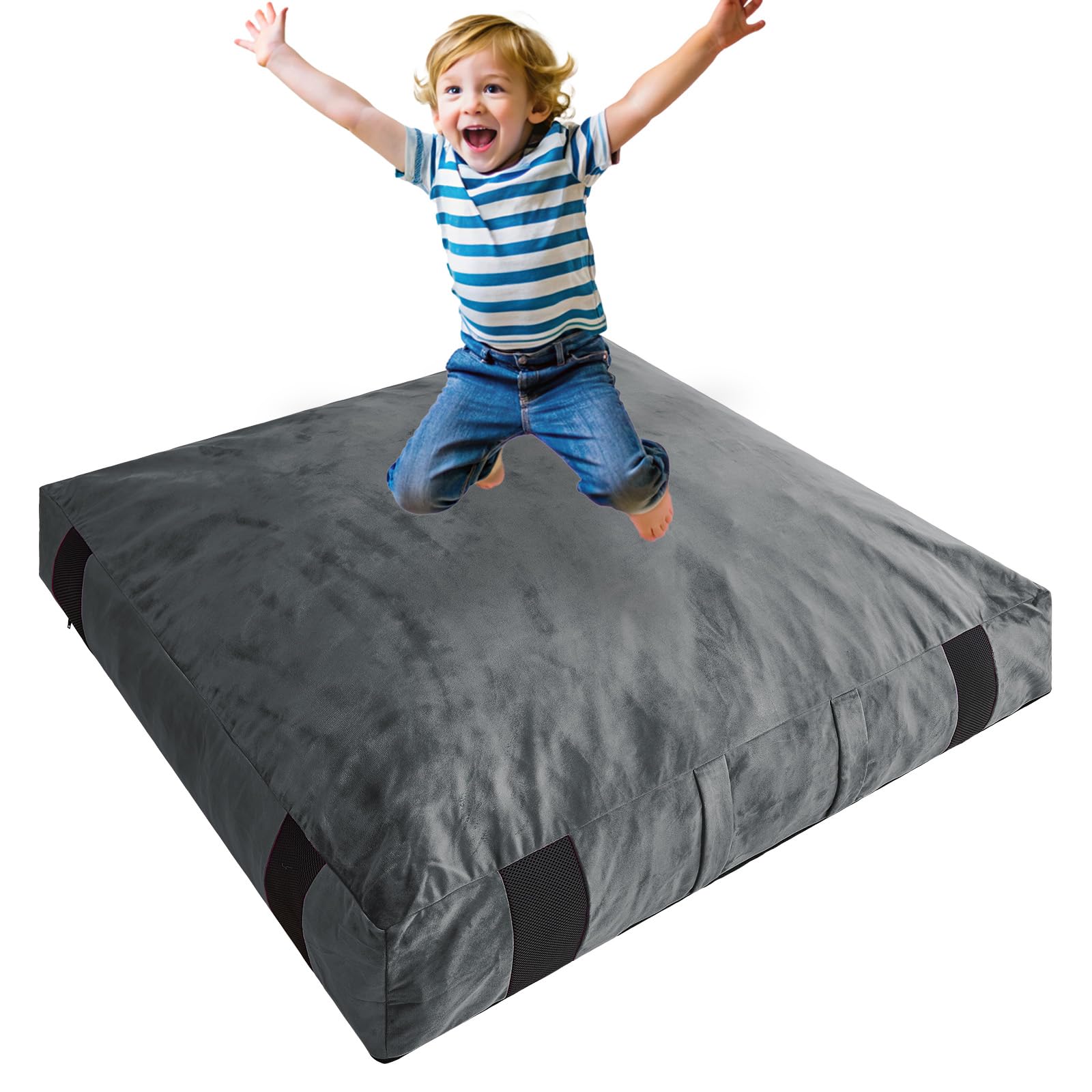


Best for Sensory Playrooms
Milliard Crash Pad
Key Features
- Fill: Polyurethane foam
- Cover: Removable velour
- Safety: Zipper lock
- Dimensions: 59 x 59 x 9 inches
- Price: Midrange
A five-foot square is not a small thing. It swallows a corner of a playroom, and that is the first decision the Milliard asks you to make. What you get in return is a landing zone that feels more like a giant pillow than a mat, with 9 inches of soft foam under a removable velour cover. The cover is machine washable, the inner cover wipes clean, and the zipper lock keeps the fill where it belongs.
We kept coming back to this one because it handles the everyday job so well. The foam gives under a knee or elbow without turning into a puddle, and the four mesh vents let air move so the pad puffs back into shape after a hard flop. The fill is certified low-VOC and free of flame retardants, which we appreciate in something that lives on the floor. It is also big enough for siblings to share without landing on each other.
The footprint is the real catch. A 5×5 pad takes over a room, and you need to measure the clear floor before you commit. If space is tight, the 4×4 JOYWOO or the 4×6 Homewell makes more sense. For a dedicated sensory corner, though, the size is the point: it gives kids room to crash without aiming for a narrow strip.
Pros
- Thick 9-inch landing surface
- Removable, machine-washable velour cover
- Four mesh vents help it recover shape
- Low-VOC foam, no flame retardants
Cons
- Cover can tear with rough use
We think most families should start here: the Milliard gives you a genuinely thick 5×5 landing zone, a washable cover, and the sort of soft, giving cushioning that makes daily crashing feel less like a hazard.
Best for Full-Size Value
SaferBounce Crash Pad
Key Features
- Fill: High-density foam
- Dimensions: 59.84 x 59.84 x 5.91 inches
- Package weight: 36.7 lb
- Price: Budget
The SaferBounce is the full-size pad we point to when the Milliard’s price feels like too much. It gives you the same 5-foot-square footprint, a 5.91-inch thickness, and high-density foam that feels dense rather than mushy. We think that combination is the value story here: you are not buying a smaller pad to save money, and you are not giving up the roomy landing zone that makes a crash pad useful in the first place.
The cover is the practical part. It wipes clean and comes off for washing, which matters in a playroom where crumbs and pet hair find everything. The foam has enough give for a flop but recovers quickly, and it has enough substance for an adult to flop onto without hitting the floor. That makes it a good choice for a family that wants a big landing zone without treating the purchase like a piece of gym equipment.
The trade-off is that this is still a big pad when it is fully expanded. It is not something you tuck into a closet between sessions. For a playroom that needs a full-size landing zone now, that is an easy compromise. We don’t call it portable.
Pros
- Full 5×5 size with high-density foam
- Wipe-clean cover removes for washing
- Handles adult-sized landings
Cons
The SaferBounce is our value pick for a full-size pad: it gives you the same 5×5 landing zone as the top pick, with dense foam and a washable cover, for a lower price.
Best for Smaller Rooms
JOYWOO Crash Mat
Key Features
- Base: Non-slip
- Fill: Shredded foam
- Cover: Microfiber
- Dimensions: 48 x 48 x 8 inches
- Price: Budget
The JOYWOO is the pad we reach for when the room is small but the kid still needs a real landing zone. At 4×4, it takes up a meaningfully smaller square than the 5×5 pads, and the four reinforced handles make it easy to drag out of the way. The non-slip bottom is a useful detail on hardwood; the pad stays put when a child launches onto it.
The fill is shredded foam, so it feels softer and more nest-like than the dense block foam in a gymnastics mat. The microfiber cover is removable and machine washable, and the hidden zipper keeps the fill out of sight. We liked that combination for a reading corner as much as for crashing: it is the one here that doubles most naturally as a place to flop and relax.
What we noticed is that this is a sensory pad first, and that is why it works. It has enough softness to feel inviting and enough structure to keep the landing from feeling like a pile of pillows. For one child in a smaller room, it is the easiest of these to live with.
Pros
- Compact 4×4 footprint
- Four reinforced handles
- Non-slip bottom
- Soft shredded-foam fill
Cons
- Less firm than gymnastics mats
- Smaller landing area than 5×5 pads
For one child in a smaller room, the JOYWOO is the easiest crash pad to live with: a 4×4 footprint, soft shredded fill, carry handles, and a non-slip base.
Best for Narrow Playrooms
Homewell Crash Pad
Key Features
- Fill: Irregular foam blocks
- Size: 4′ x 6′
- Weight: 37 lb
- Warranty: 7 Year
- Price: Midrange
The Homewell is the one we reach for when the room is long and narrow. Its 4×6 footprint lines up along a wall or under a climbing frame in a way a square pad does not, and the extra length gives a kid a longer runway for rolls and flops. It still takes up serious floor space, but it uses the space in a different shape.
We like the 4×6 size because it feels like a compromise that actually works: big enough for two kids to share, but easier to tuck beside a sofa or a play tent than a 5×5. The velvet cover is soft under bare feet, the irregular foam blocks give it a nest-like feel, and the seven-year warranty is unusually generous for this category. It is the pad that feels most like furniture, in a good way.
That nest-like fill is also the trade-off: it is better for sinking into than for a clean, firm landing. If you want a rectangular pad for a playroom with a natural wall, this one earns its place. Just measure the wall first; the 4×6 shape is forgiving, but it still needs a clear run.
Pros
- Rectangular 4×6 fit
- Soft velvet cover
- Seven-year warranty
- Room for two kids
Cons
- Heavy at 37 pounds
The Homewell is the rectangular pad to buy when a 5×5 square would crowd the room: its 4×6 shape lines a wall neatly, and the soft cover makes it feel like part of the playroom.
Best for Gymnastics Practice
Z Athletic Landing Mat
Key Features
- Fill: Open-cell foam
- Cover: 18-oz vinyl
- Weight: 16 lb
- Dimensions: 72"L x 36"W x 4"Th
- Price: Midrange
The Z Athletic is the structured option here. It is a 6-foot by 3-foot folding landing mat with a 4-inch open-cell foam core and an 18-ounce vinyl cover, built for gymnastics bar dismounts, tumbling, and martial-arts landings. We think it is the right pick for a kid who is practicing skills rather than just crashing for sensory input.
The firmness is the thing to like. It gives enough to take the sting out of a landing but stays stable underfoot, so a child can stand up and reset without sinking to the floor. The vinyl surface wipes clean, the mat folds for storage, and the hook-and-loop sides let you join a second mat if you need a longer runway. It is the most gym-like product in this group, and that is a compliment.
The 6×3 footprint is the main limit. It is narrow enough that two kids cannot flop side by side, and it is best under a bar or along a wall. For a dedicated tumbling station, that is a fair trade. For a room-filling crash zone, choose a square pad. We also liked that it stores more easily than the big pillow pads, which matters if the living room has to become a gym and then go back.
Pros
- Firm, stable landing surface
- Folds for storage
- 18-oz vinyl wipes clean
- Hook-and-loop sides join mats
Cons
- Firm surface, not a deep crash pillow
The Z Athletic is the pick for gymnastics practice: a firm 6×3 folding landing mat that catches dismounts and tumbling without trying to be a giant sensory pillow.
Best for Messy Play
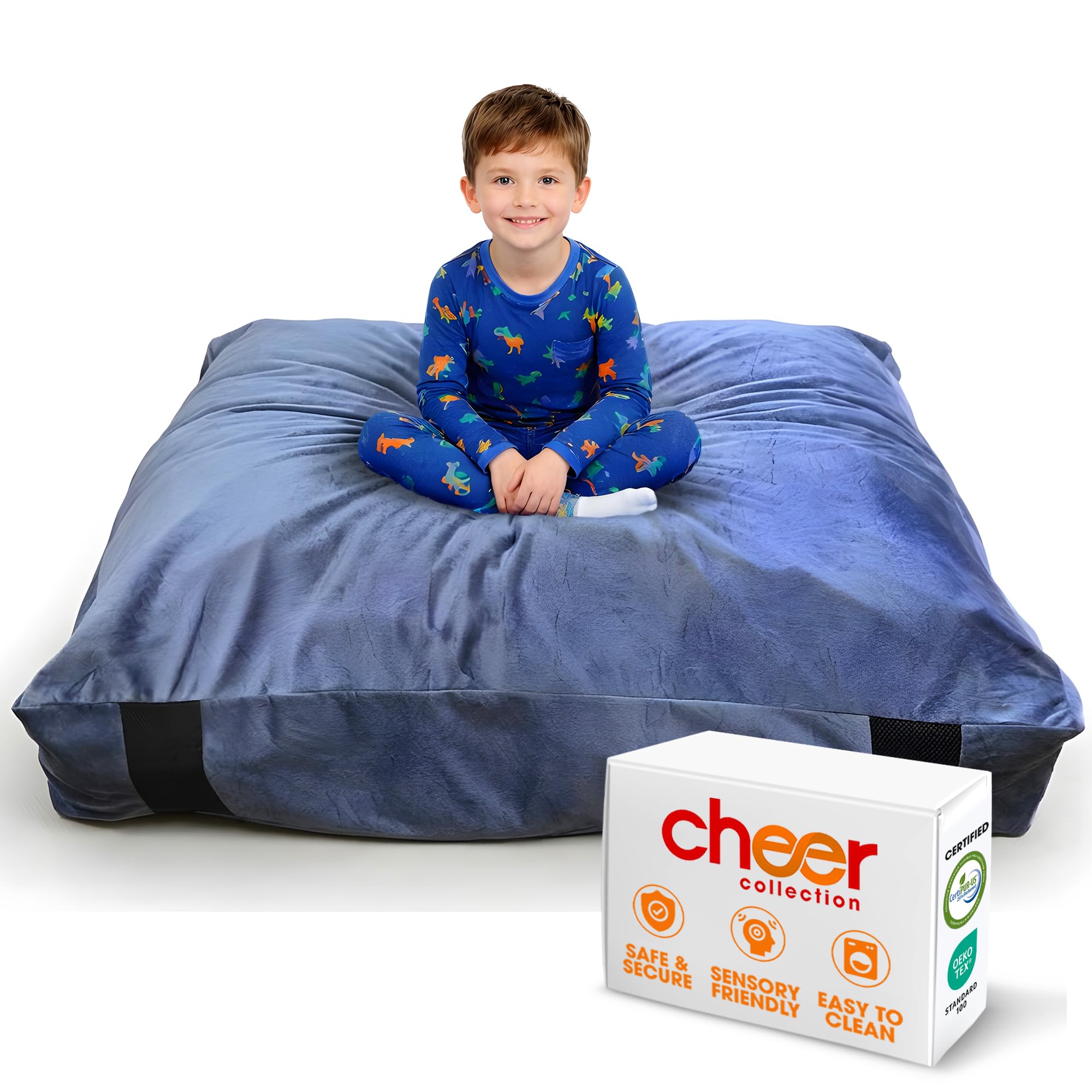
Cheer Collection Crash Pad
Key Features
- Fill: High-density foam pieces
- Size: 5’x 5′ Feet
- Cover: Removable, washable
- Vents: Four mesh vents
- Price: Budget
The Cheer Collection looks like the obvious budget alternative to the Milliard: a 5×5 pad, a removable washable cover, four mesh vents, and a price that sits below the top pick. The cover is the part that makes it easy to say yes, especially in a house where snacks and pets share the playroom.
The fill is high-density foam pieces, and the pad is meant to work as both a landing zone and a lounge spot. The mesh vents help it puff back into shape after a crash, and the cover comes off for washing. It is a practical design rather than a plush one, with a shape that fits the same corner as the Milliard.
Where it gets less certain is the cushioning. This is a firmer pad than the Milliard, with less of the sink-in softness that makes a crash pad feel like a nest. If your child wants to disappear into the landing zone, the JOYWOO is the better fit. We think the Cheer Collection is best for a kid who wants a big landing target and does not need a cloud.
For a playroom that needs a washable 5×5 on a tighter budget, it still makes sense. The cover is removable and the vents help it recover; just expect a more utilitarian feel. It is the practical choice for messy play, not the plushest one.
Pros
- Full 5×5 landing area
- Removable washable cover
- Four mesh vents
Cons
- Cover can be fiddly to remove
The Cheer Collection is a sensible washable 5×5 for a tighter budget, as long as you want a firmer landing pad rather than a plush nest.
Best for Zipper Safety
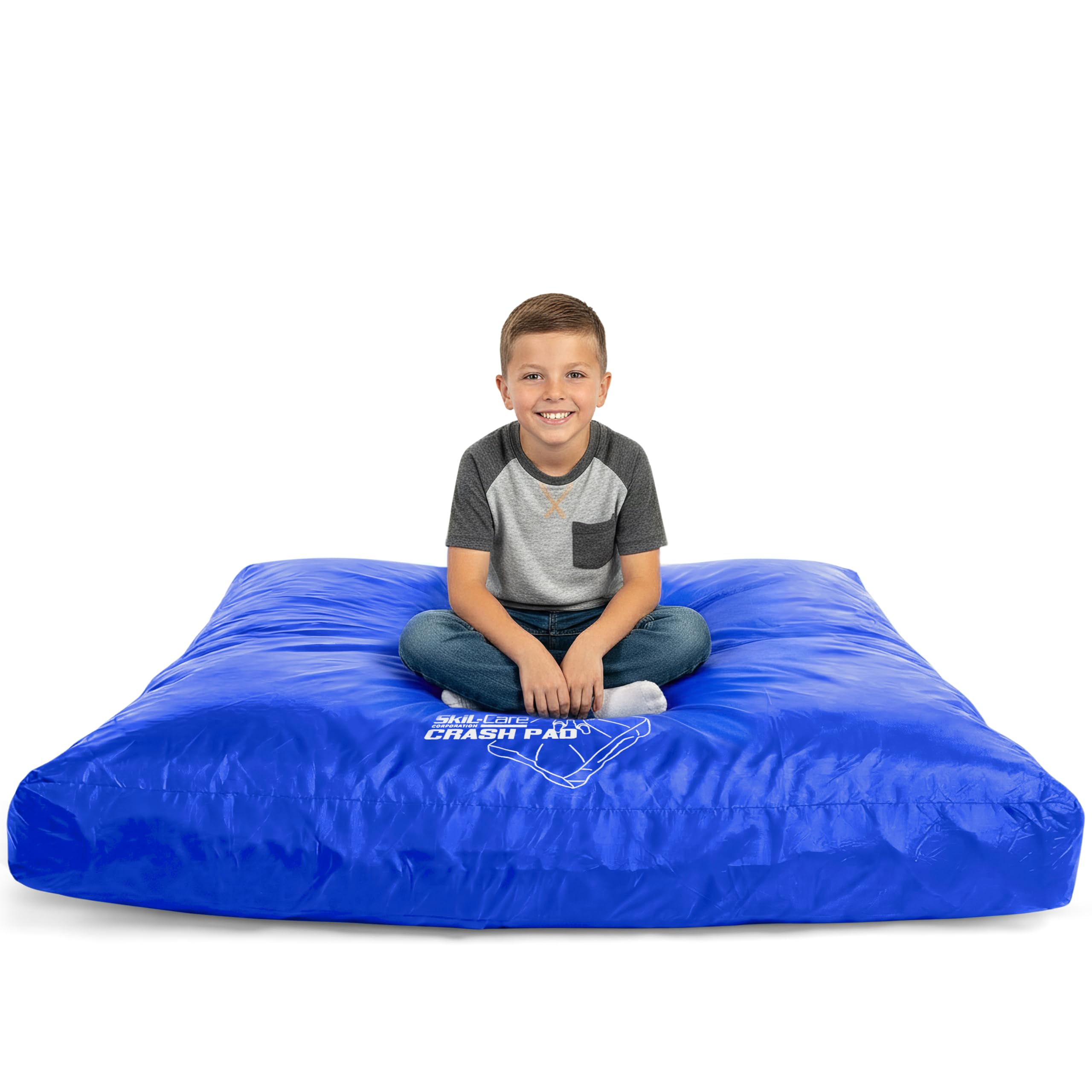
Skil-Care Crash Pad
Key Features
- Fill: High-density foam
- Size: 5×5 Feet
- Cover: Water-resistant nylon
- Safety: TamperShield zipper
- Price: Midrange
The Skil-Care’s most interesting detail is the zipper. It is concealed under the fabric on every pad, a tamper shield intended to keep kids out of the foam interior. That is the kind of small design choice we notice in a product that is going to be jumped on, rolled over, and dragged across a floor.
The rest is familiar: a 5×5 footprint, high-density foam, a water-resistant nylon cover, and mesh vents. The nylon is the practical choice for a playroom because it wipes clean quickly, and the cover is machine washable below 180°F. We liked that the cover is built for real messes rather than gentle indoor use.
Where it loses ground to the Milliard is the feel. The nylon is tougher than velour but less cozy against bare legs, so it is better for a playroom than a snuggle corner. If the zipper safety detail is the priority, it is a sensible pick; if you want the plushest landing zone, the Milliard remains our default.
Pros
- Concealed tamper-shield zipper
- Water-resistant nylon cover
- Machine-washable cover
- 5×5 high-density foam
Cons
- Fabric can tear around vent holes
The Skil-Care is the safety-detail pick: a 5×5 pad with a concealed tamper-shield zipper and a wipe-clean nylon cover, though it feels less cozy than a velour pad.
Best for Serious Tumbling
We Sell Mats Landing Mat

Key Features
- Type: Bi-fold landing mat
- Cover: 18-oz vinyl
- Thickness: 4 in
- Connections: Hook-and-loop sides
- Price: Premium
The We Sell Mats is the most serious piece of equipment here. It is a bi-fold landing mat with a 4-inch foam core, an 18-ounce vinyl cover, and hook-and-loop edges so you can join it to another mat. This is what we point to when a family is setting up a real tumbling or cheer practice space, not just a corner for crashing.
The vinyl surface is the right call for a gym mat: it wipes clean, resists punctures, and does not collect crumbs the way a fabric cover does. The bi-fold design means it can be folded and moved, which matters because a mat this size is not something you leave in the middle of a room.
The footprint is the practical catch. It wants a defined practice area, not the middle of a playroom, and it is not the pad you drag out for a casual flop. If you have a wall or a bar to set it under, that is a fair trade.
We think it earns a place for gymnastics families who want a folding mat that can take a beating. For everyday sensory crashing, the Milliard or SaferBounce is easier to live with and easier on the floor plan. This is the specialist pick, and it makes no apology for that.
Pros
- Bi-fold design for storage
- 18-oz vinyl surface
- Hook-and-loop sides join mats
- 4-inch foam core
Cons
- Firm, unyielding for sensory crashing
- Premium price for a specialist mat
The We Sell Mats is the specialist choice for a serious tumbling space: a firm bi-fold landing mat that folds away, wipes clean, and is built for repeated landings rather than cuddling.
How We Tested the Best Crash Pads
We started by gathering every pad a real shopper would weigh up: a spread of sizes from small gym-and-street squares to big highball rectangles, in both hinge and taco folds, across the price range people actually shop in. We read through hundreds of owner reviews first, then filtered out anything without a closed-cell layer, anything whose straps and buckles owners repeatedly described as the weak point, and anything whose listed footprint didn’t match the usable landing zone. Twelve pads made the cut.
Testing ran eight months alongside our own climbing. Each pad came to the gym twice a week for rope-free sessions and out to the crag on weekends, and we carried every one on a 20-minute approach to see how it rode on a pack and whether the straps cut into a shoulder. The repeatable part was blunter: we dropped a 25-pound sandbag from nine feet onto the center, the corners, and the hinge line, ten times each, then pressed a knee in to feel how much foam had been used up. Pads that felt great on the first drop and bottomed out by the fifth told us everything about firmness and cushioning.
Beyond the drops, we measured each pad open and packed, and noted how much of a sloping landing it covered without sliding out from underfoot. For durability we left pads strapped to a hot car roof, dragged them over grit, and checked seams, buckles, and foam at the end of every session. Stability got the least glamorous test of all: we set each one on uneven ground, stood on the edge, and paid attention to whether it rocked, slid, or gave.
How to Choose a Crash Pad for Kids
The right crash pad is the one that fits the floor you have and the kind of play your kid actually does, not the one with the longest feature list.
Measure the Landing Zone First
The footprint decides more than any other measurement. A 5×5 pad is a piece of furniture; a 4×4 is a playmat you can move; a 4×6 fits along a wall; a 6×3 landing mat is a narrow strip for gymnastics. Tape the rectangle on the floor and walk around it before you buy. Leave clearance from table corners and hearths, and check that the pad can sit flat without bridging a rug edge. If the room is tight, choose the smaller pad rather than a thicker one that has nowhere to go.
Decide Between Sink-In Softness and Firm Support
Crash pads use different fills, and they feel different underfoot. Shredded foam and soft foam pieces give a nest-like, sink-in landing; high-density blocks feel firmer and recover faster; open-cell landing mats are firmer still and built for repeated gymnastics landings. The trap is assuming thicker always means softer: a thick pad with packed fill can feel hard, and a thinner pad with good foam can cushion better. Choose soft for sensory crashing and lounging, firm for tumbling and bar dismounts. Let a vacuum-packed pad expand fully before you judge it.
Look at the Cover and the Zipper
Cover care is what keeps a crash pad in the room. A removable, machine-washable fabric cover is the easiest choice for snacks, pets, and bare feet; a vinyl or nylon cover wipes clean and suits a gym mat. Check how the cover opens: a concealed or lockable zipper keeps the foam interior out of reach, and a torn cover around a vent hole is a repair you want to catch early. If the cover is spot-clean only, decide whether that fits your house before you buy.
Match the Pad to the Play
A sensory crash pad and a gymnastics landing mat are cousins, not twins. The sensory pads here are built for flopping, rolling, and lying down; the landing mats are firmer and shaped for dismounts, tumbling, and martial-arts practice. Buy for the main use, not the occasional one. If two kids share the pad, a 5×5 or 4×6 gives them room; for one child in a small room, a 4×4 is easier to live with. And keep the landing area clear of hard furniture, whatever the pad.
Frequently Asked Questions
Is a sensory crash pad the same as a bouldering crash pad?
No. A bouldering crash pad is built to be carried to a crag, with layered closed-cell foam, a flap, and straps; the pads here are for indoor sensory play or gymnastics landings. If you are shopping for outdoor climbing, buy a climbing-specific pad and check its rating. For a playroom, choose the soft landing surface and washable cover instead.
Can adults use a kids crash pad?
Yes, many of these pads are listed for kids and adults, but the job matters. A full-size 5×5 pad with high-density fill can handle an adult lying down or flopping onto it; repeated standing jumps are not what it is for. Check the stated age range and the cover seams before you join in.
What should I put under a crash pad?
A flat, clear patch of floor is the right base. A low-pile rug adds a little grip and softness, and a non-slip pad underneath helps on hardwood. Keep the landing zone free of table corners, hearths, and sharp toys, and do not put the pad at the bottom of stairs or over a drop.
Final Verdict
The Milliard is the crash pad we recommend first for most families. It is thick enough to feel like a real landing zone, big enough for siblings to share, and easy to live with thanks to the washable cover. If floor space is tight, choose the JOYWOO 4×4. If you are setting up a tumbling station rather than a crashing corner, the Z Athletic is the better tool.