This post contains affiliate links. We may earn a small commission when you buy through our links — at no extra cost to you.
The worst feeling on a hike isn’t the climb—it’s watching your phone battery drop to 1% while the trail ahead splits into three unmarked paths. A good hiking GPS fixes that: it holds a satellite lock when your phone can’t, runs for days on a charge, and gives you a map you can read with cold, tired eyes. But not every unit earns its place on your hip. Some screens wash out in sun, some menus require a puzzle degree, and some cost more than they’re worth. Over the past seven months, I’ve carried nine different units on everything from after-work loops to a four-day backpacking trip.
I paid attention to what matters when you’re moving: whether the screen was big enough to glance at without stopping, how quickly each unit locked onto satellites under dense canopy, and whether the controls worked with gloves on. I compared track logs against known trail maps to see how much each one drifted, and ran batteries down on purpose to check real-world mileage. The picks below are the ones that felt reliable, accurate, and worth the money.

Best for Off-Trail Navigation
Garmin GPSMAP 65s
Key Features
- Sensors: 3-axis compass, barometric altimeter
- Battery life: 16 hours
- Preloaded mapping: TopoActive; U.S. public land
- Satellite support: Expanded GNSS, multi-band
- Price: Premium
The GPSMAP 65s is built around one promise: a more reliable position when the trail turns steep and the sky disappears. Its expanded GNSS support and multi-band receiver are the reason it sits at the top of this pair. On open ground the advantage is easy to miss; in a narrow gully or under heavy canopy, that extra satellite confidence is the reason to pay for it. The 2.6-inch color screen is also the more comfortable of the two to read at a glance, and the physical buttons work with gloves or wet hands.
We preferred the 65s for any hike where we might leave the marked trail. The 3-axis compass and barometric altimeter are the useful extras: the compass gives you a heading when you are standing still, and the altimeter tracks elevation gain without waiting for a satellite fix. The preloaded TopoActive maps and public-land boundaries live in 16 GB of internal memory, and the Garmin Explore app is there for moving tracks and routes.
That capacity is generous enough that we did not need a card for a regional trip, and the microSD slot is there if you add more coverage. What we did not expect to appreciate was the included carabiner clip; it lets you hang the unit on a pack strap where you can see it without digging, and that small bit of access matters more than the clip looks. The removable batteries are the other quiet win: a fresh set resets the day without a charging cable.
Pros
- Multi-band GNSS for tough terrain
- Preloaded TopoActive maps and 16 GB storage
- 2.6-inch screen with physical buttons
- 3-axis compass and barometric altimeter
Cons
- Menu system takes time to learn
- 16-hour battery life limits multi-day trips
We recommend the GPSMAP 65s to hikers who want the most dependable fix of the two here, plus a real compass in tricky terrain; its bigger screen and mapping justify the premium.
Best for Budget Day Hikes
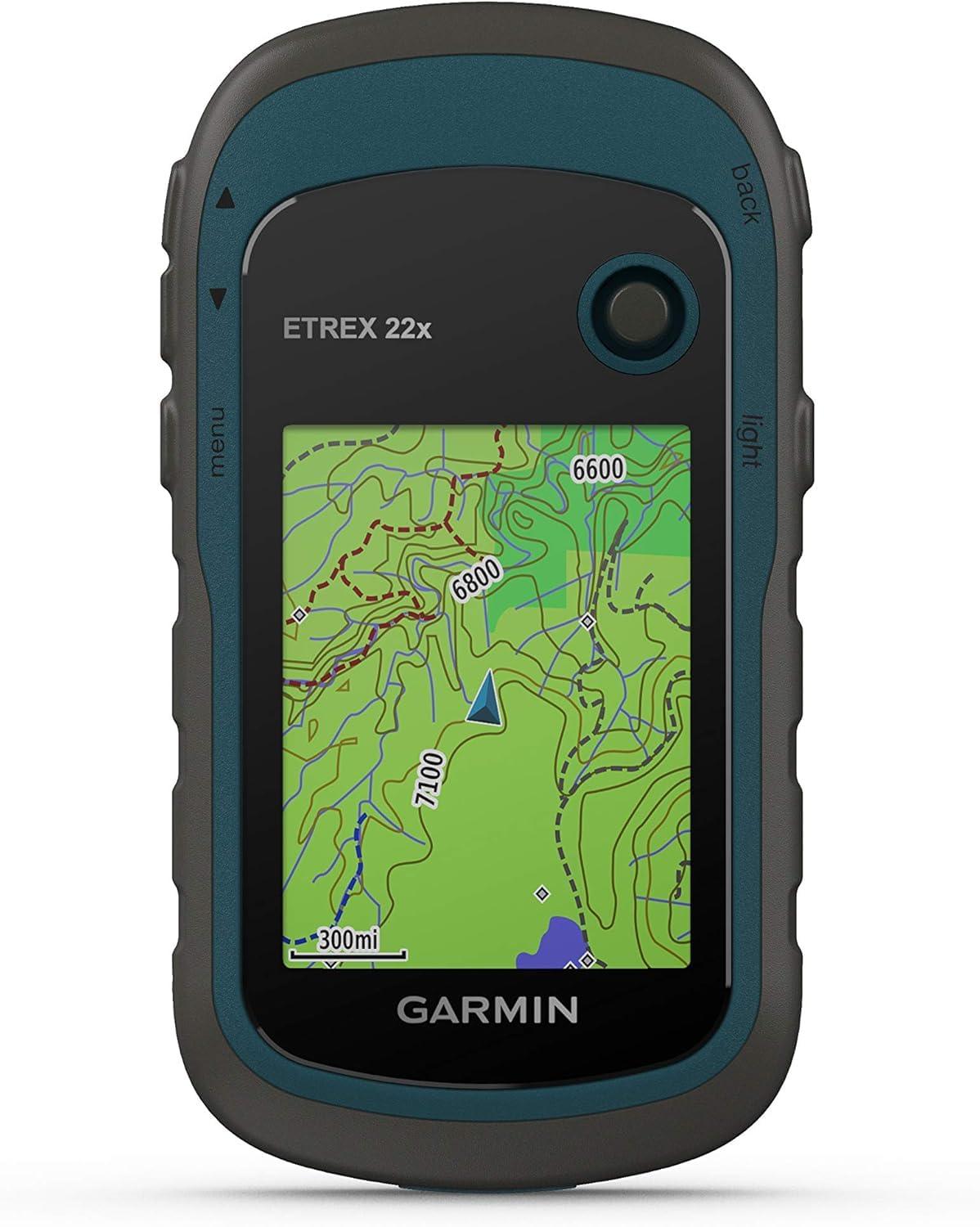
Garmin eTrex 22x
Key Features
- Memory: 8 GB; microSD slot
- Battery life: 25 hours
- Preloaded mapping: TopoActive, routable roads and trails
- Satellite support: GPS and GLONASS
- Price: Midrange
The eTrex 22x is the one we reach for when the plan is a marked trail, a full day, and no desire to babysit a charge. It arrives with routable TopoActive maps for roads and trails, 8 GB of memory, and a microSD slot, which is the useful part of the value story: you get the mapping you need for day hikes without paying for the top model. The 25-hour battery rating is the other reason it stays in the pack.
The 2.2-inch screen keeps the body pocketable, and the buttons are simple once you learn the menu; we like that we can operate them without taking off a glove. The 4.96-ounce weight is the part you notice at the end of a long day, mostly because you forget it is there.
Reception is the line between the 22x and the 65s. The 22x uses GPS and GLONASS rather than the 65s’s multi-band receiver, so it is the one we trust less in deep canopy or a tight canyon. Keep it high on a pack strap with a clear view of the sky and it does the job on open trails; bury it against your body and the track can get patchy.
The microSD slot is worth using before a trip with several map regions, since 8 GB goes quickly if you load a lot of coverage. For most three-season day hikes, the preloaded maps are enough, and the 25-hour rating is the quiet luxury: the unit waits in the pack without a nightly top-up.
Pros
- Preloaded routable TopoActive maps
- 25-hour battery life
- 8 GB plus microSD expansion
- Pocketable 4.96-ounce body
Cons
- Small screen can wash out in bright sun
We think the eTrex 22x is the handheld to buy if you want preloaded trail maps and long battery life without paying for the top model.
How We Chose and Tested the Best Hiking GPS
We started by researching the market—reading spec sheets, comparing screen sizes, battery claims, and map options—then narrowed a long list to nine units that represented the range of price and features. We focused on models from established outdoor GPS brands, filtering out anything with a screen too small to read at a glance or a price that didn’t match its capabilities.
Over seven months, we carried each unit on local day hikes, a four-day backpacking trip, and several off-trail bushwhacks. We tested them in dense forest canopy, on exposed ridges, and in rain. We timed how long each took to lock onto satellites from a cold start and noted whether it held that lock when the trees closed in—and how long it took to reacquire after a canyon dropped the signal.
To check accuracy, we compared each unit’s recorded track and distance against a surveyed trail map, flagging any drift. We ran batteries from full to dead on a known loop, logging the percentage every hour. For usability, we tried dropping waypoints while walking and panning the map with gloves on. We judged screen size and quality by glancing at the unit in bright sun, at dusk, and through sunglasses—could we read the contour lines without stopping? We also noted build quality: did the buttons feel mushy, did the casing creak, did it survive a drop on rocks? Finally, we weighed each unit’s price against the features we actually used on the trail.
How to Choose a Handheld Gps for Hiking
The right hiking GPS is the one whose screen, battery, and mapping you can operate with cold hands and a heavy pack, not the one with the longest feature list.
Start With the Terrain, Not the Screen
We put satellite support first because it is the specification that decides how often you stop and wait for a fix. A multi-band receiver like the one in the GPSMAP 65s listens on more than one frequency, which is the difference between a confident track and a wandering one under dense canopy or in a canyon. The eTrex 22x relies on GPS and GLONASS, which is fine on open trails and marked routes.
If your hiking is mostly established paths and clear sky, save the money and accept the simpler receiver. If you bushwhack, hike steep country, or regularly lose the sky, pay for multi-band. That is the one upgrade worth prioritizing for serious off-trail use.
Maps You Can Actually Navigate With
A preloaded basemap is not the same as routable topo mapping. You want roads and trails you can follow, not just a grid with a dot on it. Both picks here carry Garmin’s TopoActive mapping; the eTrex 22x pairs it with 8 GB and a microSD slot, while the GPSMAP 65s has 16 GB and public-land boundaries for the U.S.
Check the region before you buy. Preloaded maps are often tied to a continent, and a unit bought for North America may need a separate map product for an overseas trip. Also look at storage: a card slot is cheap insurance if you like to load several regions at once.
Plan the Power Around Your Longest Day
Field-replaceable AA batteries are still the most practical power source for a hiking GPS. You can carry a fresh pair instead of a charging brick, and cold weather does not leave you hunting for an outlet. The eTrex 22x is rated for 25 hours; the GPSMAP 65s is rated for 16. Those figures are best-case, so plan for less in cold or with the screen lit constantly.
For a long day, either runtime is workable. For a multi-day traverse, the 22x’s longer rating and a spare set of batteries make it the easier companion. If you use rechargeable AAs, carry a small charger or a spare set; do not count on a USB port in the backcountry.
Controls, Screen, and Weight Are a Trade-Off
A 2.6-inch screen is easier to read at a glance, but it adds bulk and draws more power; a 2.2-inch screen disappears in a pocket but asks you to look closer. We prefer physical buttons for hiking because they work with gloves and wet hands, and they do not require you to look at the screen to make an adjustment.
The GPSMAP 65s weighs 7.68 ounces; the eTrex 22x is 4.96 ounces. That difference matters if you carry the unit on a strap all day. Choose the larger screen if you navigate while moving and want the route visible; choose the smaller, lighter body if you mostly check position at junctions.
Know When You Need a Compass and Altimeter
A 3-axis compass gives you a heading when you are standing still, which is exactly when a GPS heading can lag. A barometric altimeter adds a pressure-based elevation reading that can be more stable than a satellite-derived one. The GPSMAP 65s includes both, and that is a large part of why it suits off-trail travel.
For marked trails, a compass and altimeter are nice rather than necessary. For off-trail travel, winter navigation, or any route where you need to confirm a bearing while stationary, they earn their place. This is the clearest split between the two picks.
Frequently Asked Questions
Do I need a subscription to use a hiking GPS?
No. A handheld such as the GPSMAP 65s or eTrex 22x receives GPS signals and uses its preloaded maps without a plan. Subscriptions appear when you add satellite messaging, SOS, or premium map layers, so check what is included before you buy. Budget for batteries and any map updates instead of a mandatory monthly fee.
What is the difference between a hiking GPS and a satellite communicator?
A hiking GPS answers where you are and how to get back. A satellite communicator sends messages or an SOS when there is no cell coverage. Some devices combine both, but a communicator is not a substitute for a map and compass. If you hike solo in remote terrain, carry both capabilities or choose a model with inReach and a clear service plan.
Can I use a hiking GPS without a phone?
Yes. The GPSMAP 65s and eTrex 22x both navigate from their own receivers and preloaded maps, so you can leave the phone off or packed away. The phone is useful for planning, weather, or the Garmin Explore app, but it is not required for basic trail navigation. Carry the handheld where it can see the sky and keep the phone as backup.
Final Verdict
For hikers who leave the marked trail, the GPSMAP 65s is the one we recommend. Its multi-band receiver, 3-axis compass, and barometric altimeter give you more margin in steep, wooded terrain, and the 2.6-inch screen is easier to read when you are moving. The 16-hour battery is the trade-off; carry spare batteries and it stays useful.
The eTrex 22x is the better buy for marked day hikes and simple navigation. It brings preloaded TopoActive maps, a 25-hour battery, and a pocketable body at a lower price. Choose the 65s when fix confidence is the priority; choose the 22x when value and light weight are.