This post contains affiliate links. We may earn a small commission when you buy through our links — at no extra cost to you.
Every hiking watch promises to track your altitude, navigate you home, and last for days. But the real test comes when you’re miles from the trailhead and the battery is draining faster than expected, or the altimeter needs re-calibration.
The market pushes AMOLED screens and solar charging as must-haves, but few buyers realize that a bright display can cut battery life in half, and solar only extends run time if you spend hours in direct sun each day. Combined with the hassle of frequent altimeter calibration, it’s easy to overpay for features that don’t help. This guide cuts through the hype to help you pick a watch that actually matches how you hike.
Whether you need offline maps for remote routes, non-stop GPS for multi-day trips, or just reliable environmental sensors for day hikes, we’ve identified the watches that deliver real-world performance for their intended use.


Best for Daily Fitness & Hiking
Garmin Instinct 2
Key Features
- GPS & Navigation: Multi-GNSS, Tracback
- Battery Life: 28d smart, 30h GPS
- Sensors: ABC, good accuracy
- Display: 1.12" MIP monochrome
- Durability & Water Res: MIL-STD-810, 100m
- Price: Mid-Range
Where the top pick excels with offline maps and dual-band GPS, the Instinct 2 goes all-in on battery life and durability. Its 28-day typical charge and MIL-STD-810 toughness make it the watch you barely think about — no daily charging, no babying. The tradeoff is a monochrome MIP display and breadcrumb-only navigation, which means no color topo maps or turn-by-turn guidance. That suits a specific buyer: someone who wants reliable tracking and weeks of power, not a cartographic companion.
This is the right watch for backpackers traversing multi-week trails or tradespeople working in harsh environments. The comprehensive health sensors — heart rate, sleep, stress, Body Battery — run continuously without draining the battery. The small 1.12-inch screen may be hard to read at a glance, and the lack of offline maps rules it out for anyone who navigates by detailed terrain. For those who just need GPS breadcrumbs and long runtime, the tradeoffs are easy to accept.
Pros
- 28-day battery life between charges – minimal intervention even on long trips
- Fiber-reinforced polymer and Gorilla Glass survive drops, water, and daily abuse
- Heart rate, sleep, stress, and Body Battery track accurately without killing battery
- Garmin ecosystem provides reliable GPS and Tracback routing for backcountry tracks
Cons
- In low-light or cloudy conditions, the monochrome screen lacks the readability of modern AMOLED displays
- For hikers relying on topographic maps, breadcrumb-only navigation offers no terrain detail or turn prompts
- The 1.12-inch screen with small data fields can be hard to read clearly at a glance
For backpackers and outdoor workers who value battery life and toughness over map detail, the Instinct 2 is a strong practical fit.
Best for Amoled Hiking
Garmin Instinct 3 AMOLED
Key Features
- GPS & Navigation: Multi-band, breadcrumb
- Battery Life: 18d smart, 30h GPS
- Sensors: ABC, good accuracy
- Display: 1.2" AMOLED, 1000 nits
- Durability & Water Res: MIL-STD-810, 100m
- Price: Premium
The Garmin Instinct 3 AMOLED brings a vivid 1.2-inch AMOLED display to the rugged Instinct line, maintaining up to 18 days of battery life – a clear step up from the previous MIP screen. Unlike the top pick, which offers full offline topo maps, this watch is limited to breadcrumb trail navigation, so hikers who rely on detailed maps for route planning will need to look elsewhere.
This watch suits fitness-focused hikers who want a bright color screen for quick glances at stats and notifications, and who value Garmin’s health ecosystem. The 45mm case is smaller than some competitors, which may be less obtrusive but also means a smaller display area. If you need full topographic maps for backcountry navigation, the Instinct 3’s breadcrumb-only approach will be a dealbreaker.
Pros
- Vivid AMOLED display readable in bright sunlight
- Realistic 18-day battery life with typical smartwatch use
- Built-in flashlight is genuinely useful for camping and night hikes
- Rugged build with metal-reinforced bezel and 100m water resistance
Cons
- No offline topo maps – only breadcrumb trail navigation, limiting independent route planning
- Premium pricing places it near watches with full maps and larger screens
- 1.2-inch display may feel cramped for users wanting multiple data fields or larger numbers
If you want a bright AMOLED screen in a durable Garmin without needing full offline maps, the Instinct 3 AMOLED is a solid choice – just be clear on its navigation limits before hitting remote trails.
Best for Non-Gps Hiking
Casio Pro Trek PRG-270
Key Features
- Battery Life: Solar, long life
- Sensors: ABC, needs calibration
- Display: Digital LCD, negative/positive
- Durability & Water Res: 100m water, rugged
- Price: Mid-Range
Solar charging keeps this watch running for years without a battery swap, while the altimeter, barometer, and compass deliver reliable environmental data. The barometer trends are particularly useful for spotting weather changes on the trail, and the compass holds its bearing well.
The altimeter requires calibration before each hike – errors of over 100 feet have been noted after a day of use, so it’s best treated as a relative tool rather than an absolute elevation reference. The digital display is readable in daylight but needs the backlight in low light, which is adequate though not exceptional.
This watch suits hikers who want a low-maintenance companion for tracking weather trends and direction, not GPS routes or offline maps. It also fits fieldwork roles where toughness and sensor information matter more than smartphone sync. For navigation-dependent trips, a separate GPS device is necessary.
Pros
- Solar charging eliminates battery changes for years of use.
- Compass and barometer provide accurate weather trend data.
- Tough case and 100m water resistance handle rugged outdoor conditions.
Cons
- Display contrast can make reading difficult in dim light without the backlight.
- Altimeter accuracy varies and needs recalibration before each hike – errors over 100 feet have been reported.
- No GPS navigation – requires a separate device for route tracking or mapping.
A solid choice for hikers who want a durable, solar-powered sensor watch and don’t need GPS – it delivers where it counts at a mid-range price.
Best for Ultra Endurance
Garmin Enduro 3

Key Features
- GPS & Navigation: Multi-band, TopoActive maps
- Battery Life: 90d smart, 320h GPS solar
- Sensors: ABC, excellent
- Display: 1.4" MIP sapphire
- Durability & Water Res: Titanium, MIL-STD, 100m
- Price: Luxury
The Enduro 3’s core advantage is its battery – up to 90 days with solar, meaning weeks of GPS tracking without a charger. The preloaded TopoActive maps and multi-band GPS provide reliable navigation off-grid. However, its design and cost target a narrow audience – this watch is for those who spend consecutive days in the backcountry and need a tool that won’t quit.
Pros
- Solar battery life measured in months – charge once and forget about power for weeks on trail.
- Offline TopoActive maps with turn-by-turn routing – no cell signal needed for navigation.
- Sapphire crystal and titanium bezel handle rocks and scrapes without scratching.
Cons
- At 51mm, the case sits large on smaller wrists – worth trying on before buying.
- The premium price places it well above most competitors – only worth it if you need the battery and maps.
For hikers spending four or more days in the backcountry who refuse to carry a backup battery, the Enduro 3 is the most capable tool. For anyone else, the price and size make it a difficult choice.
Best for Analog Style Hiking
Garmin Instinct Crossover

Key Features
- GPS & Navigation: Multi-GNSS, breadcrumb
- Battery Life: Up to 70d solar
- Sensors: ABC, good
- Display: Analog + small digital MIP
- Durability & Water Res: MIL-STD-810, 100m
- Price: Mid-Range
This hybrid brings analog hands to a rugged GPS watch with solar charging, offering solid battery life and reliable navigation sensors. The trade-off is a small, dim digital display that can be hard to read in low light or direct sun, and analog hands that may block data on the screen. Some units have also shown internal condensation in freezing conditions. For hikers who need a bright display or detailed mapping, an all-digital alternative provides clearer navigation tools and better visibility.
Pros
- Hybrid analog-digital design merges classic watch style with GPS and solar charging.
- Solar charging extends battery life significantly, reducing charging frequency on multi-day trips.
- Rugged build meets MIL-STD-810 standards and 100m water resistance for tough conditions.
Cons
- Screen readability suffers in low light or direct sun due to a small, dim display.
- Analog hands can cover key digital data points on the compact screen.
Best for weekend hikers who prioritize analog aesthetics and battery longevity over display clarity and mapping capabilities.
Best for Budget Rugged
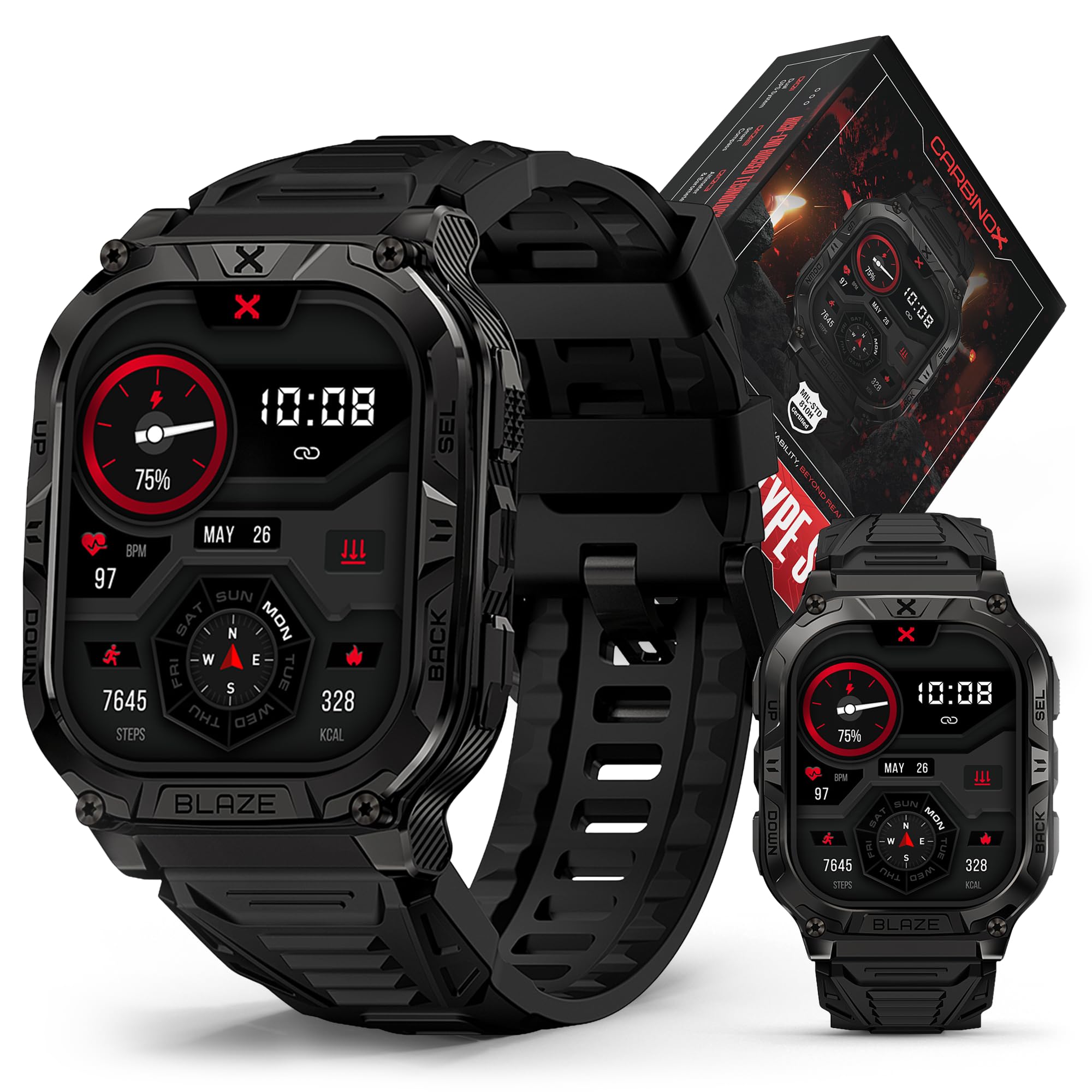
CARBINOX Blaze
Key Features
- GPS & Navigation: Built-in, 7 modes
- Battery Life: 7-10 days typical
- Sensors: ABC basic, HR inaccurate
- Display: 1.43" AMOLED, 1000 nits
- Durability & Water Res: IP69K, 50m water
- Price: Budget
The CARBINOX Blaze delivers a bright AMOLED display and a tough IP69K-rated case at a price that undercuts most competitors. Battery life reaches 5–7 days with typical use, and setup is uncomplicated. However, GPS and altitude tracking can be inconsistent – not reliable for navigation-dependent hiking where accurate barometer or altimeter readings matter. Some units may show sensor drift or connectivity drops over time. This watch works for day hikes where the route is familiar, but for backcountry trips or multi-day navigation, it’s better as a backup or casual alternative.
Pros
- Bright 1.43" AMOLED visible outdoors even in sunlight.
- IP69K waterproofing and Gorilla Glass handle drops, dust, and submersion.
- Battery lasts 5–7 days on a full charge with mixed use.
Cons
- GPS and altitude readings can be inconsistent, limiting reliability for navigation.
- Some units may experience sensor or battery issues after several months of use.
Pick this if you need a budget-friendly rugged watch for light outdoor tracking, construction work, or as a backup – not as your primary navigation tool for serious hiking.
Best for Large Screen
CARBINOX Edge
Key Features
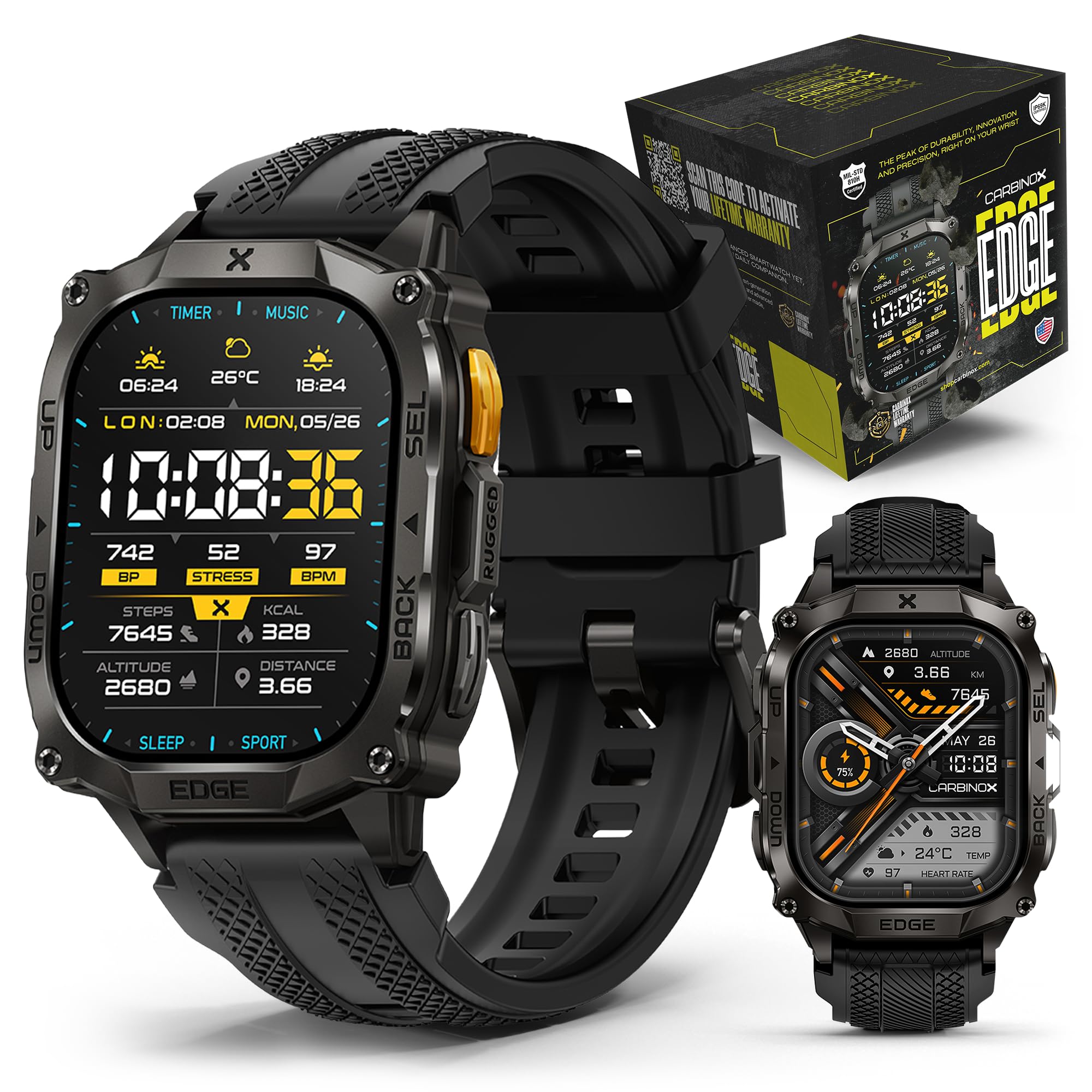
- GPS & Navigation: Dual-band GNSS
- Battery Life: Up to 25d typical
- Sensors: ABC, limited data
- Display: 1.96" AMOLED
- Durability & Water Res: Stainless steel, IP69K/5ATM
- Price: Mid-Range
The CARBINOX Edge stands out with a 1.96" AMOLED display — one of the largest in its class — and dual-band GNSS that locks onto six satellite systems. The stainless steel case and Gorilla Glass give it a premium, rugged feel, and early reports indicate battery life can stretch beyond a week with moderate use. That combination of screen real estate, multi-band GPS, and durable materials is hard to find at this price. The tradeoff is that Bluetooth pairing can drop mid-session, and the companion app takes some patience to set up. For a hiker who relies on consistent navigation or seamless data transfer, these glitches introduce uncertainty the more established alternatives don’t carry. This watch is better suited to early adopters or casual trail users who value a large map display and can work around occasional disconnections.
Pros
- Large 1.96" AMOLED display provides clear map details and notifications.
- Stainless steel case and Gorilla Glass deliver a premium, rugged build.
- Dual-band GNSS supports accurate positioning across six satellite systems.
Cons
- Bluetooth pairing can drop unexpectedly, which may interrupt data sync.
- Initial setup with the companion app can be confusing and time-consuming.
This watch fits hikers who want a big AMOLED screen and dual-band GPS at a bargain price, but only if they can tolerate occasional connectivity hiccups — for reliable navigation on multi-day trips, a more proven model is worth the extra cost.
Best for Classic Abc
Suunto Core Classic

Key Features
- Battery Life: CR2 user replaceable
- Sensors: ABC, reliable barometer
- Display: Negative/positive LCD, dim
- Durability & Water Res: Composite case, 30m water
- Price: Mid-Range
The Suunto Core Classic has been a go-to for backpackers who want altimeter, barometer, and compass without smart distractions. Its lightweight build and accurate storm alarm are genuinely useful on trail. However, it lacks GPS navigation entirely, and the overall display and button quality reflect an older design era. At its current price, many alternatives offer brighter screens, better durability, and GPS – making this a niche choice for those who prioritize simplicity and analog-style operation over modern features.
Pros
- Lightweight and comfortable for all-day wear.
- Accurate barometer with an effective storm alarm.
Cons
- Display is dim and difficult to read in low light; backlight is weak.
- Button and bezel can experience sticking or loosening over time.
Best for backpackers who want a simple, durable ABC watch without GPS or smart features – not for navigation-dependent hikes.
Best for Budget Gps
Tiwain Military Smart

Key Features
- GPS & Navigation: Built-in, 6 systems
- Battery Life: 7-10 days typical
- Sensors: ABC, altimeter, compass
- Display: 1.43" AMOLED
- Durability & Water Res: IP68, military standards
- Price: Budget
Tiwain’s Military Smart Watch delivers a crisp 1.43-inch AMOLED display, built-in GPS, and a useful flashlight at a price that’s hard to beat – along with battery life that lasts close to a week. For occasional hikers who want basic tracking without investing much, this combination is appealing. However, connectivity and data collection concerns make it a risky choice for navigation-critical trips. This watch is best suited as a backup or for casual day hikes where reliability isn’t paramount.
Pros
- Strong value for an AMOLED GPS watch – delivers bright display and navigation at a budget price.
- Bright AMOLED screen with good outdoor visibility – two band choices included.
- Built-in flashlight adds convenience for nighttime setup or emergencies.
Cons
- Bluetooth connection can drop, affecting GPS track sync and notification delivery during a hike.
- The companion app collects more personal data than typical – worth reviewing privacy policy before pairing.
Best for casual day hikes where low cost and a bright screen matter more than consistent connectivity or data privacy.
Best for Casual Hiking
Timex Expedition Digital

Key Features
- Battery Life: Lithium user replaceable
- Sensors: Compass only
- Display: Digital LCD, Indiglo
- Durability & Water Res: 100m water, resin case
- Price: Budget
The Timex Expedition Digital delivers exceptional value for a rugged digital watch: a large, easy-to-read display with Indiglo backlight, lightweight resin case, and 100m water resistance. For casual daily wear or light outdoor use, it’s a capable timepiece. However, hikers expecting environmental sensors will find it lacking: no altimeter, barometer, or GPS – only a basic compass that offers limited directional help. Combined with occasional reports of bands that may break and Indiglo that can stop working over time, this watch is best viewed as a budget daily beater rather than a navigation tool.
Pros
- Exceptional value – rugged build at a budget-friendly price.
- Large display with bright Indiglo backlight for easy reading in low light.
- Lightweight and comfortable for all-day wear.
Cons
- Wrist strap may break at the buckle after months of use.
- Indiglo backlight or watch function can stop working over time, requiring replacement.
Best for budget-conscious users who need a durable, no-frills digital watch with a basic compass – not for hikers who rely on altitude, barometric, or GPS navigation.
Best for Adventure & Gps
Amazfit T-Rex 3
Key Features
- GPS & Navigation: Dual-band, offline maps
- Battery Life: 27d smart, 180h GPS
- Sensors: ABC, needs calibration
- Display: 1.5" AMOLED, 2000 nits
- Durability & Water Res: MIL-STD, 100m water
- Price: Mid-Range
Offline maps and dual-band GPS give the T-Rex 3 navigation capability that rivals watches costing twice as much. The map display is usable on the bright AMOLED screen, and the dual-band GNSS locks onto satellites quickly even in heavy tree cover.
Battery life spans two to three weeks with typical smartwatch use, and over a week with continuous GPS tracking – enough for multi-day hikes without recharging. The 2000-nit AMOLED screen remains readable in direct sunlight, and the glove mode works well with gloved fingers.
The T-Rex 3 is built for hikers who want a do-it-all smartwatch – notifications, music controls, and voice assistant – without needing a charger mid-trip. It suits users leaving the Apple Watch ecosystem for longer battery, as long as they can live without taking calls on the wrist (no speaker) and accept that heart rate and step count readings can sometimes drift from reference values. These boundaries don’t affect navigation or durability, which are the core reasons to buy a rugged outdoor watch.
The 316L stainless steel bezel and military-grade temperature tolerance (–30°C to 70°C) mean the T-Rex 3 holds up to construction sites and alpine conditions alike. 100m water resistance supports freediving to 45m, adding confidence for river crossings.
Pros
- Battery lasts two to three weeks on a single charge, with quick refueling when needed.
- Bright 2000-nit AMOLED screen stays visible in direct sunlight, and glove mode works with thick gloves.
- Dual-band GNSS locks satellites quickly under tree cover; offline maps help navigate trails without phone.
- 316L stainless steel bezel and military temperature tolerance withstand drops, dirt, and extreme weather.
Cons
- Zepp OS interface feels less polished than Garmin’s; watch face options are limited.
- No speaker means no call-taking from the wrist; voice replies are limited to preset messages.
- Heart rate and step count readings can differ from reference values – fine for casual tracking, less reliable for precise metrics.
For hikers who want offline maps, long battery, and a rugged build without paying Garmin prices, the T-Rex 3 is the practical choice – just be aware its fitness tracking is secondary to navigation and durability.
Best for Performance Athletes
Suunto 9 Peak Pro

Key Features
- GPS & Navigation: 4 satellite, turn-by-turn
- Battery Life: 40h GPS, 300h tour
- Sensors: ABC, HR inaccurate
- Display: 1.2" MIP color, sapphire
- Durability & Water Res: Titanium/steel, MIL-STD, 100m
- Price: Mid-Range
The Suunto 9 Peak Pro offers premium materials and 40-hour GPS battery life in a compact, lightweight build – impressive for athletes who want to move fast. Its navigation tools are simpler than Garmin’s, and sensor accuracy (HR, step count) isn’t reliable enough for all-day health tracking. This watch is at its best on open trails and roads, not for hikers who need robust backcountry navigation and consistent environmental data.
Pros
- Fast GPS lock in open terrain with reliable tracking
- 40-hour battery life in a watch that weighs under 60g
- Premium sapphire glass and titanium build resist scratches
Cons
- GPS accuracy may drift in dense forest cover and urban canyons
- Menu navigation can be unintuitive, especially for those used to Garmin’s interface
For trail runners and fast hikers who prioritize weight and fast GPS lock over navigation depth, this is a competitive mid-range option. Backcountry explorers will want a watch with more mature mapping and consistent sensors.
Best for Multi-Day Expeditions
Garmin Instinct 2X Solar
Key Features
- GPS & Navigation: Multi-band GNSS, breadcrumb
- Battery Life: Infinite solar, 40+ days
- Sensors: ABC, good accuracy
- Display: 1.1" MIP monochrome
- Durability & Water Res: MIL-STD-810, 100m
- Price: Premium
The Instinct 2X Solar’s defining strength is its solar-assisted battery: with three hours of direct sun per day, the watch effectively never needs a charger, and even without solar it lasts over 40 days in smartwatch mode. That endurance is paired with multi-band GNSS, giving reliable tracklogging in canyons and under tree canopy. You give up the color maps and touchscreen found on the top-rated Amazfit T-Rex 3, but the monochrome MIP display is readable in direct sunlight and draws negligible power.
This watch is best suited for long-distance backpackers, mountaineers, and thru-hikers who need weeks of GPS tracking without carrying a power bank. The 50mm case fits wrists 145–228mm, so those with smaller wrists should try it on first. The monochrome screen and button-only interface mean no music playback or offline topo maps beyond breadcrumb navigation – but for essential navigation and expedition use, these are acceptable compromises.
Pros
- Solar charging enables weeks to months between charges in the backcountry
- Multi-band GNSS provides accurate tracking in challenging terrain and deep canyons
- Built-in LED flashlight with SOS strobe is useful around camp and for signaling
- Military-grade build survives drops, extreme temperatures, and rough handling
Cons
- Monochrome MIP display lacks color and resolution, making data-heavy screens harder to read
- The 50mm case may feel bulky on smaller wrists (fits 145–228mm)
- No music storage, touchscreen, or offline topo maps beyond breadcrumb navigation
If your priority is weeks of GPS tracking without recharging and you can accept a basic display and larger case, the Instinct 2X Solar delivers that capability better than any watch near its price.
How to Choose
Choosing a hiking watch means balancing navigation needs, battery life, and durability – but marketing often overshadows the real-world trade-offs.
GPS & Navigation
Offline topo maps let you navigate without cellular service, but many watches offer only breadcrumb tracking – a line on a blank grid that shows where you’ve been, not what’s ahead. For remote trails, full mapping is invaluable; for marked paths, breadcrumbs often suffice.
Multiband GNSS improves accuracy in canyons and dense forests by locking onto multiple satellite frequencies simultaneously. Single-band watches may drift under tree cover, adding uncertainty to your position.
Battery Life
Battery ratings split into smartwatch mode and GPS-on hours. A watch claiming 14 days may last only 30 hours with GPS active – enough for a long day hike, but not a multi-day trek without recharging. Solar charging can extend that, but only with direct sun exposure of several hours daily.
AMOLED displays consume significantly more power than MIP screens. A bright, colorful watch may need charging every two days with heavy GPS use, whereas a monochrome MIP watch can run for weeks. The trade-off is visual clarity versus endurance.
Sensor Accuracy
Altimeters measure pressure changes to estimate elevation, but barometric pressure shifts with weather, causing drift. Regular calibration at known points – trailhead signs or map contours – keeps readings within 50 feet. Without calibration, errors of over 100 feet are common.
Compasses are typically reliable out of the box, but require holding the watch level and away from metal objects. Barometer trend lines help predict weather changes, but storm alarms are only useful if you understand local pressure patterns.
Display Type
AMOLED screens offer vibrant colors and high contrast, making maps and data fields pop. However, they require the watch to wake from standby, and their brightness drains the battery quickly. MIP (memory-in-pixel) displays are always-on, reflect sunlight for excellent outdoor readability, and use minimal power.
In low-light conditions, AMOLED backlights are strong, while MIP screens often rely on a weaker front light. If you frequently hike in dim forests or at night, a watch with a good backlight – or a built-in flashlight – becomes a practical advantage.
Durability & Water Resistance
MIL-STD-810 certification means the watch survived drops, vibration, and extreme temperatures in lab tests. Combined with a 100-meter water rating, it can handle rain, stream crossings, and accidental submersion. Watches with 30-meter WR are splash-resistant only and not suitable for swimming or prolonged rain.
Bezel materials matter: stainless steel and titanium resist scratches better than polymer. Mineral or sapphire glass protects the display, with sapphire being nearly scratch-proof but more expensive. These factors determine how the watch wears during years of backcountry use.
FAQ
Can a GPS hiking watch work without a phone?
Yes, most GPS watches download satellite data independently to track your location and record routes. Offline maps require pre-loading via a connected phone or computer, but once saved, the watch displays them without cellular service. Basic navigation like breadcrumb trails works entirely without a phone.
Why does my altimeter give different readings every time I hike?
Altimeters measure air pressure to estimate elevation, but barometric pressure changes with weather, causing readings to drift. Calibrating at a known altitude – like a trailhead sign – corrects the offset. If you skip calibration, expect errors of 100 feet or more.
How many days does a solar GPS watch actually last on a week-long backpacking trip?
Solar watches can extend battery life significantly if you hike in open terrain with strong sun exposure for several hours daily. Under heavy forest canopy or cloudy skies, solar gain is minimal, and the watch will drain at its non-solar rate. For a week-long trip, plan on charging every 4–6 days unless you are in direct sun most of the day.
Is a rugged smartwatch worth the extra cost over a basic ABC watch?
If you need GPS tracking, offline maps, or health monitoring during hikes, a rugged smartwatch justifies its price. For day hikers who only want altimeter, barometer, and compass – and don’t mind carrying a separate map – a simpler ABC watch like the Suunto Core or Casio Pro Trek is lighter, cheaper, and more reliable in those specific sensors.