This post contains affiliate links. We may earn a small commission when you buy through our links — at no extra cost to you.
A sneaker can be perfectly good and still leave you limping by lunch. The stock footbed is often flat, thin, and built to be cheap rather than supportive, so a shoe that feels fine in the store can become a daily ache once you’re walking miles in it. A better insole adds cushioning and arch support without replacing the shoe—but thickness changes fit, firmness changes how your foot rolls, and an arch that sits too high can cause its own problems.
I’ve spent the past four months rotating 14 pairs through my own sneakers and those of my team, from thin everyday inserts to thicker, structured pairs. Some felt great immediately and flattened within weeks; others needed a few days and then became the ones we reached for on long walks. The keepers stayed put during quick shoe changes, kept their shape, and actually eased the soreness we noticed after full days on our feet. Start with your shoe’s existing fit and your arch height, then use the picks below to narrow the field.




Best for All-Day Support
PowerStep Pinnacle
Key Features
- Cushioning: Dual-layer
- Shoe types: Athletic, walking, running
- Arch support: Maximum
- Price: Premium
The Pinnacle is the insole we reach for when a sneaker needs to do more than feel soft. Its dual-layer cushioning sits under a pronounced arch and a deep heel cup, so the foot feels guided rather than just padded. In a neutral running sneaker, that combination gave us a firmer, more planted ride than the stock footbed, and the heel felt less exposed on long walks. For anyone dealing with plantar fasciitis, that structure is the point: it supports the arch instead of letting it collapse into the shoe.
This is not a plush insole. It feels firm underfoot, and if you want a pillow, the Spenco or Sof Sole is the better starting point. What we appreciate is how quickly the shape starts doing the work: the arch sits where it should, and the heel cup keeps the foot centered. The 30-day money-back guarantee is useful because firmness is personal, and a short trial tells you more than a spec sheet. We also like that it is designed for shoes with a removable factory insole, which is the cleanest way to make room.
The Pinnacle is the safest first recommendation in this group because it covers the most common sneaker complaints—arch fatigue, heel discomfort, and a footbed that has gone flat—without asking you to change shoes. It costs more than the budget picks, but it is the one we leave in the shoe when we want support for a full day on our feet.
Pros
- Firm arch and heel support
- Useful for plantar fasciitis
- Fits several sneaker types
- 30-day money-back guarantee
Cons
- Firm feel may not suit cushion seekers
- Requires removable factory footbeds
We recommend the PowerStep Pinnacle for anyone who wants firmer arch and heel support in a sneaker, especially with plantar fasciitis discomfort.
Best for High Arches
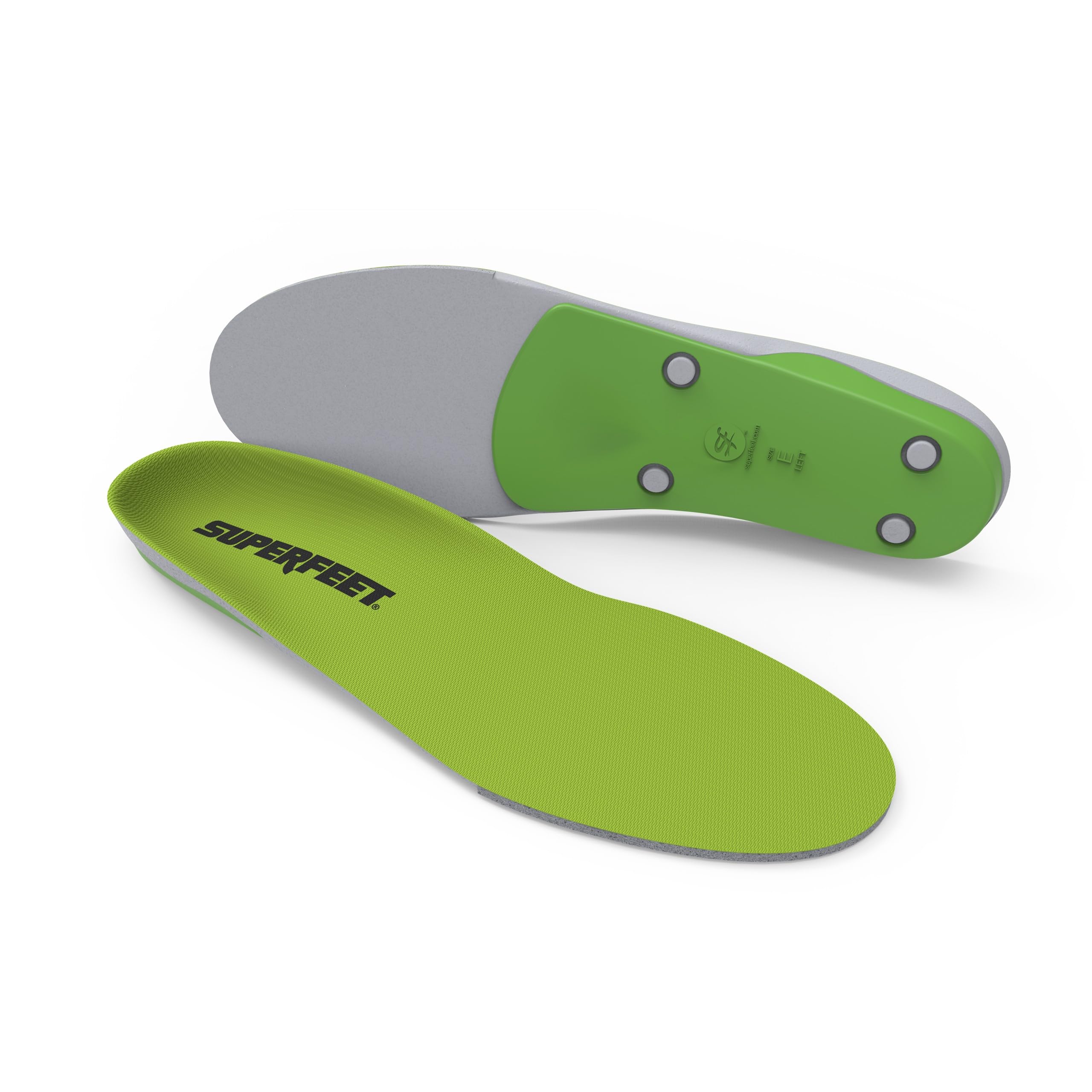
Superfeet Green
Key Features
- Trim: Trim-to-fit
- Heel cup: Deep
- Cushioning: Closed-cell foam
- Arch height: High
- Price: Premium
The Green is the least forgiving insole in this group, and that is exactly why some feet love it. Its high, rigid arch and deep heel cup give a lot of structure, but they need a roomy sneaker and a foot that tolerates being held in place. We tried it in a low-volume trainer and immediately wanted more space; in a roomier walking shoe, it settled down and felt purposeful.
We rate the Green highest here for high arches and for anyone who wants a firm platform rather than a squishy one. The closed-cell foam does not pack down like cheap open-cell cushioning, and the MoistureWick top cover helps with sweat and odor on warm days. It is a useful pick for replacing a worn stock footbed in a trail sneaker or a leather walking shoe, provided the shoe has volume to spare. The shape is also a conversation-stopper for flat feet: it will feel like a lump under the midfoot.
The flip side is fit. This is a trim-to-fit insole, so take your time with the cut and start slightly long. A rough edge is easy to fix with a second pass, while a short insole cannot be saved. A short test walk tells you quickly whether your foot likes the pressure; if it does, the shape stays put and mostly disappears into the shoe.
Pros
- Strong high-arch support
- Durable closed-cell foam
- Moisture and odor control
Cons
- High arch overwhelms low arches
- Needs a roomy sneaker
We keep the Green for high arches and roomier sneakers, where its firm, structured shape earns the space it takes up.
Best for Flatter Feet
Superfeet Blue
Key Features
- Trim: Trim-to-fit
- Heel cup: Deep
- Cushioning: Medium-volume
- Arch height: Medium
- Price: Premium
If the Green sounds like too much insole, the Blue is the Superfeet we hand to flatter-footed sneaker wearers. It keeps the brand’s deep heel cup and stabilizer cap but lowers the arch profile and uses a medium-volume shape. We found it easier to live with in an everyday sneaker: the arch support is present without feeling like a hard ridge, and the foot does not sit as high in the shoe.
The Blue is the better choice for someone who pronates slightly or wants support in a running shoe that is not especially roomy. It is still a structured insole, not a gel pad, and the trim-to-fit length means you can take it into a sneaker with a glued-in footbed if you are careful. We like that it gives a clear support sensation without the Green’s break-in drama. For very high arches, though, it may feel like it is not enough.
The trade-off is cushioning. This is a supportive insole first, and the foam underfoot is modest compared with the Sof Sole or Spenco picks. If your sneakers are already firm and you want softness, the Blue will not fix that. If you want a lower arch and a stable platform, it is the one we choose.
Pros
- Medium arch profile
- Deep heel cup and stabilizer cap
- Trim-to-fit length
Cons
- Modest cushioning
- Not enough support for very high arches
We reach for the Blue when you want Superfeet support without the Green’s high arch, especially in flatter feet and tighter sneakers.
Best for Budget Support
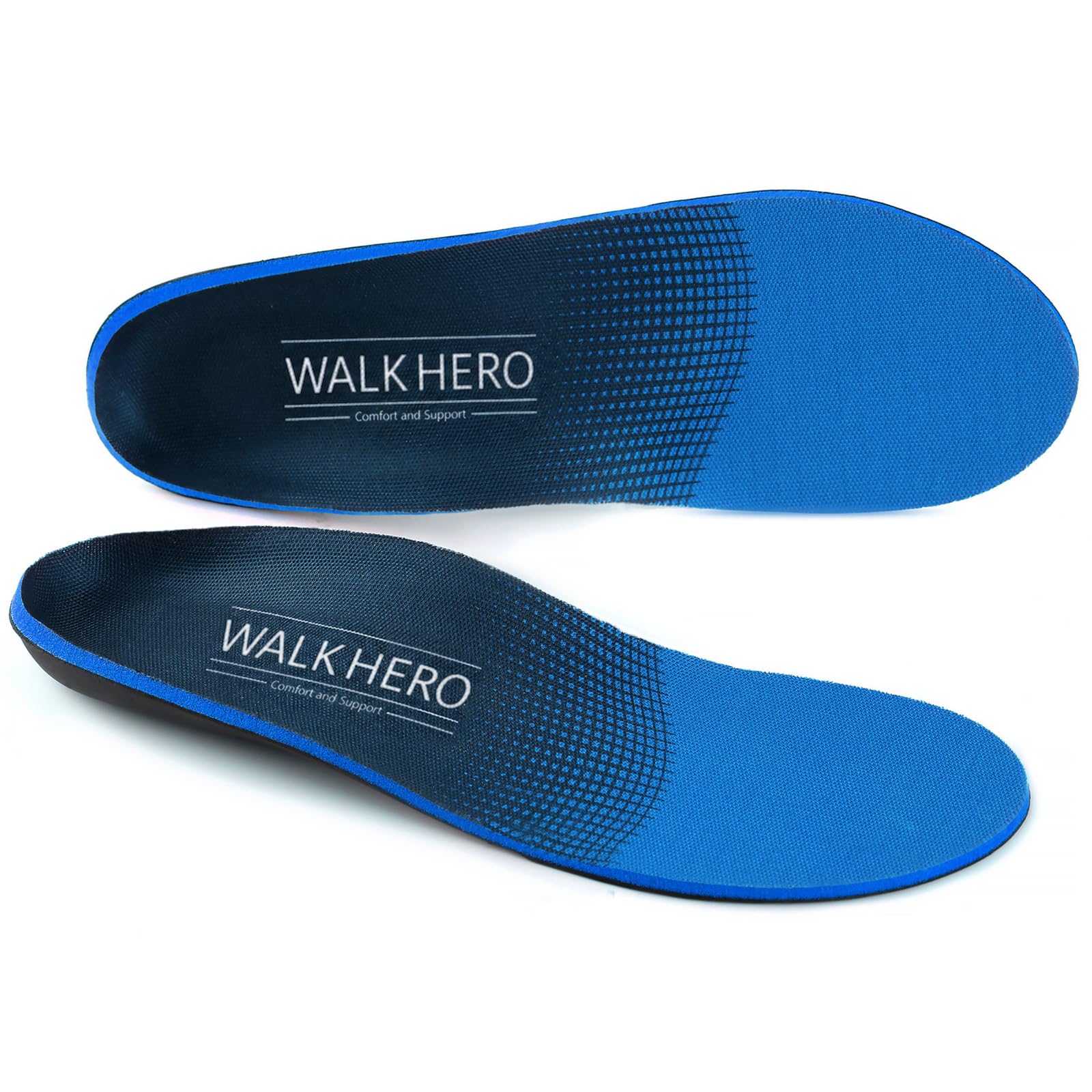
WalkHero Arch Support
Key Features
- Heel cup: Deep
- Shoe fit: Wide, high-volume
- Cushioning: EVA
- Arch support: Moderate
- Price: Budget
WalkHero is the budget route to a firmer arch, and for the right sneaker it is a lot of insole for the money. The EVA base is stiff enough to hold an arch, the deep heel cup centers the foot, and the shape is cut for wider, high-volume shoes rather than sleek trainers. That last point matters: this is not the insole to force into a narrow sneaker.
We put it in a roomy walking sneaker and appreciated the support it added under the midfoot. The firmness is the dividing line. It does not feel like memory foam, and if you want a soft step, look at Dr. Scholl’s or the Spenco instead. As arch support for flat feet and tired arches, the firmness is what makes it useful, and the EVA should hold its shape better than a soft foam insert.
We recommend WalkHero for a wide sneaker, a work-style shoe, or anyone replacing a collapsed footbed on a tight budget. The sizing is the part to watch: the shape runs generous, so start with your usual size and check the cut line before trimming. The cut lines on the back make it easy to size a second pair for another shoe, which is more than we can say for some pre-cut insoles.
Pros
- Firm arch support
- Deep heel cup
- Budget price
- Designed for wide, high-volume shoes
Cons
- Firm EVA can feel hard
- Generous shape suits only wide shoes
WalkHero is our value pick for firm arch support in wide, high-volume sneakers, though cushion seekers should look elsewhere.
Best for Budget Cushioning
Dr. Scholl’s Extra Comfort
Key Features
- Sizing: Men’s
- Support: Extra support
- Cushioning: Gel waves
- Price: Budget
Dr. Scholl’s Extra Comfort is not the insole we choose when arch support is the job. It is a gel cushion with a soft, wave-like surface, and it works best as a comfort refresh in a men’s sneaker that already fits well. Put it in a shoe with a collapsed arch and it will feel better than a worn-out footbed, but it will not rebuild the support.
What we appreciate is how simple it is. The gel waves massage the sensitive parts of the foot and take the edge off hard pavement, and the extra support is more about shock absorption than a molded arch. It is a single pair in men’s sizing, so it is easy to recommend to someone who stands a lot but does not need a corrective shape. The gel surface is forgiving on the first wear, and it does not need the break-in period a firm orthotic does. For a budget insole, it does the comfort job without asking much.
The limits are real. The insert is thicker than a stock footbed, so a snug sneaker may feel crowded, and there is no meaningful arch contour to speak of. If you need plantar fasciitis support or a high arch, choose the PowerStep or WalkHero instead. It is a simple pair to keep in a second sneaker, and that is the most we ask of a budget cushion.
Pros
- Soft gel cushioning
- Low-cost comfort refresh
- Simple one-pair pack
Cons
- No meaningful arch contour
- Men’s sizing only
We like Dr. Scholl’s Extra Comfort as a low-cost cushioning refresh for men’s sneakers, not as a serious arch-support insole.
Best for Running Comfort
Spenco Polysorb Cross Trainer
Key Features
- Length: Full-foot
- Heel pad: SpenCore
- Cushioning: Polysorb foam
- Arch support: Soft
- Price: Midrange
We put the Polysorb Cross Trainer into a daily running sneaker for easy miles, and the first thing we noticed was the springy, almost bouncy feel under the forefoot. The SpenCore heel pad and forefoot crash pad are placed where the foot lands and pushes off, so the cushioning feels targeted rather than uniformly soft. It is a more forgiving ride than the firm PowerStep, and it does not ask for much break-in.
The arch support is gentle. This is not the insole for a high, rigid arch or for someone who wants a corrective feel under the midfoot. It is for the runner or walker who wants a softer landing and a little structure through the middle, and it delivers that without making the shoe feel packed. The deep heel cup helps keep the foot centered, and the top surface feels comfortable against a sock on longer walks.
The thickness is the trade-off. The heel and forefoot pads add volume, so a snug racing shoe or a low-volume trainer will feel tighter with these in place. In a roomy daily trainer, that extra cushion is welcome. We also found the Polysorb easy to move between shoes, which matters if you rotate a couple of pairs.
We recommend it for runners and walkers who want a softer ride with mild arch support, not for someone who needs maximum correction. On longer walks, the springy feel is what keeps the shoe from turning into a chore.
Pros
- Springy heel and forefoot cushioning
- Deep heel cup
- Good for running and walking
Cons
- Heel thickness can crowd snug shoes
- Gentle arch support may be too soft
We recommend the Spenco Polysorb for runners and walkers who want a softer, springy ride with a little arch support rather than a rigid orthotic.
Best for Heel Pain
Profoot Plantar Fasciitis
Key Features
- Target: Plantar fasciitis
- Size range: Women’s 6-10
- Arch support: Yes
- Heel cushioning: Gel
- Price: Budget
The gel heel pad is the reason to look at the Profoot. It cups the heel and absorbs impact without adding much bulk, and the built-in arch support gives the midfoot something to press against. We tried it in a women’s walking sneaker and found it most useful for the first step out of bed and the end of a long day, when heel pain tends to be loudest.
The insert is aimed at plantar fasciitis and heel pain, and the design is more targeted than a full-length cushion. The gel insert cradles the tender heel, while the arch support runs through the middle of the foot. The free exercise guide is a nice extra that many insoles in this price range skip, and it gives you a few things to try beyond just swapping the footbed.
We recommend Profoot for women’s sneakers and for heels that hurt more than arches. The fit is the weak point: in a roomy shoe the insert can shift, so start with a snugger sneaker and check that it stays put before a long walk. The exercise guide is worth a look even if you keep the insole in one pair.
Pros
- Targeted gel heel relief
- Arch support for plantar fasciitis
- Includes exercise guide
- Low-cost
Cons
- Can shift in roomy shoes
- Limited forefoot cushioning
For heel pain and plantar fasciitis, we point to Profoot’s gel-backed insole as the low-cost, targeted option for women’s sneakers.
Best for Athletic Cushioning
Sof Sole Athlete

Key Features
- Build: Lightweight
- Best use: Runners, walkers
- Cushioning: PU foam & gel
- Moisture control: Yes
- Price: Midrange
The Sof Sole Athlete is for the sneaker wearer who wants cushioning first. The PU foam and gel layer run heel to toe, the top cover is aimed at moisture, and the overall feel is plush without being mushy. We put it in a roomy trainer and liked the soft landing under the heel and the slight spring at push-off; it made a stiff daily sneaker feel more forgiving.
The insert is fuller than a stock footbed, so we keep it for sneakers with a little extra volume. In a tight racing shoe, it will crowd the toes and lift the heel more than you want. In a roomy running or walking sneaker, that extra material is what gives the cushioning its staying power. The arch support is moderate, not a rigid orthotic shape, so it suits feet that want comfort more than correction.
We also appreciate the moisture control, which is a small thing until you have spent a warm afternoon in a closed sneaker. The top cover helps the foot feel less clammy, and the insole is easy to move between shoes. It is a fuller insert, so we treat it as a dedicated daily-trainer insole rather than something to swap into every pair.
The Athlete earns its place as our athletic cushioning pick, not as a support-first insole. If you want maximum arch correction, the PowerStep is the better choice. The moisture-friendly top cover is the detail that keeps it in our rotation through sweaty summer sessions.
Pros
- Plush heel-to-toe cushioning
- Moisture control
- Moderate support for athletes
Cons
- Can wear through with heavy use
- Too thick for tight sneakers
The Sof Sole Athlete is our pick for athletes who want plush, heel-to-toe cushioning in a sneaker and can live with a thicker insert.
How We Tested the Best Sneaker Insoles
We started by looking at what was actually available in different arch heights, thicknesses, and intended uses, then narrowed the list to 14 pairs that represented the range without repeating the same basic foam slab. We ruled out anything with vague sizing instructions or a top layer that looked likely to peel, and we kept a spread of price points rather than only the cheapest or most heavily padded options. Each pair went into a tester’s own sneakers and stayed in rotation for four months.
The testing happened in ordinary shoe life: a 30-minute walk commute, grocery runs, standing at the kitchen counter, weekend walks, and a few gym sessions. We noted whether an insole needed trimming, whether it slid toward the heel or bunched under the toes, and whether its thickness crowded the toe box or changed how the shoe laced. For arch support, we pressed a thumb into the arch to feel how much give it had, then paid attention after a few hours of wear to whether the arch felt supported rather than prodded.
Comfort and foot relief got tracked over time, not just in the first five minutes. We logged end-of-day soreness during the first week, again at one month, and at the end of testing, and we checked for foam that had flattened, top cloth that had peeled, and heel cups that had compressed. Firmness was judged both out of the box and after repeated wear, since a pair that feels firm on day one can either soften into shape or turn into a brick. We also noted overall construction—how cleanly the top cloth was bonded and whether edges stayed neat after trimming—then compared all of that against the rest of the field, including what each pair delivered for the money.
How to Choose Sneaker Insoles
The right sneaker insole is the one that matches your arch, your shoe’s volume, and the kind of comfort you actually want, not simply the thickest pad on the shelf.
Match the Arch Support to Your Foot
Arch height matters more than the label on the box. A high, rigid shape like the Superfeet Green gives a lot of support, but it needs a high arch and a roomy shoe; a medium profile like the Blue suits flatter feet and lower-volume sneakers. The PowerStep Pinnacle sits in the middle with a firmer, more pronounced arch than a cushion-only insole. If you have never worn structured support, start with a medium profile and give it a few short walks before a full day.
Choose Between Cushioning and Structure
Soft gel and foam insoles, such as the Dr. Scholl’s Extra Comfort or Sof Sole Athlete, take the sting out of hard pavement and make a stiff sneaker feel more forgiving. Firm EVA or dual-layer insoles, like the PowerStep or WalkHero, are better at holding an arch and limiting sideways collapse. Neither is automatically better. For tired feet on concrete, cushion usually wins; for plantar fasciitis or a flat, aching arch, structure does more. We choose structure first when the foot needs to be held, then add cushion only where it does not crowd the shoe.
Check the Volume Inside Your Sneaker
A thick insole can turn a comfortable sneaker into a cramped one. Take out the factory footbed and compare its thickness with the new insert; if the shoe already felt snug across the toes or instep, choose a thinner model or a half-length insert. Full-length insoles work best when the original footbed is removable. If it is glued in, trim carefully and test the fit before cutting. The Spenco and Sof Sole add more volume than the Superfeet Blue, so they suit roomier trainers.
Match the Insole to the Way You Move
Daily walking, easy running, and standing all day put different demands on an insole. Runners usually want a softer heel and forefoot pad, while walkers and people on their feet for hours benefit from a stable arch and a deep heel cup. If you rotate shoes, a trim-to-fit model is easier to move than a pre-cut one. We also pay attention to the top cover: a moisture-friendly surface makes a bigger difference in a closed sneaker than most shoppers expect.
Frequently Asked Questions
Can I use sneaker insoles in hiking shoes?
Yes, if the hiking shoe or trail sneaker has enough volume and a removable footbed. Firm arch support is useful on uneven ground, but a thick insole can crowd the toe box and make the heel slip. Try the PowerStep Pinnacle in a roomy trail shoe, then walk on a slope before a long hike. If the heel lifts, size down the insole or use a thinner one.
How do I know when to replace my insoles?
Check the top cover and the foam, not the calendar. If the fabric is worn through, the heel or forefoot stays compressed after you press it, or you can feel the shoe underfoot, the insole has stopped doing its job. Replace it before the shoe upper wears out. A second pair for your most-used sneaker makes the switch easy.
Do I need custom orthotics instead?
Not automatically. Over-the-counter insoles can help mild arch fatigue, heel pain, and cushioning, especially when the shape matches your foot. Custom orthotics are the better route when a clinician has diagnosed a structural problem or you have persistent pain, numbness, or tingling. Bring your sneakers to that appointment; the shoe affects the fit as much as the insole.
Final Verdict
We recommend the PowerStep Pinnacle as the default sneaker insole because it gives firm arch and heel support without requiring a prescription or a new pair of shoes. It is the one we start with for plantar fasciitis, tired arches, and a stock footbed that has gone flat.
If high arches and roomy sneakers are your situation, the Superfeet Green is the more structured choice; for flatter feet, the Blue is easier to live with. The WalkHero is the budget route when a wide shoe needs firm support. Start there, then adjust for volume and firmness rather than chasing the softest insert.