This post contains affiliate links. We may earn a small commission when you buy through our links — at no extra cost to you.
A wood fire gives you the crackle and the smell; a gas fire gives you flames in thirty seconds and no ash to sweep up in the morning. That tradeoff is the real decision, and the size, shape, and finish of a pit all fall in line behind it. I’ve spent nine months with 12 fire pits in my own backyard, and a good one does something simpler than it sounds: it turns a patio into a room you’ll actually sit in after dark.
Heat output, it turns out, depends less on flame height than on how deep the bowl sits and how much air gets under the fuel — something nobody tells a first-time buyer. The warmest of the 12 were also the ones that held up, with no rust blisters at the welds after a wet spring and no wobble when someone leaned on the rim. We timed assembly, too, because a pit that takes two people and an hour of diagrams is the one that ends up back in the box. The picks below are the ones that earned a permanent spot on my patio.



Best for Portable Propane Fires
Outland Living Firebowl 893
Key Features
- Fuel: Propane
- Weight: 23 lb
- Bowl size: 19 in. diameter
- Heat output: 58,000 BTU
- Price: Midrange
A fire you can carry is a different purchase from a fire you build in the yard, and this is the one we recommend to most people. The Firebowl 893 runs off a standard 20 lb propane tank, lights with a dial rather than kindling, and keeps working when wood fires are banned — which, in a dry October or at a campground with restrictions, is often the only evening you get a flame at all. At 23 pounds, with a lid that doubles as a carry case, it moves from truck to patio without a second pair of hands.
The 19-inch bowl throws 58,000 BTU, more than any of the fire tables here, and the lava rocks need a few minutes before the warmth really comes back at you. Once they’re hot the flame reads like a campfire rather than a row of jets, and the 10-foot hose and tank ring let you tuck the cylinder behind a chair instead of underfoot. There’s nothing to assemble: the regulator is already attached, and the cover does double duty as the lid you carry it by.
What it isn’t is furniture. There’s no tabletop for drinks, and the bowl sits low, so you’re in camp chairs rather than at a dining set. If your evenings happen on a deck with a glass in your hand, one of the fire tables here suits better. If they move — campsite one weekend, driveway the next — nothing else in this group travels like this one.
Pros
- Works when wood fires are banned
- 23 lb with a lid and carry kit
- 58,000 BTU from a 19-inch bowl
- Nothing to assemble out of the box
Cons
- No tabletop for drinks or plates
- Heat thins out in a breeze
For most people this is the fire pit that actually gets used: instant light, no smoke, no ash, and it packs into the truck for the weekend.
Best for Backyard Wood Fires
Solo Stove Bonfire 2.0
Key Features
- Fuel: Wood
- Weight: 21.8 lb
- Diameter: 19.5 in.
- Material: Stainless steel
- Price: Premium
Smoke is the reason people give up on fire pits. The Bonfire’s answer is a double-wall burn: air comes in at the base, feeds the fire from below, and the gases that would leave as smoke get burned at the top of the bowl. What comes off is heat and a faint shimmer, and the fire is hot enough to sit close to within a few minutes of lighting.
The bowl is 19.5 inches of stainless steel at 21.8 pounds, and it arrives with a stand, a removable base plate and ash pan, and a nylon carry case. The ash pan is the part we appreciate most — cleanup is lift, dump, wipe, instead of scooping cold ash out of a bowl. It lights fast on kindling and settles into an even burn that leaves fine gray ash rather than half-burnt splits.
Two things to go in with your eyes open. It smokes like any wood fire until it’s genuinely hot, so the first few minutes still sting, and the accessories sold alongside it are priced like a hobby. Neither changes the conclusion: on a small patio, in a yard with close neighbors, this is the wood pit we want, and it’s the one that comes closest to giving you a campfire without the smell in your jacket the next morning.
Pros
- Near-smokeless once the fire is hot
- Ash pan makes cleanup a lift and a dump
- Stainless bowl with stand and carry case
- Burns dry wood down to fine ash
Cons
- Add-on accessories are priced high
Buy this one if smoke is what you hate about campfires — it’s the closest a wood pit here gets to a flame with no column following you.
Best for Patio Entertaining
BALI Outdoors 42-Inch Fire Table
Key Features
- Fuel: Propane
- Weight: 78.5 lb
- Tabletop: 42 x 24 in.
- Heat output: 60,000 BTU
- Price: Premium
Forty-two inches wide, 24 inches tall and topped in ceramic tile, the BALI reads as a patio table first and a fire second — which is why it gets used more than a bowl on the ground. The 60,000 BTU burner sits in a bed of blue glass under a lid that drops on to turn the whole top into a surface for plates and glasses.
Of the fire tables here, this is the one we want on our own patio. The proportions do it: 42 by 24 inches is enough for two people to eat at and six to sit around, and the blue glass throws a warmer, deeper light than lava rock. Assembly is straightforward enough for one person, and the flame lights to a proper fire rather than a ring of blue dots.
The weak point on any steel fire table is the finish, and this one is no different — rust on the base and frame shows up on tables that live outside uncovered. Buy a cover with it and the calculus changes; leave it out in the rain and the frame is the first thing to go. At 78.5 pounds it’s furniture, so decide where it goes before you fill the glass.
Heat is worth thinking about too. Sixty thousand BTU warms the people in front of it, not the yard, and a breeze takes a share of that — this table is at its best on a sheltered patio with the chairs pulled close. What it does better than a low bowl is hold that warmth up at dining height, where you’re actually sitting.
Pros
- 60,000 BTU under a usable tabletop
- Tile top resists scratches and fading
- Blue glass throws a deeper light than rock
- One person can put it together
Cons
- Push-button ignition can take a few tries
If the fire pit is going to live on a patio and hold drinks, this is our pick: 60,000 BTU, a real tabletop, and a finish that looks good in daylight.
Best for Small Patios
Ciays 28-Inch Fire Table
Key Features
- Fuel: Propane
- Weight: 57 lb
- Tabletop: 28 x 28 in.
- Heat output: 50,000 BTU
- Price: Midrange
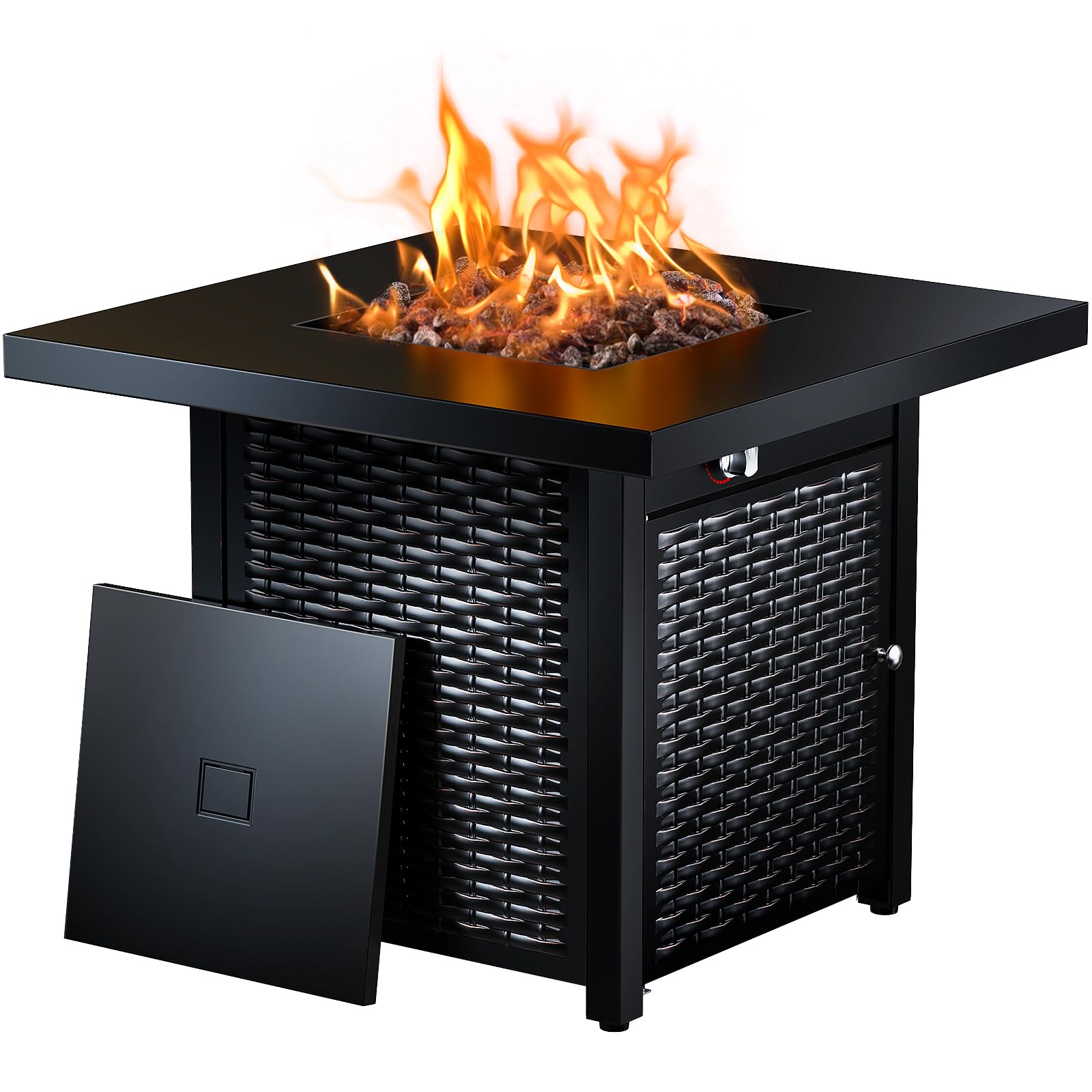
Twenty-eight inches square is the entire argument for this table: it fits a balcony or the corner of a deck where a 42-inch fire table would eat the space of a dining set, and at 25 inches tall it still pulls up to patio chairs. The 50,000 BTU burner is enough for four people at conversation distance, the lava rock gives the flame something to sit in, and the lid closes over the burner to make a plain side table. For a small outdoor space, this is the fire table we point people to first.
What you give up is tabletop. The burner takes the middle, so what’s left at the corners holds a drink and a bowl of snacks rather than dinner for four, and the square steel body shows wind-blown ash more than a darker top would. On a city balcony, where the alternative is no fire at all, those are easy trades to make.
Pros
- Fits where a 42-inch table can’t
- 50,000 BTU with a CSA listing
- Lid turns it into a side table
- Dining height for patio chairs
Cons
- 57 lb, so moving it takes two people
- Lava rock looks plainer than glass
The compact fire table we point people to for a small patio or a deck corner: dining height, 50,000 BTU, and a lid that makes it useful before dark.
Best for Patio Wood Fires
TIKI Patio 25-Inch Fire Pit
Key Features
- Fuel: Wood
- Weight: 45 lb
- Bowl size: 25 in. diameter
- Heat radius: 4 ft
- Price: Premium
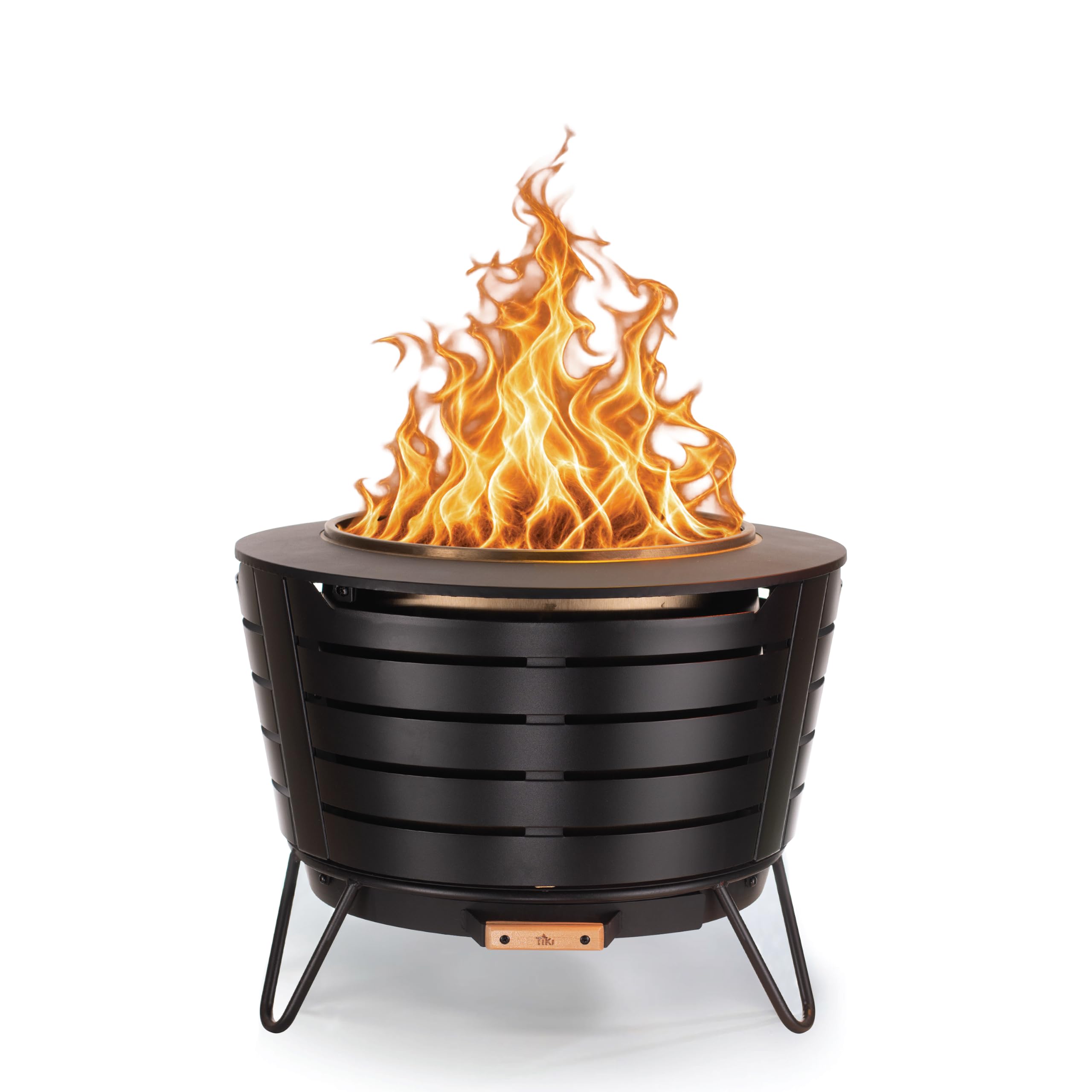
TIKI calls this smokeless, and the honest version is low-smoke: the airflow design burns off most of what would otherwise come at you once the fire is hot, so you can sit in one place instead of shifting every few minutes. On a cold start, with damp wood, it smokes like any other pit.
The build is where the money goes. Sixteen-gauge stainless with a black powder coat, a stand, a cover and a removable ash pan in the box, and a 25-inch bowl sized for four to six people around a four-foot heat radius. The ash pan earns its place — it turns cleanup into a lift-and-dump instead of a scooping job.
It’s 45 pounds, so it stays where you put it, and longer splits need cutting down to sit in the bowl. Neither bothers us on a patio; both would bother us at a campsite, which is why this one stays home.
So the case is this. It’s the best-looking wood pit here, it comes with the cover and the ash pan, and it gets you closer to a real log fire than the propane picks ever will while giving up the thing that ruins a fire for a lot of people. If smoke is what you hate, the Solo Stove handles it better and the gas models handle it completely. If you want actual logs on a patio, this is the one.
Pros
- Cover, stand and ash pan included
- Low smoke once the fire is hot
- Four-foot heat radius for four to six
- 16-gauge stainless with a powder coat
Cons
- Premium price for a wood pit
- Eats through splits on a hot fire
Our pick for a wood fire on a patio: a 25-inch bowl, cover and ash pan included, and smoke low enough that you stay in your chair.
Best for First Fire Pit
Amazon Basics 27-Inch Fire Pit
Key Features
- Fuel: Wood
- Height: 25.6 in.
- Weight: 17.6 lb
- Bowl size: 23 in. diameter
- Price: Budget
The lattice on the sides isn’t decoration. It lets air in around the fire, which gets it burning faster, and it throws a pattern of light across the patio once the flames are up. At 27 inches across and 17.6 pounds, it’s a one-person object — out of the shed, onto the patio, done.
The 23-inch bowl takes store-bought splits with room to move them around, and it gives three or four people a decent fire. A spark screen and poker come in the box, the rim sits at 25.6 inches so you’re not stooping to poke it, and assembly runs off a parts list and a diagram rather than written instructions — workable, but you want daylight and a little patience.
For a first fire pit, a rental yard, or a house where the pit lives under a tarp half the year, this is the sensible buy: light, cheap, and honest about what it is. Tip the water out of the bowl after rain — it collects — and keep it covered, because the paint inside burns off in the first few fires and bare steel rusts. Treat it as a two- or three-season pit and it’s money well spent.
Pros
- Lowest price in this group
- 17.6 lb, easy to move alone
- Spark screen and poker included
- Lattice sides feed the fire and throw light
Cons
- Thin steel dents, and the screen ring is flimsy
The cheapest honest way into a backyard wood fire — a light, simple pit we recommend for a first yard or a rental.
Best for Style-Led Patios
Ciays 43-Inch Ceramic Fire Table

Key Features
- Fuel: Propane
- Burner: H-shaped stainless steel
- Tabletop: 43 x 24.6 in.
- Heat output: 50,000 BTU
- Price: Midrange
The top is the reason to look at this one. Four ceramic panels with a real grain to them, set around a stainless H-burner and a bed of glass rock, with a glass wind guard standing around the flame. Unlit, it looks like patio furniture rather than a gas appliance, which is more than most fire tables manage.
We rate this above the plain steel tables at the same size. Fifty thousand BTU is enough on a sheltered patio, the wind guard is the detail that decides whether you’re still outside in October, and the burner is CSA-certified. The lid drops over the flame bed to make a dining surface, so the table earns its footprint at lunchtime too.
The compromises are modest: 50,000 BTU against the 60,000 BTU tables here, and a ceramic-and-glass top that wants a wipe-down to stay sharp. Assembly is a one-person job with labeled hardware. As with any steel fire table, the finish is the long game — buy a cover the same week as the table, because that’s what decides how it looks after two winters.
Pros
- Ceramic top looks good unlit
- Glass wind guard steadies the flame
- Lid converts it to a dining table
- CSA-certified H-shaped burner
Cons
- Less heat than the 60,000 BTU tables
The best-looking fire table here, and the glass wind guard means you’ll still be sitting outside when the evening turns breezy.
How We Tested a Dozen Fire Pits Through Fall, Winter, and Spring
We started by pulling together every fire pit we could find that had an actual spec sheet behind it — bowl depth and diameter, gauge of steel, fuel type, and whether the maker sells replacement grates and covers — and cut anything that looked like a marketplace listing with no support behind it. That left 12 pits, wood-burning and propane, spanning budget models to buy-it-once steel. I ran them for nine months, from the first cool night in September through a wet spring.
Assembly came first, since it tells you a lot: I built each pit alone with a stopwatch running and noted the steps where I had to call someone over to hold a panel. Then the real work happened after dark, on weeknights and at a couple of backyard birthdays. I timed how long it took a fire to catch with a standard ignition method, held a digital thermometer at seat height to see whether the warmth reached my knees or just my face, and leaned my weight on each rim to check whether the thing shifted on the pavers.
Because these live outside, ours stayed outside. Every pit sat through a week of rain, after which I checked the welds, the grate, and the painted finish for rust, and wiped down the exteriors to see which surfaces showed every smudge and which still looked new months later. The final pass was the morning after: scooping ash, swapping a propane tank, and figuring out what it takes to make each one presentable again. Value was the simplest call, and the last one I made — whether I’d spend my own money on it after living with it that long.
How to Choose a Fire Pit
The fire pit you’ll actually use is the one that fits where you sit and what you’re allowed to burn; the finish is the last thing to decide, not the first.
Start With Fuel, Not Looks
Wood or propane settles more than any other decision. Wood gives you crackle, real logs and a fire you build; it also gives you smoke, ash to deal with, and restrictions in dry months and at many campgrounds. Propane lights with a dial, produces no smoke or ash, and is usually still allowed where wood fires are not — but you’re buying a tank, and the flame is a bed of jets under rock rather than a living fire.
Check your local burn rules and the campground’s restrictions before you fall for a bowl you saw online. If a flame is banned where you burn, a wood pit is furniture; a gas one is still a fire.
Match the Size to Your Chairs
A bowl gives you a fire and nothing else — you carry your own drink. A fire table puts a flat top around the burner at roughly dining height, so it pulls up to patio chairs and holds a plate. Decide which piece of furniture you’re buying before you compare dimensions.
Then size it to the people: a bowl in the low-to-mid twenties of inches is a four-to-six-person fire, a 28-inch square table suits two to four, and a 42-inch table seats six. Buying bigger than your seating just burns more fuel to produce the same warmth, and a table you have to walk around is a table you stop using.
What Smokeless Really Means
No wood-burning pit is smokeless, including the ones that print it on the box. The better designs feed air above the fire so the gases that would leave as smoke burn instead — and that only happens once the pit is properly hot. A cold start, damp wood or an overloaded bowl all bring the smoke back.
If no smoke at all is the requirement, buy propane. If you want a wood fire you can sit close to, a secondary-burn pit gets you most of the way there, and knowing that before the first fire saves you from feeling cheated on a damp Tuesday.
Heat Is About Reach, Not Just BTU
BTU tells you how much gas a burner can consume, not how warm your knees will be. Wind strips more heat off a patio than a lower output ever will, which is why a glass wind guard on a 50,000 BTU table often feels better than a bare 60,000 BTU one on an exposed deck.
On wood pits the fuel bed does the work: a hot bed of coals throws warmth sideways, and lava rock or glass media holds it and gives it back slowly. Sit closer than the manufacturer’s clearance and you’ll be warm and unsafe, which is not a trade worth making.
Weight, Storage and the Cover
Steel outdoors rusts, and the difference between a pit that lasts and one that doesn’t is usually a cover and somewhere dry to keep it. A portable pit in the low twenties of pounds is a one-person move and can live in a shed; a fire table in the sixties to eighties is furniture and wants to stay where you put it.
Decide where the pit lives before you order, then buy the cover in the same purchase. It’s the cheapest part of the whole thing and the one that decides how the pit looks after two winters.
Frequently Asked Questions
How long does a 20 lb propane tank last in a fire pit?
Propane carries roughly 21,600 BTU per pound, so a 58,000 BTU burner on full draws about two and a half pounds an hour — a standard 20 lb tank covers most of a long evening at a high flame and several nights at a low one.
Keep a spare tank if you entertain. Running dry halfway through is the one recurring hassle that comes with gas.
Can a fire pit sit on grass or artificial turf?
Not directly. A wood pit throws sparks and embers, and dry grass and synthetic turf both catch; a propane table still radiates heat downward onto whatever is under it.
Set the pit on a non-combustible surface — concrete, stone or a paver pad — and keep the clearances in the manual. On a wooden deck, a hearth pad under the legs protects the boards and gives you something to sweep ash onto.
Can you use a fire pit on an apartment balcony?
Sometimes, but less often than people hope. Many leases and local fire codes ban open-flame devices on balconies, and a wood pit is almost always out. A propane table is the type most likely to be permitted, and only with the building’s written approval.
Ask before you buy, and never store a 20 lb cylinder inside the apartment. If the answer is no, a portable gas pit used elsewhere is the better spend.
Final Verdict
The Outland Living Firebowl is the fire pit we recommend first. It lights in seconds, keeps working when wood fires are banned, and at 23 pounds it goes camping as easily as it goes out to the patio; the only thing you give up is a tabletop.
If the pit will stay in one place, the BALI 42-inch table turns that spot into furniture. If you want real logs with barely any smoke, the Solo Stove Bonfire earns its price.