This post contains affiliate links. We may earn a small commission when you buy through our links — at no extra cost to you.
The worst moment in hanging a bike on the wall isn’t the drilling — it’s letting go. A rack that sags, twists, or tears out of the drywall takes a frame, a derailleur, and a patch of paint with it, and the repair bill dwarfs whatever you saved on the mount. What a good one actually buys you is floor space back plus the confidence to walk past your bike without flinching.
My garage is narrow enough that two bikes on the floor meant sidestepping them every morning, so I’ve gotten fussy about this category. Over the past six months, my team and I hung 10 different mounts — hook, folding-arm, and rail styles — and what separated the good from the bad wasn’t price. It’s where the load ends up: a 40-pound rating means nothing if the anchors in the box are the part that gives out first, and a mount sized for a 25c road tire won’t cradle a 2.4-inch knobby. The picks below are the ones still dead level after months of daily use.



Best for Heavy Bikes
Steadyrack Swivel MTB Rack
Key Features
- Pivot: 160 degrees
- Bikes held: 1
- Weight limit: 77 lb
- Wheel and tire fit: 24 to 29 in wheels and 2.1 to 2.8 in tires
- Price: Premium
Loading is where most wall racks lose people, and it’s the first thing we noticed about the Steadyrack. There’s no hoisting a heavy bike over your head: you tip it onto its rear wheel, roll it forward, and the cradle picks up the front tire. The rack is rated to 77 lb, which covers a serious e-MTB, and that roll-in motion is what earned it the top spot here.
The 160-degree pivot does more for a garage than the number suggests. Empty, the arm folds flat against the wall; loaded, you swing the bike to one side to clear a car door, a workbench, or the path to the freezer. We kept coming back to this one whenever the bike was heavy and the space was tight, because loading it is a roll rather than a lift.
Two conditions come attached. Fenders are out — the cradle has nowhere to put a mudguard — and fat bikes sit right at the edge, since the window is 2.1 to 2.8 inches and 4.5-inch tires barely squeeze in. It’s also the most expensive rack in this group. If neither exclusion applies to your bike, the extra money buys something you feel every single time you park.
Pros
- Roll-in loading, no lifting
- 160-degree pivot folds flat
- 77 lb capacity suits e-MTBs
- Swings bikes clear of a car door
Cons
- No fenders or mudguards
- Fat tires barely fit the 2.8 in cradle
The rack we point most people to: you roll a heavy bike in rather than lifting it, and it swings flat against the wall. Fendered bikes need something else.
Best for Level Storage
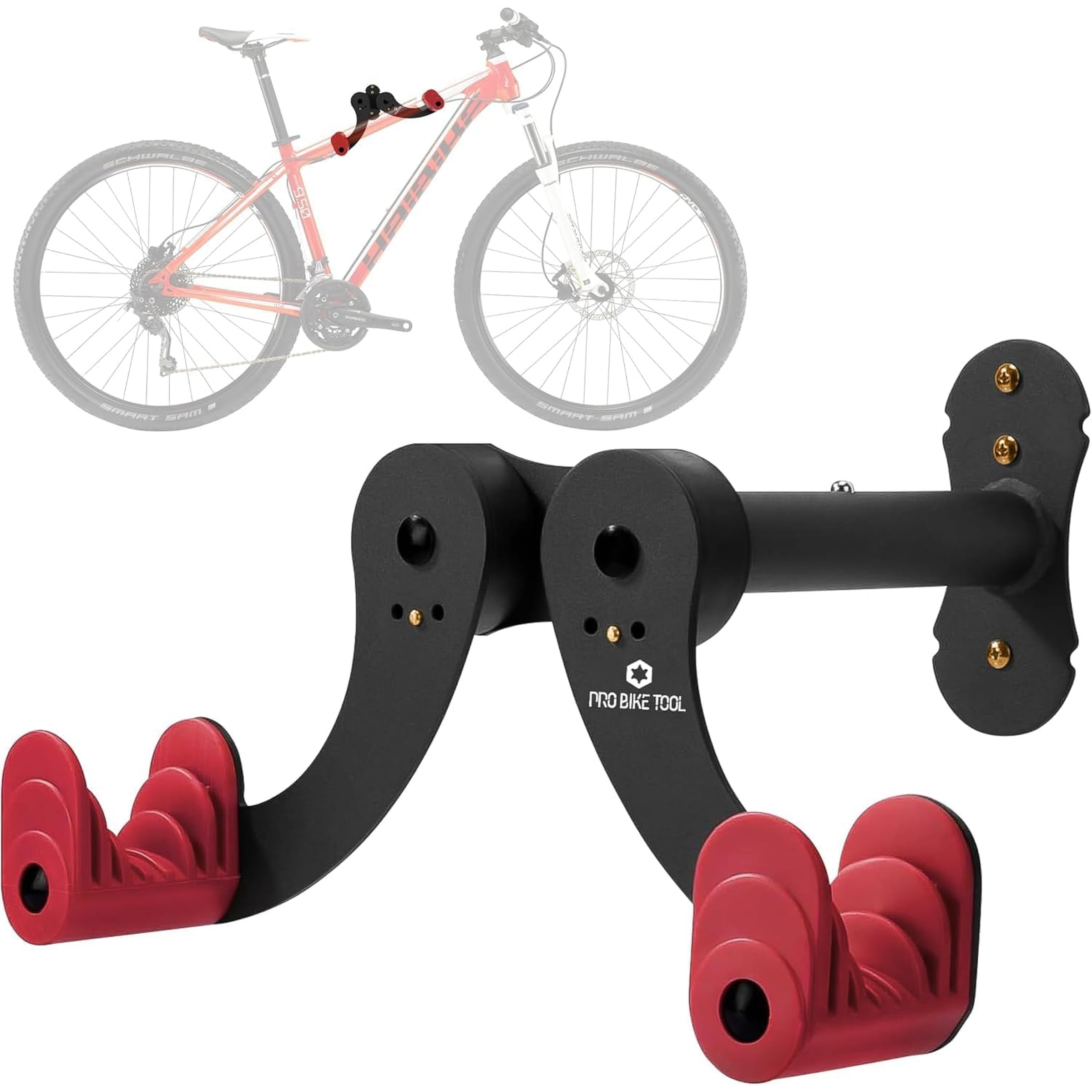
PRO BIKE TOOL Wall Mount Rack
Key Features
- Cradles: Rubber-coated
- Bikes held: 1
- Weight limit: 48.5 lb
- Arm extension: 8.7 to 12.6 in
- Price: Midrange
Vertical racks dominate this category, but not every bike wants to stand on its tail. PRO BIKE TOOL’s rack takes the frame instead: two rubber-cradled arms on a beam that extends from 8.7 to 12.6 inches, leaving the bike level and low against the wall. In a narrow garage that horizontal line leaves the space above and below it usable.
What we appreciated is that the arms adjust independently, so a sloped top tube or a full-suspension frame still sits level instead of hanging nose-down. The ratchet holds its position, the cradles are soft enough for a carbon frame, and an elastic strap keeps the front wheel from flopping sideways. It’s a simple idea executed properly.
The 22 kg rating is the boundary — that’s a light-to-middling bike, not a loaded e-bike. The three mounting holes are also fixed in place, so offer the bracket up to your studs before you drill; if the spacing misses, the fix is a longer screw into a different spot, not the supplied anchors.
Pros
- Independent arm adjustment fits odd frames
- Rubber cradles protect carbon and paint
- Elastic strap steadies the front wheel
- Compact horizontal footprint
Cons
- 22 kg limit rules out loaded e-bikes
Our pick when the bike should sit level and low on the wall. The arms adjust to the frame, the whole thing stays compact, and light bikes are the brief.
Best for Multi-Bike Garages
StoreYourBoard 5-Bike Rack
Key Features
- Mounting: Wall studs
- Bikes held: Up to 5
- Rail length: 46 in
- Mounting slots: 45
- Price: Midrange
One bike is a rack problem; five bikes is a wall problem. StoreYourBoard solves it with a 46-inch rail, 45 mounting slots, and hooks that slide to wherever you need them — a different proposition from five separate brackets all fighting over the same stud.
The hooks take a bike by the front or rear wheel, and that flexibility matters more than it sounds: alternating the direction lets wide handlebars overlap instead of collide. Mounting is a stud-to-stud job with the included hardware, and the rail spreads the load across every stud it crosses rather than concentrating it on four screws.
Hang five full-size bikes and the row gets tight — four is the comfortable number, and fat tires don’t fit the hooks at all. We think the adjustability is the real purchase here: what you’re buying is the ability to re-space the wall as the household’s bikes change, not five identical hooks.
Measure the widest handlebar in the house before you commit to five on one rail, and set the rail height so the hanging rear wheels clear the floor with room to sweep underneath.
Pros
- 45 slots let you re-space the rail
- Holds up to five bikes on one wall
- Hooks take front or rear wheel
- Spreads load across studs
Cons
- Five full-size bikes is a tight fit
- Fat tires don’t fit the hooks
For four or five bikes in one garage, this is the rack to beat: a single rail, hooks you can slide, and every bike on the same wall.
Best for Family Fleets
monTEK Swivel 4-Pack
Key Features
- Swivel: 150 degrees
- Tire width: Up to 3.54 in
- Weight limit: 66 lb each
- Hooks included: 4
- Price: Midrange
Four pivoting hooks for less than a pair of premium ones is the arithmetic that makes this set interesting, and it’s the cheapest way in this group to put a whole family on swivel mounts. If you have four riders and one garage wall, that math does most of the deciding.
Each hook carries 66 lb and takes tires up to 3.54 inches, a wider window than the roll-in racks allow, so gravel and plus-size tires go in without complaint. The 150-degree swing lets bikes sit square to the wall or be pushed to either side, and an empty hook folds back out of the way.
The loading is the compromise. These are hooks, not cradles, so you lift the front wheel in, and with a heavy e-bike that’s the awkward moment of the whole routine. The hardware suits studs and masonry; on anything else, buy proper anchors before you start drilling.
Pros
- Cheapest per-bike route to swivel storage
- 66 lb per hook
- Tires up to 3.54 in wide
- 150-degree swing folds flat
Cons
- You lift the front wheel into the hook
We recommend it when you need pivoting storage for several bikes without premium prices: four hooks, 66 lb each, and a wide tire window.
Best for No-Frame Hanging
Borgen Pedal Hook 3-Pack
Key Features
- Material: Powder-coated alloy steel
- Hold type: Pedal hook
- Weight limit: 66 lb each
- Hooks included: 3
- Price: Midrange
Borgen’s hook doesn’t touch the frame, the fork, or the rim. It takes the pedal. That means nothing to scratch on a carbon frame, nothing to thread between spokes, and no hunting for a straight tube on a bike with a complicated linkage.
Three hooks come in the box, each rated for 66 lb, powder-coated and lined with rubber where the pedal rests. The wheel brackets are optional, which we think is the right call: screw them in and a mountain bike sits horizontally, leave them off and the bike simply hangs. Either way the bike ends up flat against the wall and well out of the way.
Because the bike is held at the crank, where it lands on the wall depends on where the pedal sits when you lift it, so plan the mounting height around your bike rather than around the stud spacing. At 66 lb, a loaded e-bike leaves very little margin. For three ordinary bikes, it’s a lot of storage for modest money.
Pros
- Nothing touches frame, fork, or rim
- Three hooks in one set
- Optional wheel brackets keep MTBs level
- Rubber lining protects the pedal finish
Cons
- 66 lb ceiling leaves little e-bike margin
Nothing on this rack touches your frame or rim — it takes the pedal. A neat, affordable way to hang three bikes in a shed or garage.
Best for One Heavy Bike
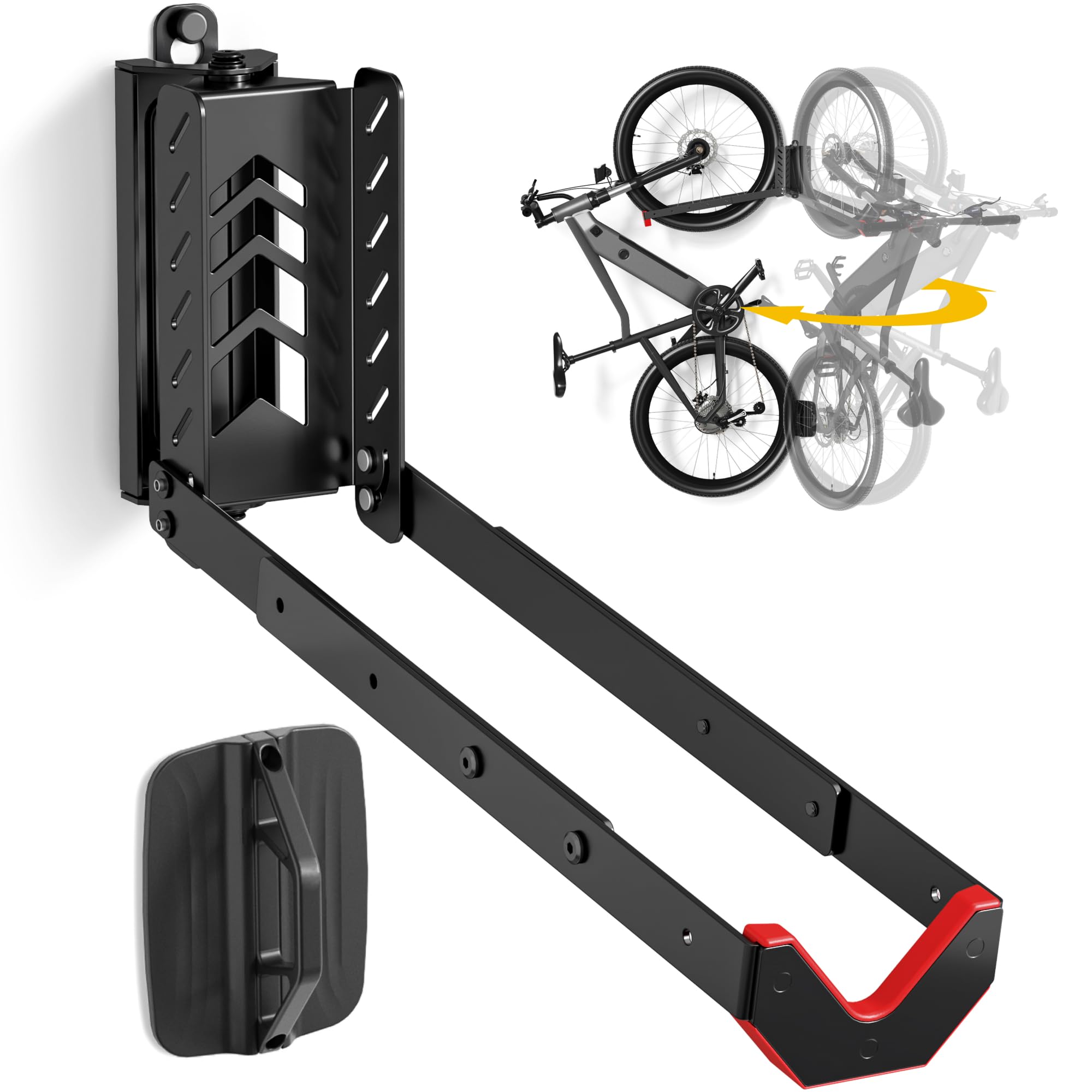
monTEK No-Lift 1-Pack
Key Features
- Pivot: 120 degrees
- Bikes held: 1
- Weight limit: 77 lb
- Wheel and tire fit: 16 to 29 in wheels, tires up to 3.54 in
- Price: Midrange
The no-lift idea is the good part, and this rack delivers it for well under what our top pick costs: balance the bike on its rear wheel, roll it into the cradle, done. It’s rated to 77 lb, the same figure as the Steadyrack, and it takes 16 to 29 inch wheels with tires up to 3.54 inches.
Where it gives something up is the swing. The pivot covers 120 degrees rather than 160, so a folded bike stops short of flat against the wall and doesn’t tuck as far to the side when it’s loaded. In a single-bike hallway that rarely matters; in a tight two-car garage it can.
Big wheels are the other watch-out. On some 29ers and 27.5 setups the front wheel doesn’t settle squarely in the cradle and twists under the bike’s weight as it comes to rest. Fenders are out, as with every roll-in rack here. We’d still choose it for one heavy bike on a budget — check the tire against the limit and make sure there’s a stud where you want it.
Pros
- No lifting: roll the bike in
- 77 lb per rack
- Wider 3.54 in tire window
- Folds flat when empty
Cons
- Shorter 120-degree swing than our top pick
- No fenders, and some 29ers sit awkwardly
The cheaper route into no-lift storage, and it holds 77 lb. You give up some swing range and a little clearance for big wheels.
Best for Budget Starter
Housolution 4-Pack Hooks

Key Features
- Hook type: Fixed, rubber-coated
- Weight limit: 99 lb each
- Hooks included: 4
- Price: Budget
Four steel L-hooks with a rubber dip, screwed into studs: that’s the whole product, and there’s a reason it’s the least expensive way to get a pile of bikes off a garage floor.
Each hook is rated to 99 lb, which is more than enough for anything you’d hang by a wheel, and the hooks are compact enough to run four along one wall without a rail. The rubber coating keeps rims and spokes from getting marked, and installation is about as simple as hardware gets.
What you don’t get is any control over how the bike sits. It hangs from one wheel and swings, so bar ends find shoulders and a bike can rotate into the car’s mirror. Wide tires don’t clear the hook either, and the plastic plugs in the box are no substitute for a stud. As a first rack for kids’ bikes and a shed, we think it earns its place; as the only rack for a good bike, it’s a compromise.
Pros
- Cheapest way to hang four bikes
- 99 lb per hook
- Rubber-coated to protect rims
- Compact enough to skip a rail
Cons
- Bike swings freely on one fixed hook
- Wide tires don’t clear the hook
If bikes only need to be off the floor, four fixed hooks do it for very little money. Expect swinging, and no room for fat tires.
Best for Apartment Walls
Delta Leonardo Wall Rack

Key Features
- Included: Rear-wheel tray
- Bikes held: 1
- Tire width: Under 2.5 in
- Weight limit: 40 lb
- Price: Budget
A hook holds the front wheel, and the rear wheel then leans on whatever’s behind it. The Leonardo’s answer is a small tray that catches the back tire and holds it off the wall, which is the detail that makes it presentable outside a garage.
We think the tray earns its keep — no black marks on the paint, and the bike sits flat instead of dangling. The powder-coated hook is small and tidy, and with a bike on it the whole assembly looks more like furniture than storage. In a hallway or a studio apartment, that’s worth paying attention to.
Two ceilings come with it. The rating is 40 lb, so an e-bike is out, and the hook only takes tires under 2.5 inches, which rules out most mountain bikes. The tray itself relies on adhesive, and against a textured or cold wall it can let go; screw or bolt it down and the problem disappears. For a road bike or a commuter in a small flat, none of that matters much.
Pros
- Rear-wheel tray keeps the wall clean
- Looks good outside a garage
- Fast install with included hardware
Cons
- 40 lb limit and 2.5 in tire ceiling
The tidiest single-bike rack here for a room you actually look at, thanks to the rear-wheel tray. Light bikes with narrow tires only.
Best for Tidy Hallways
Feedback Sports Velo 2D

Key Features
- Arms: Independently adjustable
- Warranty: 3 years
- Bikes held: 1
- Weight limit: 50 lb
- Price: Midrange
Machined aluminum, an anodized finish, and two arms that move independently in two directions — the Velo 2D looks like the expensive option, and it is. What you get for it is control over where the bike sits rather than just whether it’s off the floor.
That two-way adjustment is the practical part. You can set how far the bike stands off the wall and at what angle, so handlebars clear a door frame and pedals don’t catch a hip in a narrow passage. On an awkward frame it takes a few minutes of fiddling to balance the bike, and then it stays put, which is exactly what you want from a rack in a hallway you walk through daily.
Fifty pounds is the limit, and there’s a three-year warranty behind it — longer cover than anything else here. For one bike in a space you care about, the premium buys something you notice every day; for three bikes in a garage, the money goes further elsewhere.
Pros
- Arms adjust in two directions
- Anodized aluminum finish
- 50 lb capacity
- Three-year warranty
Cons
- Premium price for a single bike
We like the two-way arm adjustment and the finish: it parks one bike exactly where you want it, including in a narrow hallway, at a premium.
How We Hung, Loaded, and Rechecked 10 Bike Wall Mounts
We started by pulling together every wall mount we could find from brands we’d trust holding a bike over a car, then cut the list by style (hook, folding arm, vertical rail), stated weight rating, how far the arms reach off the wall, and whether the hardware in the box matched what the instructions actually called for. Mounts that needed a proprietary rail or a bike-specific adapter we couldn’t buy on its own didn’t make the cut. That left 10 mounts, from budget to buy-it-once.
Each one went up the same way: one person, a drill, a level, and whatever came in the carton. We timed from opening the box to the first bike hanging, and we deliberately installed them on three surfaces — a stud wall in a garage, a concrete basement wall, and a plaster wall in an older apartment — to see whether the instructions actually said which anchors to use where. We counted the trips back to the hardware store for different bolts, and noted whether the drilling template lined up or left us guessing.
Then we lived with them. Bikes went up and down twice a day — a 32-pound commuter, a kid’s 16-inch, and a mountain bike on 2.4-inch tires — and we rechecked every mount with a level at week one, month three, and month six, watching for sag at the arm, wobble at the plate, and any crushing where the bolts bit into the wall. We measured how far each one stood off the wall to judge the space it truly saved, re-hooked bikes one-handed at the end of a long ride, and checked whether the rubber coating held or wore through at the rim contact points. Anything that shifted in the first month didn’t survive to the six-month check.
How to Choose a Bike Wall Mount
The rack is the easy part — the wall, the tire, and the way you load the bike decide whether you’ll actually use it.
Start with how the bike is held
Four designs cover almost everything here, and the right one follows from your bike’s weight. A fixed or swivel hook takes the front wheel and costs the least, but you lift the wheel in and the bike hangs free to swing — fine for a light road bike, irritating for anything heavier. A roll-in cradle, like the Steadyrack or the monTEK no-lift, lets you balance the bike on its rear wheel and push it in, which is the only loading method here we’d call genuinely easy on a heavy e-bike.
Frame cradles hold the bike by the tubes so it sits level and low, and pedal hooks touch neither frame nor rim. Pick the loading motion first, then weigh capacity, fit, and looks.
Find the studs before you shop
Nearly every rack here wants wood studs, masonry, or concrete, and the anchors in the box are the part to trust least — plastic plugs in drywall are how a mount ends up on the floor with a bike attached. A three-hole bracket has to land on one stud, so measure your stud spacing before choosing. A rail with sliding hooks, like the StoreYourBoard’s 45-slot version, or a plywood ledger screwed across studs gives you somewhere to mount when the spacing doesn’t line up.
Mark the stud centers first. Then buy the rack that fits them, not the other way around.
Check the tire, the fender, and the wheel
Tire width is where universal quietly stops being true. The Delta takes tires under 2.5 inches, the Steadyrack 2.1 to 2.8, and the monTEK racks up to 3.54 — so a gravel or plus-size tire narrows the field quickly. Fenders rule out the roll-in cradles entirely, because there is nowhere for a mudguard to go. A true fat bike with 4-to-5-inch tires needs a rack sold for fat bikes, and none of these are it.
Read the sidewall before you order rather than after.
Plan the swing, not just the rack
Pivot range decides whether the rack fits your garage. A 160-degree swing lays a bike close to flat and moves it clear of a car door; 120 degrees is enough in a hallway but can leave the bars in a second car’s way. Think about the arc the handlebars sweep, not the hook — the bars are what hit things. On a multi-bike rail, alternate front-wheel-up and rear-wheel-up so the bars interleave instead of colliding.
Frequently Asked Questions
How high should I mount a bike wall rack?
High enough that the hanging bike’s rear tire clears the floor by an inch or two, and low enough that the front wheel and bars stay below the ceiling or the garage-door track. The bike’s own length sets that, so dry-fit first: hold the bike against the wall, mark where the cradle meets the tire, then drill.
On a rail, set the height once and slide the hooks afterward.
Will a wall mount hold an e-bike?
Weigh the bike with the battery and lock fitted and compare it with the per-bike rating — the racks here run from 40 lb up to about 99 lb. The roll-in racks rated at 77 lb are the realistic choice for a heavy e-MTB, and they need a fender-free fork.
Whatever the rating, the mount is only as strong as what it’s fixed to: studs or masonry, never drywall alone.
Does hanging a bike by its front wheel damage the wheel?
Usually not. A rubber-coated hook spreads the load across the tire, and the wheel carries it roughly the way it carries a rider. The exceptions are deep-section carbon rims and narrow metal hooks, where the contact patch gets small — a cradle that supports more of the tire is gentler.
Check the coating on the hook before you hang anything expensive from it.
Final Verdict
For most people the Steadyrack is the answer. It’s the rack here that takes a heavy bike without a lift, and the 160-degree swing gives the floor back to the car. If your bike is light and you want it hanging level and low instead, the PRO BIKE TOOL does that job for less money.
A household with four or five bikes should start with the StoreYourBoard rail rather than buying brackets one at a time — the ability to re-space the wall is worth more than any single hook.