This post contains affiliate links. We may earn a small commission when you buy through our links — at no extra cost to you.
The worst part of a hitch bike rack isn’t loading the bikes—it’s the half-second after you hit a highway expansion joint, when you glance in the mirror to check that everything is still where you strapped it. A good rack turns that flinch into a non-event: it holds bikes steady at speed, fits your receiver without a wrestling match, and makes loading feel routine. It also locks down, so a coffee stop doesn’t become a sprint back to the car.
I’ve helped friends wrestle bargain racks into place and watched pricier ones sway on a single bump, so I care less about features than how a rack behaves when it’s loaded. Over the past nine months, we tested eight hitch racks, assembling them in the driveway and living with them through school runs, trailheads, and highway miles. A spec sheet can tell you capacity and receiver size; it won’t tell you whether the rack rattles or whether the instructions make sense at 7 a.m. The picks below are the ones that made an ordinary ride easier.


Best for Four-Bike Family Duty
Allen 542QR 4-Bike
Key Features
- Security: Keyed locking quick-release
- Hitch fit: 2 in receiver
- Rack weight: 10 kg (22 lb)
- Bike capacity: 4 bikes, 140 lb total
- Price: Midrange
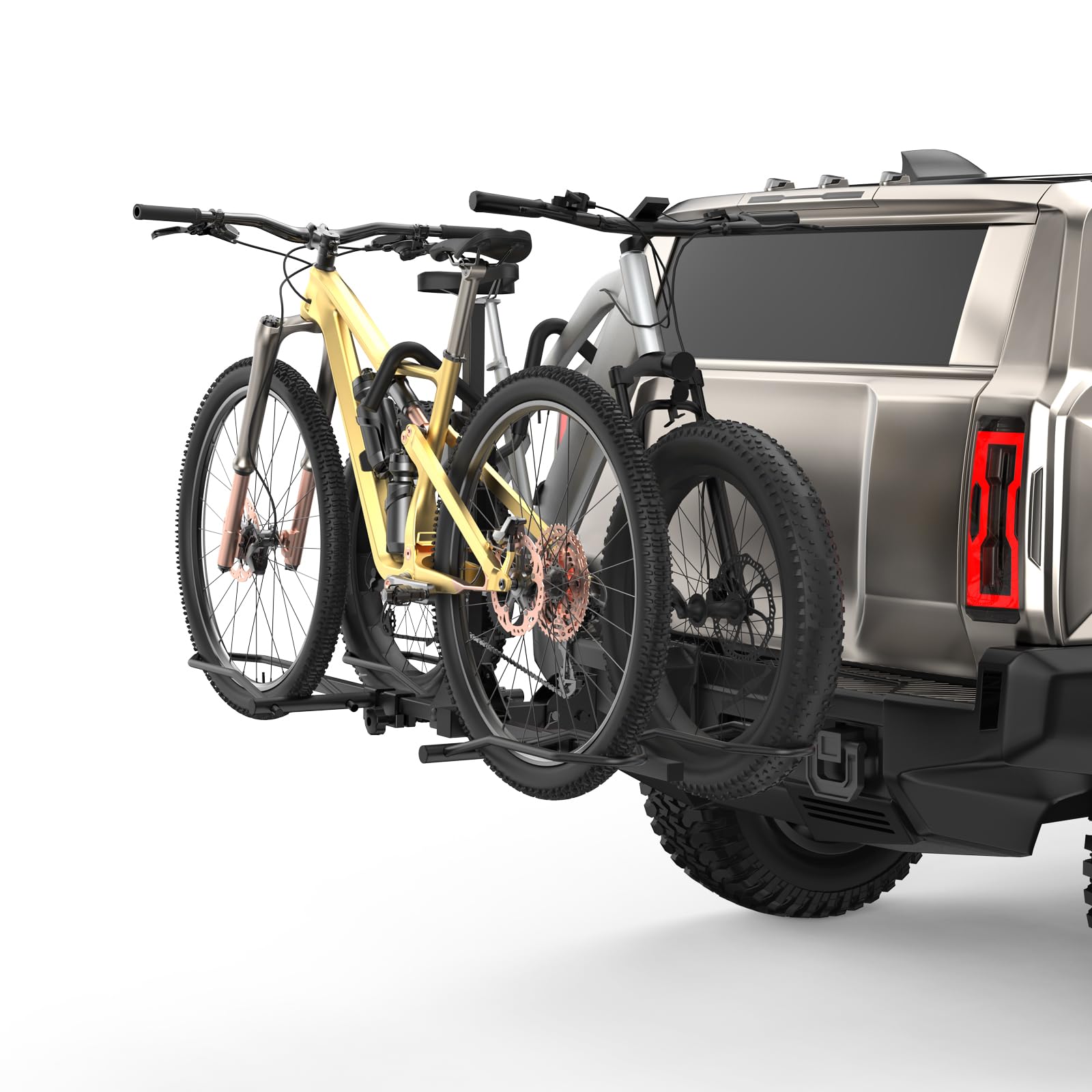
The locking quick-release hitch is why this Allen sits at the top of our list. You slide the rack into a 2-inch receiver, turn the key, and the mechanism pulls the rack tight against the hitch instead of leaving it to clunk. We noticed the difference before a single bike was loaded: the usual shiver from the receiver is simply gone, and the same key stops someone walking off with the rack.
Weight matters more than the spec sheet admits. At 22 pounds this is light enough to hang and pull off by yourself, and a rack you can mount in a minute is a rack that actually gets used.
Four bikes and 140 pounds is the working rating, and each cradle has its own tie-down, so frames are held individually rather than bundled together. The gap between cradles is tight, though, and four full-size adult bikes take some shuffling before everything clears. Step-through frames, kids’ bikes and anything without a horizontal top tube need an adapter bar, which isn’t in the box.
The rack tilts back for hatch access with bikes loaded and folds up when empty. The locking collar is the one part worth watching — it can bind and turn removal into a fight, so check it moves freely before you need the rack off. Otherwise, this is the four-bike rack that goes on our own car.
Pros
- Keyed hitch lock doubles as the anti-wobble device
- 140 lb rating genuinely covers four adult bikes
- 22 lb, so one person can mount it
- Tilts loaded and folds when empty
Cons
- Cradle spacing is tight for four full-size bikes
Our default for a 2-inch receiver: four bikes, a keyed hitch lock that kills the wobble, and 22 pounds to hang.
Best for Smaller Hitches
Swagman XC 2-Bike
Key Features
- Bike hold: Wheel trays with ratchet arm
- Hitch fit: 1-1/4 in and 2 in, Class 2+
- Rack weight: 28 lb
- Bike capacity: 2 bikes, 35 lb each
- Price: Midrange
If your vehicle has a 1¼-inch receiver, most of this list is closed to you. The Swagman XC isn’t: it fits both 1¼- and 2-inch receivers, needs a Class 2 hitch or better, and holds two bikes by the wheels with an upright that clamps the frame.
The ratcheting arm is the part we enjoy using. It comes down on the top tube in one motion per bike, with no straps to thread, and the anti-wobble device built into the hitch keeps the whole thing from shivering on the road. At 28 pounds it comes off the car without a struggle.
What it doesn’t include is a lock — the hitch pin and a security cable are separate purchases, and until you fit a locking pin the rack is only as secure as the pin in the hole. The 35-pounds-per-bike ceiling is the other boundary: a heavy e-bike will bend the wheel baskets, which is a job for a tray rack with more headroom.
For a couple of road, gravel or hybrid bikes it is the neatest thing here, and the frame clamp takes seat tubes and top tubes of very different diameters. It also takes a 2-inch receiver, so the rack survives the next car.
Pros
- Fits both 1¼-inch and 2-inch receivers
- Ratchet arm clamps a bike in one motion
- Anti-wobble device built into the hitch
Cons
- Locking hitch pin and cable sold separately
- 35 lb per bike rules out heavy e-bikes
Our choice for a 1¼-inch receiver: two bikes clamped by the wheels in one motion, and a rack that stores on a shelf.
Best for Premium Hatchback Setup
Thule Outpace 3
Key Features
- Hitch fit: 2 in and 1-1/4 in
- Frame clamp: 0.8-3.5 in tubes
- Rack weight: 43 lb
- Bike capacity: 3 bikes, 110 lb total
- Price: Premium
Three bikes for premium money is the first thing to wrestle with, and the case for the Outpace 3 rests on how it is built rather than how many bikes it carries. The frame is aluminum, it folds into a compact bundle with a carrying handle, and the head rotates and slides to clamp nearly any tube between 0.8 and 3.5 inches.
The tilt is the feature we appreciate most: it drops the rack with the bikes still on it, so a hatchback or wagon owner can get into the trunk mid-trip without unloading. Wheel straps and a frame clamp hold each bike in three places, and bikes load in any order, which means the smallest frame doesn’t have to go last.
It fits 2-inch and 1¼-inch receivers, and an adapter is included, so it can move between cars. The trade-off is bulk: at 43 pounds it is the heaviest rack in this group, and the folding hinge is one more mechanism to keep clean and working freely.
110 pounds across three bikes suits a road-and-gravel family. If you are hauling e-bikes or four riders, the capacity runs out long before the quality does.
Pros
- Tilts down with the bikes still loaded
- Folds compact with a carrying handle
- Frame clamp spans 0.8 to 3.5 inch tubes
Cons
- At 43 lb it is the heaviest rack here
- Three-bike limit for premium money
The premium pick for a hatchback household: three bikes, a tilt that works loaded, and a body that folds small.
Best for Budget Tray Rack
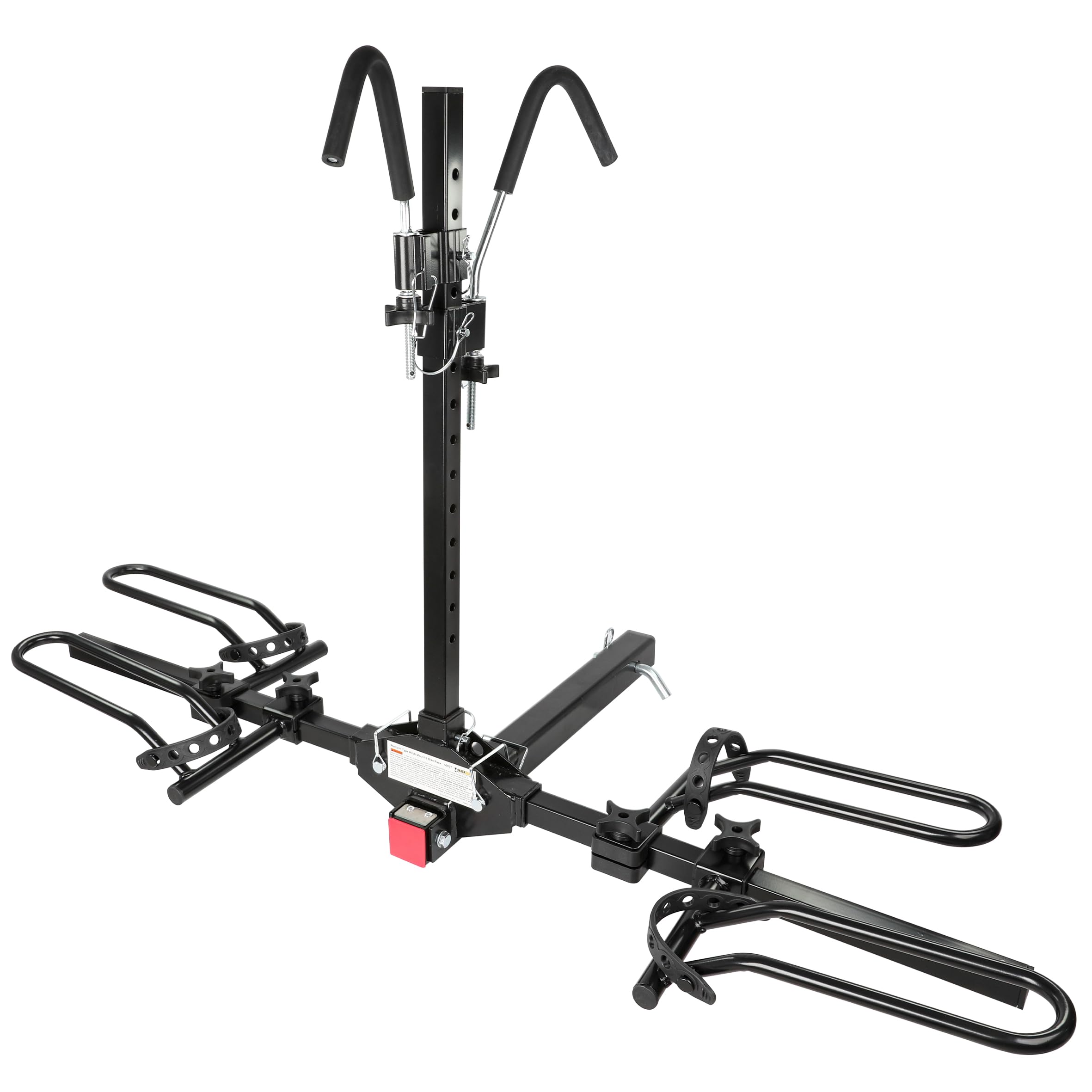
MaxxHaul 50027 Platform
Key Features
- Fit range: 20-26 in wheels, 2-1/4 in tires, 63 in wheelbase
- Hitch fit: 2 in, Class III/IV only
- Rack weight: 33.1 lb
- Bike capacity: 2 bikes, 40 lb each
- Price: Budget
Twenty to twenty-six inches is the wheel range this MaxxHaul tray accepts, and that one figure decides whether the rack suits you. Adult mountain, road and hybrid bikes sit inside it; a 29er, a fat bike or anything with tires wider than 2¼ inches does not.
It is also strict about the hitch: MaxxHaul rates it for 2-inch Class III or IV receivers only, and not for RVs, campers or trailers. Within those lines it is a lot of tray rack for the money — two bikes drop into adjustable cradles, foam-padded hooks come down over the tires, and a locking knob tightens the upright so it doesn’t sway.
We like that the post lifts out, which is how a 33-pound rack disappears into a garage corner between trips, and the folding arms keep the empty rack tidy on the car. The cradles slide along the beam, so a short-wheelbase kids’ bike can share the trip with an adult hybrid.
One thing sours it: the tilt mechanism has a wobble to it with bikes loaded, the sort of shake a strap silences. For two standard bikes on a truck or SUV with a proper hitch, it is among the cheapest ways into wheel-tray loading.
Pros
- Wheel trays hold bikes with no frame contact
- Removable post stores out of the way
- Adjustable cradles take different wheelbase lengths
Cons
- No lock on the hitch pin or bikes
- Wheel trays stop at 26 inches
The budget tray for standard bikes: wheels held, frames untouched, as long as your wheels sit between 20 and 26 inches.
Best for Fat-Tire E-Bikes
TRAILXPERT Fat-Tire Rack
Key Features
- Tire fit: Up to 5 in wide
- Hitch fit: 2 in receiver
- Rack weight: 33.4 lb
- Bike capacity: 2 bikes, 160 lb total
- Price: Midrange
Five-inch tires is the claim, and it is the reason this rack exists in a group where most trays give up at 2¼ inches. If the garage holds a fat bike, an e-bike or both, the TRAILXPERT is the one here that takes them without letting air out first.
Two bikes, 160 pounds, and hooks that come down over the frames and lock with a key — a small thing that makes a large difference when the car sits in a trailhead lot all afternoon. The tilt release drops the loaded rack for hatch access, and it folds up compactly when the car is empty.
Welds and paint look better than the price suggests, and at 33 pounds it is manageable for one person, though the frame is long enough that a second pair of hands makes mounting easier. Both the hitch pin and the bike hooks are keyed, which is rare among the racks here.
Two 60-pound e-bikes come in well under the rating, and the wheel holders slide to take different wheelbases without tools. If your bikes are all standard road or hybrid models, you are paying for tire capacity you won’t use.
Pros
- Trays take fat tires up to 5 inches
- Keyed hitch pin and locking bike hooks
- 160 lb total covers two e-bikes
Cons
- Instructions are thin for the hardware involved
- Locking hooks need exact alignment to engage
Our fat-tire pick: 5-inch trays, keyed hooks and 160 pounds of headroom for two e-bikes, without a second mortgage.
Best for Cheapest Four-Bike
Amazon Basics 4-Bike
Key Features
- Hitch fit: 2 in receiver
- Stability: Anti-rattle design
- Rack weight: 10.7 kg (23.6 lb)
- Bike capacity: 4 bikes, 132 lb total
- Price: Budget
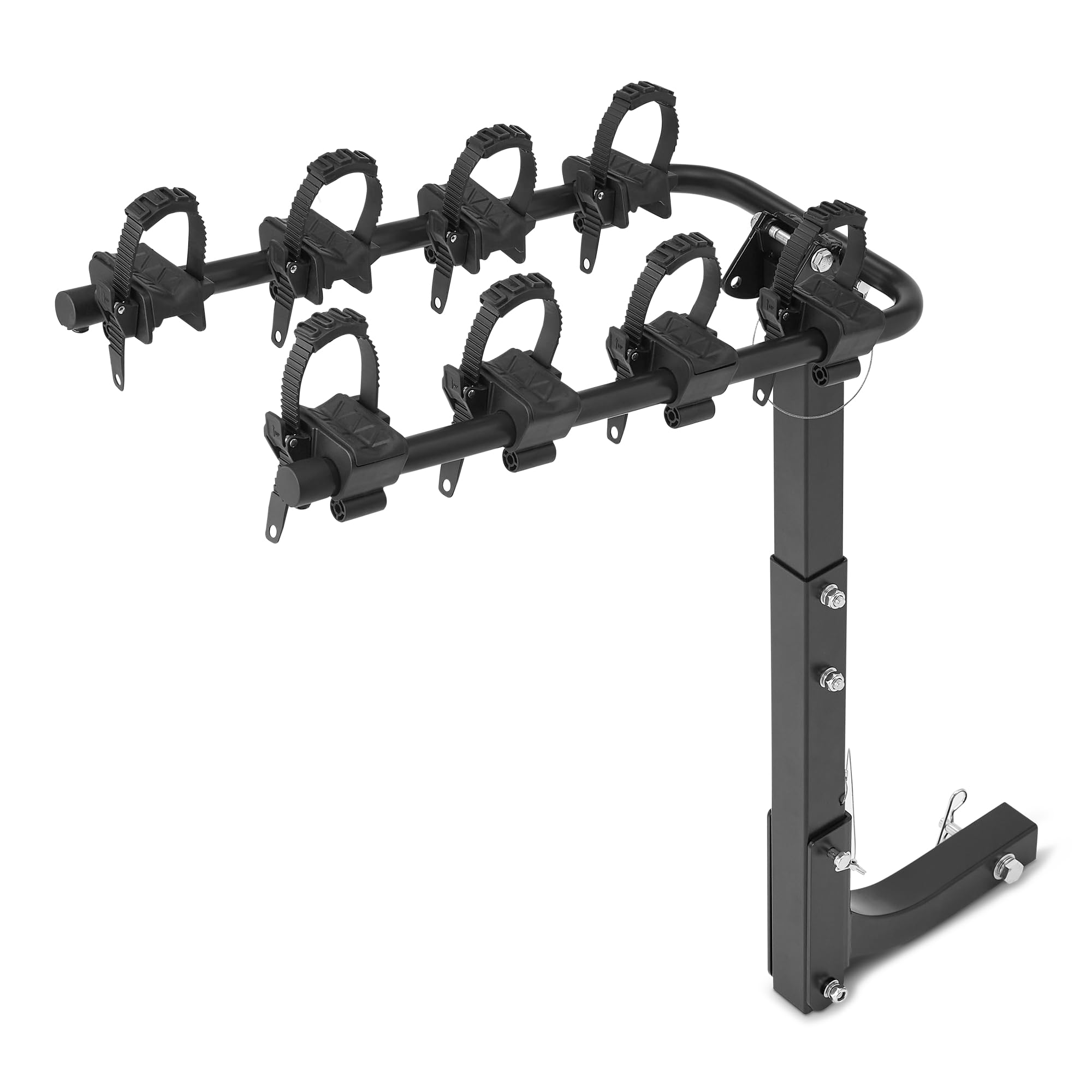
The cheapest route to four cradle positions is this Amazon Basics rack, and it does the basic job without drama: powder-coated steel, folding arms, an anti-rattle fitting and a 132-pound rating.
Assembly is straightforward with the hardware in the box, and the folding arms drop the empty rack out of the way between trips. Loading is the standard hanging routine — lift each frame into the hooks and strap it down — and it is quick once you have done it twice.
Four cradles is not the same as four bikes, though. The arms are spaced for slim frames, so four mountain bikes with wide bars take negotiation, and step-through or kids’ frames don’t sit in the cradles without an adapter bar, which is worth adding at checkout.
For a family running two adult bikes and two kids’ bikes to a local trail, it is the least expensive way onto the hitch, and the anti-rattle design keeps it quiet on the drive. It is a starter rack, and it is honest about it.
Pros
- Anti-rattle design keeps the empty rack quiet
- Least expensive four-cradle rack in this group
Cons
- 132 lb total leaves no room for e-bikes
The cheapest way to four cradle positions, best for a family with two adult bikes and two kids’ bikes.
Best for Light Bikes Only
Allen 542RR 4-Bike

Key Features
- Hitch fit: 2 in receiver
- Rack weight: 23 lb
- Hatch access: Tilts back, arms fold
- Bike capacity: 4 bikes, 22 kg (48 lb) total
- Price: Midrange
Past the four-bike badge is the number that matters: 22 kg, about 48 pounds, of total load. Two adult mountain bikes come close to that on their own. Whatever the cradle count suggests, this is a rack for a couple of light bikes, a pair of kids’ bikes, or a mix — not four adults’ worth of steel.
Read that way, it is good value. The cradles hold each bike with its own tie-down and the retainer clips are on lanyards, so nothing disappears in the driveway. The arms fold out of the way, the rack tilts back for hatch access, and at 23 pounds it is one of the easiest here to lift onto the hitch.
The hitch hardware is the annoying part. There is no lock, and the pin hole in the shank is sized for a half-inch pin rather than the five-eighths most locking pins use, so a standard lock may not drop in without drilling it out. Plan on a bolt and a cable instead, or a session with a drill.
For occasional trips with two or three bikes it does everything asked of it, quietly and for very little money. Just don’t buy it expecting to load four full-size bikes and drive to the trailhead.
Pros
- Individual tie-downs with lanyarded retainer clips
- 23 lb, easy for one person to mount
- Tilts for hatch access and folds away
Cons
- Cradle spacing is tight for four adult bikes
A light, cheap four-cradle rack that really carries two or three bikes — read the 22 kg rating before you buy.
Best for Occasional Weekend Use
Young 80 lb Platform

Key Features
- Design: Folding platform, cushioned hooks
- Hitch fit: 2 in receiver
- Bike capacity: 2 bikes, 80 lb total
- Price: Budget
Eighty pounds is the whole allowance: 40 pounds a bike, two bikes, and not much room beyond that. For a pair of hybrids or two kids’ bikes on a platform, that is enough — it is a light-duty tray rack, and it is priced like one.
The layout is what we like. Bikes sit in wheel cradles with soft cushioned hooks over the frames, so nothing hangs from a top tube and nothing rubs paint, and loading is a lift-and-drop rather than a balancing act.
Adjustable knobs let you snug the cradles to different wheel sizes, so a kids’ bike and an adult hybrid can share the trip, and the folding action makes it easy to stow against a garage wall. Nothing here needs tools once it is on the car.
For occasional weekends on a sedan or small SUV it earns its place, and the low price makes its manners easy to forgive. Two e-bikes are past the rating before you leave the driveway.
Pros
- Wheel cradles with cushioned hooks protect paint
- Folds flat for garage storage
Cons
- Sits loose in the receiver without a stabilizer
A light-duty folding platform for two ordinary bikes, priced like the occasional-use rack it is.
Best for One Heavy E-Bike
Young Single with Ramp

Key Features
- Ramp: Detachable loading ramp
- Hitch fit: 2 in receiver
- Rack weight: 35.3 lb
- Bike capacity: 1 bike, 100 lb
- Price: Midrange
The ramp is the whole idea. One bike, 100 pounds, and a detachable ramp you roll a heavy e-bike up instead of lifting — nothing else here offers that, and anyone who has hoisted a 70-pound e-bike onto a hitch rack after a long ride knows what it is worth.
The rest is solid: reinforced steel and aluminum, a 2-inch receiver, an arm that pins the bike down, and straps over the wheels. It is rated for RV use, which most of this list is not, and at 35 pounds it comes off the hitch without a wrestling match — lighter again if you leave the ramp at home.
It is a one-bike rack, and that is a real boundary. A second rider means a second rack or a different design, and a two-bike platform costs about the same. The holding arm also sits roughly where you want to stand while rolling the bike on, so loading takes a little choreography.
For a solo rider with an e-bike and no appetite for lifting, this is the sensible answer, and the ramp doubles as a stand when you are loading in a gravel lot. It just doesn’t grow with the household.
Pros
- Detachable ramp for loading a heavy e-bike
- Stated RV-approved compatibility
- 100 lb capacity for a single bike
Cons
- Straps can loosen on long drives
The pick for one heavy e-bike: a ramp you roll it up, an RV rating, and no lifting at the end of a ride.
How We Tested the Best Hitch Bike Racks
We started by comparing specs for receiver size, bike capacity, folded dimensions, weight, and the hardware each rack used, then narrowed the field to eight models that covered different priorities rather than just different prices. Over nine months, we assembled each rack in a driveway, timed the first solo install, and noted where the instructions forced us to backtrack or guess. A rack that took two people and an hour to set up started with a disadvantage.
In real use, we loaded road bikes, mountain bikes, and kids’ bikes up to each rack’s stated capacity, then drove highway stretches, washboard gravel, and speed-bump-heavy parking lots. We watched for sway at speed, checked whether bikes rubbed or crowded each other, and tested fit on both common receiver sizes where the rack allowed it, along with hatch clearance and whether the rack cleared a garage ceiling. We also locked bikes to the rack and the rack to the hitch during coffee stops, then gave everything a tug to see what actually held.
Durability and ease of use got judged over the long haul: we left racks mounted through rain and sun, installed and removed them repeatedly, and folded or tilted them with bikes off. We noted where hands pinched, how much force a latch needed, and whether loading a fourth bike turned into a puzzle. Value came down to the hardware, warranty, and daily hassle relative to the asking price—not just the sticker. The racks that scored best were the ones we stopped thinking about.
How to Choose a Hitch Bike Rack
The hitch decides your shortlist long before the bikes do — get the receiver size and class right and most of the confusion disappears.
Start with the receiver, not the rack
Look at the sticker on your hitch before anything else. A 1¼-inch receiver is usually Class I or II and suits two bikes on a light rack; a 2-inch receiver is typically Class III or IV and takes the four-bike carriers. The rack’s own weight counts too, because it hangs off the same tongue as the bikes.
An adapter sleeve changes the size of the opening, not the rating of the hitch, so a 1¼-inch Class II vehicle doesn’t turn into a four-bike tow rig with a sleeve. Two picks here fit the smaller receiver, the Swagman XC and the Thule Outpace 3; the MaxxHaul 50027 is expressly Class III and IV only.
Frame cradles or wheel trays
Hanging racks hold bikes by the top tube, and their advantage is mechanical simplicity: less rack weight, more bikes for the money, and a package that folds out of the way. The cost is frame compatibility. Step-through, kids’ and many full-suspension bikes have nothing for the cradle to grab, so you add an adapter bar.
Tray racks hold the wheels, which suits heavy e-bikes and awkward frames, but they are fussier about what fits. The MaxxHaul 50027 stops at 26-inch wheels and 2¼-inch tires; the TRAILXPERT takes 5-inch fat tires. Measure your tire width before you assume a tray will take it.
Match the load rating to the bikes you own
The number on the box is a total for the rack unless the listing says otherwise. Four bikes at 30 pounds each is 120 pounds, which sits comfortably under the Allen 542QR’s 140-pound rating and well past the Allen 542RR’s listed 22 kg. E-bikes change the arithmetic fast: two 60-pound bikes are 120 pounds, and only a few racks here are rated for it.
Weigh your heaviest bike, multiply by the number of riders, and compare that to the total — then check the per-bike figure as well. A rack with four cradles is not a promise about four adult bikes.
Why the same rack feels solid on one car and loose on another
Wobble follows this category around, and it usually comes from the joint between rack and receiver rather than the rack itself: a pin slightly undersized for the hole, a worn receiver, or a bolt that needs another turn. Anti-rattle fittings, hitch tighteners and keyed pins all attack the same problem from different angles.
If a rack shivers in the hitch, deal with it before a long drive rather than turning up the radio. Tilt and fold mechanisms are the other wear point — check they still latch positively after a season of gravel and road salt.
Think about who lifts it
Rack weight runs from 22 pounds to 43 pounds in this group, and that gap decides whether the rack goes on the car on a Tuesday evening or lives in the garage. If you fit it alone, choose lighter and accept less capacity.
If it stays on the car all season, the folding designs earn their keep by leaving a small footprint when empty. A removable upright, like the MaxxHaul’s, is the other way to make a heavy rack liveable between trips.
Frequently Asked Questions
Can I use a hitch bike rack on an RV or travel trailer?
Only if the rack is rated for it. A receiver on the back of a trailer moves far more than one on a car, and most tray racks here, including the MaxxHaul 50027, are explicitly not for RVs, campers or trailers. Look for a rack that states RV approval — the Young single-bike carrier does — and check the loaded weight against the trailer hitch’s own rating before you set off.
How do I stop bikes rubbing against each other on a hanging rack?
Load the heaviest bike closest to the car and alternate frame direction where the cradles allow, so handlebars and pedals don’t line up. Use every cradle strap, then run a bungee from the outermost frame to the rack upright to stop the stack rocking as one unit. If a single bike still swings, an adapter bar for its frame usually settles it.
What extras will I end up buying?
Usually a lock. The Allen 542QR has a keyed hitch lock built in and the TRAILXPERT keys both its hitch pin and its bike hooks; the Swagman XC sells its locking pin and cable separately, and the Allen 542RR has no lock at all. Add an adapter bar if anyone rides a step-through or kids’ bike, and a hitch tightener if the rack shifts in the receiver.
Will a rack set off my parking sensors or block the backup camera?
Often, yes. A loaded rack sits in the path of rear sensors and cross-traffic alerts, and many cars let you switch those off for towing — worth finding in the menu before the first trip. Check the camera view and that the license plate is still readable with the rack folded up; if not, a low tray design or a repositioned plate bracket fixes it.
Final Verdict
If your vehicle has a 2-inch receiver, the Allen 542QR is the rack to buy. Four bikes, a keyed lock that pulls it tight in the hitch instead of letting it clatter, and 22 pounds to lift make it the easiest good decision here.
Two requirements change the answer. A 1¼-inch receiver leaves the Swagman XC for two bikes, or the Thule Outpace 3 for three and a tilt that works with the bikes loaded. Fat tires or e-bikes point to the TRAILXPERT’s 5-inch trays.