This post contains affiliate links. We may earn a small commission when you buy through our links — at no extra cost to you.
Every ounce matters on the trail, and power banks are notorious for promising ultralight builds that don’t hold up. Many listings quote slim measurements and low weights that rarely match reality. This guide cuts through those inflated claims to find the banks that actually deliver on their specs.
The real trade-off isn’t just capacity versus weight — it’s whether you need rugged waterproofing for stream crossings and drops, or if a lightweight, fast-charging bank will serve you better for most trips. The right choice depends on your hiking style, not marketing hype.
We’ve narrowed down the power banks that genuinely meet their weight, speed, and durability promises. Use this to pick the one that fits your pack and your route — not a spec sheet.
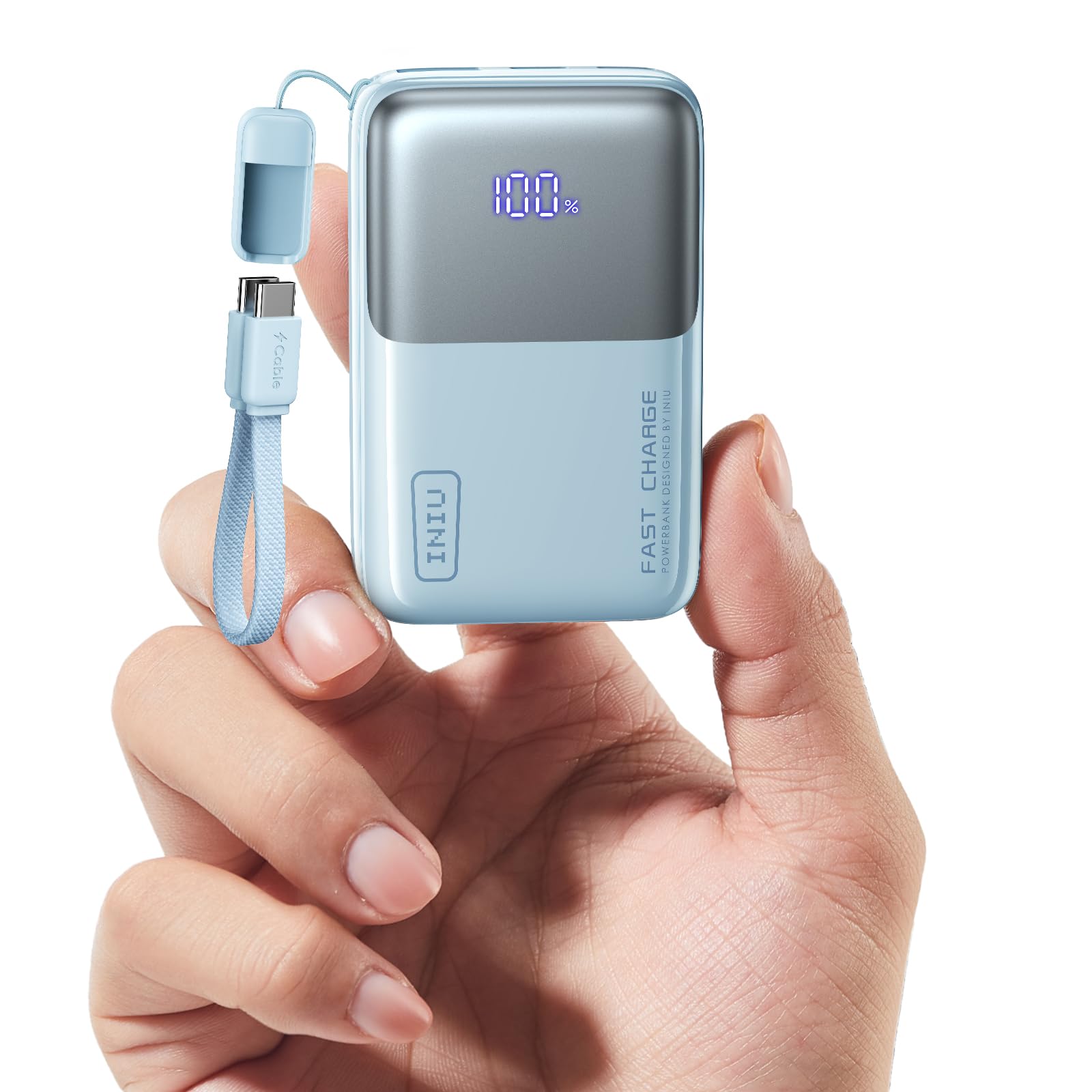


Best for Ultralight Backpackers
INIU Mini 10K 45W
Key Features
- Battery Capacity: 10000mAh
- Charging Speed: 45W PD
- Weight: 160g
- Ports: USB-C, USB-A, built-in cable
- Price: $
Weighing just 160 grams and slim enough to disappear into a hip belt pocket, the INIU Mini 10K 45W delivers a full 45W PD – enough to push an iPhone from 20% to 92% in 30 minutes. That combination of weight and charging speed is rare at this price.
The built-in nylon-braided cable detaches, so you don’t need to pack a separate cord. On day hikes or short trips, the 10000mAh capacity refuels a modern smartphone about twice, and the small footprint means it never feels like a burden.
This is the right choice for ultralight backpackers and day hikers who want fast charging without the extra ounces. It’s not built for rugged waterproof conditions or laptop charging, and a small portion of units may have charging faults out of the box – testing immediately upon arrival is a sensible step.
Compared to heavier, slower rugged options, the INIU offers a clear weight-to-speed advantage at a budget-friendly price. The detachable cable adds convenience without adding bulk.
Pros
- Ultra-light 160g design fits in pockets and hip belts without weighing you down.
- True 45W PD charging refuels phones quickly – 30% to 90% in under half an hour.
- Detachable nylon-braided lanyard cable means one less cord to carry.
- Budget-friendly price for the performance and weight savings.
Cons
- Some units may arrive with charging issues – testing immediately upon receipt is advisable.
For ultralight backpackers who need fast charging with minimal weight, this is the clear choice – just verify functionality on arrival.
Best for Rugged Adventurers
ELECOM NESTOUT 15K Rugged
Key Features
- Battery Capacity: 15000mAh
- Charging Speed: 32W USB-C PD
- Weight: 364g
- Ports: USB-A, USB-C
- Price: $$
The ELECOM NESTOUT carries an IP67 rating and passes MIL-STD-810G drop tests, meaning it handles rain, submersion, and a fall onto rock without missing a beat. Where lighter banks demand careful handling, this one shrugs off stream crossings and muddy campsites. The textured shell and protected port covers make it easy to grip with wet hands — no slippery plastic here.
That ruggedness comes with tradeoffs. At 364 grams and 32W USB-C PD charging, it is noticeably heavier and slower to top off than the lightweight top pick (160g, 45W). The USB-A port output is especially sluggish — okay for trickle-charging a headlamp overnight but frustrating for a camera or tablet. If you prioritize fast refueling between hikes, this bank will feel pokey.
The 15,000mAh capacity holds enough for three to four phone charges, which suits a multi-day trip. A built-in tripod mount on the side lets you attach it to a camera stand for time-lapse or as a base for a lantern — a nice bonus for camp use. Some units have shown reduced capacity after several months; keeping an eye on charge cycles is prudent, but the majority hold up well over a season of regular use.
Pros
- Survives full submersion in fresh water and drops onto concrete without damage.
- Tripod mount on the body doubles as a camera accessory or lantern base.
- Grippy, textured shell stays secure in wet or gloved hands.
- Three ports (USB-A, USB-C in/out) allow simultaneous charging of two devices plus the bank itself.
Cons
- USB-A port delivers noticeably slow output — best for low-draw devices like earbuds or a headlamp.
- Capacity can drop after several months of heavy use in a minority of units; worth testing early on.
This bank earns its place for backpackers who expect to get their gear wet and banged up — just be ready to charge devices at a relaxed pace and carry an extra 150g over the lightest options.
Best for Camp Hikers
aswayke 20K Lantern
Key Features
- Battery Capacity: 20000mAh
- Weight: 454g
- Ports: USB-C, USB-A
- Price: $$
The aswayke’s integrated 420-lumen lantern with five modes turns this power bank into a campsite light source, and the IP68 rating means it can handle full submersion and drops that would ruin a typical charger. That combination is rare at this price point.
This design targets car campers, basecamp hikers, and emergency kit users who want one device for both charging and lighting. The 1-lb weight and bulk rule it out for ultralight backpacking, and some units have a loose lantern attachment or a display that stays on longer than expected — worth checking on arrival.
When used at a car campsite or as a backup in a vehicle, the 20,000mAh capacity charges a phone three to four times, and the lantern provides enough light for cooking or reading. The USB-C PD input refills the bank in a few hours, so it’s ready for the next trip.
Pros
- Built-in 420-lumen lantern with five brightness settings replaces a separate camp light.
- IP68 waterproof and shockproof construction survives rain, submersion, and drops.
- 20,000mAh capacity charges a typical phone three to four times over a long weekend.
Cons
- At 1 lb, the weight is too heavy for backpacking trips where every ounce counts.
- The lantern attachment may feel loose on some units, and the power indicator can stay on unexpectedly.
Best suited for car campers and emergency kits who value a bright light and rugged build over pack weight. Not the right choice for anyone counting grams.
Best for High-Capacity Travelers
Anker 20K 87W
Key Features
- Battery Capacity: 20000mAh
- Charging Speed: 87W total
- Weight: 440g
- Ports: USB-C built-in, USB-C, USB-A
- Price: $$
Anker 20K 87W delivers 20,000mAh capacity and 87W total output, enough to fully recharge a MacBook or multiple phones. Unlike the compact retractable-cable power bank, this model prioritizes capacity and laptop-level power over pocket-friendly size.
This power bank suits road trippers, hotel travelers, and anyone who doesn’t mind carrying nearly a pound in exchange for laptop-level power. It is less ideal for backpacking or ultralight setups where every gram matters — the 0.97 lb weight and lack of simultaneous charging (you cannot charge the bank while powering a device) are real constraints for those scenarios.
The built-in USB-C cable cuts down on gear clutter, and the fast 87W discharge means short wait times for devices. The solid build quality holds up well in a duffel bag or car console.
Pros
- High 20,000mAh capacity delivers 3-4 phone charges or a laptop top-up during extended travel.
- Built-in USB-C cable eliminates the need to carry a separate charging cord, reducing gear.
- Fast 87W total output charges a MacBook or phone quickly, with solid construction.
Cons
- Weighs 0.97 lb — noticeable bulk for backpackers trying to keep pack weight low.
- Pass-through charging is not supported on some units; the bank cannot charge itself while powering connected devices.
A capable travel companion for car campers or those who need laptop-level power, but too heavy for backpacking trips where every ounce counts.
Best for Compact Travelers
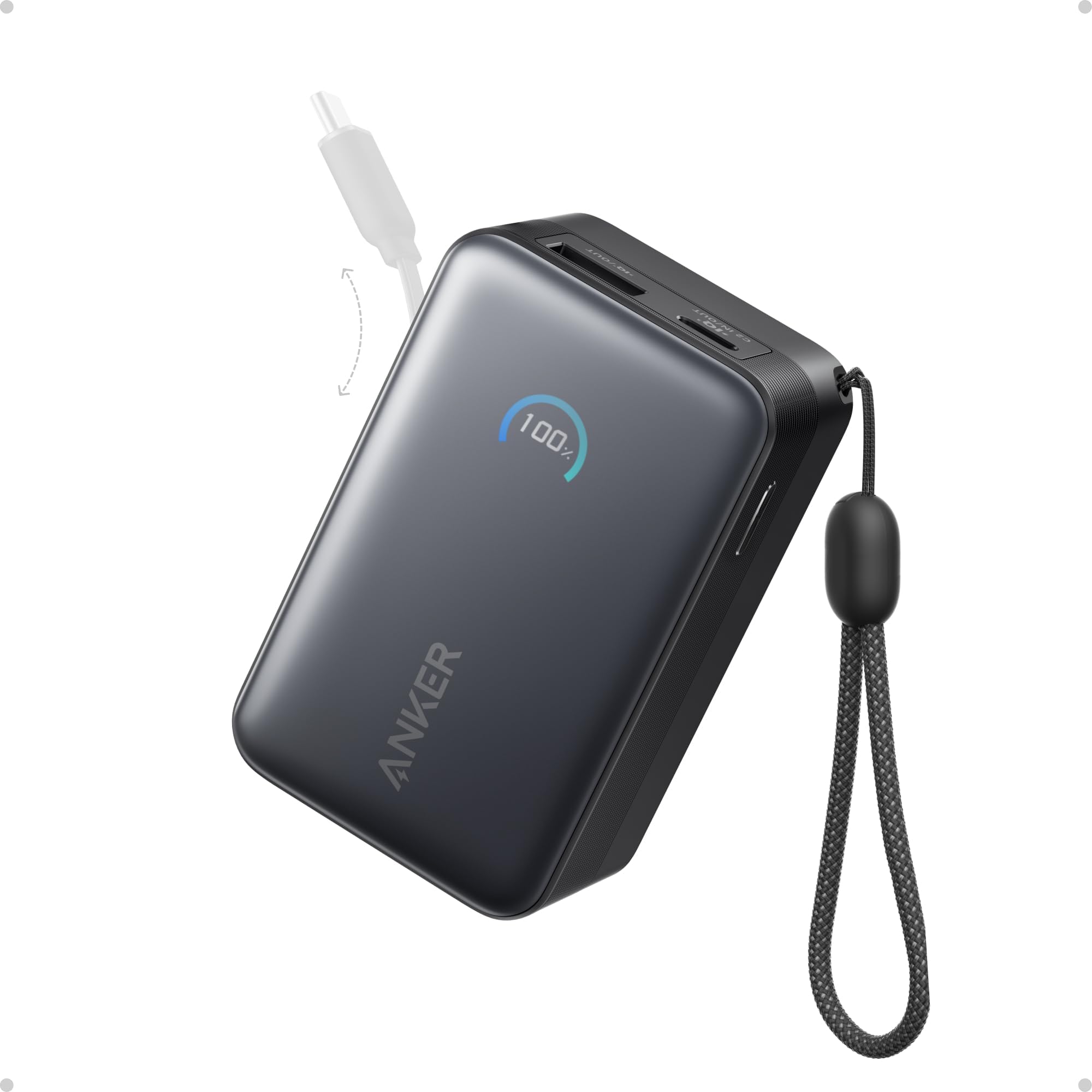
Anker Nano 10K 45W
Key Features
- Battery Capacity: 10000mAh
- Charging Speed: 45W PD
- Weight: 231g
- Ports: Retractable USB-C, USB-A
- Price: $$
The Anker Nano Power Bank combines 45W PD charging with a built-in retractable USB-C cable that keeps things tidy — no loose cords to dig for. Its small frame fits in a pocket or daypack, making it handy for short hikes or daily commutes where you need a quick top-off without the bulk. However, at 231g it’s heavier than some competitors at this capacity, and battery capacity can degrade after months of use. For extended backpacking trips where every gram counts and consistent performance over time is critical, this isn’t the ideal choice. It’s a better fit for casual outings where the clever cable design and fast charging outweigh the compromises.
Pros
- 45W PD fast charging recharges phones to 50% in under 30 minutes.
- Built-in retractable USB-C cable eliminates the need for a separate cord.
- Compact size fits easily in a pocket or small bag.
Cons
- Battery capacity can degrade after months of use, holding less charge over time.
- At 231g, it’s heavier than some similarly-sized 10,000mAh banks.
Best for day hikers or commuters who prioritize the retractable cable and fast charging, and don’t need ultralight weight or long-term capacity consistency.
How to Choose
The real weight of a power bank often exceeds its listed weight by 10-20%, so always check user-reported weights before buying.
Battery Capacity
Capacity (mAh) determines how many times you can recharge your devices, but not all mAhs are equal. Conversion loss from the battery cell to your phone’s battery typically wastes 10-30% of the rated capacity, so a 10,000mAh bank may only deliver 7,000-8,000mAh usable.
For a typical smartphone with a 3,000-4,000mAh battery, a 10,000mAh bank provides 2-3 full charges. If you also power a camera, GPS, or tablet, step up to 20,000mAh — but expect the weight to double.
Charging Speed
Charging speed is measured in watts (W). USB Power Delivery (PD) at 20W or higher can charge a phone from 20% to 80% in about 30 minutes, while older 5V/3A (15W) banks take 1.5-2 hours for the same job.
A faster charging bank also recharges itself quicker when you have access to a wall outlet, which matters on resupply stops. However, fast charging generates more heat, which can accelerate battery cell aging over time.
Weight and Size
Weight is the single most important factor for backpackers. A 10,000mAh bank typically weighs 160-250g, while 20,000mAh models range from 350-600g. Every extra 100g feels like a pound by mile 15.
Manufacturers often list dimensions without case thickness or cable loops. Read user reviews for actual carry weight, and consider whether the bank will live in a hip belt pocket or deep inside your pack.
Durability
IP67 or IP68 waterproofing means the bank can survive rain, stream crossings, and submersion in shallow water. A non-waterproof bank may fail if moisture seeps into the USB port or casing, especially when packed in a damp tent or sweaty pocket.
Shockproof construction (drop-tested to military standards) protects against tumbles on rocky terrain. For most backpackers who avoid extreme conditions, a robust but non-waterproof bank is adequate — but if you ford streams regularly, a sealed unit is cheap insurance.
Ports and Compatibility
USB-C is now standard for both input and output. A bank with at least one USB-C PD port ensures fast charging for modern phones and tablets. USB-A ports are still useful for older devices or sharing with a friend.
Built-in cables eliminate the need to carry separate cords, but they add weight and are often short (10-20 cm). Some retractable cables fail after repeated use. If you prefer a clean setup, a bank with integrated cable is convenient; otherwise, bring your own durable cord.
FAQ
Can I take a 20,000mAh power bank on a plane for backpacking?
Yes, as long as the bank is under 100 watt-hours (Wh). A 20,000mAh bank at 3.7V is 74Wh, which is well within TSA limits. Always carry it in your carry-on, not checked luggage, and make sure the bank is clearly labeled with its capacity.
How many times will a 10,000mAh power bank charge my phone on a multi-day hike?
Expect 2-3 full charges for a modern smartphone with a 3,000-4,000mAh battery, after accounting for conversion losses. If your phone battery is larger or you use your phone heavily for navigation, you may only get two charges. Consider a 20,000mAh bank for trips over three days without resupply.
Why does my power bank feel like it’s losing capacity after a few months?
Lithium-ion cells naturally degrade with use and time, especially when exposed to heat or stored at full charge. A noticeable drop in capacity after a few months often indicates a lower-quality cell or an early defect. To slow degradation, avoid deep discharges and store the bank at 50-60% charge when not in use.
Is a waterproof power bank worth the extra weight for backpacking?
If you regularly hike in rain, ford streams, or camp in wet environments, yes. A waterproof bank (IP67 or higher) survives submersion and prevents moisture damage to the USB port. For dry-weather backpackers who keep electronics in a dry bag, a non-waterproof bank saves 100-150g. It’s a trade-off between weight and peace of mind.