This post contains affiliate links. We may earn a small commission when you buy through our links — at no extra cost to you.
Camping power stations have matured fast: nearly every new model packs LiFePO4 batteries and can recharge in under an hour. But those headline specs don’t always translate to real campsite performance – a 1kWh unit will run a CPAP for two nights, yet struggle to keep a fridge cool for a full day in summer.
The real divide isn’t between brands – it’s between how you camp. Solo overnighters need something different from family RV trips. We’ve broken down the key specs and trade-offs to help you pick the station that fits your gear, not the other way around.
Understanding your actual draw – and the hidden idle drain – makes the difference between a power station that works and one that leaves you in the dark.


Best for Lightweight, Fast Recharge
Jackery Explorer 1000 v2
Rating: 4.7 ★ | Price: $$ | Weight: 23.8 lbs | Capacity: 1070Wh | AC Output: 1500W (3000W surge) | AC Outlets: 3 | Battery Type: LiFePO4
At 23.8 lbs, the Jackery Explorer 1000 v2 is the lightest 1kWh station from a major brand — a full 3 lbs lighter than the top pick in this category. That weight savings, combined with a 1-hour AC recharge (double the speed of many competitors), makes it a practical choice for campers who move between sites or need a quick top-up mid-trip. The tradeoff: this unit isn’t expandable, and some units have shown irregular charging behavior — worth confirming the warranty handles replacements smoothly.
This station suits car campers and RV users who run a small fridge, lights, and devices for a night or two, and want to recharge quickly during a lunch stop. The LiFePO4 battery offers long cycle life, but if you need surge power for a motor-driven appliance or plan to expand capacity later, the top pick’s expandable design is a better fit.
Pros
- Fast 1-hour AC recharge – great for topping up between campsite activities.
- Powers fridge, CPAP, and electronics steadily for overnight camping.
- Lightweight at 23.8 lbs with easy-carry handle – simple to move from car to tent.
Cons
- In some cases, units have shown sudden power cut-offs or failure to charge – worth purchasing with a flexible return policy.
- No expansion port for adding extra battery capacity – if your power needs grow, you’ll need a separate unit.
For car campers who value a lighter, quick-charging station over future expandability, the Jackery Explorer 1000 v2 is a strong fit — just check the warranty terms for peace of mind.
Best for High Capacity, Long Life
BLUETTI Elite 200 V2
Rating: 4.7 ★ | Price: $$$ | Weight: 53.35 lbs | Capacity: 2073.6Wh | AC Output: 2600W (3900W lift) | AC Outlets: 4 | Battery Type: LiFePO4
The Elite 200 V2 delivers 6,000+ charge cycles from automotive-grade LiFePO4 cells and idles at just 10W – roughly three times lower than comparable 2kWh units. That combination means you can charge it daily for over 17 years without noticeable degradation, and leave it plugged into appliances without wasting power when nothing’s running. Against the lighter, expandable top pick (EcoFlow Delta 2), you gain extreme longevity and efficiency but give up the ability to add extra battery packs and the portability to carry it from car to campsite.
This is the right call for full-time RVers, cabin owners, or anyone setting up a base camp where the power station stays put for days at a time. The 53-lb weight rules out frequent relocation – you’ll want a dolly or vehicle transport. It also runs a premium price, landing near what some competitors charge for a 2kWh unit with a solar panel included. The payoff is a power source designed to outlive your RV or cabin, not just a weekend trip.
Pros
- 6,000+ cycle life – the longest in any portable station under 3kWh.
- Standby consumption of 10W, 3x lower than most rivals, reduces wasted power.
- 3900W power lift runs heavy appliances like air conditioners without tripping.
Cons
- At 53 lbs, it’s best moved by vehicle or dolly – not for frequent carrying.
- Premium price tier – costs nearly as much as some competitors’ 2kWh models bundled with solar panels.
If your camping or off-grid setup is stationary and you want a power station that will outlast everything else you own, the Elite 200 V2 is a smart long-term investment – just don’t plan on moving it around.
Best for Budget, Portable
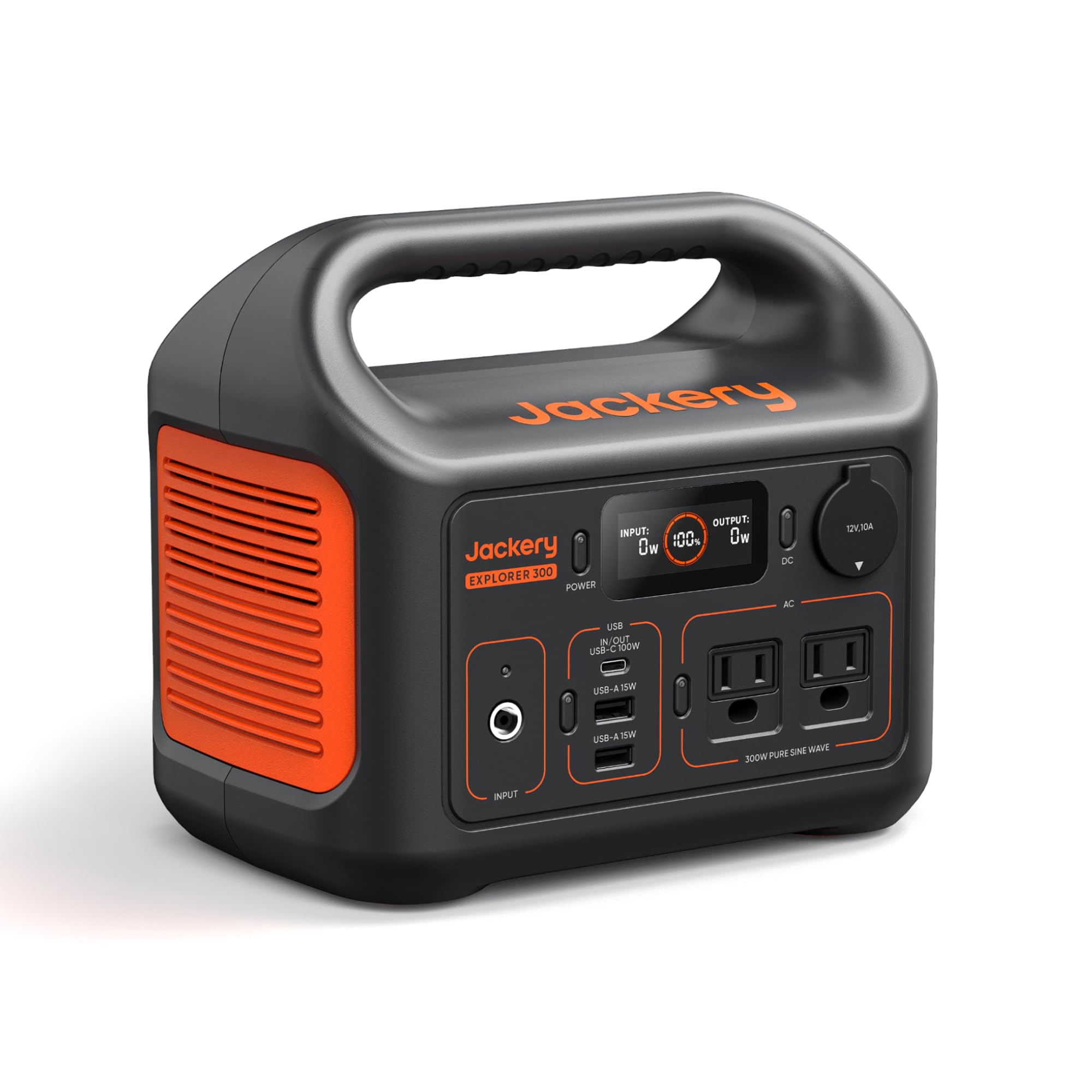
Jackery Explorer 300
Rating: 4.6 ★ | Price: $ | Weight: 7.1 lbs | Capacity: 292Wh | AC Output: 300W (600W surge) | AC Outlets: 2 | Battery Type: Lithium Ion
The Jackery Explorer 300 offers a compact, entry-level power solution that prioritizes portability and low cost over capacity and expandability. At 7.1 lbs, it’s light enough for backpacking and holds enough charge to top up phones, cameras, and run a CPAP for an overnight trip. Its 300W AC output handles small electronics, but the older Li-ion battery cells may degrade faster than the LiFePO4 chemistry found in newer competitors—a known tradeoff in this price tier.
This station is best suited for backpackers and car campers whose power needs are limited to device charging, a CPAP, or a few LED lights for a single night. It is not a fit for those who need to run mini fridges, coffee makers, or other 500W+ appliances, or for extended off-grid stays without solar panels. Buyers should weigh the shorter cycle life of the Li-ion battery against the lower upfront cost and light weight.
Pros
- Lightweight and compact design makes it easy to carry on backpacking trips.
- Charges phones, cameras, and runs CPAP machines without issues.
- Holds charge for multiple days, sufficient for a single overnight trip.
Cons
- Older Li-ion battery cells may show capacity loss within a year of regular use.
- AC output capped at 300W – cannot power mini fridges, coffee makers, or other higher-wattage appliances.
The Jackery Explorer 300 is a smart entry-level buy for budget-conscious campers who need light weight and basic device charging – just be aware the battery won’t last as many cycles as newer LiFePO4 models.
Best for High Capacity, Ups
BLUETTI AC180

Rating: 4.6 ★ | Price: $$ | Weight: 37.4 lbs | Capacity: 1152Wh | AC Output: 1800W (2700W peak) | AC Outlets: 2 | Battery Type: LiFePO4
The BLUETTI AC180 delivers 1152Wh capacity at a price point where most competitors offer only 1kWh, making it a strong value for powering a fridge or small appliances during a weekend trip. It can recharge from 0-80% in 45 minutes via wall outlet, and its UPS function with 20ms switchover works well for backup power at a base camp. However, the 37.4 lb weight makes it impractical to carry any distance, and the ~20W idle draw reduces usable capacity when running small loads like lights or phone chargers. This tradeoff is easy to accept if the station stays in one spot — in a vehicle, RV, or tent site — but frequent movers should look at lighter options.
Pros
- 1152Wh capacity runs a refrigerator for 12+ hours on a single charge.
- 0-80% charge in 45 minutes, full recharge in 1 hour via AC wall outlet.
- UPS function with 20ms switchover provides backup power for sensitive electronics.
Cons
- At 37.4 lbs, moving it between sites requires effort – fine for vehicle-based setups but not for carrying.
- Idle draw of ~20W reduces efficiency for small loads like fans or phone chargers.
For car campers or RV owners who keep the power station in one place, the AC180 delivers strong capacity per dollar and fast recharging – a practical choice for base camp power.
Best for Silent, Budget 1Kwh
DJI Power 1000

Rating: 4.4 ★ | Price: $ | Weight: 29 lbs | Capacity: 1024Wh | AC Output: 2200W (2600W peak) | AC Outlets: 2 | Battery Type: LiFePO4
The DJI Power 1000 delivers whisper-quiet operation at 23dB and a robust 2200W AC output, making it one of the best options for silent camping where noise is a concern. Its fast 70-minute recharge and 800W solar input are also strong points. However, a higher-than-expected defect rate — including units that may not turn on or drain battery quickly — and the limitation to only two AC outlets (no 12V port) mean this station is best suited for budget-conscious campers who can accept some risk and don’t need extensive connectivity.
Pros
- Exceptionally quiet 23dB operation for silent camping
- Full AC recharge in 70 minutes, plus 800W solar input for quick top-ups
- Great value for a 1kWh station with 2200W output when on sale
Cons
- Some units may fail to power on or experience rapid battery drain
- Only two AC outlets and no built-in 12V port limit device connectivity
This station works well for campers who prioritize silence over broad compatibility, need only a couple of AC plugs, and are comfortable buying with a flexible return policy.
Best for Many Ports, Fast Charge
Anker SOLIX C1000

Rating: 4.7 ★ | Price: $$ | Weight: 27.6 lbs | Capacity: 1056Wh | AC Output: 1800W (2400W peak) | AC Outlets: 11 | Battery Type: LiFePO4
The Anker SOLIX C1000 delivers the broadest port selection in its class – eleven outlets including three USB-C ports and five AC outlets – alongside a compact 27.6-pound frame that fits easily in a car trunk. Its UltraFast mode charges to 80% in 43 minutes and fully in 58 minutes, outpacing most similarly sized stations. The tradeoff: capacity is fixed at 1056Wh with no expansion option, and some owners have noted charging irregularities over time. For campers who need to power multiple devices quickly and value port variety over scalability, this is a capable option.
Pros
- Fast 43-minute 80% charge and 58-minute full charge via UltraFast mode
- 11 ports including multiple USB-C and five AC outlets for wide device compatibility
- Compact size – 15% smaller than comparable 1kWh models
Cons
- No detachable battery or expandability – capacity is fixed at 1056Wh
- Occasional charging irregularities have been noted; a flexible return policy offers peace of mind
Best for campers who prioritize many ports and fast recharging over future expandability, and who are prepared for occasional charging quirks.
Best for Ultra-Fast Recharge, High Output
Anker SOLIX C1000 Gen 2
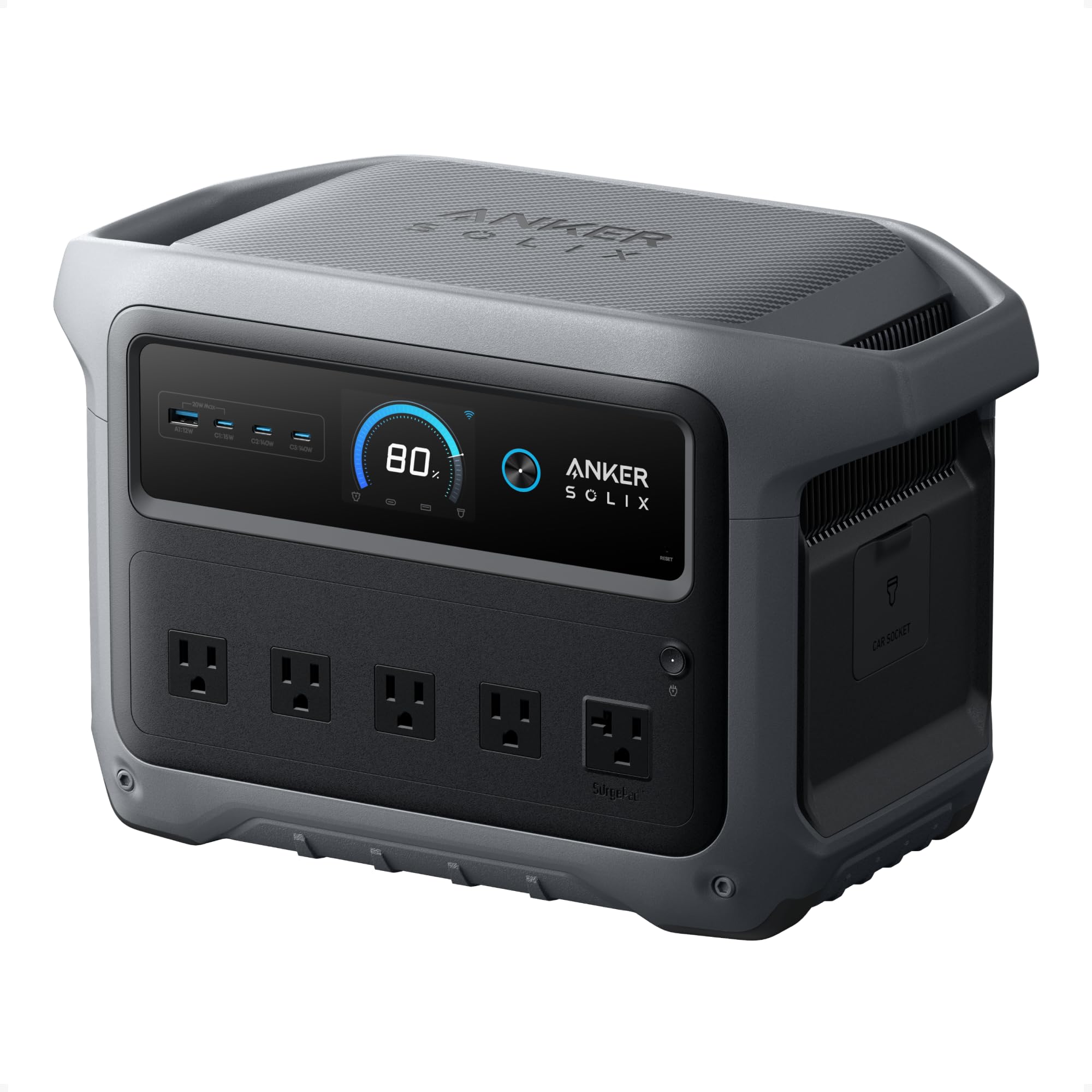
Rating: 4.7 ★ | Price: $$ | Weight: 24.9 lbs | Capacity: 1024Wh | AC Output: 2000W (3000W peak) | AC Outlets: 9 | Battery Type: LiFePO4
The Anker SOLIX C1000 Gen 2 delivers the fastest AC recharge in its class – a full 1,024Wh in under an hour – and provides 2000W of continuous output, enough for induction cooktops and power tools. Its compact footprint makes it easier to stow than most 1kWh rivals. However, at 24.9 lbs it’s not for backpackers, and some units have experienced port or charging failures out of the box. This makes it a strong pick for car campers who prioritize speed and power over the lighter weight or longer track record of the more established top pick.
Pros
- Full recharge in 49 minutes – fastest in the 1kWh class, ideal for quick top-ups between campsite stops.
- 2000W continuous output handles induction cooktops, microwaves, and power tools without issue.
- 14% smaller than comparable 1kWh units – easier to pack and store in a vehicle.
Cons
- At 24.9 lbs, too heavy for hiking or backpacking – better suited for car camping or basecamp use.
- Occasional charging or port failures have been noted right out of the box – worth testing immediately after purchase.
Best for campers who need ultra-fast recharging and high power output, and who can accept a weight tradeoff and the possibility of early QC variance.
Best for Lightweight 2Kwh, Fast Charge
Jackery Explorer 2000 v2

Rating: 4.6 ★ | Price: $$$ | Weight: 39.5 lbs | Capacity: 2042Wh | AC Output: 2200W | AC Outlets: 3 | Battery Type: LiFePO4
At 39.5 lbs, the Jackery Explorer 2000 v2 is 41% lighter than typical 2kWh stations, making it practical to carry from car to campsite. It charges from empty to 80% in just over an hour and runs quietly with a built-in UPS for backup power. The tradeoffs are clear: it’s still too heavy for hiking, and the three AC outlets may feel limiting if you need to power multiple appliances at once. This is a strong match for campers who want high capacity without wrestling a 60-lb block, but not for those heading into the backcountry or running a full appliance suite.
Pros
- Lightest 2kWh unit at 39.5 lbs – manageable for car-to-site transport.
- Charges from 0–80% in about 66 minutes with emergency mode.
- Quiet operation and 20ms UPS switchover for reliable backup power.
Cons
- At 39.5 lbs, it’s not suitable for hiking – fine for car camping.
- Only three AC outlets may require a power strip for multiple devices.
Best suited for car campers who prioritize portability over outlet count and don’t need to carry it far from the vehicle.
Best for Compact, Usb-C Fast
Anker SOLIX C300
Rating: 4.6 ★ | Price: $$ | Weight: 9 lbs | Capacity: 288Wh | AC Output: 300W (600W surge) | AC Outlets: 3 | Battery Type: LiFePO4
Nine pounds, three AC outlets, and a LiFePO4 battery — the Anker SOLIX C300 stands apart by shrinking a full-port power station into a backpack-friendly frame. It charges phones, laptops, and a small camp light without forcing you to rely on DC-only adapters. The 140-watt USB-C port pulls double duty: it charges the station from a car or wall in under an hour to 80%, then powers a fast-charging laptop once you set up camp.
Operation stays quiet at 25 decibels — less than a whisper — so it won’t intrude on a morning in the woods. The padded handle and 9-pound weight keep it easy to stow, and the three AC outlets mean no extra power strip for small gear. For someone traveling light who still expects a modern charge cycle, the LiFePO4 cells deliver thousands of cycles before degradation becomes noticeable.
The C300 suits a solo camper or day-tripper who needs phone, laptop, and a lantern to last a night or two. Pair it with a solar panel and it stretches across a weekend for modest device charging. The inherent tradeoff is the 300-watt AC output cap — it cannot run a portable fridge or any appliance that approaches 500 watts, which keeps it squarely in the device-charging camp rather than a base-camp power hub.
Pros
- Compact 9-pound build with LiFePO4 cells delivers long cycle life in a travel-friendly shape.
- 140W two-way USB-C charges the station to 80% in 50 minutes and powers a laptop equally fast.
- 25dB noise level keeps the unit silent in quiet outdoor settings.
Cons
- 288Wh capacity can be drained overnight if multiple devices are charged simultaneously.
- 300W AC output excludes portable fridges and any appliance above 300 watts.
Solo campers and day-trippers get lightweight AC power for phones, laptops, and a lamp in a frame that won’t weigh down a pack — just don’t plan on running a fridge.
Best for Expandable, Fast Charge
EcoFlow DELTA 2
Rating: 4.7 ★ | Price: $$ | Weight: 27 lbs | Capacity: 1024Wh | AC Output: 1800W (2700W surge) | AC Outlets: 15 | Battery Type: LiFePO4
The EcoFlow DELTA 2 gives campers a practical 1024Wh base with room to grow. A weekend setup can start with phones, lights, camera batteries, a laptop, and a small fridge, then expand later with extra batteries instead of replacing the whole station. That matters for buyers who are not sure whether their camping power needs will stay small.
Fast AC charging is the feature that changes how you plan around it. A 0–80% charge in 50 minutes means the station can recover quickly before leaving home, during a short generator window, or while plugged in at a campground. Full charging in 80 minutes keeps it from becoming another device that needs all night on the outlet.
The 1800W AC output gives it enough headroom for a fridge, microwave, and device charging without forcing constant load juggling. The 15 available outlets also make it easier to treat the unit as a central camp power hub rather than a single-appliance backup battery.
The app adds useful control for checking status and managing output without walking back to the unit. That is more helpful in an RV or organized car-camping setup than on a minimal campsite, where the physical controls and display are still the main interface.
This is for car campers, RV owners, and cabin users who want enough capacity for small appliances and the option to scale up later. The boundary is clear: at 27 lbs, it is not a backpacking power station; fan noise during charging and early screen or charging issues are possible in some cases.
Pros
- Expandable capacity supports longer trips without replacing the main station
- Very fast wall charging reduces pre-trip planning time
- High AC output handles small appliances and device charging together
- LiFePO4 battery chemistry suits repeated camping and RV use
- 15 outlets make it easier to run a mixed camp power setup
Cons
- At 27 lbs, long carries from the vehicle get old quickly
- During fast wall charging, fan noise may be audible nearby
- Screen or charging problems can appear early, so inspect it during the return window
The DELTA 2 is the right mid-range camping station for buyers who want 1kWh now, appliance-ready output, and a clean path to more capacity later.
How to Choose
The most important factor is matching your actual power draw to battery capacity, because a 1kWh unit can only deliver about 850Wh in real-world use due to inverter losses and protection limits.
Battery Capacity (Wh)
Capacity tells you how much energy the station stores, but real usable capacity is 10–15% lower. A 1kWh unit will run a 60W fridge for roughly 10–12 hours in warm weather, not the 16+ hours a simple division suggests.
For a weekend trip with a fridge, lights, and device charging, aim for 1kWh. For two nights of heavier use or CPAP, 2kWh gives a comfortable buffer without solar recharging.
AC Output Wattage
Output wattage determines which appliances you can run simultaneously. A 300W station handles phones, cameras, and CPAP, but a mini fridge or induction cooktop needs 1000W or more.
Check the continuous rating, not the surge. Many stations advertise peak watts that last only milliseconds. A 1800W continuous output powers most camping appliances except high-draw items like electric kettles or air conditioners.
Number of AC Outlets
More outlets mean less daisy-chaining with power strips. For a family campsite running a fridge, lights, and a laptop, 3–4 outlets are practical. Two outlets force prioritization.
USB-C ports are increasingly important – they charge modern devices faster than USB-A and can even recharge the station itself on some models.
Portability (Weight)
Weight is the biggest trade-off in this category. A 7-pound unit fits in a backpack; a 27-pound unit is car-camping only. Every additional 10 pounds makes moving the station from car to tent more laborious.
The sweet spot for car camping is 20–30 pounds – heavy but manageable. For hiking, anything over 10 pounds is too much unless you’re base camping a short distance from the vehicle.
Battery Chemistry
LiFePO4 (lithium iron phosphate) batteries last 3,000–6,000 cycles, while older Li-ion cells last 500–1,000 cycles. For occasional camping, LiFePO4 isn’t strictly necessary, but it avoids capacity degradation after a few seasons.
Most 2025 models use LiFePO4, but some budget units still use Li-ion – check the spec. The extra cost is worth it if you plan to keep the station beyond two years.
FAQ
Can a portable power station run a CPAP machine all night while camping?
Yes, most CPAP machines draw 30–60W, so a 1kWh station can run one for 10–15 hours. Use the unit’s AC outlet or a DC converter for better efficiency. Check your CPAP’s specific draw and add 20% for humidifier use – a 300Wh station may only last one night.
Why does my power station lose charge even when nothing is plugged in?
All power stations have a standby draw to keep circuits active – typically 10–30W per hour. Over a week of storage, this can drain 10–20% of capacity. To minimize self-discharge, charge the unit to 80% and store it in a cool place; some models offer a ‘transport mode’ that reduces parasitic drain.
How long does it take to recharge a 1kWh power station with a 100W solar panel?
In full sun, a 100W panel delivers roughly 60–80W after MPPT losses. Recharging a 1kWh station from empty takes 12–16 hours. For practical camping, use a 200W solar panel to cut that to 6–8 hours, or rely on wall charging which is typically 1–2 hours for modern stations.
Is LiFePO4 battery worth the extra cost for occasional camping use?
Yes, because it prevents capacity fade after a few seasons. LiFePO4 lasts 3,000+ cycles vs 500 for Li-ion. If you camp twice a year, Li-ion will degrade noticeably in 5–7 years; LiFePO4 will still hold near-full capacity. The $30–50 premium is justified for long-term reliability.