This post contains affiliate links. We may earn a small commission when you buy through our links — at no extra cost to you.
Many campers discover too late that a ‘portable’ generator isn’t always easy to carry – and the quiet ones run out of power faster than expected. The real choice isn’t battery vs gas; it’s matching your power needs to your trip length and tolerance for noise.
Battery stations now charge in under an hour and weigh less than 30 pounds, but they top out at around 1 kWh of usable capacity. Gas generators can run for days on a tank but require fuel storage, maintenance, and a willing neighbor.
This guide breaks down the trade-offs so you know exactly which type works for weekend car camping vs week-long off-grid stays – no marketing fluff, just the numbers that actually matter on the trail.



Best for Camping & Home Backup
EcoFlow DELTA 2
Rating: 4.7 ★ | Price: $$ | AC Output: 1800W/2700W surge | Weight: 27 lbs | Fuel Type: LiFePO4 battery
The DELTA 2 charges from 0 to 80% in under an hour, a speed that lets you top off between campsite activities or recharge midday during a power outage. That 1800W continuous output handles a microwave, coffee maker, or refrigerator without complaint — enough capacity for most kitchen appliances and power tools when you’re off-grid or bracing for a storm.
At 27 lbs, it’s not the lightest 1 kWh station — you’ll notice it in a backpack or when carrying from car to campsite. The tradeoff is a solid build and the ability to add an extra battery later, bumping total capacity to 3 kWh. That expandability is rare at this price point and gives home backup users a path to longer runtime without buying a second whole unit.
This station suits campers who want to run power-hungry gear like electric coolers or induction cooktops, and homeowners who need a backup that can grow with their needs. The 5-year warranty adds some peace of mind, though a small percentage of units can develop charging faults over time — a reason to buy from a retailer with a straightforward return policy and test the unit thoroughly within the first few weeks.
Pros
- Charges from 0–80% in 50 minutes — fastest in its class
- 1800W continuous output runs most kitchen appliances and power tools
- Expandable to 3 kWh with an extra battery — unique at this price
- Solid build with a 5-year warranty supports daily use
Cons
- Heavier than some 1 kWh rivals at 27 lbs — more noticeable for hiking or long carries
- Charging faults may appear in a small portion of units over time — worth buying with a flexible return window
The DELTA 2 delivers the best combination of fast charging, high output, and room to grow — it’s the right call for campers who need real appliance power and homeowners who want a backup that can scale. Just watch the weight and plan a test period to catch any unit variation early.
Best for Camping & Emergency
Jackery Explorer 1000 v2
Rating: 4.7 ★ | Price: $$ | AC Output: 1500W/3000W surge | Weight: 23.8 lbs | Fuel Type: LiFePO4 battery
The Jackery Explorer 1000 v2 is one of the lightest 1 kWh battery stations you can carry, shedding about 3 lbs compared to the EcoFlow DELTA 2 while still powering essentials like a CPAP, mini-fridge, or microwave. Its emergency AC charging mode refuels in about an hour, matching the speed of many competitors. The 1500W continuous ceiling means you can’t run a microwave and fridge simultaneously – a boundary worth noting for heavy users.
This station fits first-time buyers who want a lightweight, well-established option without fuel complexity. For campers and home backup with moderate loads, it handles most portable needs. Some owners have noted intermittent power cuts – something to check early with a flexible return policy.
Pros
- Weighs just 23.8 lbs with a foldable handle – easy to carry to camp or stash in a car.
- Charges from a wall outlet in about an hour in emergency mode – fast turnaround when you need it.
- Powers CPAP machines, mini-fridges, and even microwaves – enough for moderate camping and backup.
Cons
- 1500W continuous output means you cannot run a microwave and refrigerator simultaneously – a boundary for heavy users.
- In some cases, units may cut power intermittently – worth checking with a generous return policy.
For campers who want a light power station with a solid reputation, the Explorer 1000 v2 is a smart choice – it handles most portable needs without fuel hassle.
Best for Camping, Rv, Home
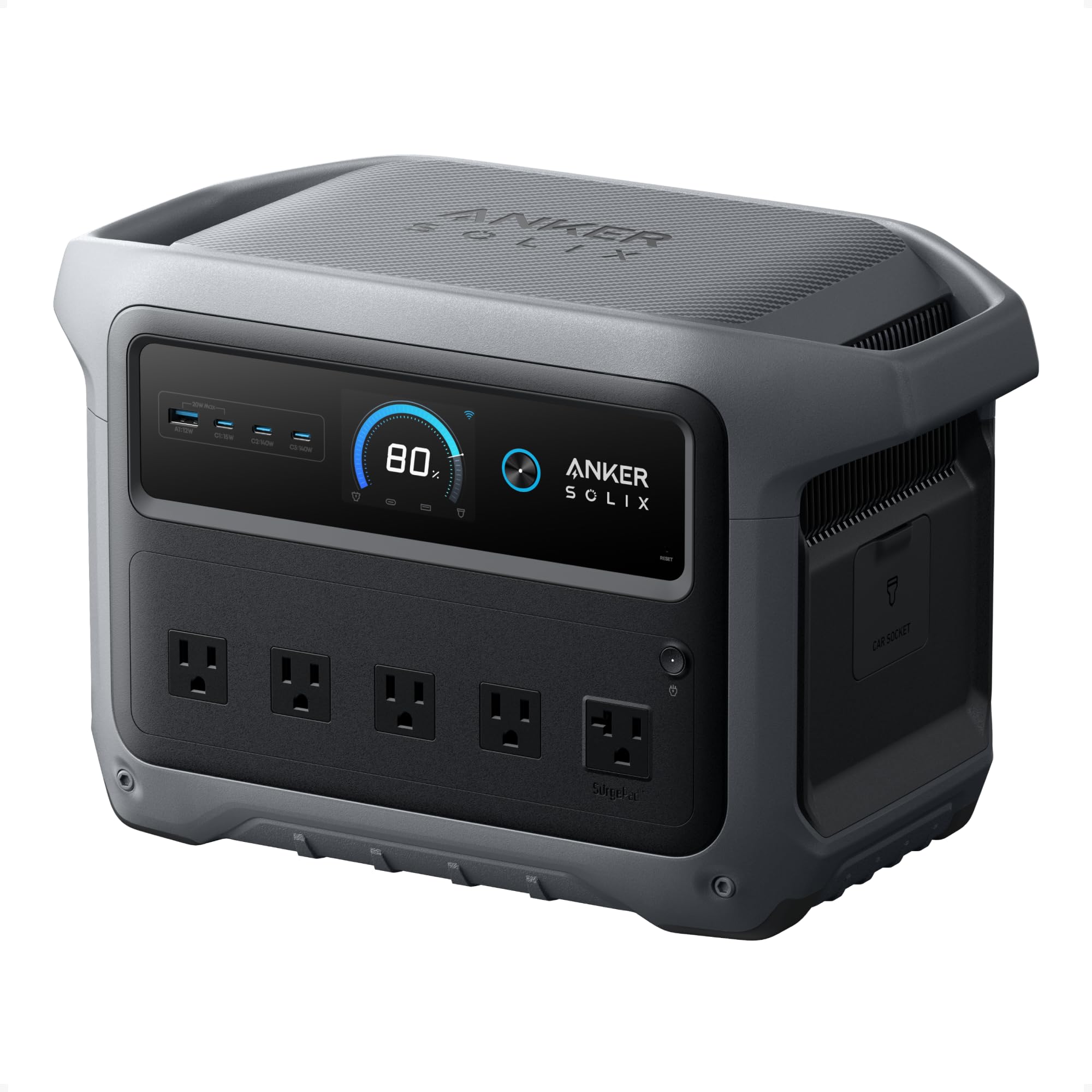
Anker SOLIX C1000 Gen 2
Rating: 4.7 ★ | Price: $$ | AC Output: 2000W/3000W surge | Weight: 24.9 lbs | Fuel Type: LiFePO4 battery
The Anker SOLIX C1000 Gen 2 recharges from empty to full in 49 minutes via AC, and its 2000W continuous output (3000W peak) handles microwaves, CPAP machines, and most power tools without strain. At 24.9 pounds, it’s also a few pounds lighter than similarly specced competitors, making it easier to move around a campsite or RV.
This station is best suited for campers who need quick turnaround between charges, RV owners wanting a silent backup that fits in tight spaces, and emergency home backup for essential electronics. It’s not designed for power tools drawing sustained over 2000W or extended off-grid trips without solar — the 1kWh battery runs out in about a day under moderate load. A small number of units may drain overnight when idle, so it’s worth checking the charge before heading out.
Pros
- 0–100% AC recharge in 49 minutes – fastest in its class.
- 2000W continuous output handles most portable appliances without tripping.
- Weighs 24.9 lbs – noticeably lighter than comparable 1kWh stations.
Cons
- Battery capacity (1024Wh) is moderate – expect to recharge daily under typical camping loads.
- Some units may drain overnight when idle – worth checking charge before extended storage.
If fast charging and high continuous output are your priorities, the Anker SOLIX C1000 Gen 2 delivers where it counts, as long as you’re comfortable with its modest battery size and the occasional idle drain.
Best for Rv & Home Backup
Westinghouse iGen4000DFc
Rating: 4.6 ★ | Price: $$$ | AC Output: 3300W/4000W peak | Weight: 62.8 lbs | Fuel Type: Gas/Propane
At 52 dBA, the Westinghouse iGen4000DFc is quiet enough for campgrounds while delivering 3300 running watts from gasoline or propane. That noise level is lower than most conventional generators and makes extended use near neighbors or campsites practical. The dual-fuel capability means you can run on propane for longer storage or swap to gas for peak output.
This generator suits RV campers who need to run air conditioning or charge batteries for hours, plus anyone who wants emergency home backup with fuel choice. The 63‑lb weight is manageable with the built-in wheels and handle, but lifting it into a truck bed solo is awkward. Fuel storage and routine maintenance (oil changes, carburetor care) are part of ownership — something battery stations skip entirely.
Pros
- Quiet operation at 52 dBA – low enough for campground use without disturbing neighbors.
- Dual fuel: runs on gasoline or propane, extending storage life and fuel options.
- Remote electric start via key fob – start from inside the RV or house.
Cons
- At 63 lbs, it’s heavy to lift manually – wheels ease movement but don’t replace a second person for loading.
- Requires fuel storage and regular engine maintenance that battery stations eliminate entirely.
For campers and home backup users who need extended runtime for heavy loads, this is the quietest gas generator at its power level — just be prepared for the weight and maintenance that come with fuel-powered gear.
Best for Backpacking & Lights
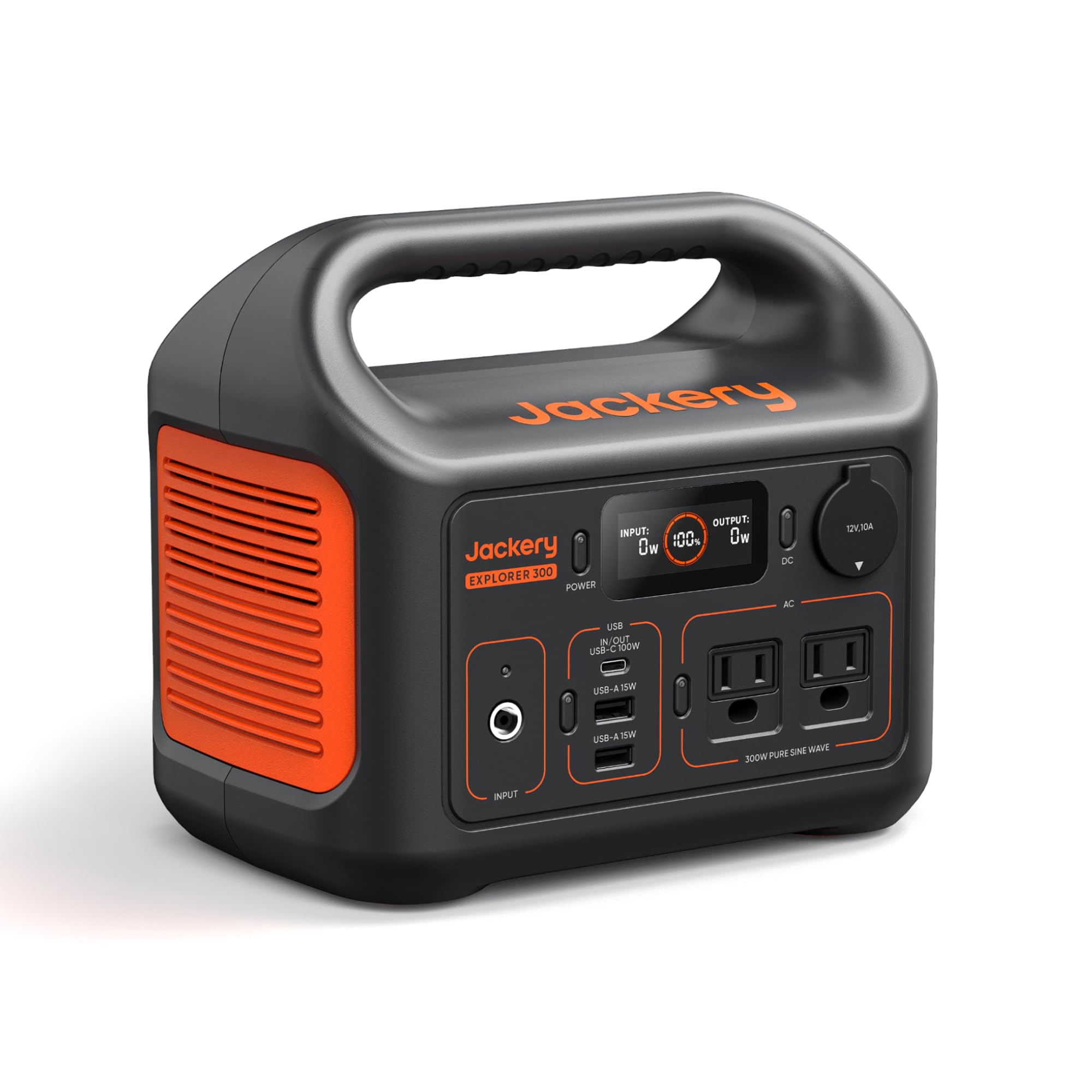
Jackery Explorer 300
Rating: 4.6 ★ | Price: $ | AC Output: 300W/500W surge | Weight: 7.1 lbs | Fuel Type: LiFePO4 battery
The Jackery Explorer 300’s 7-pound weight puts it in a class of its own among portable power stations. Compared to the 1 kWh units like the Jackery 1000 v2, it’s less than a third the weight, but you give up the ability to run a fridge or power tools – this is strictly for phones, laptops, lights, and a CPAP for a night.
This power station is for ultralight campers, backpackers, and anyone who needs to charge small electronics for a night or two. Without a solar panel, its 293Wh battery won’t stretch beyond a day or two of use – plan accordingly. It’s limited to 300W continuous output, so heavy appliances are off the table.
Pros
- Extremely portable at 7 lbs, fits easily in a backpack.
- Adequate for charging phones, tablets, laptops, and running a CPAP for a night.
- Consistently well-regarded for dependable performance.
Cons
- Without a solar panel, a single charge lasts about a day for small electronics – not enough for multi-day trips.
- Solar panel not included – you’ll need to buy separately for solar recharging.
For backpackers who prioritize weight over raw power, the Explorer 300 is the right choice – just plan for limited runtime.
Best for Camping & Outages
Anker SOLIX C1000

Rating: 4.7 ★ | Price: $$ | AC Output: 1800W/2400W surge | Weight: 27.6 lbs | Fuel Type: LiFePO4 battery
With a 43-minute sprint to 80% charge and 1800W continuous output from eleven ports, the C1000 handles camping and home backup tasks efficiently. The trade-offs are a slightly lower peak surge (2400W vs. 3000W) and a full charge that takes 58 minutes — the Gen 2 cuts that to 49 minutes while boosting continuous output to 2000W. A small number of units have experienced charging failures after extended use, so buying from a retailer with a flexible return policy adds peace of mind. If the Gen 2 is available at the same price, it’s the stronger option; otherwise, this remains a capable station at a discount.
Pros
- Charges from 0 to 80% in under 45 minutes — fast enough to top up between camping activities.
- Eleven outlets including two AC ports provide ample connectivity for small appliances and electronics.
Cons
- Peak surge is 2400W — lower than the Gen 2’s 3000W, which may limit running multiple high-startup appliances simultaneously.
A value-oriented pick if found at a discount, especially when the extra peak output of the Gen 2 isn’t required.
Best for Rv & Home Backup
BLUETTI AC180

Rating: 4.6 ★ | Price: $$ | AC Output: 1800W/2700W surge | Weight: 37.4 lbs | Fuel Type: LiFePO4 battery
The AC180 delivers fast charging and high continuous output that can handle a refrigerator, microwave, or power tools. The trade-off is weight: at 37 lbs it’s noticeably heavier than other 1 kWh stations, so it works best in dedicated RV or home backup setups where portability isn’t a priority. Charging reliability can vary between units – some owners have noted charging issues after several months, which makes a return-friendly purchase worth considering.
Pros
- Charges from 0-80% in under an hour – ready quickly for sudden power needs.
- 1800W continuous output runs most household appliances without tripping.
Cons
- 37 lb weight limits portability – not a unit you’ll want to carry on foot.
- Charging reliability can vary between units; occasional charging issues have been noted.
Best for RV or home backup where you can leave it in place and value fast charging over portability – but consider a warranty or easy return given the variability in long-term charging behavior.
Best for Home Backup & Worksite
WEN DF475T

Rating: 4.5 ★ | Price: $$ | AC Output: 3800W/4750W peak | Weight: 105.8 lbs | Fuel Type: Gas/Propane
The WEN DF475T offers dual-fuel flexibility (gas or propane) and a peak output of 4750W on gasoline, enough to run a fridge, sump pump, and a few lights during an outage. For the price, it’s hard to match the wattage-to-dollar ratio. However, at 105.8 lbs and with noise levels above inverter-type generators, it’s a better fit for home backup than quiet campsites. Some units have shown battery drain or failure within the first year, so keeping a trickle charger handy is a practical precaution. If you need a workhorse for the house or job site and have a truck to move it, this generator delivers real value.
Pros
- Dual-fuel capability (gas/propane) at a budget price with 4750W peak output.
- Electric start handles 120V and 240V loads reliably — quick ignition on propane as well.
Cons
- At 105.8 lbs and over 80 dB, it’s too loud and heavy for quiet camping or solo carrying.
- Battery quality can vary — some owners need to replace or trickle-charge the battery within a year.
For home backup on a budget where noise isn’t a concern, the WEN DF475T offers exceptional power per dollar — but skip it if you need quiet, lightweight portability for camping.
Best for Travel & Light Camping
Anker SOLIX C300

Rating: 4.6 ★ | Price: $ | AC Output: 300W/600W surge | Weight: 9 lbs | Fuel Type: LiFePO4 battery
The SOLIX C300 stands out for its 140W USB-C two-way fast charging—recharging from 0-100% in roughly an hour—and a 9-lb body with built-in handle. That speed and portability suit travelers and light campers who mainly charge laptops and phones. However, the 300W AC output and 288Wh capacity limit it to small electronics; a 500W kettle won’t run, and extended off-grid use demands a solar panel. It’s also priced higher than the Jackery 300 for similar specs, making it a premium choice for USB-C convenience over raw capacity.
Pros
- Fast recharging via USB‑C (140W two‑way) – 0-100% in about 1 hour.
- Compact and travel‑friendly design with a built‑in handle.
Cons
- For light camping where you mainly charge laptops and phones, the 300W AC output will run those devices but won’t handle a 500W kettle.
This station fits best when USB-C fast charging and compact size matter more than AC wattage or capacity—ideal for tech-heavy day trips or overnight camping where you only need to charge phones, tablets, and a laptop.
Best for Day Hikes & Emergencies
BLUETTI Elite 30 V2
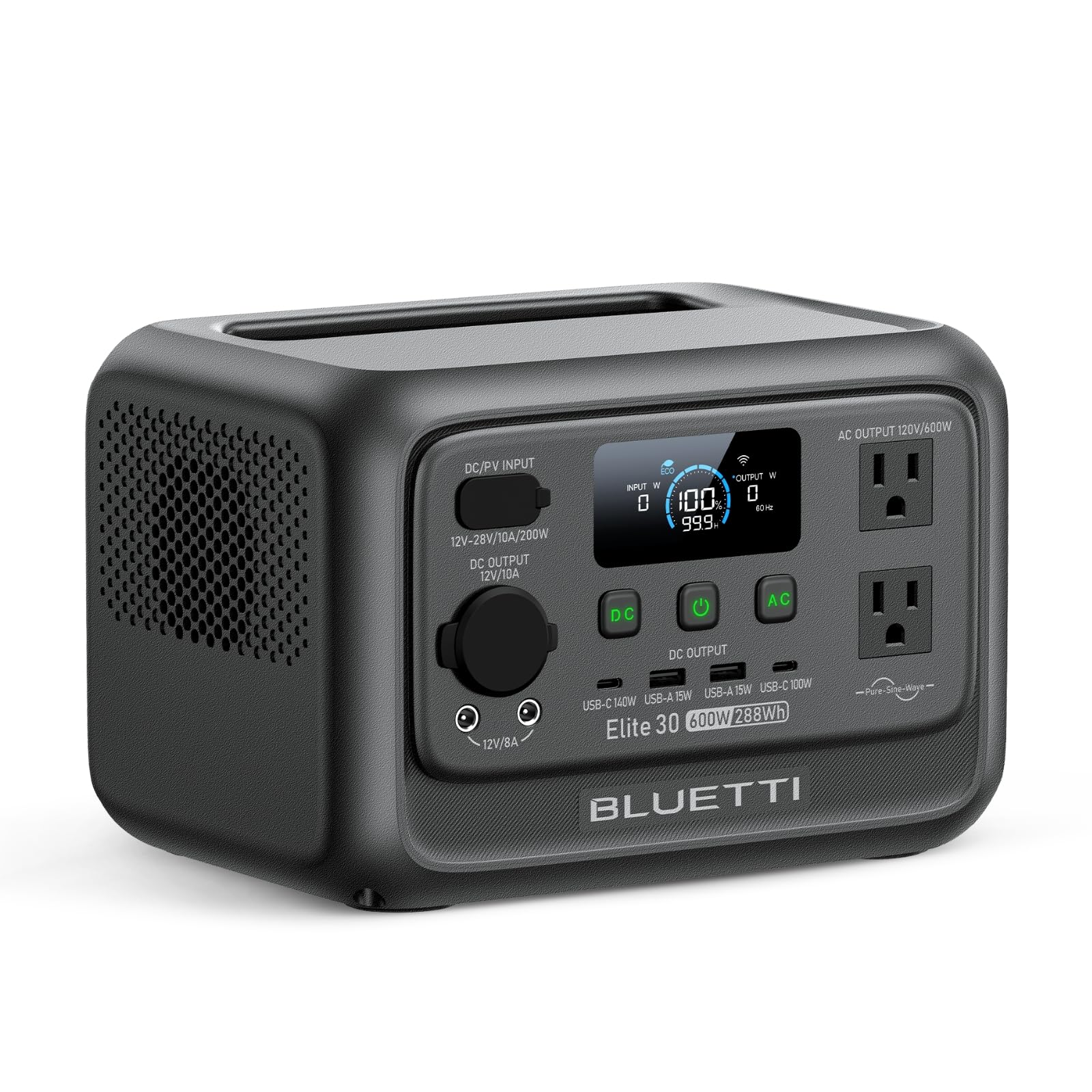
Rating: 4.5 ★ | Price: $ | AC Output: 600W/1500W surge | Weight: 9.4 lbs | Fuel Type: LiFePO4 battery
The BLUETTI Elite 30 V2 packs 600W continuous output and a 1500W Power Lifting surge into a 9.4 lb frame that fits in a daypack. It charges from AC in 70 minutes and switches to battery power in 10ms, protecting sensitive electronics during outages. The catch is the 288Wh battery – enough to top up phones, tablets, and a CPAP for a night, but not a refrigerator or extended off-grid use without solar panels. It serves minimalist campers and emergency backup users well, though its recent release means fewer field reports than the Jackery 300.
Pros
- 1500W surge lets it start small appliances like coffee makers.
- Compact at 9.4 lbs with fast AC charging (70 min full).
Cons
- 288Wh battery limits runtime to small devices for a day or less.
Best for day hikers and emergency phone/laptop charging who value high surge in a tiny package over battery capacity.
Best for Home Backup & Worksite
WEN GN5602X

Rating: 4.4 ★ | Price: $ | AC Output: 4500W/5600W peak | Weight: 120 lbs | Fuel Type: Gasoline only
The WEN GN5602X delivers 5600W peak power with electric start and a CO shutdown sensor at a price that undercuts most competitors. It’s easy to assemble and simple to operate. The tradeoffs: gasoline-only fuel and a noise level that suits worksite or home backup over quiet camping. This generator offers strong value for budget-conscious homeowners needing occasional power – just be aware of its limitations.
Pros
- Electric start gets you up and running quickly.
- Built-in CO shutdown sensor adds peace of mind.
Cons
- At 82 dB, this generator is noticeably louder than inverter models – fine for worksites but not quiet campsites.
- Electric start performance can vary – some owners report issues after repeated use, so the recoil start is a useful backup.
For homeowners who need occasional backup power for essential loads and don’t mind the noise, this generator offers outstanding value. It’s less suitable for camping or quiet environments.
Best for Camping & Road Trips
BLUETTI Elite 100 V2
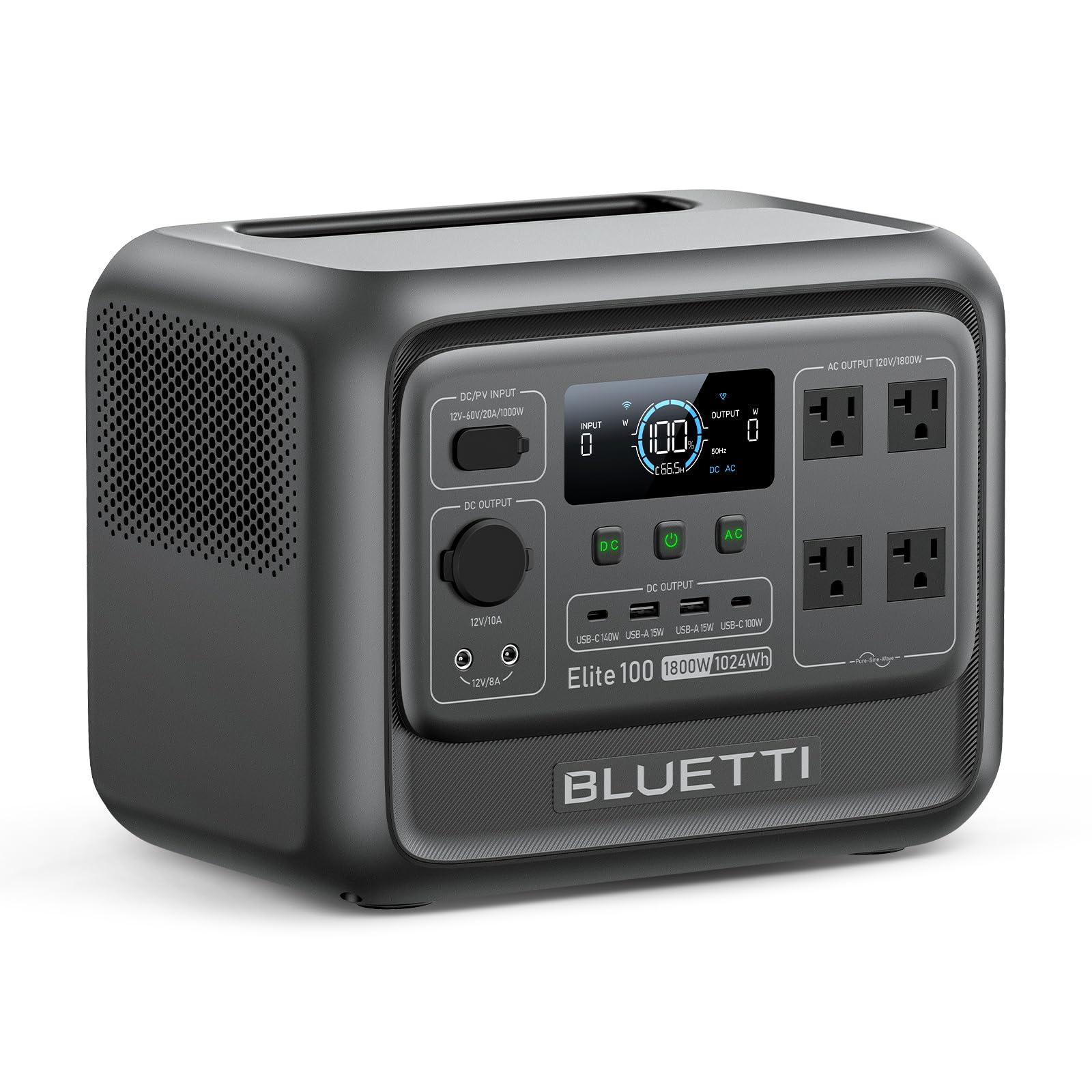
Rating: 4.5 ★ | Price: $$ | AC Output: 1800W/3600W surge | Weight: 25 lbs | Fuel Type: LiFePO4 battery
The BLUETTI Elite 100 V2 packs 1024Wh into a notably compact 25-pound chassis—roughly 35% smaller than typical 1kWh stations—and accepts a full charge in 70 minutes. Its 3600W surge handles power-tool startups without hiccup. However, with a limited review history and a shorter dependability track record compared to established models, this station suits campers who prioritize packing space over long-term peace of mind.
Pros
- Compact footprint – 35% smaller than typical 1kWh stations, easier to stow in tight campsite gear.
- Fast AC recharge – full in 70 minutes so you’re not waiting on power between outings.
Cons
- Unit may stop turning on after a few uses – consider a return-friendly purchase.
Ideal for campers with limited storage who need a fast-charging, high-surge station and are willing to accept a shorter dependability track record.
How to Choose
The right generator for you depends on how much power you actually need and how you plan to recharge – battery capacity and AC output are the two numbers that matter most.
Battery Capacity
Measured in watt-hours (Wh), this determines how long your devices run. A 1000Wh station will power a 50W mini-fridge for about 15 hours of actual runtime – but inverter losses and self-consumption eat 15–20% of that, so expect closer to 12 hours.
For a weekend camping trip with lights, phones, and a small cooler, 1000Wh is comfortable. For multiday off-grid use without solar, you’ll want at least 2000Wh or a gas generator.
AC Output Wattage
Continuous wattage is the steady load the unit can handle; surge wattage covers the startup spike of motors (like a fridge compressor). A 1500W station will run a 600W microwave, but not a 1500W space heater.
If you plan to run a 10,000 BTU AC unit, you need an inverter generator – most battery stations cap out around 2000W continuous.
Recharge Speed
Fast AC charging (under 1 hour) is a game-changer for campsite turnarounds – you can top off during a lunch break. Solar recharge is much slower: a 200W panel on an average day will take 6–8 hours for a 1000Wh battery.
Cloud cover cuts solar output by 50–80%, so never rely on solar alone if you need a full charge by evening.
Weight and Size
Every pound matters when you’re carrying a generator from the car to the campsite. Battery stations under 30 lbs are manageable for one person; gas generators over 60 lbs require a dolly or a second set of hands.
For backpackers, anything over 10 lbs is nonstarter – the Jackery Explorer 300 at 7.1 lbs is about the practical limit for a multi-mile hike.
Fuel Type
Battery power is silent, zero-emission, and requires only an outlet or solar panel to recharge. Gasoline and propane give you unlimited runtime at the cost of noise, fumes, and fuel storage (stale gas clogs carburetors within months).
Dual-fuel generators offer flexibility – propane stores indefinitely and burns cleaner, but reduces output by about 10%. Natural gas is ideal for home backup but not portable.
FAQ
Can a portable power station run a CPAP machine all night?
Yes, most 1 kWh stations can run a CPAP (30–60W) for 12–20 hours. The Jackery Explorer 1000 v2 or Anker SOLIX C1000 Gen 2 are both excellent choices. Check your CPAP’s wattage and add 10% for humidifier drain. A 300Wh unit like the Jackery Explorer 300 will run a standard CPAP for one night without humidifier.
How many hours will a 1000Wh battery run a mini-fridge while camping?
A modern 12V compressor mini-fridge draws about 30–50W averaged over a day. A 1000Wh battery delivers 800–850 Wh usable after losses, giving you 16–28 hours of runtime. In practice, that’s a full weekend without needing a recharge. If you open the fridge often or temps are high, expect closer to 12 hours.
Do portable generators need to be grounded for safe camping use?
Battery power stations are fully enclosed and grounded internally – no extra grounding needed. Gas generators with a floating neutral (most portable units) do not require grounding for camping unless connected to a home electrical panel. Always use a GFCI outlet when powering electronics outdoors.
What’s the quietest portable generator for hiking campsites?
Battery power stations are essentially silent – the Anker SOLIX C300 runs at 25 dB, quieter than a whisper. Among gas generators, the Westinghouse iGen4000DFc at 52 dBA is the quietest camping inverter model, comparable to a normal conversation.