This post contains affiliate links. We may earn a small commission when you buy through our links — at no extra cost to you.
Budget multi-packs dominate search results because they promise four lights for the price of one. But an uncomfortable number arrive with dead units or fail within weeks. That trade-off makes sense only if you plan to stash them in emergency kits and accept the risk of a dud here and there.
The real gap is between value and reliability. A single well-built lantern with solid solar charging and USB backup costs about the same as a multi-pack yet works year after year. It comes down to whether you need a backup light you can trust on a backpacking trip or a handful of throwaway lights for the truck and basement.
This guide focuses on the lanterns that consistently charge, hold their battery, and light up when you need them most — whether that’s deep in the backcountry or during a blackout.




Best for Ultralight Backpackers
LuminAID PackLite
Key Features
- Brightness: 75 lumens adjustable
- Charging Options: Solar + Micro-USB
- Battery Life: 24 hr
- Portability: 5.3 oz, inflatable
- Water Resistance: IP67 (submersible)
- Price: $$
At 5.3 ounces and collapsing to the size of a deck of cards, this inflatable lantern is one of the lightest ways to bring ambient light on a backpacking trip or stash in an emergency kit. Its built-in solar panel pairs with USB charging for backup, and the IP67 rating means it can survive a drop in a puddle or an overnight rain. The 75-lumen output is modest – fine for personal use inside a tent or lighting a small table, but not enough to illuminate a campsite.
This suits backpackers and ultralight campers who prioritize weight and packability over raw brightness, as well as families who want a safe, floating lantern for kids. The adjustable brightness helps stretch the 24-hour runtime, and the dual charging removes the worry of cloudy days – though relying solely on solar will take a full day of direct sun. Anyone needing bright task lighting or a heavy-duty shell should look elsewhere.
Pros
- Packs flat to 5.3 oz – fits easily in any backpack or emergency kit.
- Ambient glow works well inside a tent or during power outages.
- Multiple brightness settings let you extend runtime or boost visibility.
Cons
- Inflation valve and power button can become stiff or unresponsive after repeated use, especially in dusty conditions.
- Battery capacity may gradually decrease after several months of regular use, shortening runtime on high.
For backpackers and emergency kits, the LuminAID PackLite delivers dependable ambient light in a package that weighs almost nothing – just keep in mind that 75 lumens suits close quarters, not room-filling brightness.
Best for Emergency Preparedness
d.light S3
Key Features
- Brightness: 30–60 lumens
- Charging Options: Solar only
- Battery Life: 12 hr
- Portability: 0.29 lbs
- Water Resistance: Water resistant
- Price: $
Charges even on cloudy days and carries a 2-year warranty, making it a straightforward solar lantern for off-grid use. The d.light S3 skips USB charging entirely – you rely on the built-in panel. This suits buyers who want a no-fuss emergency kit light or a lantern for developing regions where mains power is scarce. Brightness is modest at roughly 30-60 lumens, fine for reading or close tasks but not for lighting a room. If you need USB backup or higher output, consider the LuminAID top pick instead.
Pros
- Charges effectively in overcast weather.
- Build quality that holds up over years of use.
- Low cost for the performance offered.
Cons
- Solar-only charging; no USB port for backup charging.
- Modest brightness suitable for personal tasks, not for lighting a room.
The d.light S3 is the budget pick for anyone who values long-term durability and cloudy-day performance over USB convenience – fit for emergency kits and off-grid use.
Best for Bright Area Lighting
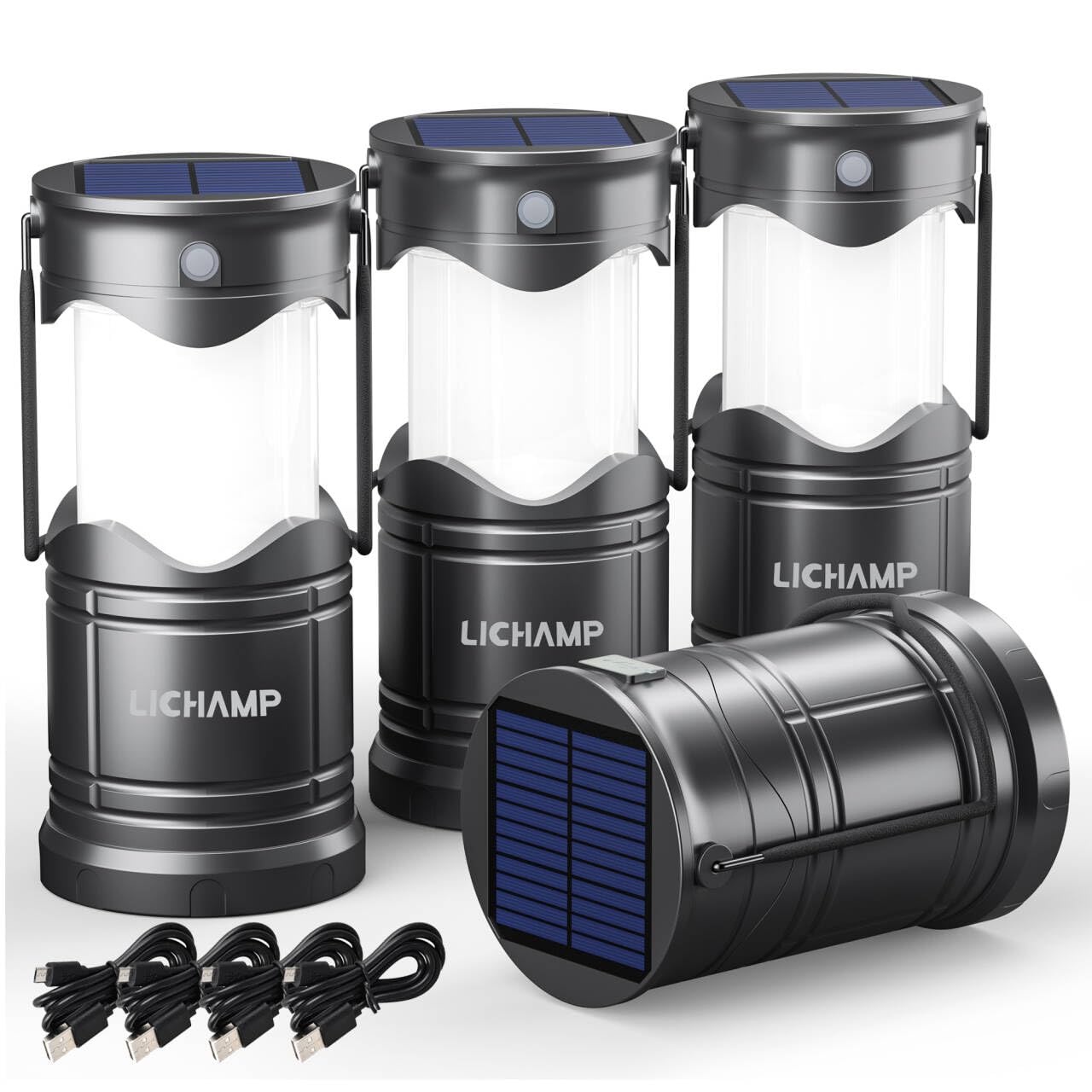
Lichamp 4-Pack
Key Features
- Brightness: 600 lumens 3 modes
- Charging Options: Solar + USB + 3xAA
- Battery Life: 8+ hr on high
- Portability: 4 units packable
- Water Resistance: Water resistant
- Price: $$
The Lichamp 4-Pack delivers 600 lumens of adjustable light plus a warm orange mode, three brightness levels, and three power sources (solar, USB, AA). That’s more raw output than any other multi-pack here, making it a solid choice for lighting up a campsite or room during an outage. The tradeoff is unit consistency: some lanterns may arrive with reduced battery capacity or stop charging after a few cycles. If you need a bright, flexible set for family camping or emergency backup and can accept the possibility of an occasional dud, the Lichamp offers impressive value per lumen.
Pros
- 600-lumen output with three adjustable modes, including a warm setting
- Triple charging via solar, USB, or AA batteries for flexible power
- Sturdy build that feels solid in hand
Cons
- Some units may arrive with weak battery life or stop holding a charge after a few uses
If you need a bright, multi-mode area light and are willing to roll the dice on unit reliability, this pack delivers more punch than any other in its price tier.
Best for Survival Kits
Mesqool Crank Lantern
Key Features
- Brightness: 200 lm lantern
- Charging Options: Solar + USB + Hand crank
- Battery Life: 23–35 hr
- Portability: 0.66 lbs
- Water Resistance: IPX4
- Price: $
This lantern offers three ways to charge — solar, USB-C, and a hand crank — giving it a redundancy advantage over basic solar-only models. Phone charging through the USB output is slow and drains the battery, so it’s not a practical power bank. The compact size may feel less robust for daily handling, but fits well in an emergency kit. For preppers on a budget, the hand crank adds a layer of backup that simpler lanterns lack, and at a lower cost than many alternatives. It’s not the brightest or most durable option, but it covers the essentials for unexpected outages and off-grid use.
Pros
- Hand crank, solar, and USB-C charging provide backup options.
- Combined lantern and flashlight modes suit different lighting needs.
Cons
- Phone charging can be slow and drains the lantern quickly.
- The lantern is smaller than expected; the build may feel less sturdy.
A sensible pick for emergency kits that need multiple charging paths without breaking the bank.
Best for Extended Car Camping
Lepwings Lantern
Key Features
- Brightness: 60–280 lumens dimmable
- Charging Options: Solar + USB-C
- Battery Life: 80 hr low / 6 hr high
- Portability: 1.27 lbs
- Water Resistance: IPX4
- Price: $$
The Lepwings lantern stands out with its 6000mAh battery, enough to recharge a phone two or three times – a practical power bank for off-grid stays. The dimmable warm light spans 60 to 280 lumens, adjustable for tent ambiance. Solar charging is included but very slow; USB-C is the realistic way to keep it powered.
This 1.27 lb lantern suits car campers and emergency kits where phone charging matters and USB is available. It is not for ultralight backpackers or those expecting fast solar recharge.
Pros
- Large 6000mAh battery provides multiple nights of runtime on low brightness
- Dimmable warm light with USB-C charging that is easy to use
Cons
- Some units have a switch that may become unresponsive with use
- Battery life on high brightness drops to about 6 hours, much less than the low-mode estimate
A good choice for extended camping trips with USB access, but not for those depending on solar as the primary power source.
Best for Budget Families
XTAUTO 4-Pack Lantern
Key Features
- Brightness: 4W 360° LED
- Charging Options: Solar + USB
- Battery Life: 25 hr
- Portability: Collapsible to phone size
- Water Resistance: IPX4
- Price: $$
The XTAUTO 4-pack delivers solid brightness from each lantern, collapsing small enough to stash in a glovebox or drawer. Some units can arrive non-functional or may not remain operational after several uses, so plan for duds when stocking up. This set suits budget-minded car campers or families equipping multiple rooms who can absorb an occasional defect – not for backpackers or those needing guaranteed long-term performance.
Pros
- Bright 360-degree LED lighting covers a room or campsite
- Collapsible design shrinks to phone size for easy storage and carry
- Great value for a four-pack – each lantern costs roughly the price of a coffee
Cons
- USB port for charging devices may not function in some units
- Some units can arrive non-functional or may not remain operational after several uses
A cost-effective way to light up multiple areas, provided you treat it as a bulk buy where a few duds are possible – ideal for emergency kits and casual camping where spares are welcome.
Best for Car Campers Bright
LETMY 4-Pack

Key Features
- Brightness: 600 lumens 360°
- Charging Options: Solar + USB + 3xAA
- Battery Life: 2–4 hr high
- Portability: 1.12 lbs 4-pack
- Water Resistance: IPX4
- Price: $$
This lantern delivers impressive brightness from a compact design and offers three power options – USB, solar, and AA backup. Solar charging is slow and battery life on high is around 2–4 hours, so it’s not ideal as a primary solar light. Some units may have charging reliability issues. Still, for buyers who can use USB or AA batteries and want high output at a low price, it’s a good value.
Pros
- Very bright for a compact lantern – 600 lumens lights up a room.
- Three power sources (USB, solar, AA) provide flexibility.
Cons
- Battery life on the highest setting can be 2–4 hours, shorter than claimed.
Best for car campers or backup use where USB or AA power is available, not for solar-dependent scenarios.
Best for Magnetic Mounting
Xynover 4-Pack

Key Features
- Brightness: 100 lumens 360°
- Charging Options: Solar + USB + 3xAA
- Battery Life: 12 hr
- Portability: Magnetic base + hook
- Water Resistance: IPX4
- Price: $$
The Xynover 4-pack brings magnetic bases and hanging hooks for hands-free placement in tents, cars, or metal surfaces. At 100 lumens per lantern, it’s adequate for small spaces but dimmer than other 4-packs at this price. Battery life tends to drop after a few camping trips, and the USB charging port can be finicky on some units — a gamble for those expecting years of use. Best for car campers who value mounting convenience over max brightness and can tolerate possible reliability hiccups.
Pros
- Magnetic base and hook let you stick it to vehicles or hang it overhead without extra hardware.
- Three power sources (solar, USB, AA batteries) offer flexibility when solar alone isn’t enough.
Cons
- Battery runtime may shorten noticeably after several camping trips, making it less suited for long-term frequent use.
Grab this pack if magnetic mounting is your priority and you’re okay with a lantern that may not hold up beyond a season or two.
Best for Ultra-Budget Emergency
DIBMS 4-Pack

Key Features
- Brightness: 300 lumens 360°
- Charging Options: Solar + USB
- Battery Life: 6–11 hr
- Portability: 8 oz per unit
- Water Resistance: IPX4
- Price: $
This 4-pack delivers ample light and solar charging at a remarkably low price. However, occasional charging problems and limited long-term data make it better suited for casual camping or emergency backups where a few duds won’t ruin your trip.
Pros
- Bright and compact for a 4-pack
- Great value price
Cons
- Solar or USB charging may not operate in some units
Best for budget-conscious buyers who can accept occasional charging issues and plan to use them in casual settings.
Best for Ultralight Ambient
Goal Zero Crush Light

Key Features
- Brightness: 60 lumens 3 modes
- Charging Options: Solar + Micro-USB
- Battery Life: 35 hr low
- Portability: 0.28 oz collapsible
- Water Resistance: Water resistant (no IP)
- Price: $$
The Goal Zero Crush Light weighs next to nothing and packs flat, making it a natural fit for ultralight trips where every gram matters. Its candle flicker mode creates a warm, relaxing glow inside a tent or as a nightlight. But at 60 lumens, it is too dim for reading or cooking, and some units have shown uneven battery retention over time. This is a specialist tool for weight-obsessed minimalists, not a replacement for a reliable camp lantern.
Pros
- Weighs only 8 grams and collapses flat for packing.
- Candle flicker mode provides pleasant ambient light.
Cons
- Long-term battery performance can be uneven under regular use.
Works best as a lightweight backup for ultralight backpackers who prioritize gram savings over brightness and longevity.
Best for Patio Dining Light
LETRY Table Lamp

Key Features
- Brightness: 35/140/330 lumens
- Charging Options: Solar + USB
- Battery Life: 60–70 hr low
- Portability: Approx 1 lb
- Water Resistance: IP44 splash
- Price: $$
This lamp delivers warm even light with three brightness levels from a simple touch control, and its low setting runs for multiple nights on a full charge. However, the IP44 rating doesn’t prevent water from seeping in around the button if rain hits it directly, so it’s not a reliable outdoor camping lantern. Its real home is on a covered patio or in a room where it provides cozy emergency lighting when the power goes out.
Pros
- Beautiful design with warm, even light that complements patio and home decor.
- Three brightness levels via touch control – simple to adjust from ambient to reading light.
Cons
- In rainy conditions, water may seep through the button area – best kept under cover or indoors.
A good choice if you want attractive patio ambiance or a reading light during power outages, but don’t rely on it as a weatherproof camping lantern.
Best for Temporary Lighting
Wsky 4-Pack

Key Features
- Brightness: 100 lumens
- Charging Options: Solar + USB + 3xAA
- Battery Life: 12 hr
- Portability: Magnetic base + hook
- Water Resistance: IPX4
- Price: $$
The Wsky 4-Pack combines solar, USB, and AA battery options with a magnetic base and folding hook, making it easy to place in tents or on metal surfaces. Its 100-lumen output is adequate for emergency lighting. However, build quality and power bank function can vary between units, so this is best for temporary or casual use rather than long-term outdoor exposure.
Pros
- Bright enough for tents and emergencies at 100 lumens.
- Multiple power sources (solar, USB, 3x AA) and magnetic/hook mounting for hands-free placement.
Cons
- Unit-to-unit variance in build quality and power bank function may affect reliability.
A decent choice for car camping or emergency kits where magnetic mounting is handy, given you accept possible quality inconsistencies.
How to Choose
Solar lanterns vary widely in real-world performance, and the spec sheet rarely tells the full story of how they behave after a few camping trips.
Brightness (Lumens)
Lumens determine how large an area the lantern can illuminate. A 60-lumen light is fine for a tent or reading, while 300+ lumens can light up a picnic table or small room. But manufacturers often quote peak brightness achievable only on a fresh battery and in ideal conditions. After a few charge cycles or in cold weather, output drops noticeably.
For camp tasks like cooking or navigating a campsite, aim for at least 100 lumens. If you need to see trail markers from a distance or light up a large group cooking area, 300+ lumens is the safer bet.
Charging Options
Solar panels on small lanterns produce about 0.5 to 1 watt in bright direct sun. That means a full charge takes 6–12 hours of direct sunlight. Overcast days can triple that. USB charging (Micro-USB or USB-C) is far more reliable and allows you to top up indoors or from a power bank.
Some lanterns also accept AA batteries as a backup. That feature is valuable if you are on a multi-day trip without access to USB power. Hand crank options add redundancy but are slow and best reserved for emergency kits where every second of charge matters.
Battery Life
Manufacturer battery life claims are almost always measured on the lowest brightness setting. On high, runtimes can be 2–4 hours instead of the advertised 12 or 35. Battery chemistry also matters: 18650 cells (common in power bank lanterns) hold capacity longer than cheaper built-in Li‑ion packs. Cold temperatures (below 40°F) can cut runtime by 30–50%.
Look for lanterns with replaceable batteries if longevity is a priority. For most users, a battery that lasts 8+ hours on medium is enough for an evening of camping.
Portability
Weight and packed size determine whether a lantern disappears into a backpack or stays in the car. Inflatable designs like LuminAID weigh around 5 ounces and flatten to the size of a phone. Collapsible lanterns fold down to similar dimensions but add a few ounces. Magnetic bases and hanging hooks make a lantern more useful hands-free but add bulk.
If you backpack, keep the lantern under 8 ounces. For car camping, weight is less critical, but a compact shape still helps with packing efficiency.
Water Resistance
An IPX4 rating means the lantern can handle splashing rain but not immersion. IP67 means it can survive being dropped in a puddle or submerged briefly. Few campers need a submersible light, but if you camp in heavy rain or near water, IP67 provides peace of mind. Lower ratings are fine for tent use but can lead to failure if left in an open cup holder during a storm.
Check whether the charging port cover seals properly — many failures occur when water seeps into the USB socket.
FAQ
How long does a solar lantern take to fully charge in direct sunlight?
In bright midday sun, most solar lanterns take 6–12 hours for a full charge. Overcast skies or indirect light can double that time. USB charging is always faster and more reliable. If you plan to rely on solar, set the lantern out early in the day and rotate its panel toward the sun every few hours.
Can I use a solar lantern while it’s charging?
Most solar lanterns cannot be used while charging via solar panel because the current is too low to both power the LED and charge the battery. Some allow use during USB charging, but the brightness may be limited. Check the manual — if the option doesn’t exist, run the lantern on battery power first, then recharge.
Why does my solar lantern stop working after a few months?
Quality control is the main culprit. Budget solar lanterns often use cheap Li‑ion cells with no protection circuitry, leading to battery failure, swollen cells, or broken charging ports that stop recognizing USB power. The on/off switch and button contacts are another common failure point. If your lantern dies early, it’s likely a manufacturing defect rather than user error.
Are solar lanterns bright enough to read by while camping?
A 60-lumen lantern is fine for reading a book in a tent, but it won’t light up a page if the ambient light is low. For comfortable reading, look for at least 75 lumens with a diffuser that spreads light evenly. Models with adjustable brightness allow you to dial in the exact level without blinding yourself.