This post contains affiliate links. We may earn a small commission when you buy through our links — at no extra cost to you.
Gravity water filters promise clean water with minimal effort — hang a bag, let physics do the work. But anyone who has watched their flow rate dwindle to a trickle by day three knows the promise often outpaces reality. The root cause isn’t the filter itself, but what goes into it.
Sediment, algae, and fine silt are the real throttle. Most filters on the market rate their flow using laboratory-clean water, not the murky stream you actually dip your bag into. That mismatch is why a filter that claims 1.5 liters per minute might deliver half that in the backcountry — unless you pre-filter with a bandana or coffee filter.
The other hidden trade-off: faster-flowing filters often clog sooner, while slower ones last hundreds of gallons longer. This guide matches filters to your specific water sources and group size, so you pick the one that keeps flowing when you need it.
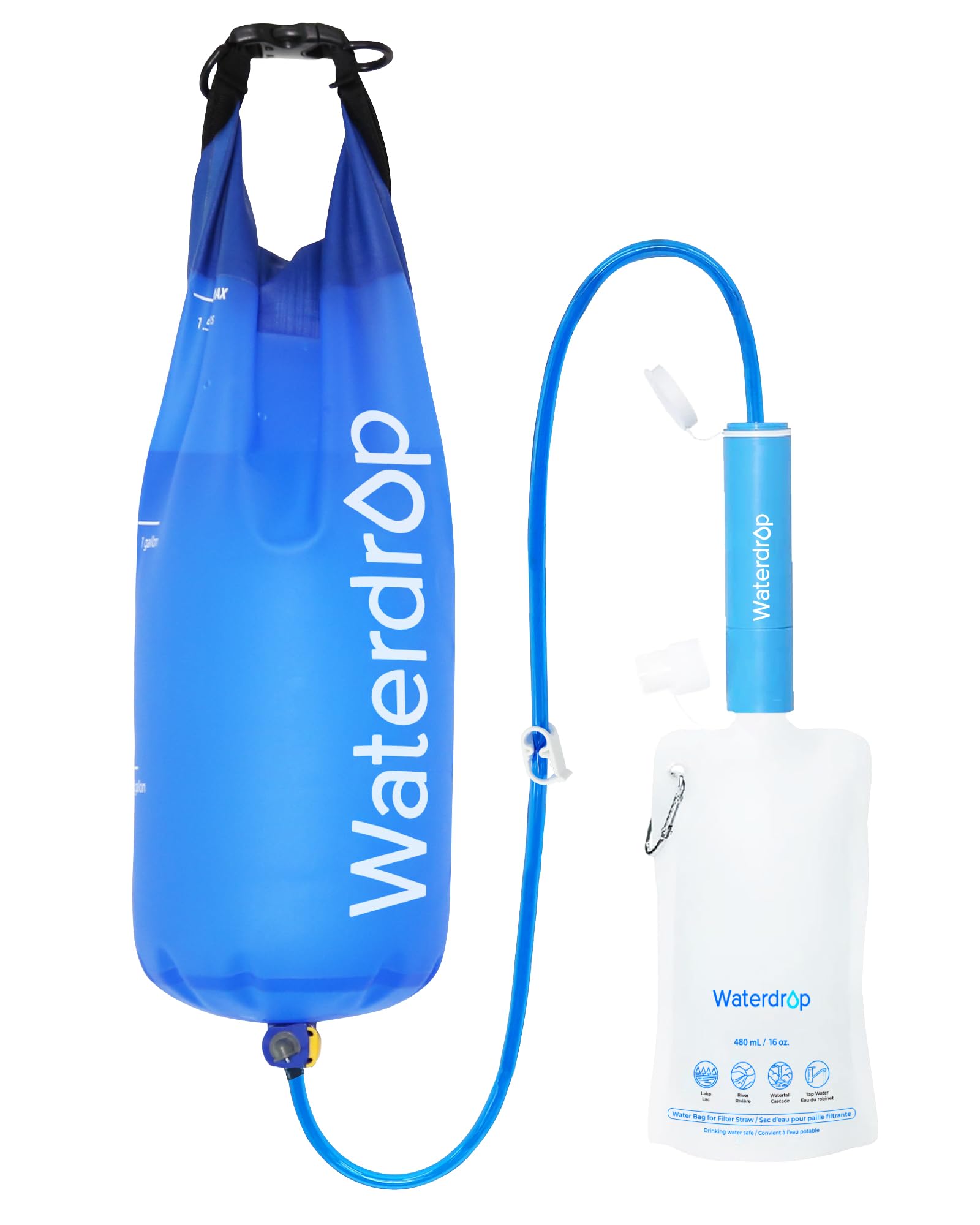


Best for Solo/duo Backpacking
Waterdrop Gravity Filter Straw
Key Features
- Capacity: 1.5 gal
- Flow Rate: 700 ml/min
- Filter Life: 1,400 gal
- Weight: 4.64 oz
- Filtration: 0.1 micron UF
- Price: $
The Waterdrop Gravity Filter Straw pairs a 4.6-ounce build with five-stage filtration and a 1,400-gallon filter life, all at a budget-friendly price. It filters 700 ml per minute out of the box, producing clean water with no noticeable aftertaste — a step ahead of many straw-style filters in this price range.
This setup works best for solo or duo campers who don’t mind a moderate pace. The flow slows noticeably when pulling from silty sources, and at 4.6 oz it’s heavier than ultralight alternatives like the Sawyer Mini. Pre-filtering through a bandana helps, but this is a patient hiker’s tool — not a group system or a gram-weenie’s pride.
Pros
- Delivers clean, pleasant-tasting water with minimal aftertaste.
- Filter lasts 1,400 gallons, reducing replacement cost over time.
- Gravity-fed setup is simple to hang and requires no pumping or squeezing.
Cons
- Flow rate drops noticeably without pre-filtering; may be slow for impatient users.
- Moderate weight compared to ultralight options — not the lightest kit for gram counters.
For solo or duo campers who want capable filtration without the premium price, the Waterdrop hits the mark.
Best for Family/group Camping
Platypus GravityWorks 4L
Key Features
- Capacity: 4 L
- Flow Rate: 1.75 L/min
- Filter Life: 1,500 gal
- Weight: 11.5 oz
- Filtration: 0.1 micron HF
- Price: $$$
The Platypus GravityWorks filters at 1.75 L/min, making it the fastest portable gravity system for groups. Best for car camping and base camps where weight is less of a concern; not suited for backpacking due to its bulk. The bag grommets can pull out over time, and the clean reservoir needs thorough drying to prevent mold.
Pros
- Filters 4 liters in under 2.5 minutes — among the fastest in its class.
- Simple hang-and-filter setup with no pumping or squeezing required.
- Long filter life (1,500 gallons) reduces replacement costs.
Cons
- Grommets on the hanging bags may pull out with use.
- Clean reservoir is difficult to dry, risking mold if not stored properly.
A premium group filter that trades weight for speed — ideal for families at base camps who want water filtered in minutes.
Best for Ultralight Backpacking
Sawyer SP160 Mini
Key Features
- Capacity: 1 gal
- Flow Rate: 0.1-0.2 L/min
- Filter Life: 100,000 gal
- Weight: 1.5 oz
- Filtration: 0.1 micron HF
- Price: $
At 43 grams (1.5 oz) and a filter lifespan of 100,000 gallons, the Sawyer Mini is the ultralight choice for backpackers. Its hollow fiber media effectively removes bacteria and protozoa from clear water sources, outperforming many straw-style filters. Gravity-fed flow is slow — expect 0.1–0.2 liters per minute — and the included bag can tear near the handle after repeated use.
This setup suits solo hikers who don’t mind a leisurely water collection pace and are willing to swap the bag for a durable alternative or use the squeeze adapter. It’s not a group solution or a hassle-free bag experience, but for weight-conscious minimalists the filter’s longevity makes it a long-term companion.
Pros
- Effective filtration for backcountry streams and lakes.
- Ultralight at 1.5 oz — easy to pack for long trips.
- Good value given the filter can outlast years of trips with proper maintenance.
Cons
- Included bag may develop tears near the handle over time.
- Flow rate can be a slow trickle, especially with silty water sources.
Best for ultralight solo backpackers who prioritize weight and filter longevity over speed and bag convenience — a specialist tool, not an all-rounder.
Best for Rv/cabin/emergency
Berkey Travel (2 Elements)
Key Features
- Capacity: 1.5 gal
- Flow Rate: 0.05 gpm
- Filter Life: 6,000 gal
- Weight: 4 lb
- Filtration: Activated carbon
- Price: $$$$
The Travel Berkey removes over 200 contaminants and delivers exceptionally clean, great-tasting water with a straightforward setup. Its 6,000-gallon filter life makes it a long-term solution for stationary use. The tradeoff: flow is extremely slow — expect hours to fill 1.5 gallons — and some units experience spigot leakage from the start.
This filter suits RV and van life campers, off-grid cabins, and emergency home storage where water quality is the priority and speed doesn’t matter. It is not designed for backpacking or hiking due to its weight and slow flow. Occasional filter defects have been noted, so verify function upon arrival.
Pros
- Produces high-quality, great-tasting water
- Easy to set up and use
- Size is ideal for daily use in RV or on countertop
Cons
- Spigot leakage may occur from the start in some units
- Filtration is very slow, taking hours for 1.5 gallons
High upfront cost but very long filter life makes this a solid investment for stationary off-grid or emergency use where slow flow is acceptable.
Best for Groups Needing Speed
Practical Survival 6L System
Key Features
- Capacity: 12 L total
- Flow Rate: 0.6 gpm
- Filter Life: 1,800 gal
- Weight: ~1 lb
- Filtration: 0.1 micron HF
- Price: $$
The Practical Survival Store system filters at 0.6 gallons per minute — faster than many comparably priced options — and includes separate dirty and clean bags with a cleaning plunger. Its 12-liter total capacity serves groups well during car camping or base camp use. The minor leak potential at connection points requires periodic checking, but the system otherwise delivers dependable filtration for its mid-range price.
Pros
- Includes separate dirty and clean bags, filter, and cleaning plunger — a self-contained setup.
- Filters effectively even in silty water, often exceeding the rated capacity in real-world use.
Cons
For groups needing fast water without a premium price tag, this system offers strong performance with one minor caveat to check.
Best for Budget Group Camping
Membrane Solutions 6L Pro

Key Features
- Capacity: 6 L
- Flow Rate: 500 ml/min
- Filter Life: 1,320 gal
- Weight: 12.8 oz
- Filtration: 4-stage 0.1 micron
- Price: $
The Membrane Solutions 6L Pro offers a large capacity and NSF-certified filtration at a budget price, making it a tempting option for car camping or emergency kits. However, its flow rate slows noticeably after initial use, and the filter can clog when exposed to sediment-heavy water, limiting its utility to known clean sources or pre-filtered water.
Pros
- NSF-certified 4-stage filtration captures contaminants down to 0.1 microns.
- 6-liter capacity suits small groups and emergency preparedness without frequent refills.
Cons
- Filter may clog and stop working when used with silty or debris-heavy water sources.
Best suited for car campers or emergency kits where water sources are known to be clear, and where slower flow is acceptable.
How to Choose
The single most overlooked factor in choosing a gravity filter is that flow rate drops exponentially as the filter loads with silt — so pre-filtration and backflushing matter more than the manufacturer’s clean-water spec.
Capacity
Capacity determines how much water you can treat in one fill. For solo hikers, a 1-gallon bag is enough for a day’s drinking and cooking. Groups of four or more need at least 4 liters to avoid refilling mid-meal.
Larger bags weigh more and take longer to fill from a stream, especially if the opening is narrow. A 6-liter bag might save trips but becomes unwieldy to hang from a low branch. Match capacity to how many people you’ll filter for and how often you’re willing to refill.
Flow Rate
Flow rate is the speed at which clean water comes out — but the real-world number is often half the advertised rate after a few uses. This happens because sediment clogs the hollow fibers inside the filter element. A filter rated at 1.5 L/min might start at 1.0 L/min and drop to 0.3 L/min by the third liter.
To keep flow up, backflush the filter after every trip and pre-filter silty water through a bandana. Some filters, like the Platypus GravityWorks, maintain higher flow longer because their hollow fiber design allows more surface area. A faster filter is worth the extra cost if you’re filtering for a group.
Filter Life
Filter life is measured in gallons before the element needs replacement — but that number assumes you’re filtering relatively clean water and backflushing regularly. A filter rated for 1,400 gallons might clog after 100 gallons if you’re dipping from a mud puddle.
Sawyer’s Mini filter is an extreme outlier at 100,000 gallons because its hollow fibers can be backflushed aggressively. In contrast, carbon-based filters like the Berkey have no backflush and last until the carbon is spent, typically 6,000 gallons. If you plan to use the filter for years and many trips, a longer-life filter saves money over time.
Weight
Weight is critical for backpackers, less so for car campers. Every ounce matters when you’re carrying a filter, bags, and potentially a backup method. The Sawyer Mini at 1.5 ounces is the lightest viable option, but its slow flow means you’ll wait longer for water. A heavier filter like the Platypus (11.5 oz) or Berkey (4 lb) makes sense only when you aren’t carrying it far.
A common trap is buying an ultralight filter for group use — you save weight but the bag is too small and slow to keep three people hydrated. Match weight to the distance and duration of your trip.
Filtration
Most gravity filters use a 0.1 micron hollow fiber membrane or ultrafiltration. This removes bacteria and protozoa but not viruses. For US backcountry water, that’s sufficient. If you’re traveling where viral contamination is a risk, you need a filter with a chemical stage (like iodine or chlorine) or a UV light — no gravity filter on this list handles viruses.
Carbon stages improve taste and remove chemicals like chlorine, but they don’t add safety against pathogens. The Berkey uses a carbon-based ‘Black Berkey’ element that claims to remove many contaminants, but independent testing shows its flow is very slow. For most campers, a 0.1 micron membrane is the practical standard.
FAQ
How long does a gravity water filter take to filter 1 liter?
With clean water and a new filter, most gravity systems filter 1 liter in 1 to 2 minutes. But after filtering silty water, that time can triple or quadruple. Pre-filter through a bandana and backflush after each trip to keep times short. For a quick estimate, look at the flow rate in liters per minute — but expect half that in real use.
Can I use a gravity water filter for backpacking?
Yes, if you choose a lightweight model like the Sawyer Mini (1.5 oz) or Waterdrop (4.6 oz). Gravity filters eliminate the need to squeeze or pump, saving arm fatigue on long hikes. But you need a tree or branch to hang the bag, which isn’t always available above treeline. For alpine trips, a pump or squeeze filter is more reliable.
Why is my gravity water filter so slow?
Clogged hollow fibers are the usual culprit. Fine sediment builds up inside the filter, blocking water flow. Backflushing with a clean syringe or plunger can restore speed. If the filter is still slow, you may be using it with very turbid water without pre-filtering. Also, cold water flows slower because it’s more viscous.
What is the best gravity water filter for a family of 4?
A family of four needs a system that filters at least 4 liters in under 5 minutes. The Platypus GravityWorks is the top choice, with a 4L capacity and flow rate of 1.75 L/min. For a cheaper alternative, the Practical Survival 6L system offers similar speed at half the price. Avoid solo-oriented filters like the Sawyer Mini — you’ll be waiting too long.