This post contains affiliate links. We may earn a small commission when you buy through our links — at no extra cost to you.
A folding knife under $10 with thousands of positive reviews sounds like a steal. But many ultra-budget options share a hidden problem: the lock doesn’t hold. That turns a useful tool into a safety hazard. This guide focuses on knives that actually lock open and close reliably, so you can carry with confidence.
The sweet spot combines affordable price with proven lockup and smooth one-hand operation. Whether you need a lightweight office companion or a rugged outdoor blade, the picks below balance cutting performance, durability, and safety. Paying a few extra dollars often eliminates the lock headaches that plague the cheapest models.
When a knife opens cleanly with one hand and stays locked until you release it, every cutting task becomes faster and safer. That reliability is the real benchmark for an EDC blade worth carrying daily.



Best for Budget Edc Outdoor
Kershaw Clash
Key Features
- Blade Steel: 8Cr13MoV
- Opening: Assisted
- Lock Type: Liner Lock
- Handle Material: Glass-filled nylon
- Weight: 4.3 oz
- Price: $
The Clash’s SpeedSafe assisted opening engages smoothly with a thumb stud or flipper, deploying the blade each time without hesitation. The glass-filled nylon handle feels dense and secure in hand, and the 8Cr13MoV steel blade arrives sharp enough for daily cutting tasks. Owners note that the edge holds well through cardboard and light wood use without frequent touch-ups. At a budget-friendly price, the Clash delivers features often reserved for knives twice its cost, with tight lockup and no noticeable blade play.
This knife is a natural fit for budget-conscious users who want dependable one-hand opening without spending over $30. Larger hands may find the handle short, and the pocket clip screws can loosen over time — periodic tightening is part of the routine. For average-handed carriers who value performance per dollar, the Clash offers consistent action and edge retention that outpaces its price point.
Pros
- Blade arrives sharp and maintains its edge through regular use
- Smooth assisted opening works consistently with one hand
- Solid build quality with no blade play and tight lockup
Cons
- Pocket clip screws can loosen over time; periodic tightening is needed.
- Handle size may feel small for users with larger hands.
If you need a dependable daily carry knife without the premium price tag, the Kershaw Clash’s combination of assisted opening, sharp blade, and durable build makes it the default pick in its budget category.
Best for Hunting, Traditional
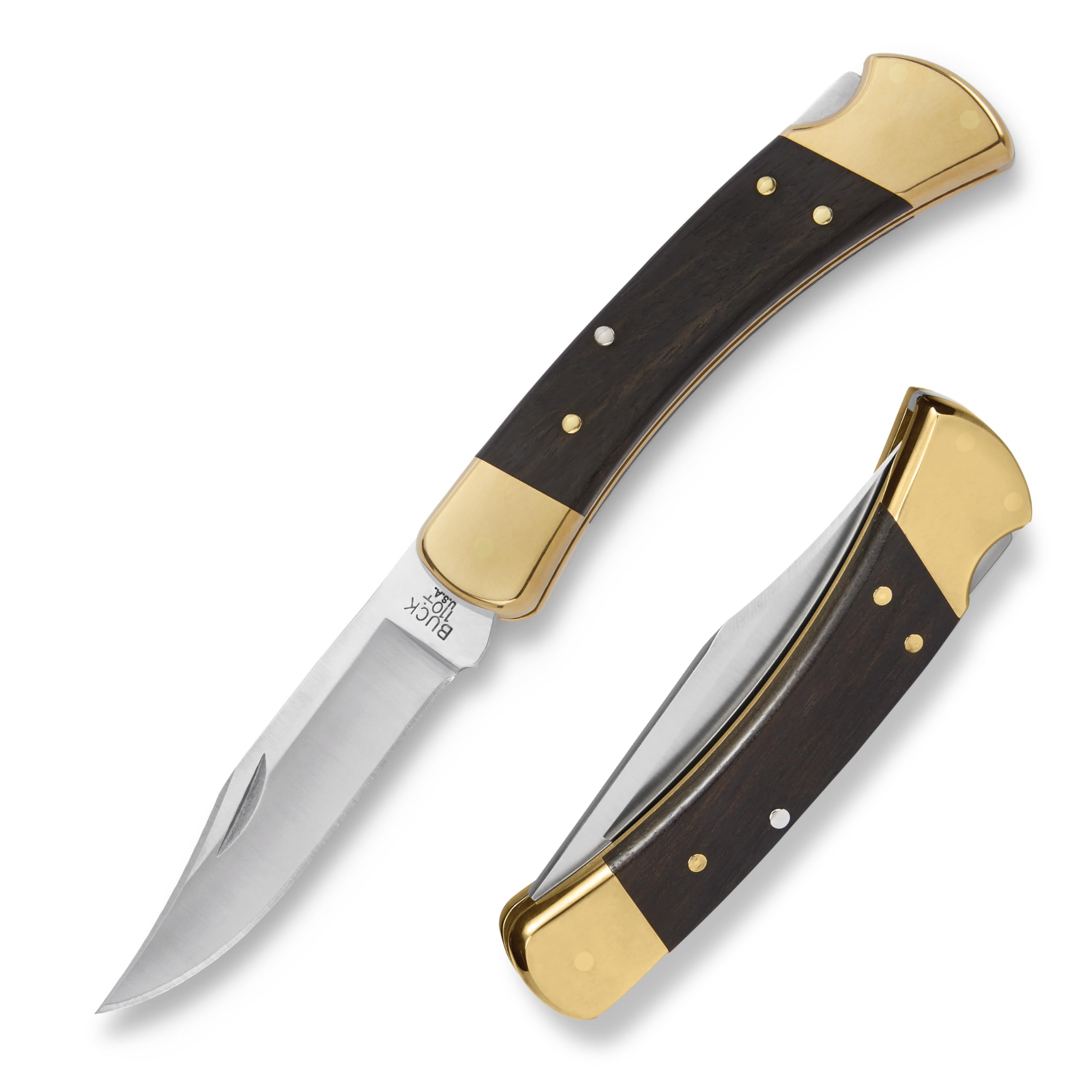
Buck 110 Folding Hunter
Key Features
- Blade Steel: 420HC
- Opening: Manual
- Lock Type: Lockback
- Handle Material: Brass & wood
- Weight: 7.2 oz
- Price: $$$
The Buck 110 delivers the iconic lockback design and solid brass-and-wood construction that have made it a hunting favorite for decades. The included leather sheath and razor-sharp 420HC blade hold up well in the field. What it gains in rugged durability it sacrifices in modern EDC convenience: the knife requires two hands to open and close, and its 7.2-ounce weight makes pocket carry cumbersome. This is the right choice for hunters, collectors, and anyone who values craftsmanship and a belt-carry tradition over one-hand deployment and lightweight daily carry.
Pros
- Iconic brass and wood construction feels solid and built to last.
- Blade arrives razor sharp and holds its edge well through heavy use.
- Includes a genuine leather sheath that fits securely on a belt.
Cons
- Heavy weight makes pocket carry impractical; best suited for belt sheath use.
- Requires two hands to open and close — no one-hand deployment.
Buy the Buck 110 if you want a heirloom-quality lockback for hunting or collecting, and don’t mind carrying it on a belt instead of in a pocket.
Best for Office Light Carry
Kershaw Leek
Key Features
- Blade Steel: Sandvik 14C28N
- Opening: Assisted
- Lock Type: Frame lock
- Handle Material: 410 stainless steel
- Weight: 3 oz
- Price: $$
Where the top pick offers budget-friendly reliability, the Kershaw Leek trades raw affordability for a noticeably sleeker profile and higher-grade blade steel. The 3-inch Sandvik 14C28N blade arrives razor sharp and takes a fine edge well, while the 3-ounce frame and slim pocket clip let it disappear into a dress shirt or slacks without bulk.
This knife suits office workers, light-duty users, and anyone who prioritizes a discreet carry over brute strength. The thin tip is engineered for slicing, not prying or twisting — applying lateral stress can snap it. For clean, precise cuts on envelopes, boxes, tape, or string, the Leek performs comfortably; it’s not designed for heavy outdoor tasks or blade abuse.
Pros
- Superb build and sleek anodized finish resist scratches and wear
- Razor sharp out of box and easy to resharpen on standard stones
- Extremely slim and lightweight; carries unnoticed in a pocket
Cons
- Thin tip can snap if used for prying or twisting motions
- Blade geometry limits it to slicing tasks; not for heavy-duty chopping or scraping
The Leek is a refined choice for those who value slim carry and premium steel over all-out durability — ideal for the office or light EDC, but requires respect for its fragile tip.
Best for Full-Size Outdoor Edc
CIVIVI Praxis
Key Features
- Blade Steel: 9CR18MOV
- Opening: Manual
- Lock Type: Liner Lock
- Handle Material: G10
- Weight: 4.42 oz
- Price: $$
Compared to the top pick, the Praxis offers a longer blade and sturdier G10 handle. It suits EDC users who need more cutting capacity for outdoor tasks, though the pocket clip screws can loosen and the tip may snap under lateral stress.
Pros
- Blade arrives razor sharp and holds its edge through extended use.
- Premium 9CR18MOV steel at a price that undercuts many similarly specced knives.
Cons
- Pocket clip screws may loosen over time, allowing the clip to shift or detach.
- Blade tip can break if used for prying or heavy lateral stress.
A capable folder for those who value blade length and steel choice over pocket profile; the clip screw issue is manageable with thread locker.
Best for Compact Budget D2
CIVIVI Mini Praxis
Key Features
- Blade Steel: D2
- Opening: Manual
- Lock Type: Liner Lock
- Handle Material: G10
- Weight: 4.05 oz
- Price: $
The CIVIVI Mini Praxis packs D2 steel into a pocket-friendly 2.98-inch package with a smooth flipper action and G10 handle that feels grippy in hand. The blade arrives sharp and holds its edge well through typical daily tasks — opening boxes, cutting cord, light food prep. At this price point, the steel quality is a clear step above the budget Kershaw Clash, though the tradeoff is a compact frame that suits smaller hands best. Large-handed users will find the handle cramped, and the liner lock can be stiff enough to make one-hand closing awkward until it wears in.
Pros
- Solid build quality and tight fit-and-finish for the price
- Razor-sharp out of box with good edge retention from D2 steel
- Comfortable ergonomic handle for smaller hands
Cons
- Liner lock may be stiff initially, making one-hand closing difficult
- Compact size can feel too short for users with larger hands
A smart choice for buyers who prioritize edge retention and value over size — best for medium to small hands and those willing to work through a stiff lock break-in period.
Best for Outdoor All-Rounder
Spyderco Tenacious
Key Features
- Blade Steel: 8Cr13MoV
- Opening: Manual
- Lock Type: Liner Lock
- Handle Material: G10
- Weight: 4.8 oz
- Price: $$
The Tenacious brings Spyderco’s thumb-hole deployment and G10 handle construction to a mid-range price point, offering a manual alternative to budget assisted-opening folders like the Kershaw Clash.
Outdoor enthusiasts who prioritize a secure grip and blade length will appreciate the ergonomics, though the 4.8 oz weight and 3.3-inch blade create a pocket profile that feels bulkier than typical EDC knives. The pocket clip screws can loosen with use – a minor maintenance item for those willing to apply thread locker.
Pros
- G10 handle and liner lock provide a sturdy, confidence-inspiring platform for cutting tasks.
- Blade arrives sharp and holds its edge through typical outdoor cutting.
Cons
- Pocket clip screws may loosen over time, requiring occasional tightening or thread locker.
- Its size and weight are noticeable in a pants pocket – better suited to a pack or jacket pocket.
An outdoor-focused EDC folder that delivers Spyderco’s hallmark feel – just be prepared to tighten the clip screws occasionally.
Best for Budget Tactical Edc
Kershaw Brawler

Key Features
- Blade Steel: 8Cr13MoV
- Opening: Assisted
- Lock Type: Liner Lock
- Handle Material: Glass-filled nylon
- Weight: 3.9 oz
- Price: $
The Kershaw Brawler combines a modified tanto blade with assisted opening at a budget-friendly price. The build feels solid for the price, with a glass-filled nylon handle and liner lock. The compact 3-inch blade and 3.9 oz weight make it pocketable. The spring assist may lose tension after months of heavy use, and the handle is small for larger hands.
Pros
- Modified tanto blade offers piercing capability and a distinct tactical look.
- Assisted opening deploys the blade quickly with a flipper.
Cons
- Spring assist may lose tension after extended use.
A fitting choice for occasional carry and light cutting tasks, especially for those who prioritize the tactical look and quick deployment over long-term spring reliability.
Best for Heavy-Duty Budget
Kershaw Cryo

Key Features
- Blade Steel: 8Cr13MoV
- Opening: Assisted
- Lock Type: Liner Lock
- Handle Material: Stainless steel
- Weight: 4.1 oz
- Price: $$
All-steel build gives the Cryo a solid, weighty feel that some prefer, and the assisted opening works quickly. That same heft makes it noticeable in a pocket, and a small number of units may experience spring assist failure over time — less adaptable than the top pick for varied daily carry needs.
Pros
- Solid all-steel construction gives a premium, sturdy feel
- Quick assisted opening at a budget-friendly price
Cons
- In pocket carry, the 4.1-ounce weight is noticeable — buyers prioritizing minimal pocket heft should explore lighter options
Best for those who value a weighty all-steel feel and assisted opening over pocket discretion; inspect spring function soon after purchase.
Best for Ultra-Budget Entry
Smith & Wesson Extreme Ops

Key Features
- Blade Steel: 7Cr17Mov
- Opening: Manual
- Lock Type: Liner Lock
- Handle Material: Aluminum
- Weight: 3.5 oz
- Price: $
Under $12 gets you a sharp blade and lightweight carry. But the stiff action demands two hands, and pocket clip screws may loosen. It can’t match smoother-opening knives, but budget buyers who accept these limits get a functional EDC.
Pros
- Outstanding value for money
- Sharp blade out of the box
Cons
- One-handed opening and closing can be difficult
Best suited for first-time knife owners who want a low-cost entry point and can tolerate a non-assisted, two-hand deployment.
Best for Tactical Heavy Utility
S&W SWMP4LS

Key Features
- Blade Steel: 4034
- Opening: Assisted
- Lock Type: Liner lock + safety lock
- Handle Material: Aluminum with rubber
- Weight: 7.6 oz
- Price: $$
The SWMP4LS brings a safety lock, glass breaker, and 3.6-inch serrated blade to a mid-range price point. Its substantial build and sharp edge out of the box suit users who prioritize lock security over pocket comfort. Weight and bulk, however, make it impractical for daily pocket carry — the 7.6-ounce frame and stiff assisted opening are better suited to a vehicle or emergency kit than an EDC rotation.
Pros
- Sturdy build with a substantial, confidence-inspiring feel
- Blade arrives sharp and maintains an edge well
Cons
- Very heavy and bulky for pocket carry; assisted opening can be stiff
Best for those who need a durable backup knife for a vehicle or emergency kit and don’t mind the heft.
Best for Disposable Backup
GOOD WORKER Pocket Knife

Key Features
- Blade Steel: 440C
- Opening: Manual
- Lock Type: Liner Lock
- Handle Material: Aluminum
- Weight: 4.12 oz
- Price: $
An extremely low price gets you a sharp serrated blade, glass breaker, and seatbelt cutter in a compact package — the strength is pure entry-level value. But the blade can be difficult to open and may not close properly, and the liner lock may not engage, which makes this better suited for a glove compartment as a disposable emergency tool rather than an everyday carry knife. For reliable one-hand opening and a lock you can trust, the top pick in this set is a safer choice.
Pros
- Budget-friendly price for a multi-tool folding knife
- Sharp blade out of the box with serrated edge
Cons
- Blade opening and closing can be unreliable, and the liner lock may not engage, leading to unexpected blade movement during use
Only consider this if you need an ultra-cheap emergency tool for a vehicle or emergency kit where locking reliability isn’t critical.
Best for Occasional/gift
Grand Way Wood Handle

Key Features
- Blade Steel: 440C
- Opening: Assisted
- Lock Type: Liner Lock
- Handle Material: Wood & metal
- Weight: 6.3 oz
- Price: $
The wood and metal handle gives this knife a classic look at an entry-level price, and the blade arrives sharp. However, the screws may loosen over time and the knife is heavy for daily pocket carry, making one-handed closing tricky. Best suited for occasional use or as a gift where appearance matters more than hard use.
Pros
- Attractive wood handle design
- Sharp blade out of box
Cons
- Screws may come loose over time, requiring periodic tightening
Worth considering if you want a good-looking knife for light, occasional tasks and don’t mind checking screws now and then.
How to Choose
The lock mechanism decides whether an EDC knife is a tool or a hazard – many sub-$10 knives fail this test.
Blade Steel
Blade steel determines edge retention and sharpening ease. 8Cr13MoV offers decent edge life and easy sharpening at a low cost. D2 steel holds an edge much longer but is tougher to sharpen and more brittle. Sandvik 14C28N provides a good balance with fine-grain edge stability.
For outdoor tasks that involve cutting rope, cardboard, or wood repeatedly, a premium steel like D2 or 14C28N saves time between sharpenings. For light daily use, 8Cr13MoV is sufficient and easier to maintain in the field.
Opening Mechanism
Assisted opening uses a spring to snap the blade open after you push past a detent. It allows fast one-hand deployment but adds a mechanical part that can wear out or break. Manual flipper tabs or thumb holes rely on your own force and have fewer failure points.
If you need quick access for safety or frequent cutting, an assisted opener is convenient. For long-term reliability and lower maintenance, a well-tuned manual opener is more durable.
Lock Type
Liner locks are common and work well when properly heat-treated, but can be stiff or fail if poorly executed. Lockback designs like the Buck 110 are extremely secure but require two hands to close. Frame locks are slim and strong but demand precise machining.
For everyday carry, a reliable liner lock from a reputable brand offers a good balance of security and one-hand closing. Avoid any knife where the lock doesn’t engage with a solid click – that’s a red flag.
Handle & Ergonomics
G10 handles provide a textured, secure grip in wet conditions and resist temperature extremes. Stainless steel handles feel premium but become slippery when wet. Glass-filled nylon is lightweight and tough but can feel less refined.
For hiking and outdoor use, G10 or textured nylon is preferable. For office carry where low profile matters, steel handles work well as long as your hands aren’t wet.
Weight & Pocket Clip
Weight affects pocket comfort: knives under 4 oz disappear in a pocket, while those over 6 oz are noticeable and may require a belt sheath. A deep-carry clip keeps the knife low in the pocket but can loosen over time.
If you plan to carry the knife every day, prioritize models under 5 oz with a sturdy clip that enables tip-up carry. Heavier knives are better suited to a pack or belt sheath.
FAQ
Why won’t my folding knife stay open?
Most often the liner lock or lock bar is not engaging properly due to a weak spring or misalignment. Try cleaning the pivot and lock face with a solvent. If the lock doesn’t click into place, the knife may be unsafe to use and should be replaced.
How do I fix a loose pocket clip on my EDC knife?
Remove the clip screws, apply a drop of medium-strength thread locker (like Loctite 242), and retighten. Let it cure for 24 hours. This prevents the screws from backing out during pocket carry.
Is D2 steel better than 8Cr13MoV for an outdoor folding knife?
D2 holds an edge longer and resists wear better, making it ideal for extended cutting tasks. However, it is harder to sharpen in the field and can chip under lateral stress. 8Cr13MoV is easier to maintain and more forgiving, suitable for lighter use.
Can I make a stiff liner lock easier to close?
Apply a drop of lightweight oil to the pivot and the lock bar contact points, then open and close the knife repeatedly. If the lock bar itself is too stiff, you can carefully bend it outward using a tool – but this risks damaging the lock. Consider a knife with a more accessible lock if stiffness persists.