This post contains affiliate links. We may earn a small commission when you buy through our links — at no extra cost to you.
Few things take the shine off a good morning on the water like reaching into the cooler at 11 a.m. to find the ice gone to soup and the morning’s catch sitting in lukewarm water. A fishing cooler’s job sounds simple—keep things cold—but the gap between one that still has cubes at sunset and one that gives up by lunch comes down to wall thickness, lid seal, and how much weight you’re willing to haul. Get it right and the box doubles as a seat, a casting platform, and the one piece of gear you stop thinking about.
The biggest box isn’t automatically the right one, either. A 70-quart that lives in a truck bed is miserable to carry down a ramp alone, and a compact model that tucks under the leaning post won’t hold ice through a three-day trip. Over the past eight months, we hauled 12 coolers from pre-dawn launches to hot tailgates, loading each the way you actually would, to see which sizes, lids, and latches hold up. The picks below earned their spots.


Best for Boat and Truck
YETI Tundra 45
Key Features
- Capacity: 45 quarts
- Dimensions: 16.13"D x 25.75"W x 15.38"H
- Insulation: Up to 3 in. PermaFrost
- Empty weight: 23 lb
- Price: Premium
Molded tie-down slots and a lid gasket that seats like a freezer door are the two details we check first on any cooler headed for a boat, and the Tundra 45 has both. The shell is one piece of rotomolded plastic, so there is no seam to split when it gets strapped down and bounced across a chop. At 45 quarts it carries 26 cans at a two-to-one ice ratio, or a day’s catch, ice and lunch with a little room to spare.
Cold-keeping is where it separates from the rest of this group. It has the strongest temperature-retention record of the hard coolers here, helped by insulation up to three inches thick in the walls and lid, and by that gasket doing the sealing. For anyone keeping fish, that is the difference between ice on the second morning and a box of meltwater by noon.
Two costs come with it. It weighs 23 pounds empty, so a loaded Tundra is a two-hand lift from a tailgate and a chore on a long carry. The thick walls also eat interior space, and the inside is smaller than the outside suggests — a case of bottles plus ice will fill it. It is the most expensive cooler here by a wide margin, and that money buys insulation and a shell rather than extra features.
The drain sits low enough that meltwater and the day’s slime run out without tipping the box, and the dry basket keeps lunch above the slush. Between trips it wipes out and dries with the lid propped open. Our one lingering reservation is the interior shape: measure the biggest fish you plan to keep against those inside dimensions before you commit, because thick walls are unforgiving.
Pros
- Strongest cold-keeping of the hard coolers here
- One-piece rotomolded shell with no seams
- Tie-down slots and a low drain for boat use
- Dry basket keeps food out of the meltwater
Cons
- 23 pounds empty; a full one is a two-hand lift
- Thick walls shrink the usable interior
Our pick for anyone keeping fish: the strongest cold-keeping here, a shell built to be strapped down, and a drain that empties without tipping.
Best for Solo Day Trips
YETI Roadie 15
Key Features
- Carry: DoubleDuty strap, LipGrip handles
- Drain: BestDam drain plug
- Capacity: 22 cans or 16 lb ice alone
- Dimensions: 11.2"D x 17"W x 14"H
- Price: Premium
Per quart, the Roadie 15 is the most expensive cooler here, and we still think it earns its place: it is the only box in this group you can carry comfortably in one hand while the other holds a rod. The DoubleDuty strap and LipGrip handles give you two ways to haul it, and the Bearfoot feet keep it from skating across a wet deck or a truck bed liner.
Fifteen quarts is a personal cooler, and the numbers on the box prove it: 22 cans on their own, or 16 pounds of ice on their own, not both. A realistic load is ice, drinks and lunch, with a fish only if you have planned around it. For a solo wade trip, a morning on a kayak, or a drive to the coast, that is exactly the right size, and it stows in a footwell or behind a seat.
Temperature retention is the strongest part of its case in this set, and it is rotomolded to the same standard as the Tundra. What it does not have is ice capacity, so plan on topping up on a long, hot day. It also comes in enough colors that you can pick one you actually like, which matters more than it should when the box is small enough to live in the car all summer.
Pros
- Carries in one hand with strap or handles
- Non-slip feet hold on a wet deck
- Seals and insulates like the bigger YETIs
Cons
- Fifteen quarts fills fast with ice and lunch
- Most expensive per quart here
We recommend it to the angler who carries everything alone: one-hand portability, a real gasket seal, and room for ice, drinks and lunch.
Best for Wade and Kayak
ENGEL 13qt Drybox
Key Features
- Seal: Recessed EVA gasket, airtight
- Capacity: 13 quarts
- Warranty: Limited 5 years
- Empty weight: 3.5 lb
- Price: Midrange
Stainless latches, a hinged lid and a recessed gasket: the Engel Drybox closes like a dry bag and opens without a fight. It is 13 quarts and 3.5 pounds, with an adjustable shoulder strap and a hanging tray that keeps sandwiches and small items out of the ice, so it goes from the truck to the bank on one shoulder.
We like it best for the fishing where you are in and out of the water — a wade trip, a morning on the rocks, a kayak — because a box that seals this tightly keeps spray and slime on the outside while a couple of drinks and lunch stay cold inside. It is one of the few small hard coolers here with a real gasket, and the latches feel like they came off a toolbox rather than a picnic basket.
Ice life is the compromise. Two days is the label’s claim and a hot day is more realistically a solid day with a top-up, so load block ice or frozen bottles and treat it as a day box. The hinges are the part to keep an eye on over years rather than months. A five-year limited warranty is more coverage than several coolers here carry, which tells you Engel expects it to be knocked around.
Pros
- Airtight gasket with stainless latches
- 3.5 pounds with an adjustable shoulder strap
- Five-year limited warranty
- Hanging tray keeps small items off the ice
Cons
- Strap is thin for a loaded box
Buy the Drybox if you want a small hard cooler that seals like a dry bag and shrugs off a wet ride in the truck.
Best for Pier and Beach
Coleman Xtreme 50qt
Key Features
- Capacity: 50 quarts
- Transport: All-terrain wheels, telescoping handle
- Empty weight: 12.7 lb
- Ice retention: Up to 5 days at 90°F
- Price: Midrange
Coleman advertises five days of ice at 90°F for this 50-quart roller, and that number assumes a full box of pre-chilled contents, block ice, and a lid that stays shut. On the water it is a different story. Cooling performance holds up, but how long the ice actually lasts depends on how you load it and where it sits, so plan on a day and a half in summer heat and you will be pleased rather than disappointed.
The reason to buy it is the wheels. Eighty-four cans plus ice is more than anyone wants to carry from a parking lot to a pier, and the all-terrain wheels and telescoping handle take that load over gravel, grass and packed sand. The lid is rated for 250 pounds, so it doubles as a seat, and the drain empties meltwater without you tipping the whole thing.
Our ranking puts it as the hauler for bank and pier fishing, because it does the thing the big rotomolded boxes cannot: move a full day of gear without a second person. Two things to accept. The lid is stiff to open and does not stay up while you dig, and the wheels and handle carry the entire load, so they are the parts that end a cooler’s life first. Roll it loaded on hard ground and lift it over the soft stuff.
Pros
- Rolls 84 cans plus ice over rough ground
- Drain empties meltwater without tipping
- Lid takes a 250-pound seat load
- 50 quarts for a fraction of rotomolded money
Cons
- Lid is stiff to open and will not stay up
For pier, beach and long parking-lot walks, this is the roller we point to: 84 cans, real wheels and a seat lid.
Best for Hike-In Water
MIYCOO 40-Can Backpack
Key Features
- Capacity: 28 liters
- Dimensions: 8.6"D x 11"W x 15.7"H
- Can capacity: Up to 40 cans
- Compartments: Two plus a top pocket
- Price: Budget
The walk from the trailhead to a good bank is the reason backpack coolers exist, and 40 cans of capacity with your hands free for rods, a net and waders is a fair trade for a little weight on your back. Two compartments and a top pocket keep the layout sensible: cans and ice in the bottom, sandwiches, phone and a bottle opener up top.
Comfort is better than the price suggests. The straps spread the load across both shoulders instead of cutting into one, and the side fastening straps hold two bottles upright so they do not roll around in the ice. For a mile-long walk-in, that is the difference between arriving ready to fish and arriving with one arm longer than the other.
The liner is sealed and it handles a bag of ice and a day’s drinks without drama. Where a bag like this gives trouble is after the ice melts: water finds the zipper, and a leaking backpack is a miserable thing to wear. Pack frozen bottles, or ice in a sealed bag, instead of loose cubes, and the inside stays dry enough for food.
We rate it as the easiest way here to carry a day’s food and drinks into water you cannot drive to, and one of the cheapest hands-free options in the group. It is not a fish box — a catch needs a hard cooler with a gasket and a drain — and it is not something to leave in a truck bed for a week. For the trip it is built for, nothing else here carries as well.
Pros
- Frees both hands on the walk in
- Two compartments plus a top pocket
- Holds 40 cans in a comfortable carry
- Side straps hold bottles upright
Cons
- Not built to hold a kept fish
This is the one for hike-in water: 40 cans on your back, hands free for rods, and a price below most of the hard coolers here.
Best for Group Base Camps
Igloo Glide Pro 110qt
Key Features
- Capacity: 110 quarts
- Transport: Telescoping handle, Soft-Ride wheels
- Can capacity: 168 cans
- Empty weight: 25.4 lb
- Price: Midrange
A hundred and ten quarts and 168 cans is not a fishing cooler in the usual sense; it is the box that lives at the cabin or the campsite and holds everyone’s drinks, the food and the catch. If that is your trip, the telescoping handle and the big wheels are what make it practical at all: 25 pounds empty, and a great deal more when it is full.
Cold-keeping is the strongest part of its case. It is one of the few big boxes here whose ice retention holds up in use rather than splitting down the middle, and the THERMECOOL insulation and UV-treated lid are doing the work. The drain plug means you can empty meltwater without tipping a box that two people would struggle to tip.
The latches are the weak point. They can work loose and stop holding the lid down tight, so check them before every trip and run a strap over the lid on rough roads. It is also a two-person lift when full, and it takes up most of a truck bed. Our verdict is that it suits a fixed camp or a boat with deck space, and it is more cooler than a solo angler needs on the drive home.
Pros
- 168 cans for a camp or a crowd
- Telescoping handle rolls a full load
- Cold-keeping holds up better than most big boxes here
- Drain plug empties without tipping
Cons
- Latches can work loose and stop holding
- Two-person lift when full
Choose it when the cooler stays at camp and feeds a crowd: 168 cans, a telescoping handle, and cold-keeping that holds.
Best for Drinks and Lunch
Titan 16 Zipperless

Key Features
- Lid: Zipperless flip-open
- Capacity: 12.68 quarts
- Empty weight: 2.3 lb
- Ice retention: Up to 2 days
- Price: Budget
Reaching into a cooler with wet, fishy hands is how zippers die, and the Titan’s answer is to remove the zipper: a rigid flip lid that opens one-handed and closes without you lining up teeth. The hard liner holds its shape instead of sagging, and the SmartShelf lifts out so sandwiches and bait stay clear of the meltwater.
At 2.3 pounds empty and roughly a foot square, it fits behind a truck seat, between the seats of a skiff, or under a kayak deck. Sixteen cans plus ice is the realistic load, and the rigid liner means it packs like a small box rather than a bag, which makes it easier to load and much easier to wipe out.
Ice is the compromise. Two days is what the label says, and a soft cooler gives up ice faster than a hard box, so treat this as a few-hours cooler and pack frozen bottles rather than loose cubes. The zipperless lid is genuinely quicker with wet hands, though, and that is the reason to choose it over a cheaper soft bag.
We rate it as the lunch-and-drinks cooler for a fishing day rather than the fish box, and the lifetime limited warranty is more than most of the budget coolers here offer. The shelf is the detail that sold us: keeping a sandwich out of the slush on a hot afternoon is a small thing that feels like a big one by two o’clock.
Pros
- Zipperless lid opens one-handed
- Rigid liner does not collapse
- Removable shelf keeps food dry
- 2.3 pounds empty
Cons
- Ice life is hours, not days
- No room for a kept fish
A good lunch-and-drinks companion for a fishing day, and the zipperless lid is the reason to pick it over a cheap soft bag.
Best for Budget Day Trips
Coleman Chiller 16qt
Key Features
- Capacity: 16 quarts
- Dimensions: 12"D x 15.7"W x 11.2"H
- Empty weight: 3.6 lb
- Ice retention: Up to 36 hours
- Price: Budget
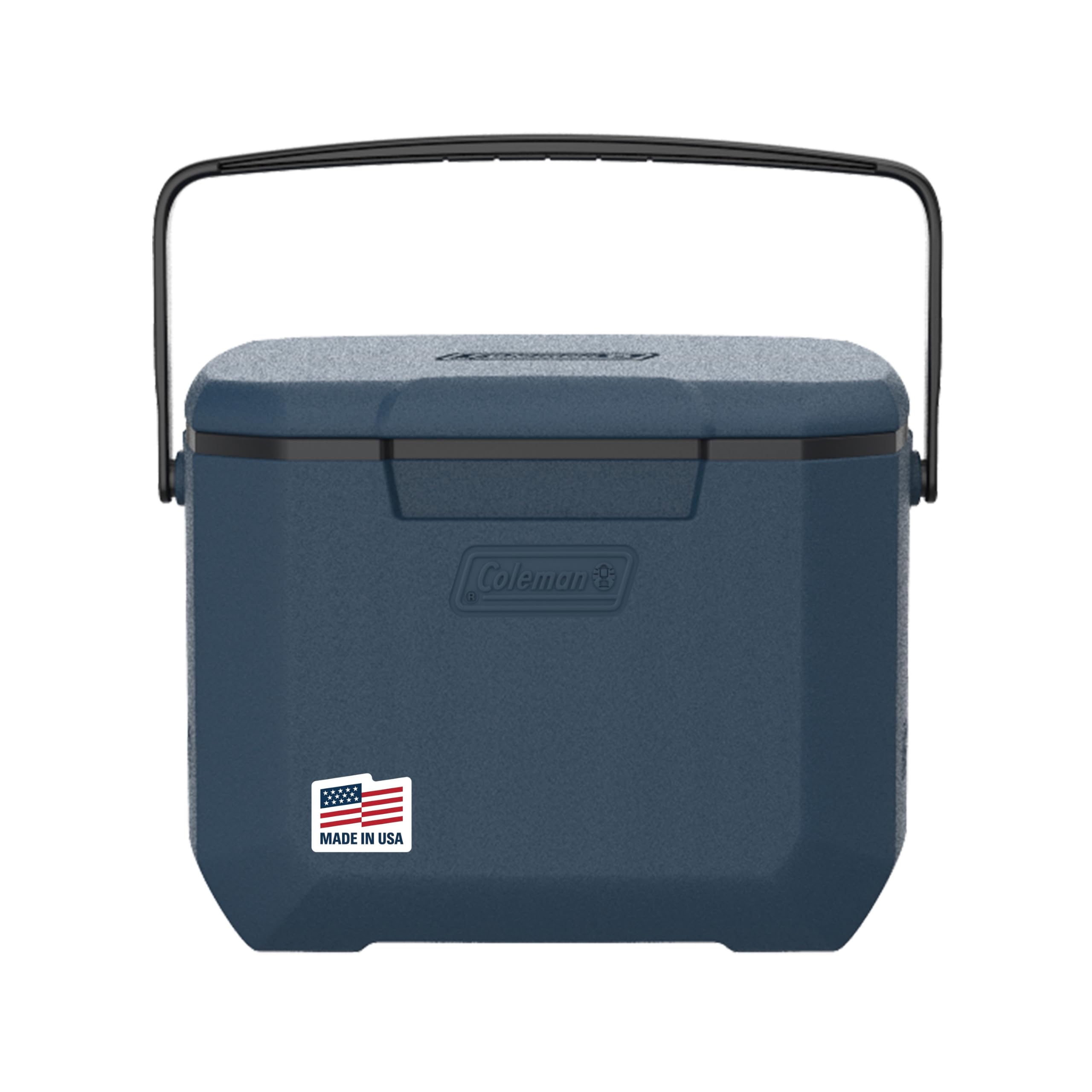
If the budget is the whole decision, this is the cooler: 16 quarts, 3.6 pounds, a lid rated to 200 pounds so it doubles as a seat on the bank, and a claimed 36 hours of ice that covers a day trip comfortably. It is the simplest box here — one compartment and a bail handle — and for drinks, lunch and a bag of ice it does everything a small hard cooler has to do. We think the seat lid is the detail that makes it worth carrying to a spot where you will be standing for hours.
The lid takes a firm pull to open and will not stay up on its own, which is a small annoyance when you are digging one-handed. Thirty-six hours is a day, not a weekend, so for an overnight trip look at a bigger box. What we appreciate most is how little it asks of you: it wipes out, it stacks in a garage, and it is light enough to move with one hand when it is packed for a day.
Pros
- Cheapest hard cooler in this group
- Lid doubles as a 200-pound seat
- 36 hours of ice covers a day trip
Cons
- Lid needs a firm pull and will not stay up
If the budget is the whole decision, this small hard cooler keeps a day’s drinks cold and doubles as a seat.
How We Tested Fishing Coolers on the Water and in the Driveway
A cooler shortlist starts with a tape measure. We began with more than 30 models, then narrowed by exterior footprint—could it slide under a leaning post or fit beside a console without eating the deck?—along with claimed ice retention, wall thickness, drain placement, and price, since a box that holds ice for four days is a bargain and one that doesn’t is a very heavy seat. That left 12 coolers, which we ran through eight months of real fishing days.
Each one came on at least three trips: dark-o’clock dock loadings where we packed it by headlamp, full days on a center console where it got slid across wet decks and sat on in waders, and a few lake weekends where it baked in a hot truck bed. One of us opened every lid one-handed with a rod in the other hand, because that’s how it actually happens.
We packed each cooler with the same 20 pounds of cubed ice plus a lunch and a few drinks, then logged what was left at the 12-, 24-, 48-, and 72-hour marks. We tilted each loaded cooler in a truck bed to watch for drips at the seal and the drain, hauled them up ramps by the handles, dropped them off a tailgate, and scuffed them against gunwales to see how the finish held up. Back home we hosed them out to check whether the drain emptied the last inch of meltwater and whether the lid stayed open while we dug around inside.
How to Choose a Fishing Cooler
The right fishing cooler is the one you can still move when it is full and trust with a catch when it is hot, and those two requirements pull against each other.
Start With How You Get to the Water
Carry, wheel, or wear: that decision comes before capacity or ice ratings, because a cooler you cannot move is a cooler you leave in the truck. A 50-quart box that weighs 12 pounds empty weighs something like 50 when it is full, which is a tailgate lift and not a quarter-mile walk.
Long walk in, a backpack cooler keeps your hands free for rods. Flat ground, a pier, a parking lot, wheels earn their keep. The trap is soft sand, where small wheels bog down and the shoulder strap quietly becomes the plan again.
Size It for the Catch, Not the Can Count
Can counts are quoted without ice, and a cooler without ice is a picnic basket. Halve the number before you trust it: the 45-quart YETI here is listed at 54 cans bare and 26 cans at a two-to-one ice ratio, and the second figure is the realistic one for a day’s drinks.
Then add the catch. A fish needs length, not just volume, so check the interior dimensions against the biggest fish you expect to keep before you buy. For two people, a day’s food and a fish, 45 to 50 quarts is the sensible band.
Treat Multi-Day Ice Claims as a Best Case
Several boxes here advertise two to five days of ice, and every one of those numbers assumes a full cooler, pre-chilled contents, block ice, shade, and a lid that stays shut. On a hot boat deck with the lid opening every ten minutes you will get a fraction of that.
Pre-chill the box with a bag of ice the night before, build the base from block ice or frozen bottles, top with cubes, and leave the meltwater until it reaches the food. Then plan on a top-up rather than trusting the label.
Check the Lid, Latches and Drain First
The lid is where coolers fail. On the large and wheeled boxes here, latches that work loose and lids that stop sealing are the most common weak point, and a lid that does not hold is a cooler that does not hold ice. Work the latches before you load it, look for a gasket you can see, and favor hinges that are metal or molded rather than a thin plastic tab.
A drain plug is the other small thing that matters: it empties meltwater without tipping the box, and it makes rinsing fish slime out far easier at the end of the day.
Hard Shell or Soft Bag?
Soft coolers are lighter, cheaper and easier to carry, and they leak at the zipper once ice turns to water. Hard coolers hold ice longer and clean up better, and they are heavy before you put anything in them.
Our rule: a soft bag for drinks and lunch on a few-hour trip, a hard box with a gasket and a drain if you are keeping fish or staying out all day. The Titan’s zipperless lid dodges the weakest part of a soft cooler, though it still is not a fish box.
Frequently Asked Questions
How do I get fish smell out of a cooler?
Rinse it the same day with mild soap and water, drain it completely, and store it with the lid propped open so air moves through. A smooth hard liner and a drain plug turn that into a five-minute job; a soft bag with fabric seams takes longer and holds odor in the stitching.
Never put a cooler away wet. That is what turns a smell into a permanent one.
Can I keep bait in the same cooler as my food?
Not loose, and never above the food. Bait leaks, and meltwater carries whatever it touches across everything else in the box. Use a sealed container inside the cooler, or a separate small box with a real gasket, and keep it below the food rather than on top of it.
If you are packing both, pack the food first and the bait last, so nothing drips on the way in.
Why not just use a plastic tub and ice?
A tub has no insulation, so a bag of ice in one is water within a couple of hours in summer, and the outside sweats onto whatever it sits on. It is fine for holding a cleaned catch at the dock, not for a day on the water.
If that is the whole job, a cheap soft bag or the Coleman Chiller does it and holds cold far longer.
Final Verdict
Our pick for most fishing trips is the YETI Tundra 45. It keeps ice longer than anything else here and takes being strapped to a deck without complaint, which is what a fish box has to do.
Fish alone and carry everything yourself, and the Roadie 15 is the same idea in a one-hand size. If the walk from the car is the hard part, the Coleman Xtreme rolls a full load for far less money.