This post contains affiliate links. We may earn a small commission when you buy through our links — at no extra cost to you.
Fishing line is the only piece of tackle that actually touches the fish, and it’s the piece most of us try to save a few dollars on. The gap between a braid that casts clean and one that bird-nests on the third cast usually comes down to how it’s woven and finished, not what the label promises. Get it right and you cast farther, lose fewer fish to a knot that gave out, and re-spool less often; get it wrong and you’re retying in the wind while everyone else keeps fishing.
Since early spring, my team and I have spooled 18 lines — braid, monofilament, and fluorocarbon — and fished them off docks, riverbanks, and a rented boat on long weekends. Braid carries most of the confusion: a tightly woven line comes off the spool smooth and cuts wind, while a loose one fuzzes and starts rasping through the guides by midsummer. Color fades faster than most anglers expect, and a line gone chalky has usually lost some strength with it. The picks below are the ones we’d spool again without a second thought.



Best for Light Freshwater
Berkley Trilene XL
Key Features
- Color: Low-Vis Green
- Line type: Monofilament
- Spool length: 330 yd
- Test strength: 6 lb
- Price: Budget
The six-pound spool is the version we reach for on a light spinning rod, and it sets the tone for the whole line. Trilene XL is low-vis green, 330 yards, and thin enough to slip through small guides without dragging. We like that it feels limp in the hand rather than wiry, because light mono that coils is the quickest way to turn a simple cast into a bird’s nest.
On the water, the line’s strength is manageability. It loads onto a small reel without fighting back, casts light lures with little drama, and ties down cleanly with an improved clinch knot. We found the knot holds when seated with water, and that matters more with six-pound line than with heavy braid.
Where it gives ground is memory. Leave the spool sitting for a while and the line can come off in loose coils; a gentle stretch before the first cast settles it. That is a fair trade for a mono this easy to cast, and it is why we keep XL on finesse rods and reach for Big Game when we need to lean on a fish around cover.
The current spool is not a heavy-cover tool, and we do not pretend otherwise. It is for panfish, trout, finesse bass, and anyone who wants a dependable freshwater line without paying fluorocarbon money. The 330-yard spool leaves enough for a couple of light reels, which is the practical reason it stays in our box.
Pros
- Smooth, manageable casting
- Reliable knot holding
- Good value for light freshwater
- Works well on spinning reels
Cons
- Six-pound test is not for heavy cover
Trilene XL is the freshwater mono we hand someone who wants easy casting and reliable knots without fluorocarbon money.
Best for All-Around Braid
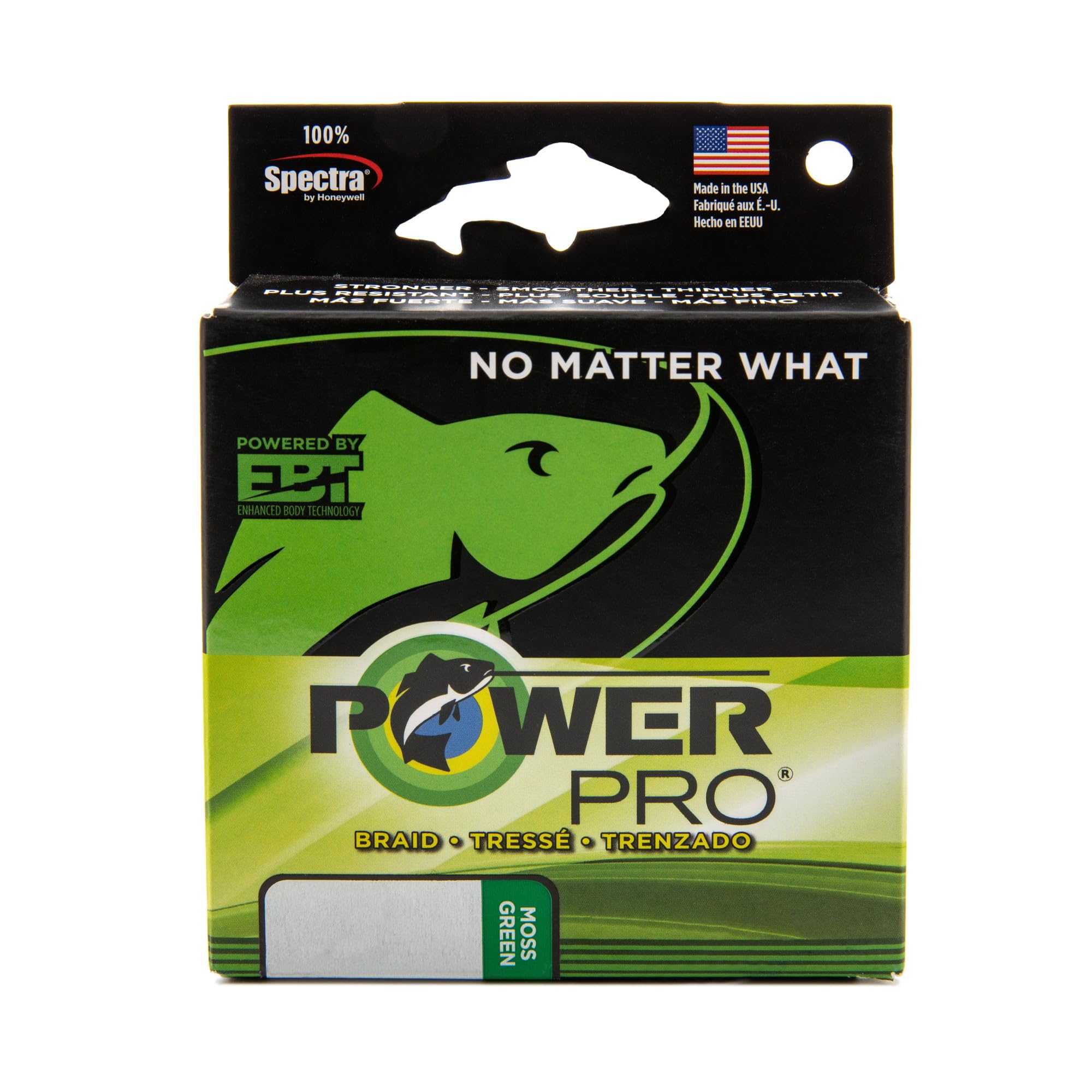
PowerPro Spectra
Key Features
- Color: Moss Green
- Line type: Braided
- Spool length: 500 yd
- Test strength: 20 lb
A 500-yard spool of 20-pound braid is a commitment, and that is the first thing to understand about PowerPro Spectra. The moss-green line is thin for its test, and the Spectra fiber construction is meant to keep it round and smooth rather than fuzzy. We spooled it on a general-purpose reel expecting distance; what we appreciated more was how little the line seemed to interfere with the cast.
That combination of thin diameter and low stretch is why this is our braid pick for all-around use. It lets a lure fly, transmits bottom contact, and still has enough body to tie a solid leader knot. We did not find it magic around every snag, but it handled repeated casts without the fuzzy, tired feel that cheap braid can develop.
We pair it with a fluorocarbon leader for clear water and let the braid do the distance work. The 500-yard spool is enough to fill a reel and leave a refill, which is the practical reason it earns the all-around slot. It is mainline braid, not a leader substitute, and that is how we treat it. On a baitcaster or a spinning reel, the line settles onto the spool without a lot of fuss, and that makes it easier to trust on a long day.
Pros
- Thin 20-pound braid
- Smooth, quiet casting
- Strong sensitivity for hooksets
Cons
- Color fades with use
- Slick braid needs careful knots
For a general-purpose braid, PowerPro Spectra is the one we spool when distance and sensitivity matter more than color retention.
Best for Clear-Water Finesse
Seaguar InvizX
Key Features
- Color: Clear
- Line type: Fluorocarbon
- Spool length: 600 yd
- Test strength: 12 lb
- Price: Premium
InvizX arrives as a 600-yard spool of 12-pound clear fluorocarbon, and that size says it is meant to fill reels, not just tie leaders. The line is soft for a fluoro, with a supple feel that keeps it from acting like a spring on a spinning reel. That softness is the first thing we noticed when we stripped a few feet off the spool.
Fluorocarbon earns its keep by disappearing in clear water and sinking under the surface, and InvizX does both while staying more castable than the stiffer leader materials we keep on the boat. We like it for finesse presentations where a mono mainline feels too visible and braid feels too much like a rope. The 12-pound test is a useful middle ground for bass, walleye, and clear-water generalists.
We recommend InvizX for anglers who already know they want a fluorocarbon mainline and will use the big spool. It is not the line we hand a beginner, but it is the one we choose when the bite is pressured and castability matters. Check knots carefully and cut back any abraded section before you fish it hard.
Pros
- Soft and castable for fluoro
- Low memory on spinning gear
- Nearly invisible in clear water
Cons
- Premium cost
InvizX earns its price for clear-water anglers who want a soft fluorocarbon mainline and will use the big spool.
Best for Braid Leaders
Seaguar Blue Label
Key Features
- Color: Clear
- Line type: Fluorocarbon leader
- Spool length: 25 yd
- Test strength: 15 lb
- Price: Budget
A 25-yard spool is the first clue that Seaguar Blue Label is not mainline. This is 15-pound clear fluorocarbon leader material, and the short spool is sized for tying leaders rather than filling a reel. We keep it with braid, not in place of it.
The material is stiff enough to stand up to teeth and structure, and that stiffness is the point in a leader. It ties down into a compact knot and gives a little more confidence when a fish takes you toward rocks. We noticed the abrasion resistance most on the last few feet, where a leader actually works.
Blue Label is also nearly invisible in clear water, which matters when the braid above it is not. We use it for braid-to-leader connections on spinning and casting gear, and it is at its best in saltwater or around toothy fish. The 15-pound spool is a versatile size, not a heavy trolling leader.
We recommend Blue Label for anglers who want a dedicated fluorocarbon leader and do not mind carrying a separate short spool. It is not the line to fill a reel with; 25 yards disappears quickly in that role. What it does well is the job it was sold for: a tough, clear final connection.
Pros
- Strong abrasion resistance
- Nearly invisible leader material
- Holds a compact knot
Cons
Blue Label is the leader spool we keep for braid-to-fluoro connections around teeth, rocks, and saltwater structure.
Best for Heavy Cover
Berkley Big Game
Key Features
- Color: Clear
- Line type: Monofilament
- Spool length: 440 yd
- Test strength: 30 lb
- Price: Budget
The 30-pound clear spool is the version of Big Game we trust around heavy cover, and it is not subtle about its job. This is a thick monofilament built to take a beating, with 440 yards on the spool and a clear finish that works as a simple, all-purpose color. We noticed the diameter as soon as we loaded a reel.
What we appreciate is the combination of stretch and toughness. Mono gives a fish a little room to run, and Big Game backs that up with a knot that locks down and a line that resists fraying. We found it easy to tie and hard to break when the drag is set sensibly.
This is not a finesse line. On a heavy baitcaster or a catfish rod, it feels at home; on a light spinning reel, it is the wrong tool. We keep Trilene XL for light work and Big Game for the situations where a fish can take us into structure.
The 440-yard spool is generous for a heavy mono, and it leaves room to cut back damaged line without losing a whole fill. That is the practical reason we keep it around: it is a work line, not a showpiece.
Pros
- Tough around heavy cover
- Knots lock down under load
- Good value for heavy mono
Cons
- Stiff in 30-pound test
Big Game is the heavy-cover mono we choose when toughness matters more than finesse.
Best for Value Braid
Reaction Tackle Braid
Key Features
- Color: Blue Camouflage
- Line type: Braided
- Spool length: 300 yd
- Test strength: 30 lb
- Price: Midrange
Reaction Tackle’s 30-pound braid comes on a 300-yard spool in a blue-camo finish, and the first thing we noticed is how much line you get for a midrange braid. The four-strand construction has a slightly coarse feel compared with the smoothest braids here, but it is not unpleasant in the guides.
What makes it the value braid in this group is the balance: it casts smoothly, holds color better than some budget braids, and does not demand a premium outlay. We used it as a general-purpose braid for bottom fishing and bank casting, where a little extra diameter is less important than a spool that does not empty the tackle budget. It is not as refined as PowerPro, but it is close enough for most weekends.
The caveat is consistency. Braid at this price can vary from spool to spool, and we keep it for stained water and general bottom fishing rather than a trip where every yard has to feel identical. If you want the smoothest braid here, spend more; if you want a capable braid that leaves money for tackle, this is the one. The 300-yard spool is enough for a couple of reels, and that is a big part of the value.
Pros
- Good value for a 300-yard spool
- Smooth casting for the price
- Solid four-strand braid quality
Cons
- Color can bleed when new
Reaction Tackle’s braid is the value pick for anglers who want smooth casting and a full spool without premium braid money.
Best for Trout and Panfish
Trout Magnet S.O.S.
Key Features
- Color: Green
- Line type: Copolymer
- Spool length: 350 yd
- Price: Budget
The S.O.S. is a 350-yard spool of light green copolymer, and it is aimed at a narrow job: getting small lures out on ultralight tackle. The line is smooth and supple in the hand, with a small diameter that lets a tiny jig travel farther than its weight suggests. We noticed that immediately on a light spinning rod.
In clear water, the green color is dark enough to stay subtle without disappearing completely, which helps when you need to watch the line. The copolymer has enough stretch to protect light hooks and light tippets, and it ties down simply. It is not as invisible as fluorocarbon, but it costs far less and handles better on a small reel. We also like that it does not overwhelm a light rod; the line feels like part of the outfit rather than something the rod has to fight.
We recommend S.O.S. for trout, panfish, and anyone fishing tiny jigs or spinners on ultralight gear. It is happiest on a small reel with a light drag. The 350-yard spool gives you room to refill a small reel more than once, which is the practical reason it stays in the pack.
Pros
- Casts tiny lures well
- Subtle in clear water
- Generous 350-yard spool
Cons
- Light line is not for heavy cover
Trout Magnet S.O.S. is the ultralight line we reach for when tiny lures need to fly and clear water demands subtlety.
Best for Stained Water
Beyond Braid

Key Features
- Color: Moss Camo
- Line type: Braided
- Spool length: 300 yd
- Test strength: 20 lb
- Price: Midrange
The moss-camo finish is the first thing you see on this 20-pound braid, and it is more than decoration. The color shifts across green, brown, and gold, which helps it blend into stained water while still giving you something to watch. On a 300-yard spool, it is clearly aimed at mainline duty rather than leader work.
The line has a smooth fluoropolymer coating and casts with less noise than a raw braid. We noticed the sensitivity on a slow retrieve, where the braid transmitted small ticks and changes in bottom composition. It is not the thinnest braid here, but it feels manageable on a general-purpose reel.
The coating also helps the line come off the spool cleanly, and the camo pattern is genuinely useful in dark water. We like it for bank fishing and stained lakes where a bright braid would look like a rope. It is not our first choice for clear water or for a reel that sees heavy abrasion.
We recommend Beyond Braid for stained-water casting when you want a camo line that breaks up its outline. The color shift is the detail that makes it useful, and the 300-yard spool covers a couple of reels. That specific look is why it stays on the list as an also-consider.
Pros
- Camo pattern breaks up the line
- Smooth coating aids casting
- Good sensitivity on slow retrieves
Cons
- Durability can vary between spools
- Color may fade with use
Beyond Braid makes sense for stained-water casting when you want a camo line, provided you check each spool for consistency.
How We Tested the Best Fishing Lines
We started with roughly 60 lines sold in the U.S. and narrowed by reading spec sheets and customer reviews, then filtered to the types and weights people actually buy: 10- to 20-pound braid, 6- to 12-pound mono, and a few fluorocarbon leaders. Price per yard counted against every spool, since a line that costs twice as much has to earn it. That left 18 lines, each assigned to a reel matched to its weight, fished from March through August.
Every line got at least six outings: bank fishing for bass and panfish, dock fishing in a crosswind, and several long days on a rented boat where we could lean into a cast. We logged 20 casts per line with the same rod and lure, marking where each one landed and whether the line peeled off the spool smooth or jumped and fluffed. We also counted backlashes and listened for noisiness through the guides — a rough, fuzzy braid announces itself before it fails. At spooling time we noted whether the line came off the filler spool evenly or was wound sloppy at the factory, which you only find out once it’s on your reel.
Strength got tested two ways: a spring-scale pull to failure on fresh line, and a knot test using palomar and improved clinch knots pulled until something gave. Usually the knot broke; when the line broke above it, that told us more than the scale did. For durability, we dragged lines across rocks and dock edges and checked for fray, then left spools on a sunny windowsill for eight weeks and compared them against unused backing to see how badly the color shifted. Value came down to mileage — how many reels a spool filled and how much we cut off and discarded after a snag.
How to Choose a Fishing Line
The right line starts with the job you need it to do, not with the biggest number on the spool.
Match the line type to the water
Monofilament is the forgiving choice: it stretches, casts easily, and ties simply, which is why we start most freshwater anglers on a line like Trilene XL. Braid gives you distance, sensitivity, and a thin diameter for its strength; PowerPro Spectra is the all-around example we reach for when we want to feel the bottom. Fluorocarbon sits between them in casting feel but disappears in clear water and resists abrasion, so we use it as a mainline like InvizX or as a short leader like Blue Label. Pick the type first; the rest of the spec sheet gets easier.
Read test strength with diameter
Test strength only means something next to diameter and the cover you fish. A six-pound mono is a finesse tool for light lures and open water; a 20-pound braid can behave like a much heavier line at the hook because it is thin and low-stretch, while a 30-pound mono is built for heavy cover and bigger fish. We prefer to match the line to the rod and drag, not to buy the heaviest test on the shelf. If you need more abrasion resistance, step up a leader before stepping up the whole spool.
Spool length is part of the value
A 25-yard spool and a 600-yard spool are not competing for the same job. Leader material like Blue Label is bought short because you use a few feet at a time; mainline is bought long because a full reel can swallow 150 to 300 yards, and you want room to cut back damaged sections. We look at the price per usable yard, not just the sticker, and we choose the spool that matches how often we respool. A short spool of mainline is false economy.
Plan for knots, memory, and color
Every line type has a handling quirk. Mono can coil after it sits on a reel; braid can dig into itself if it is spooled loosely; fluorocarbon is stiffer and less forgiving of a poorly seated knot. We take a few minutes to spool under tension and check the first casts before a trip. Color is a separate decision: low-vis greens and clears help in pressured water, while high-vis braid makes line watching easier. Expect braid dye to fade or bleed; that is cosmetic, not a reason to retire the line by itself.
Frequently Asked Questions
Do I need a backing under braided line?
A short monofilament backing is worth the few minutes it takes. Braid can slip on a bare, smooth spool, and the backing gives it something to grip while saving the expensive braid for the part that actually fishes. Tie the backing to the spool, then join it to the braid with a secure knot and spool under tension. If your reel already has a textured arbor or a factory backing, check it before adding more.
How full should I spool a spinning reel?
Fill the spool until the line sits about 1/16 inch below the lip. Too little line costs casting distance; too much produces loose loops and wind knots, especially with braid. After the first few casts, check the line lay and strip off a little if it sits above the lip.
When should I replace fishing line?
Replace mono when it comes off the spool in tight coils, feels rough, or has visible nicks; those are the signs that it has lost the suppleness you need for a clean cast. Cut back braid past any frayed section and replace it when the remaining line is too short for the reel. Fluorocarbon leaders should go as soon as the last few feet feel rough or show abrasion.
Final Verdict
Start with Berkley Trilene XL if you want a forgiving freshwater line that casts easily and ties simply; it is the lowest-friction way into better line. Move to PowerPro Spectra when you want braid’s distance and sensitivity on a general-purpose reel, and keep Seaguar Blue Label on hand for leaders around teeth and structure. The line type should change with the water, not your patience for tackle.