This post contains affiliate links. We may earn a small commission when you buy through our links — at no extra cost to you.
A mosquito net that glares in sunlight or takes twenty minutes to fold back into its bag turns a simple protection into a daily frustration. Many campers discover this only after buying the wrong type for their trip.
The real choice comes down to how you sleep: head nets work for hikers who move camp each day, hammock nets need careful ridgeline tension, and pop-up shelters offer the best enclosure but demand patience during takedown. Each design has a specific job – and the right one depends on your camping style.
This guide cuts through the marketing claims to match you with a net that actually fits your gear, your sleep setup, and your tolerance for fiddling.




Best for Car Campers
SANSBUG Screen Tent
The SANSBUG snaps open in a few seconds, creating a 86x39x35-inch bug-free zone that is tall enough to sit up in comfortably. The ultra-fine no-see-um mesh stops gnats, mosquitoes, and spiders, while the attached tarp floor keeps out ground moisture and crawling pests. At 2.5 pounds, it is best suited for car or RV camping rather than backpacking.
This shelter works well for solo car campers using a cot or sleeping pad, scout groups needing quick bug protection, and anyone who prioritizes a secure insect barrier over compact storage. The packed disc is 26 inches across — too large for airline carry-on — and folding it back into that disc requires practice. Users who expect one-handed takedown may find the process frustrating.
Pros
- Blocks all biting insects, including tiny no-see-ums, with fine mesh.
- Pops open instantly with no assembly or poles to thread.
- 35-inch height lets most people sit upright without slouching.
Cons
- Folding it back into the storage disc takes practice and can be awkward.
- The 26-inch packed disc is too large for airline carry-on or small backpacks.
Car campers who want impenetrable bug protection without fussing with poles will find this tent delivers. Just plan to practice the folding technique at home before a trip.
Best for Hikers
Benvo Head Net 2-Pack
The Benvo head net uses a dense 522-hole nylon mesh that keeps out gnats, mosquitoes, and no-see-ums effectively. It fits well over hats with an adjustable cinch cord, and the two-pack is a budget-friendly buy. This net is best for hikers, gardeners, and campers who need lightweight protection. Under direct sunlight, the black mesh can create glare that reduces visibility — a tradeoff to consider for bright, open exposures.
Pros
- Dense 522-hole nylon mesh blocks gnats, mosquitoes, and no-see-ums.
- Two-pack price makes it an affordable option for backup or shared use.
Cons
- Black mesh can create glare under direct sunlight, making visibility more difficult.
For campers and hikers who don’t spend prolonged time in open sun, this two-pack delivers effective protection without breaking the bank.
Best for Hammock Campers
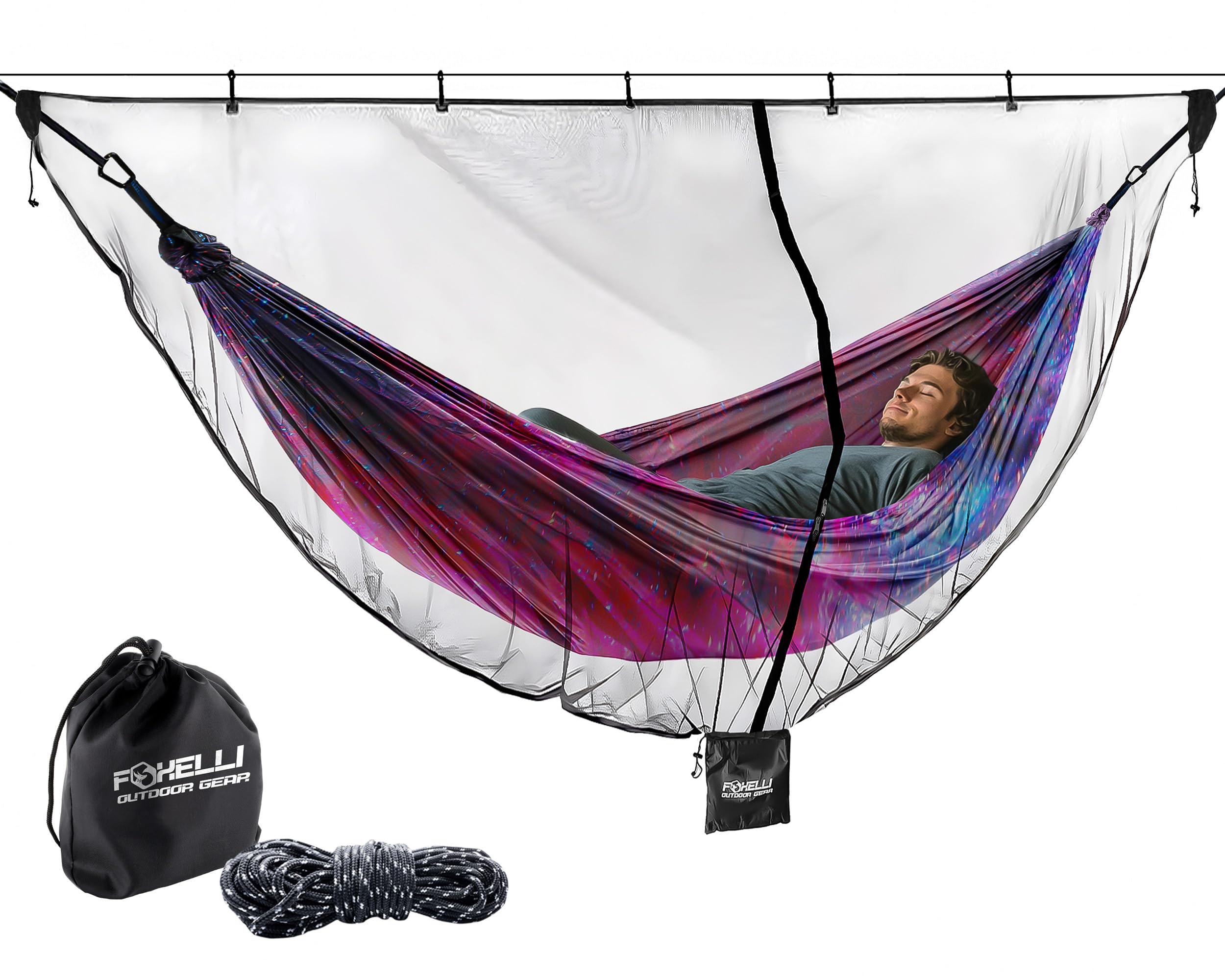
Foxelli Hammock Net
The Foxelli XL Hammock Net stands apart with its robust zippers and precise stitching, built to handle frequent trips and repeated setup. While lighter nets prioritize weight savings, this 12-foot model offers a full-coverage bug barrier that stays sealed after multiple outings.
This net suits hammock campers who value durability over pack weight. The larger packed size means it’s better for car camping or basecamp use rather than ultralight backpacking.
Pros
- Robust stitching and zippers hold up to repeated setup and weather exposure.
- Easy, fast setup with included ridgeline and clips.
- Keeps all insects out for undisturbed sleep.
Cons
- Packed size is bulkier; not ideal for lightweight backpacking trips.
Strong build quality at a reasonable price — ideal for hammock campers who want long-term durability without ultralight demands.
Best for Families
Alvantor Screen House
With a 10×10 ft interior that easily fits a picnic table, the Alvantor Screen House pops up in seconds for group bug protection. The mesh walls keep mosquitoes out while UPF 50+ fabric provides shade. However, the roof is not waterproof — rainwater pools on top and can cause sagging — and the structure is best used in calm conditions, as high winds may collapse it.
This is a practical choice for families car-camping, backyard parties, or tailgating where quick setup and communal space matter more than weather sealing. If rain is likely, budget for a rain fly.
Pros
- Pops up in seconds with no assembly required
- Effectively keeps mosquitoes, flies, and bees out of a large communal area
- Works well for camping, picnics, and backyard events
Cons
- Advertised as 10×10 ft but usable floor space may be closer to 9×9 ft
Families who car-camp and need a spacious bug-free zone will appreciate the instant setup. Just plan for dry weather or bring a rain fly.
Best for Couples
Coghlan’s Double Net
With 240-hole mesh and dimensions large enough to cover two cots or a queen bed, the Coghlan’s Hiker’s Double Net provides dependable mosquito protection at a budget price. An included hanging kit with twine and hooks makes setup straightforward in car-camping or scout camp settings. This net is best for couples sleeping on separate cots in sheltered campsites — the mesh can tear if snagged on rough surfaces, and the 240 holes per square inch won’t keep out no-see-ums, so it’s not suited for brushy terrain or tiny biting insects.
Pros
- Covers two people on separate cots or a queen-size mattress.
- Well-stitched mesh that blocks mosquitoes effectively.
Cons
- Mesh can tear if snagged on branches or rough surfaces — best treated gently.
- Slightly tight on a full queen bed; may need careful positioning to hang evenly.
For couples car-camping on separate cots, this is the most cost-effective double net option — treat it gently and avoid snags, and it will provide reliable bug-free sleep.
Best for Solo Campers
SANSBUG Mosquito Tent
The SANSBUG Mosquito Tent uses the same no-see-um mesh as the top pick but replaces the tarp floor with a lighter polyethylene floor, bringing weight down to 2.2 lbs and packing flatter. This makes it a better fit for solo car campers or anyone with limited storage space. The tradeoff is the folding process – the pop-up can be stubborn to collapse to its original size, and forcing the fiberglass poles may cause splintering. If you can work through that learning curve, you get the same effective bug protection at a lower price than the top pick.
Pros
- No-see-um mesh keeps out even tiny biting insects.
- Weighs 2.2 lbs and packs flatter than the tarp-floor version.
Cons
Solo car campers who want the top pick’s protection in a lighter, more packable package will find this a cost-effective alternative.
Best for Hikers
South to East Head Net 2-Pack

This two-pack offers exceptionally fine mesh that blocks tiny biting flies, and the generous size fits over a wide sun hat without feeling tight. The nets pack into small storage sacks for easy carry. The same dark mesh that makes it effective also creates noticeable glare in bright sunlight, reducing visibility—a tradeoff shared with other black head nets.
Pros
- 620-hole mesh keeps black flies, mosquitoes, and gnats out.
- Large enough to fit over wide-brimmed hats comfortably.
Cons
- Shiny dark mesh creates glare in direct sunlight, lowering visibility.
Best for no-see-um zones and sun-hat wearers who can accept the glare tradeoff.
Best for Scouts
Coghlan’s Rectangular Net

This net blocks standard mosquitoes on a single cot using its 180-hole mesh and included hanging hardware. The same mesh cannot stop no-see-ums, and the thin fabric may tear if snagged. Suitable for casual scout trips where some wear is acceptable.
Pros
- Blocks standard mosquitoes on a single cot effectively.
- Includes twine, hooks, and anchors for simple hanging.
Cons
- Thin mesh may tear if snagged; requires careful handling.
Solo car campers on a tight budget who only face mosquitoes will find this net adequate if they handle it gently and accept the size limitation for single cots.
G Giepht Head Net 2-Pack
G GIEPHT Head Net 2-Pack

This two-pack head net offers effective bug protection for hikers and gardeners, fitting comfortably over wide brim hats and packing into its own pouch for portability. However, the mesh can blow around in light wind, and some nets have a slight chemical odor initially — limitations that matter less for short walks or yard work than for extended, breezy hikes.
Pros
- Fits comfortably over wide brim hats without tightness.
- Lightweight and packs into its own storage pouch.
Cons
- In windy conditions, the mesh may blow against the face, and a chemical odor can be present initially.
Best for calm-weather hikes and garden work where occasional odor and wind movement don’t overshadow its low-cost bug protection.
Best for Budget Hammock
Wecamture Hammock Net

This net delivers genuine mosquito protection at a weight that ultralight backpackers will appreciate. The price is equally hard to beat. However, the mesh and strap construction can show wear after repeated trips, making it best reserved for occasional or carefully handled outings.
Pros
- Weighs only 8.8 oz, ideal for minimalist packs.
- Fine no-see-um mesh keeps mosquitoes out effectively.
Cons
- Mesh and straps may tear under heavy or frequent use, best for occasional camping.
Perfect for the weekend backpacker who watches pack weight and does not treat gear roughly; not the pick for season-long hammock use.
Best for Diy Screens
Stansport Netting Sheet

This polyester sheet weighs next to nothing at 0.2 lbs, making it easy to stash as a DIY vent screen or quick mosquito drape. The ultra-fine mesh stops flies and mosquitoes effectively. However, at 48×72 inches, it’s too small to cover a cot or serve as a primary sleeping net — better suited for custom window inserts or patching shelters.
Pros
- Weighs only 0.2 lbs yet holds up well for its size.
- Ultra-fine mesh blocks flies and mosquitoes, useful as a door screen or cover.
Cons
- At 48×72 inches, too small for cot coverage or full camping net.
Ideal for DIY car window screens or as a lightweight emergency cover, but campers needing a full sleeping net should look at larger rectangular options.
Best for Diy Repairs
Coghlan’s Netting Sheet

The 180-hole mesh blocks mosquitoes well for window screens or stroller covers. At 4×6 ft, it’s too small for a cot or sleeping bag, and the material is thin enough to tear if snagged. A practical fix for screens, not a camping shelter.
Pros
- Effective mosquito barrier for small areas
- Good quality mesh fine enough for mosquitoes
Cons
- Too small for covering a cot or sleeping bag
A budget-friendly fix for repairing window screens or covering a pet carrier; not meant for overhead camping protection.
Mekkapro King Net
MEKKAPRO King Net

This ultra-large net fits queen/king canopy beds with its included hooks, screws, and carry pouch. The fine hexagonal mesh works well for indoor insect protection. However, lack of customer feedback leaves outdoor performance unconfirmed, and the design suits static bed setups rather than camping conditions.
Pros
- Includes seven hooks, screws, string, and carry pouch for simple installation on canopy beds.
- Fine hexagonal mesh provides effective indoor insect barrier.
Cons
- Intended for indoor canopy beds — no outdoor performance data available.
A practical option for protecting your bed indoors, but choose a dedicated camping net if outdoor bug protection is the goal.
Best for —
HESTYA 4-Pack Head Nets

This four-pack of black nylon head nets offers the lowest cost per net for campers on a tight budget. However, without verified feedback, mesh density and fit for various hat sizes are unknown. The black mesh can create glare in bright sunlight, similar to other dark head nets. Best suited as a spare or for low-risk situations where bug exposure is minimal.
Pros
- Four nets at a budget-friendly price
- Lightweight nylon material
Cons
- Mesh density and fit are unverified, making effective bug protection uncertain
A cheap option for campers who want spare head nets and are willing to accept unknown protection levels.
How to Choose
The one spec that makes or breaks a bug net is mesh density—it determines whether you stay safe from no-see-ums or wake up covered in bites.
Mesh Density and Bug Protection
Mesh density is measured in holes per square inch. Standard mosquito nets use around 180 holes, which stops mosquitoes and flies but allows no-see-ums and black flies to sneak through.
For full protection against tiny biting insects, look for at least 522 holes per square inch. The trade-off: finer mesh reduces airflow slightly and can create more glare in direct sunlight.
Size and Coverage Area
Measure your sleep surface before buying. A rectangular net for a single cot needs at least 78 inches long and 32 inches wide; a double cot requires 63 inches wide. Hammock nets must match the hammock’s length—11 to 12 feet is standard.
Oversized nets drape loosely and risk pressing against your skin, allowing mosquitoes to bite through the mesh. Too small, and you leave gaps at the corners.
Weight and Packed Size
Backpackers need nets under 10 ounces that pack into a fist-sized pouch. Head nets and ultralight hammock nets (like the Wecamture at 8.8 oz) fit this category. Car campers can tolerate heavier pop-ups weighing 2–3 pounds.
Pop-up shelters often pack into a disc that is too large for a backpack or airline carry-on. If you hike to your campsite, a head net or woven rectangular net is more practical.
Ease of Setup and Takedown
Head nets slip over a hat in seconds. Hammock nets with ridgelines and clips attach to the suspension line quickly. Pop-up tents deploy instantly but require a specific folding technique to return to their storage disc.
The folding difficulty is the most common complaint across pop-up designs. Practice at home before your trip—forcing the poles can splinter fiberglass frames.
Durability of Materials
Mesh tears when snagged on branches or zipped against a rough frame. Nylon and polyester nets resist abrasion better than polyethylene. Zippers and stitching fail faster on budget hammock nets; reinforced seams and metal zippers add weight but last longer.
If you plan to use the net frequently or in brushy conditions, invest in a model with positive durability reviews—cheaper nets often rip after a few weekends.
FAQ
Why is it hard to see through my mosquito head net in direct sunlight?
Dark nylon mesh creates a glare when light hits the fibers at certain angles. Black nets are the worst offenders; white or tan nets reduce this effect significantly. If you need clear vision for hiking or fishing, choose a lighter-colored net.
How do you fold a pop-up bug tent back into its storage bag?
Most pop-ups use a twist-and-fold method: collapse the poles in thirds, then twist into a figure-eight shape before folding in half. Watch the manufacturer’s video before your trip—forcing it the wrong way can splinter the fiberglass rods.
Can mosquitoes bite through a hammock bug net if you’re pressed against it?
Yes. If the mesh is pressed tightly against your skin, mosquitoes can still reach you through the fabric. To prevent this, use a hammock net with a ridgeline that holds the net away from your body, and add a pad or underquilt that keeps tension on the sides.
What size mosquito net do I need for a standard camping cot?
A standard cot measures about 78 inches long and 30 inches wide. A rectangular net that is at least 78×32 inches will cover it completely. For double cots, look for 78×63 inches; for hammocks, a net 11+ feet long and 4+ feet wide fits most models.