This post contains affiliate links. We may earn a small commission when you buy through our links — at no extra cost to you.
Budget full-suspension bikes promise trail-ready performance at a fraction of the cost, but many arrive with backward forks, loose bolts, and wheels that need truing before the first ride. That initial effort can turn a fun purchase into a weekend project.
The key difference between a frustrating box of parts and a ride-ready bike lies in the frame material and brake type. Aluminum frames with mechanical disc brakes typically need only a quick adjustment and bolt check. Steel frames with linear pull brakes often demand truing, cable swaps, and more. That gap explains why a $450 bike can be ready in an hour while a $200 one takes all afternoon.
This guide focuses on models that balance price with predictable assembly and reliable components. The picks are bikes that get you on the trail faster — not deeper into your toolbox.


Best for Tall Riders 29Er
Schwinn Traxion 29"
Key Features
- Suspension: Dual
- Frame Material: Aluminum
- Brake Type: Mechanical Disc
- Speeds: 24
- Wheel Size: 29 in
- Price: $$$
The Schwinn Traxion stands out in the budget full-suspension category as the only model offering 29-inch wheels – a meaningful advantage for taller riders who benefit from better rollover over roots and rocks. Some units arrive with the front fork installed backwards, a quick fix that requires basic mechanical comfort.
This bike fits beginner to casual trail riders at least 5’7" tall who want 29er performance at a budget price. It is not for very short riders, and those expecting long-term durability without part replacements should consider other options. The drivetrain and axle can experience early wear in some cases, so basic tuning skills and a flexible return window are smart precautions.
Assembly is straightforward for those familiar with bike setup, and the 24-speed Shimano drivetrain provides a wide gear range for varied terrain. The mechanical disc brakes deliver adequate stopping power for light trails, though the bike’s 49-pound weight is noticeable on climbs.
Pros
- Good value for the price
- Quality suitable for entry-level riding
- Easy final assembly
Cons
- Front fork may arrive with the handlebar stem reversed, requiring a correction before the first ride
- Drive chain and cassette wear can occur earlier than expected under moderate use
For taller riders seeking a 29er without the premium price, the Traxion delivers the wheel size advantage with the understanding that a short tuning session and awareness of early wear possibilities are part of the experience.
Best for Ultra-Budget Riders
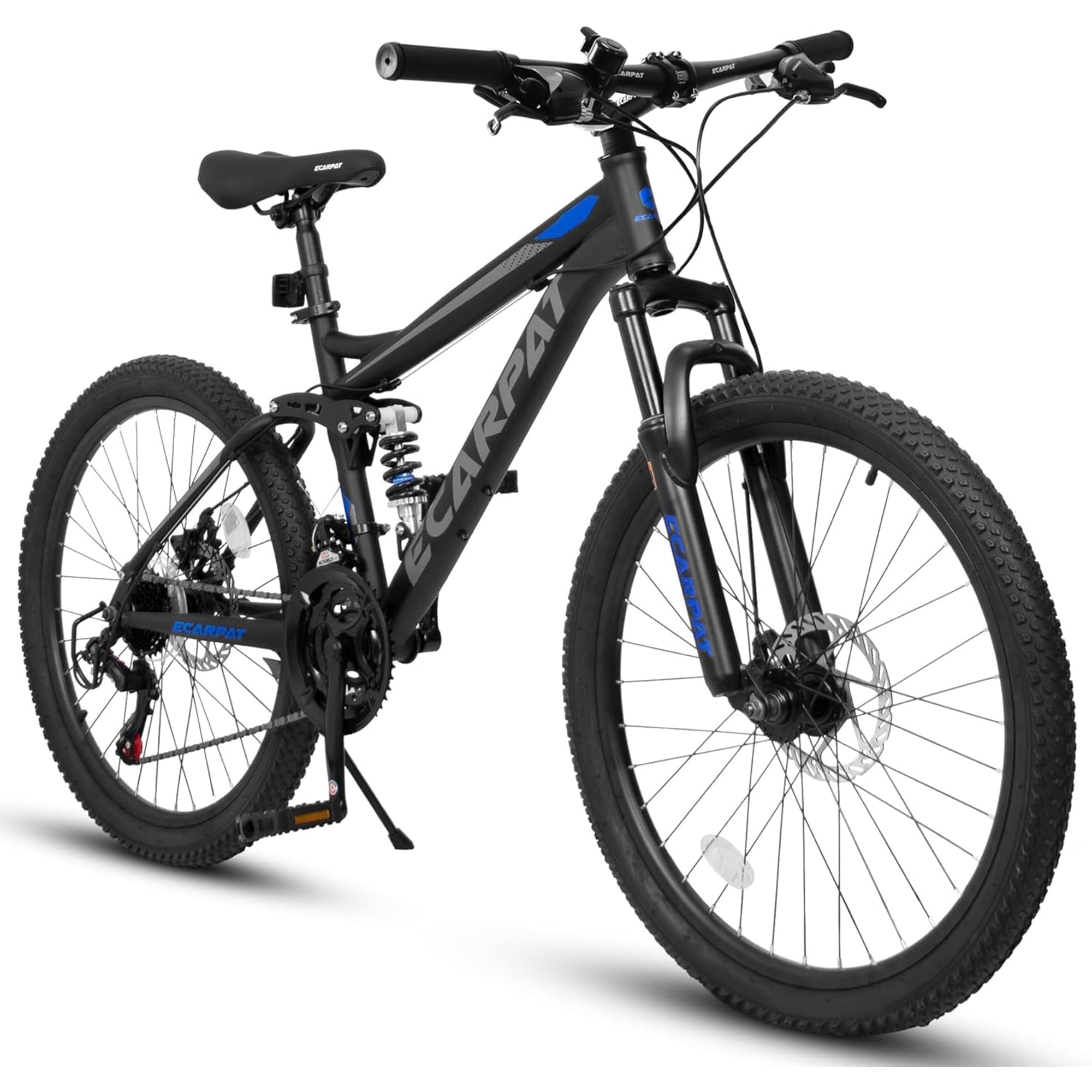
Ecarpat 27.5" Dual
Key Features
- Suspension: Dual
- Frame Material: Carbon Steel
- Brake Type: Mechanical Disc
- Speeds: 21
- Wheel Size: 27.5 in
- Price: $$
The Ecarpat Mountain Bike delivers mechanical disc brakes and a 27.5-inch wheel size at an entry-level price point, making it accessible for budget-conscious riders. However, the brakes may require adjustment after assembly, and the bike is best suited for light pavement riding rather than off-road trail use. For heavier off-road demands, the top picks offer more established track records.
Pros
- Good build quality for the price point.
- Mechanical disc brakes provide consistent stopping power on pavement.
Cons
- Brakes may require adjustment after assembly to function properly.
- Not suitable for off-road trail riding – best limited to casual pavement use.
A viable option for flat-pavement riders on a tight budget, provided you are comfortable with brake adjustment out of the box.
Best for Entry-Level Trail
Gravity FSX 1.0
Key Features
- Suspension: Dual
- Frame Material: Aluminum
- Brake Type: Mechanical Disc
- Speeds: 24
- Wheel Size: 26 in
- Price: $$$
The Gravity FSX 1.0 combines an aluminum frame with mechanical disc brakes and a 24-speed drivetrain – a spec combination that usually starts higher up the price ladder. For entry-level riders, this means a dual-suspension platform that feels substantial on the trail without the budget shortcuts seen in cheaper bikes.
Out of the box, the brakes and suspension typically need adjustment to work properly. After a basic tune-up with common tools, the bike handles moderate singletrack well – the suspension absorbs bumps within its travel, and the drivetrain shifts consistently across the gear range. Most buyers find the ride quality far better than what the price suggests.
This bike is for the budget-conscious rider who wants a genuine off-road experience, not a pavement cruiser. The 26-inch wheels limit rollover on larger obstacles, so taller riders or those tackling aggressive terrain should consider 29-inch alternatives. Initial setup is required, and while component quality is generally solid, a small number of units have experienced early part issues – buying from a retailer with a flexible return policy adds peace of mind.
Pros
- Aluminum frame with disc brakes – a spec combination that usually costs more.
- Dual suspension that works well on moderate trails after proper setup.
- 24-speed drivetrain provides a wide gear range for climbing and speed.
- Build quality feels more substantial than comparable budget full-suspension bikes.
Cons
- Brakes and suspension may need adjustment before achieving optimal performance.
- Some units have had component issues (e.g., handlebars, frame parts) after initial use – worth checking with the seller’s return policy.
For entry-level mountain bikers willing to spend an hour tuning, this is the most capable budget full-suspension bike available – no other model at this price delivers this spec quality.
Best for Casual Paved Paths
WEIZE 26" Full Susp.
Key Features
- Suspension: Dual
- Frame Material: High Carbon Steel
- Brake Type: Linear Pull
- Speeds: 18
- Wheel Size: 26 in
- Price: $
The WEIZE is the most affordable full-suspension option in this comparison, designed for neighborhood streets and paved paths rather than trail riding. Unlike the top pick’s aluminum frame and disc brakes, this model uses high-carbon steel and linear pull brakes—a trade-off that keeps the price down but limits stopping power on loose surfaces. Wheels may arrive needing truing, and brake tension typically requires adjustment before the first ride.
This bike suits a specific buyer: someone on a very tight budget who is comfortable with basic bike tuning. It’s a practical first bike for a teenager (up to 275 lbs) or for adults who stick to flat, paved routes. Expect to spend some time on the included tools—spoke wrench and hex keys—to get the wheels running true and brakes biting evenly. For riders who want a ride-ready bike straight out of the box, the additional setup may be a deterrent.
Assembly is genuinely straightforward, even for beginners, and the overall build quality at this price point is a pleasant surprise for many. The dual suspension soaks up small bumps on asphalt and light gravel, though it’s too soft for serious off-road use. Given the low entry cost, the bike delivers acceptable performance for casual cruising and short commutes.
Pros
- Very low entry price for a full-suspension bike
- Easy to assemble, even for first-time builders
- Surprisingly solid build quality for the cost
- Attractive appearance for a budget model
Cons
- Wheels may need truing before the first ride—plan to adjust spokes
- Linear pull brakes can feel weak until properly adjusted; best for pavement
- Some units experience early part defects such as flat tires or derailleur issues
If your budget is very tight and your riding stays on pavement, the WEIZE delivers full suspension at a price that’s hard to beat—just expect to spend time on initial adjustments.
How to Choose
Expect to spend an hour tuning brakes and gears on any budget full-suspension bike, regardless of the price tag.
Suspension Type
All bikes here have dual suspension, but budget systems use coil springs without rebound adjustment. That means they bob when you pedal hard uphill, sapping energy. For casual trail riding with slow climbing, the comfort outweighs the loss. For aggressive climbs, a hardtail is more efficient at the same price.
Frame Material
Aluminum frames are lighter, rust-resistant, and easier to repair than steel. Steel frames add weight and can corrode if the paint chips. Under $500, aluminum frames often use basic butted tubes that save weight without sacrificing durability. Choose aluminum if you plan to ride in wet conditions or store the bike outdoors.
Brake Type
Mechanical disc brakes provide consistent stopping power on wet trails and require only cable adjustment. Linear pull brakes are weaker and lose effectiveness when rims are wet. If you ride off-road, disc brakes are a must. On pavement, linear pull brakes are adequate with proper pad tension.
Speeds (Gears)
A wider gear range (21–24 speeds) lets you climb steep hills without spinning out on descents. 18-speed setups have larger gaps between gears, making it harder to find a comfortable cadence on rolling terrain. For hilly trails, aim for at least 21 speeds with a cassette that includes a low granny gear.
Wheel Size
29-inch wheels roll over roots and rocks more smoothly but add weight and slow acceleration. 26-inch wheels are lighter and more agile but require more pedaling to maintain speed over rough terrain. 27.5 inches split the difference. Taller riders (over 5’9") benefit from 29ers for stability; shorter riders should stick with 26 or 27.5 for standover clearance.
FAQ
Why does my brand new budget mountain bike have a wobbly front wheel?
The wheels on budget bikes often have uneven spoke tension, causing wobble even before riding. Tighten the spoke on the opposite side of the wobble a half-turn at a time until the rim runs straight. If the wobble persists, the rim may be dented and require replacement.
How much assembly does a full suspension mountain bike under $500 really need?
Even ‘85% assembled’ bikes require tightening the stem, handlebars, brakes, and gears. Expect 60–90 minutes of work with basic tools. Many bikes also need a derailleur adjustment and brake cable tune. If you’re not comfortable with bike maintenance, budget an extra $40 for a shop tune-up.
Is a $200 full suspension mountain bike safe for trails?
At this price, frame failures and brake issues are common. Stick to paved paths and flat gravel. For any trail with roots or rocks, a $200 bike lacks the frame strength and reliable stopping power needed for safe descending. A used hardtail from a known brand is a better choice.
Can I replace the linear pull brakes on a cheap mountain bike with disc brakes?
Most budget frames lack disc brake mounts, making a swap expensive or impossible. If your bike has frame tabs for disc calipers, you can upgrade to mechanical disc brakes for about $60 in parts. Otherwise, you’re stuck with V-brakes – upgrade pads to improve grip.