This post contains affiliate links. We may earn a small commission when you buy through our links — at no extra cost to you.
A bike repair stand that wobbles or lets the bike rotate is more frustrating than working on the ground. Many budget models look the part but their plastic clamps and narrow bases fail under real use.
The difference comes down to clamp material and base design. A stand that works for a lightweight road bike may struggle with a mountain bike or e-bike. This guide focuses on models that prioritize clamp grip and stability across a range of bike weights.
Whether you need a portable stand for trailside repairs or a heavy-duty floor stand for a home shop, the right choice depends on matching the stand’s capacity to your heaviest bike.
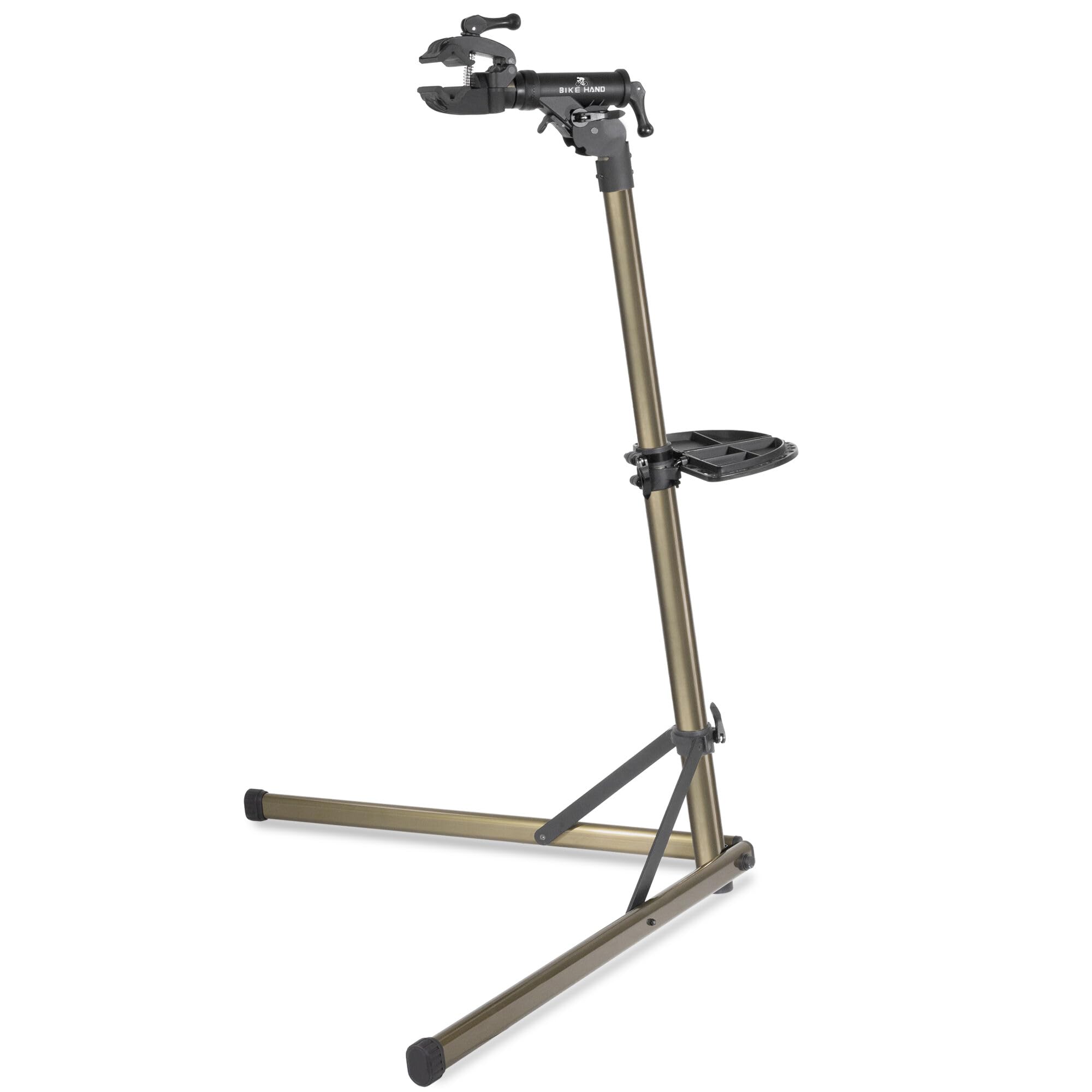


Best for Home Mechanics
BikeHand YC-100BH
Key Features
- Load Capacity: 55 lbs
- Clamp Design: Rubber/plastic jaws
- Base Stability: Tripod
- Height Range: 39-59 in
- Portability: Folds compact
- Price: $$
The BikeHand YC-100BH clamps frames securely with its 360-degree rotating head and adjustable height range from 39 to 59 inches. The aluminum build and magnetic tool tray add convenience, while the folding design reduces storage footprint. On heavier mountain bikes approaching 50 lbs, the stand can wobble when you apply force — a foot on the base steadies it.
This stand suits home mechanics who service road bikes and lighter mountain bikes under 50 lbs. The plastic clamp components have occasional reports of cracking after extended use, but for typical weekend maintenance it holds up well. If you frequently work on heavy e-bikes or professional-shop volume, sturdier options exist.
Pros
- Solid build quality holds up to regular use without loosening.
- Quick to assemble and adjust with minimal fuss.
- Folds into a compact shape for storing in a closet or car trunk.
Cons
- Plastic clamp may develop cracks over extended use.
- Stability can be insufficient with heavier bikes over 40 lbs when applying torque; may need foot on base.
For home mechanics who work on road and mountain bikes under 50 lbs, this stand offers a well-rounded experience that avoids the pitfalls of budget models without overspending.
Best for Heavy E-Bikes
Park Tool PCS-10.3
Key Features
- Load Capacity: 80 lbs
- Clamp Design: Steel yoke
- Base Stability: Tripod
- Height Range: ~57 in
- Portability: Folds
- Price: $$$
With an 80-pound load capacity and all-steel construction, the PCS-10.3 is built for the heaviest bikes a home mechanic might own. The tradeoff for this capacity is a clamp mechanism that requires some practice to operate smoothly, and assembly instructions that occasionally contain misprints or missing hardware. This stand suits owners of heavy e-bikes or fat bikes who need a stable, long-term platform and can accept the learning curve on the clamp.
Pros
- Steel frame supports heavy e-bikes and fat bikes up to 80 lbs without wobble.
- Build quality and materials match professional shop standards.
- Folds for storage while retaining rigidity during repairs.
Cons
- Clamp operation can be stiff and may stick until the user gets used to the mechanism.
- Assembly instructions have occasional misprints and some units arrive missing hardware.
For anyone who routinely works on heavy e-bikes or fat bikes, the PCS-10.3 delivers stability that cheaper stands can’t match — just plan for a short familiarization period with the clamp.
Best for Home Mechanics
Sportneer Y23-87000-01
Key Features
- Load Capacity: 60 lbs
- Clamp Design: Rubber jaws
- Base Stability: Triangular base
- Height Range: Up to 5.3 ft
- Portability: Folds
- Price: $$
The Sportneer stand’s aluminum frame and triangular rubber-footed base provide a stable platform for most repairs, while the magnetic tool tray keeps wrenches handy. Bikes over 50 lbs can introduce a wobble unless weight is centered carefully, making this stand best suited for road and mountain bikes under that weight. Home mechanics who value portability and a foldable design will appreciate the easy setup, though the top pick in this class offers slightly better balance with heavier bikes.
Pros
- Build quality feels solid and durable during repeated use.
- Delivers a strong mix of features and stability at a mid-range price.
- Assembles quickly and folds down for compact storage.
Cons
- Bikes near 50 lbs may produce a slight wobble unless the stand’s base is carefully positioned.
This stand earns its place as a runner-up by offering near-premium features at a mid-range price, as long as your bike stays under 55 lbs.
Best for Portable Use
CXWXC RS-100
Key Features
- Load Capacity: 60 lbs
- Clamp Design: Rubber jaws
- Base Stability: Triangle with stabilizer
- Portability: Folds lightweight
- Price: $$
The CXWXC RS-100 folds to under 13 lbs and holds bikes up to 60 lbs on a triangular base with a front wheel stabilizer. It’s more portable than heavier floor stands, making it a good match for home mechanics who need to store their repair stand between sessions.
This stand suits standard road and mountain bikes where stability matters more than frequent angle changes. The adjustment knobs can be finicky – the bike may rotate if not perfectly balanced – so it favors users who set the position once and leave it.
Pros
- Sturdy construction holds heavier bikes securely
- Good value for money at a mid-range price
- Folds compactly for convenient storage and transport
Cons
- Clamp and adjustment knobs can be finicky – the bike may rotate if not perfectly balanced
A solid, well-priced portable stand that delivers on stability and storage convenience – ideal for standard bikes when precise angle adjustments aren’t a priority.
Best for Budget Light Bikes
COTOUXKER HL326
Key Features
- Load Capacity: 44 lbs
- Clamp Design: Iron bench clamp
- Base Stability: Bench mount
- Price: $
At under $25, the COTOUXKER HL326 is a budget bench mount that securely clamps lightweight bikes up to 44 lbs for chain cleaning and minor adjustments. Unlike floor stands, it mounts onto a workbench to save space, making it a good fit for small garages or apartments. The spring mechanism feels basic, so this is best for occasional use rather than frequent heavy mechanical work.
Pros
- Affordable price for a functional bench mount
- Works well for lightweight bikes and can double as a clamp for other tasks
- Adjustable clamp with 360° rotation and solid build for the price
Cons
- Spring mechanism can feel flimsy, which may affect long-term durability under regular use
This bench mount suits casual bike owners with lightweight road or hybrid bikes who want an affordable space-saving option for basic upkeep; frequent mechanics should invest in a sturdier stand.
Best for Frequent Use
Feedback Sports Sport-Mechanic
Key Features
- Load Capacity: 65 lbs
- Clamp Design: Steel clamp
- Base Stability: Tripod
- Height Range: 42-65 in
- Portability: Portable
- Price: $$$
Anodized aluminum and steel tripod delivers a wobble-free platform for bikes up to 65 lbs, setting this stand apart from lighter budget options. Serious home mechanics will appreciate the portability and stability, though it lacks a built-in tool tray (a tradeoff for compact folding). The leg and rotation locks can feel stiff initially, but the overall construction justifies the premium price for those who prioritize long-term durability.
Pros
- Sturdy tripod platform holds bikes securely without wobble during repairs.
- Premium 6061 T6 aluminum and steel construction that withstands regular use.
Cons
- Leg extension and rotation locks can be stiff to operate, especially when new.
For those who prioritize rock-solid stability and portability over accessories, this stand delivers lasting performance.
Best for Light Road Bikes
Yaheetech YT-424

Key Features
- Load Capacity: 66 lbs
- Clamp Design: Plastic clamp
- Base Stability: 4 legs
- Height Range: 42.5-74.8 in
- Price: $
The Yaheetech YT-424 offers a sturdy steel build and easy assembly for under sixty dollars — impressive for the price. However, the plastic clamp can slip under load, and the four-leg base may tip if the bike isn’t perfectly balanced. This makes it a reasonable choice for light occasional maintenance on lightweight road bikes, but not for heavier builds or frequent repairs.
Pros
- Solid steel construction feels robust for the price point.
- Simple assembly gets you working quickly.
Cons
- Plastic clamp can lose grip on heavier frames, causing the bike to rotate.
A functional budget stand for very light, occasional work on sub-45-pound road bikes where a few compromises are acceptable.
Best for Light Road Bikes
RAD Cycle Pro Stand Plus

Key Features
- Load Capacity: 66 lbs
- Clamp Design: Plastic clamp
- Height Range: 41-75 in
- Price: $
At a budget-friendly price, this steel stand offers a 66 lb load capacity and a wide height range for basic tuning on road bikes. The plastic clamp may not hold securely under heavier frames, making it best suited for occasional maintenance on lightweight road bikes rather than mountain or heavy frames.
Pros
- Cost-effective steel stand with a 66 lb load capacity.
- Quick assembly with clear instructions.
Cons
- Base can wobble if the bike’s weight is unbalanced.
This stand fits the bill for occasional tune-ups on a light road bike where budget is the top priority.
Best for Light Bikes Only
ROCKBROS Bench Mount

Key Features
- Load Capacity: 44 lbs
- Clamp Design: Iron clamp
- Base Stability: Bench mount
- Height Range: 15-22 in
- Price: $
This clamp mounts to a bench or wall and handles light road bikes under 30 lbs for basic maintenance. Its 360° rotation and easy adjustment suit chain cleaning or gear swaps. However, the joint can rotate under uneven weight, making it less stable than a dedicated stand. For heavier bikes or frequent repairs, a floor stand would be more reliable.
Pros
- Affordable multi-purpose clamp works for bikes, bow vice, or livescope mounts.
- Easy to adjust and mount on bench or wall.
Cons
- Stability limited; the clamp joint can rotate under load if the bike is not perfectly balanced.
Ideal for occasional maintenance on lightweight road bikes or as a shop clamp for non-bike projects.
Handlebar Jack V3
Handlebar Jack V3

The Handlebar Jack V3 is a pair of jacks that attach to handlebars to lift the front end by 3.7 inches, giving you access to the wheel and fork without laying the bike down. It’s a clever way to protect expensive e-bike displays from scratches during trailside flats. However, it only works with handlebar mounting and offers limited stability—it’s not a substitute for a traditional repair stand or suitable for shop use.
Pros
- Compact design stows easily in a pack for trailside use.
- Prevents damage to e-bike displays and controls during roadside repairs.
Cons
- Stability is limited—can tip over on uneven ground or if bumped.
Best for e-bike owners who need a portable, display-saving solution for emergency trailside fixes—not for shop or heavy maintenance tasks.
How to Choose
The most critical factor in a bike repair stand is the clamp’s ability to hold your bike securely without slipping or damaging the frame.
Load Capacity
Advertised load capacity is often an optimistic number. A stand rated for 60 lbs may struggle with a 50-lb mountain bike because weight distribution and leverage create wobble. Look for a stand with at least 20% headroom above your bike’s weight.
Clamp Design
Clamp material determines grip and frame safety. Rubber or silicone jaws grip well and won’t scratch paint, while hard plastic can slip and cause damage. Metal-jaw clamps (like Park Tool’s steel yoke) offer durability but require careful use on thin tubes.
For carbon frames, a clamp with a soft rubber insert is essential to avoid stress fractures.
Base Stability
A wide tripod base provides better stability than a narrow four-leg design, especially when applying torque to a crank arm. The larger the footprint, the less likely the stand will tip. Some budget stands have legs that spread too narrow and require placing a foot on the base.
Height Adjustability
A stand that adjusts from about 40 inches to 60+ inches allows you to work comfortably on different bike sizes and avoid back strain. Telescoping tubes are more convenient than segmented poles, but check that the locking mechanism is positive and won’t slip under load.
Portability
If you plan to take the stand to group rides or races, weight and folded size matter. Models under 15 lbs with a carry bag are easiest to transport. However, lighter stands often trade stability for portability, so balance your needs.
FAQ
Why does my bike repair stand wobble when I work on a mountain bike?
Mountain bikes are heavier and have a different center of gravity than road bikes. The stand’s base may be too narrow or the clamp may not grip firmly enough. Look for a stand with a wide tripod base and a rubber jaw clamp that can handle the extra weight without slipping.
Can a bike repair stand hold a 60 lb e-bike safely?
Many stands rated for 60 lbs struggle in practice because e-bikes have uneven weight distribution. Choose a stand with a proven capacity of at least 80 lbs, like the Park Tool PCS-10.3, to ensure stability. Also verify that the clamp can open wide enough for thick e-bike frame tubes.
Is a bench mount bike stand better than a floor stand for a small garage?
Bench mounts save floor space but limit bike positioning, making drivetrain and wheel work more awkward. Floor stands give you full access and adjustability, so if you have room for a 2×2 foot footprint, a floor stand is more versatile for serious repairs.
How do I stop my bike from rotating on the repair stand?
Rotation usually happens because the clamp isn’t tight enough or the bike’s balance point is off. Make sure the clamp jaws grip the seatpost or frame tube firmly and that the bike is centered. Some stands have a locking rotation knob that can be tightened further. If the stand lacks a secure lock, consider upgrading to one with a friction-based rotation stop.