This post contains affiliate links. We may earn a small commission when you buy through our links — at no extra cost to you.
Dig through enough camping backpack listings and you will notice a pattern: tactical-style packs dominate the under-$40 range with flashy ratings, yet many owners report broken zippers and loose straps within months. The promise of a 40-liter pack for the price of a lunch is tempting, but the cost shows up on the trail when the load is heavy and the hike is long.
A different breed of pack exists just a step higher in price: internal frame packs with a proper hip belt and adjustable torso. They weigh more and cost two to three times as much, but they transfer weight to your hips, keep the load stable, and survive years of weekend trips. The question is whether that extra investment is worth it for your kind of camping.
The answer depends on how far you walk and how much you carry. For short car camping or light day hikes, a budget tactical pack works fine. For anything beyond a couple of miles with a full load, an internal frame pack stops being a luxury and becomes the tool that actually gets the gear there without grinding your shoulders.
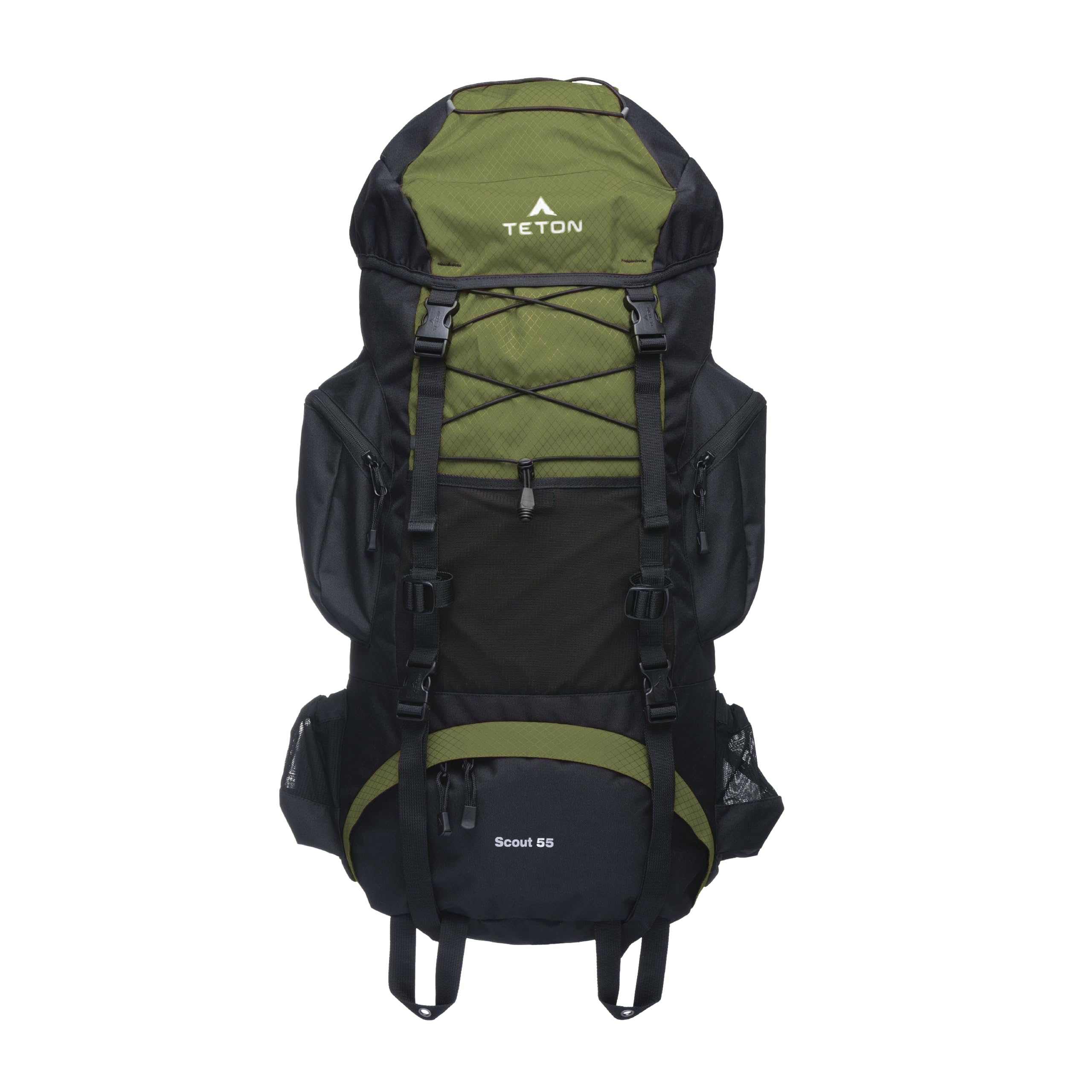


Best for Weekend Backpackers
TETON 55L Scout
Key Features
- Capacity: 55L
- Weight: 4.1 lbs
- Frame: Internal Frame
- Price: Mid-Range
The Scout’s internal frame and hip belt transfer load effectively, supporting up to 30-40 lbs on 2-4 day trips. The adjustable torso accommodates a range of body sizes, and the 55L capacity hits the sweet spot for weekend backpacking without the bulk of larger packs.
This pack is best suited for petite to medium-framed women and weekend backpackers who want a supportive pack without premium pricing. The sleeping bag compartment is compact: standard mummy bags may not fit without some adjustment, so check your gear dimensions before committing.
Pros
- Durable internal frame with solid value for multi-day trips
- Comfortable hip belt and adjustable torso for varied body types
- Well-organized pockets and compartments for gear access
Cons
- Sleeping bag compartment may be too small for standard mummy bags
- Frame can produce a squeaking noise during movement
This is the pack for weekenders who want a supportive frame without the weight or cost of premium models – just check your sleeping bag size first.
Best for Extended Trips
TETON 75L Explorer
Key Features
- Capacity: 75L
- Weight: 5.6 lbs
- Frame: Internal Frame
- Price: Mid-Range
With 75 liters of capacity, load lifters, and a sleeping bag compartment that fits standard mummy bags, the Explorer provides the room and support for trips that stretch beyond a week – a step up from the lighter 55L Scout and a cost-effective alternative to premium packs. An included rain cover adds weather protection.
This pack suits tall or large-framed hikers who need the extra volume and don’t mind the 5.6-pound weight. The adjustable torso and padded hip belt help distribute heavy loads effectively, but ultralight enthusiasts and those packing oversized sleeping bags should consider the Scout or a lighter option.
Pros
- Costs significantly less than comparable premium packs while offering similar features.
- Adjustable torso and padded hip belt allow a custom fit for tall frames.
- Multiple pockets and compression straps improve organization and load management.
Cons
- Sleeping bag compartment may be snug for oversized bags – stick to standard mummy bags.
- Shoulder straps may loosen under heavy loads, requiring periodic readjustment.
A heavy but well-supported pack for tall hikers on multi-week trips – the 75L Explorer earns its place as the volume-focused alternative to the lighter Scout.
Best for Budget Campers
REEBOW GEAR Tactical 40L
The REEBOW GEAR Tactical 40L packs a massive 40-liter capacity with Molle webbing for a budget price that few competitors match. Zippers and strap stitching can wear down under sustained heavy loads, so this pack is best suited for range days, bug-out bags, or weekend camps rather than multi-day backpacking where hardware longevity matters most.
Pros
- Massive 40-liter capacity with Molle organization at a low price
- Spacious interior with multiple compartments for gear sorting
- Sturdy enough for daily carry and light outdoor use
Cons
- Zipper teeth may separate after a few months of regular use
- Strap stitching can loosen under heavy loads, reducing long-term durability
A capable budget pack for tactical enthusiasts and occasional campers who accept that zipper and strap longevity are thinner than premium options.
Best for Ultralight Day Hikes
ZOMAKE 20L Ultralight
Weighing just 220g and folding into a fist-sized pouch, the ZOMAKE 20L is the lightest way to carry a spare for summit pushes or travel days. Its nylon fabric resists light rain, and the reflective strip adds visibility on trails. The tradeoff comes under load: the thin material and zipper hardware are not built for more than 10 pounds or rough handling. This suits day hikers who want an ultralight backup or a minimal pack for short, light carries — not for camping gear or multi-day trips.
Pros
- Ultra lightweight and packable; folds to palm size at 220g.
- Good water resistance for light rain and a reflective strip for visibility.
Cons
- Thin nylon can tear or straps may give way under loads exceeding 10 pounds.
- Zipper pull may detach with rough handling — fine for light loads but not rough use.
For ultralight day hikes and emergency backup, this pack delivers on weight and packability — just keep loads under 10 pounds and avoid rough terrain.
Best for Travel Spare
Venture Pal 40L
The Venture Pal 40L packs down to fist size at under a pound, and the integrated wet pocket keeps damp gear separate. This makes it a practical spare for travelers and a capable companion for light day hikes, though its thin nylon and basic zippers limit it to occasional use with moderate loads.
Intended as a backup pack rather than a primary, this bag suits those who need an ultralight option for emergency or short outings. For regular camping with heavy gear, stitching and zippers can fail — it is best kept for loads under 10 pounds.
Pros
- Under a pound with a fist-size pack-down, it disappears into luggage until needed.
- 40L capacity provides room for a day hike load or travel essentials beyond typical packable sizes.
- Integrated wet pocket separates damp items from dry gear — useful after a swim or rain.
Cons
- Thin nylon fabric can tear if overloaded with sharp or heavy items — best kept for soft loads under 10 pounds.
- Zipper may jam or separate after repeated use, especially if packed to capacity.
A practical spare for travelers and day hikers who need an ultralight backup. Not suitable as a primary pack for camping or heavy loads.
Best for Basecamp Use
Amazon Basics 75L
Key Features
- Capacity: 75L
- Weight: 5.1 lbs
- Frame: Internal Frame
- Price: Mid-Range
An internal frame 75L pack with rainfly at under $100, this is the most affordable large-capacity option for basecamp use. Compared to the TETON 75L Explorer, you give up load lifters and a more adjustable torso, but save significantly. It works well for short carries and moving gear from car to campsite. The shoulder straps can loosen under load, requiring re-tightening on longer hikes, and the frame may squeak during movement – neither issue impacts short-haul trips. Spacious with multiple pockets, it offers decent comfort for moderate loads.
Pros
- Great value for a large internal frame pack
- Spacious 75L capacity with many pockets
- Comfortable hip belt for moderate loads
Cons
- Frame may squeak while walking
- Shoulder straps can loosen under load, needing readjustment
Best for basecampers on a strict budget who prioritize capacity over adjustability and don’t mind occasional strap tightening.
Best for Cheap Daypack
LHI 45L Tactical

This 45L pack offers generous storage and multiple pockets for organizing gear. Zipper durability may be spotty across units, and interior pockets can tear under heavier loads – treat it as a budget daypack for light camping trips or daily carry. It lacks a standout advantage over similar-priced competitors like the REEBOW 40L, making it an also-ran in the budget tactical pack space.
Pros
- Spacious 45L capacity with Molle attachment points for external gear.
- Hydration-compatible and includes a padded laptop compartment.
Cons
- Zipper and interior pocket durability varies between units – best for light to moderate use, not heavy camping loads.
Works well as an affordable daypack or work bag for campers who pack light and don’t rely on it for extended trips.
Best for First-Time Tactical
Hannibal 40L Tactical

This 40L tactical pack offers solid initial build quality, plenty of storage pockets, and Molle webbing at a budget price. Zipper stitching can loosen after extended use, so it suits light loads and emergency kits better than frequent heavy hauling. It’s a close alternative to other low-cost tactical packs, though zipper durability is a more noticeable trade-off here.
Pros
- Good build quality and stitching for the price
- Plenty of storage compartments with Molle and hydration pocket
Cons
- Zipper stitching may come loose after a few months of use, best for lighter loads
This pack works for light day hikes and emergency kits on a tight budget, but the zipper durability means it’s not a long-term heavy hauler.
Best for Day Hikes
SKYSPER 20L Daypack

This daypack combines thoughtful design with anti-theft zippers, a whistle, and reflective strips at a budget price. It is lightweight and comfortable for short hikes or city travel, with good pocket organization. However, at 20 liters it is too small to carry camping gear, limiting it to day use or as a travel backup.
Pros
- Very well made with thoughtful design
- Lightweight and comfortable
Cons
- Limited capacity for camping gear
Ideal for day hikes or as a travel backup, but not for camping trips.
Best for Bug-Out Bag
Falko 50L Tactical

The Falko Tactical 50L offers heavier-duty stitching than cheaper tactical packs, with ample Molle webbing and pocket organization for bug-out kits or camp gear. Its material and construction feel robust for the mid-range price. However, the zippers may lose stitching or separate after extended use, making this a better fit for occasional trips or shorter outings rather than frequent heavy-load backpacking.
Pros
- Durable stitching and material for heavy use
- Extensive pockets and Molle attachment points for gear organization
Cons
- Zippers can lose stitching or separate after extended use
A capable mid-range tactical pack for short camping trips or emergency kits, provided you accept the zipper longevity as a tradeoff.
Best for Light Duty
QT&QY 45L Tactical

Strong stitching and thoughtful organization make this 45L pack a capable option for light loads or as a spare go-bag. The Molle system and laptop sleeve add versatility at a low price. However, durability can vary between units – some may experience stitching or zipper issues over time, so it’s best reserved for occasional, low-stress use rather than regular heavy loads.
Pros
- Sturdy build with reinforced stitching at key stress points
- Good value for price with useful storage features
Cons
- Durability can vary; some units may experience stitching or zipper issues over time
Best as a low-cost emergency go-bag or light-duty day pack where load is light and replacement cost is acceptable.
Best for Day Hikes
QT&QY 25L Daypack

The QT&QY 25L packs solid build quality into a small footprint, with a useful bottle holder and MOLLE panel for light organization. Good for day hikes, gym runs, or as a travel backup, but its capacity and hardware limits it to casual use — too small for camping gear, and zippers may wear over time.
Pros
- Solid build quality for a compact daypack.
- Good internal layout with bottle holder and MOLLE for light organization.
Cons
- Zippers may wear with frequent heavy loads.
A fine choice for short daily trips or as a spare pack — not for carrying camping gear.
Best for Travel Daypack
G4Free 40L Packable

While this pack offers convenient packability and a useful wet pocket for separating damp items, water resistance is limited and straps can be uncomfortable under heavier loads, making it a secondary option compared to the more capable Venture Pal packable daypack — outclassed in durability and load support.
Pros
- Lightweight and packable design stows easily in luggage or as a spare.
- Useful wet pocket for keeping damp items separate from dry gear.
Cons
- Water resistance is limited despite claims, and straps can feel uncomfortable when carrying weight.
Best for light day hikes and travel where packability matters, but not for heavier loads or wet conditions.
Best for Ultralight Backup
4Monster 16L Daypack

This 4 oz packable daypack folds to nothing, making it ideal as an emergency spare for ultralight travelers or summit pushes. However, its 16L capacity limits what you can carry, and the thin 30D nylon can tear under loads over 5 lbs — best reserved for lightweight backup duty rather than regular day hikes.
Pros
- Weighs just 4 ounces and packs down to fist size — easy to stash in luggage or a larger pack.
- Despite its small packed size, the 16L interior holds a surprising amount for a lightweight backup.
Cons
- The 30D nylon fabric can tear under moderate loads or sharp objects — best for soft, lightweight items only.
This daypack is a practical choice as a backup or ultralight summit pack for weight-conscious hikers, but not for carrying camping gear or any load over a few pounds.
Best for Everyday Carry
Wotony 30L Tactical

The Wotony 30L tactical pack offers solid build quality and a well-organized pocket layout at a fair price. Its 30L capacity and hydration bladder compatibility suit daily carry or a travel under-seat bag. However, the volume is too limited for camping gear, and zippers can slide open under heavier loads – a limitation consistent with its design as an assault pack rather than a hiking backpack.
Pros
- Solid build quality for everyday use.
- Good size and pocket layout with hydration bladder holder.
Cons
- Zipper can slide open under heavier loads – fine for light EDC but a limit for camping gear.
Good for everyday carry and travel under-seat use, not for camping or heavy loads.
How to Choose
The biggest jump in real-world capability per dollar comes when you move from a frameless tactical pack to an internal frame pack with a proper hip belt.
Capacity and Trip Length
Capacity is the first filter, but it works backwards: pick your longest trip, then choose the pack size. A 20-30L pack handles day hikes and summit pushes. For an overnight trip, 40-50L is the minimum to fit a sleeping bag, pad, stove, and food. Weekend to week-long trips need 55-75L, and anything beyond that means you are either carrying a lot of luxury gear or a very large sleeping bag.
The hidden trade-off is that a bigger pack weighs more even when empty. A 75L pack at 5.6 pounds eats into your total carry weight before you add a single item. For most 2-4 day trips, a 55L pack at 4 pounds is a better balance of space and dead weight.
Frame Type
The frame is the backbone of the pack. Internal frame packs use a metal or plastic stay that transfers load from the shoulders to the hips, keeping the weight off your spine. Frameless packs, common in tactical designs, rely on the contents to provide structure. The consequence: under 20 pounds, frameless is fine. Above that, the lack of a real frame causes the pack to sag and the shoulder straps to dig in after a few miles.
This is the single most important spec for camping. A tactical pack with a high rating can feel comfortable in the store, but on a 5-mile trail with 30 pounds of gear, the frame makes the difference between a pleasant hike and a painful one.
Hip Belt Quality
A proper hip belt wraps around your iliac crest and transfers 70-80% of the load to your legs. Budget tactical packs often have a thin webbing belt with no padding or structure, which lets the pack sag and shifts weight back to the shoulders. Internal frame packs include a padded, contoured belt that locks the load in place.
The test: tighten the hip belt and lift the pack by the shoulder straps. If the belt slides downward or feels loose, that pack will punish you on any hike over 3 miles with a full load. Look for belts that are at least 2 inches wide and have a rigid insert.
Zipper Durability
Zippers are the most common failure point on budget packs. The plastic zippers used on tactical packs under $40 degrade with UV exposure and can jam or separate after a few months of regular use. Internal frame packs in the $90-120 range typically use YKK-brand zippers that hold up to years of abuse and dirt.
If you plan to use a pack weekly or on rough trails, a pack with metal-toothed or coil zippers from a reputable brand is worth the extra cost. For occasional car camping, budget zippers may last long enough.
FAQ
Why do tactical backpack zippers keep breaking after a few months?
Most budget tactical packs use plastic zippers that are not designed for repeated heavy loads. The zipper teeth can separate under stress, and the stitching around the zipper tape pulls out. If you need a pack that sees weekly use, look for YKK-brand metal or coil zippers typically found on packs over $60. For occasional use, keep zippers clean and avoid overstuffing the main compartment.
Can I use a 40L daypack for a 3-day camping trip?
A 40L pack can work for a 3-day trip if you pack ultralight gear and are comfortable with minimal clothing. But most 40L packs in the budget range lack a proper hip belt and frame, making them painful to carry for miles. If your trip involves more than 2 miles of hiking with a full load, choose a 50-55L pack with an internal frame.
Is an internal frame backpack worth the extra money for weekend camping?
Yes, if you hike more than 2 miles to your campsite. An internal frame pack with a padded hip belt transfers weight to your hips, saving your shoulders and lower back. The extra $50-80 over a budget tactical pack is the difference between a comfortable weekend and a miserable one. For car camping where you carry the pack only a few hundred feet, a frameless pack works fine.
How do I stop my backpack shoulder straps from slipping while hiking?
Strap slippage usually comes from a poorly adjusted load-lifter strap or a hip belt that is not tight enough. First, tighten the hip belt so it sits snugly on your hip bones. Then adjust the load-lifter straps (the thin straps from the top of the shoulder to the pack) so they pull the pack closer to your back at a 45-degree angle. If straps still slip, the pack may lack a proper frame or the buckle design is faulty.