This post contains affiliate links. We may earn a small commission when you buy through our links — at no extra cost to you.
Every camping backpack is asked to do two things that fight each other: swallow a tent, a sleeping bag, a stove, and three days of food, then convince your shoulders it weighs nothing. Push capacity and the pack turns into a brick; chase lightweight and suddenly there’s no place for a headlamp you can reach in the dark. A good pack settles that argument — it carries the load on your hips, keeps your gear organized in pockets that make sense, and still fits you properly with a full load. That’s what I went looking for, and it turns out the difference between a miserable trip and an easy one is usually the bag on your back, not the forecast.
Over the past eight months my team and I lived with 14 camping backpacks, from stripped-down ultralight sacks to burly weekend haulers, loading and unloading them in living rooms, on tailgates, and at a few damp trailheads. The pattern that emerged was consistent: the packs people love are the ones that fit their torso, hold up at the seams, and don’t hide the small stuff. Sizing matters far more than liter count, and a zipper that fails on day two ruins an otherwise great bag — so we abused both. Below are the ones that earned a spot, whether you’re packing for a solo overnight or a full family site.


Best for Multi-Night Backpacking
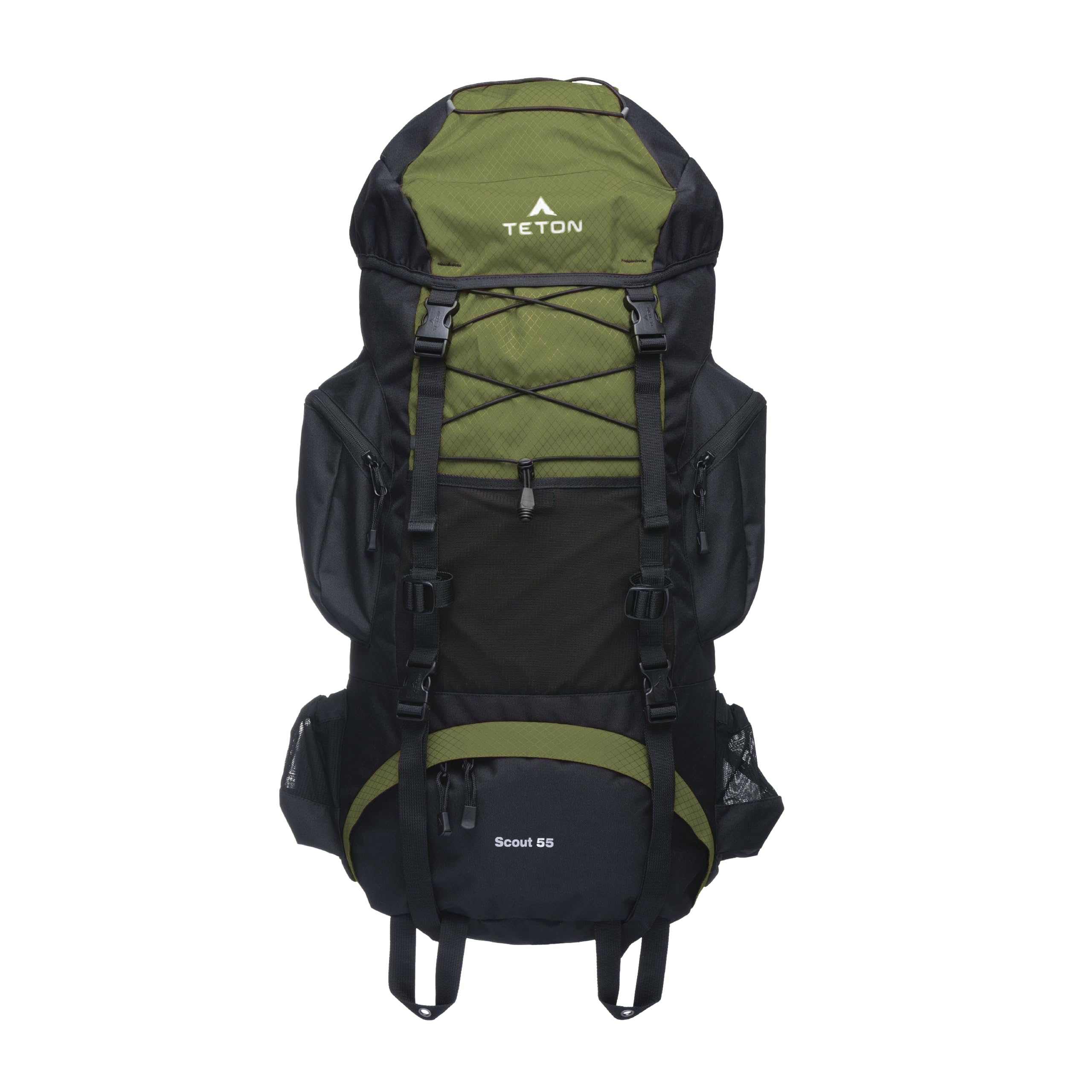
Teton Scout 55L
Key Features
- Frame: Internal frame
- Capacity: 55 liters
- Rain cover: Included
- Empty weight: 4.1 lb
- Price: Premium
Fifty-five liters is the number we steer new backpackers toward, and the Scout is why. There is room for a tent, a sleeping bag, a stove and three days of food, without so much spare volume that you fill it with things you will not use. The internal frame and multi-position torso adjustment let the pack adapt to a shorter or taller back rather than the other way around, which is why it is the one we hand over first.
The details we kept noticing are practical ones. A separate zippered compartment at the base takes the sleeping bag, so it goes in last and comes out first without unpacking everything above it. The lid has its own pockets for the small things you want on the trail, and the multidirectional compression straps pull a half-full pack back into shape instead of letting it slump. The rain cover comes in the box, which matters more than it sounds when you are buying one separately.
Two things to know before ordering. The side bottle pockets are tight on wide bottles, so a bladder in the hydration sleeve is the easier route. The sleeping-bag compartment is snug once you move up to a bulky synthetic bag, where a compression sack does the job a bigger compartment would. The torso range covers a wide spread of body lengths, and that is the quiet reason this pack suits so many people — a 55-liter sack that only fitted one kind of back would be a much shorter recommendation.
Pros
- Adjustable torso fits a range of backs
- Rain cover included in the box
- Dedicated sleeping-bag compartment
- Compression straps control a part load
Cons
- About four pounds empty
The pack we recommend first: 55 liters, an adjustable internal frame and a rain cover in the box cover most two- and three-night camping trips with nothing extra to buy.
Best for Week-Long Trips
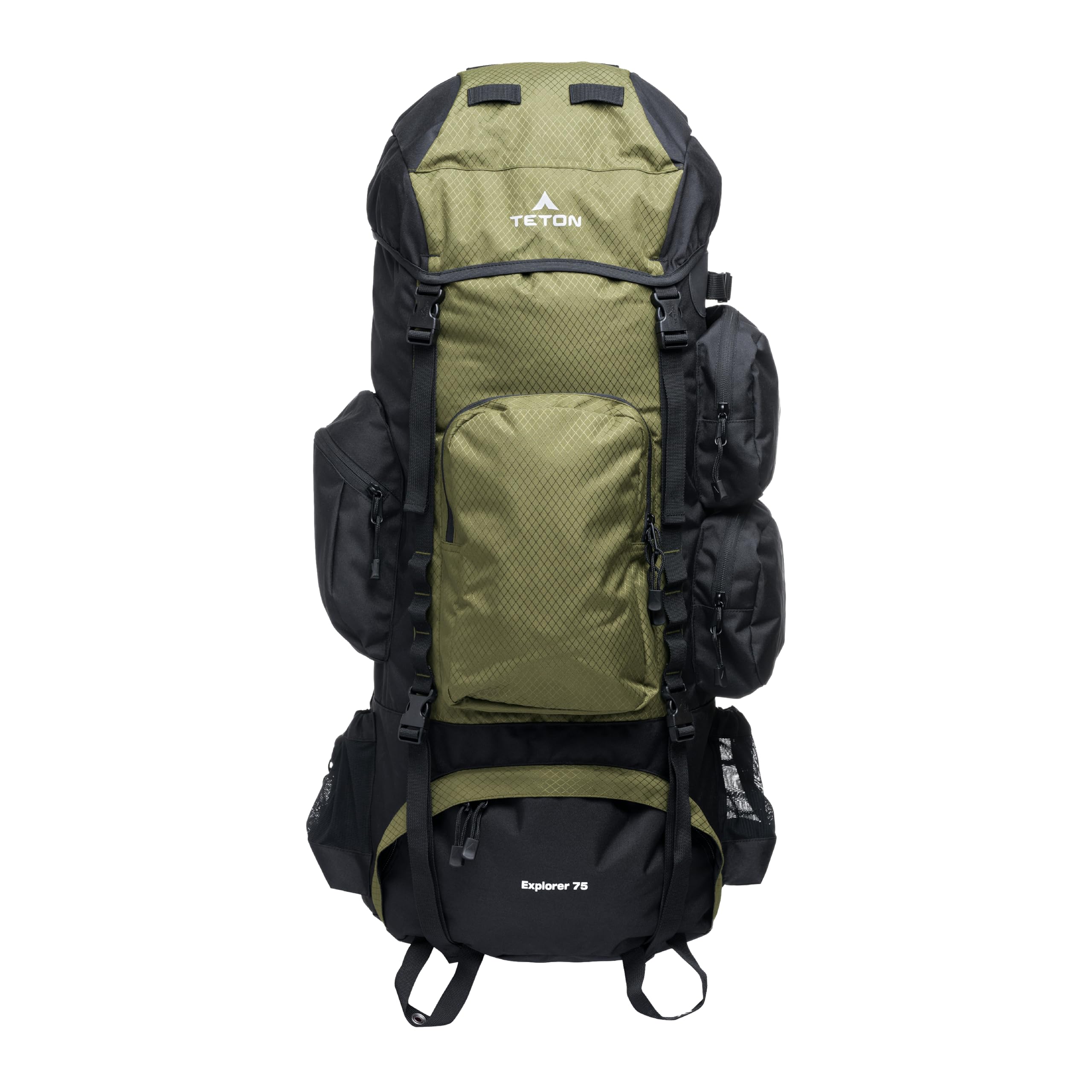
Teton Explorer 75L
Key Features
- Frame: Internal frame
- Capacity: 75 liters
- Rain cover: Included
- Empty weight: 5.5 lb
- Price: Premium
Seventy-five liters is where a pack stops being about organization and starts being about weight. This one swallows a week of food, a winter bag, or gear for two people, and it does it at 5.5 pounds empty — roughly a pound and a half more than the 55-liter Scout for twenty extra liters of space.
What matters at this size is where the weight ends up, and the Explorer puts it on the hip belt: a wide open-cell foam lumbar pad, molded channels for airflow, a harness that adjusts for torso length, and a frame that stops the load folding in half on a descent. Loaded properly, a heavy pack carried this way is less tiring than a light one hanging off your shoulders, and that is the whole argument for going bigger rather than strapping more to a smaller bag.
The caution is durability. The 600D ripstop is sturdy, but seams, buckles and strap anchors are where a full load takes its toll, so fill it to the point where the hip belt still carries the weight and stop there. The included rain cover also fits over the pack itself: lash a tent or a mat outside and the cover will not stretch around it, so line the main compartment with a trash bag when you carry gear on the outside.
Pros
- Swallows a week of gear
- Hip belt and lumbar pad carry the load
- Rain cover included
Cons
- Torso range suits medium and tall frames
- Seams and buckles can give under a full load
Buy it when the trip is a week long or you are carrying for two: 75 liters of room with a harness that puts the weight on your hips instead of your shoulders.
Best for Budget Overnights
Maelstrom 40L
Key Features
- Pockets: 10
- Capacity: 40 liters
- Rain cover: Included
- Empty weight: 2.2 lb
- Price: Budget
It costs less than a couple of the daypacks on this list and it will still carry a tent, a bag and a stove for a night out. That is the case for the Maelstrom 40L, and at 2.2 pounds with a rain cover, ten pockets and reflective printing for the walk back to camp in the dark, it is a persuasive one.
The money went into organization rather than the frame. Two bottle holders, a bladder sleeve, zippered side compartments and trekking-pole loops let you spread a small load out, and seven zippered pockets mean the stove, the headlamp and the first-aid kit each have a home. Filling a 40-liter pack takes ten minutes when everything has somewhere to go.
Where it falls short is the carry itself. The body is soft, so a heavy load rides lower and shifts more than it does in a framed pack — fine for a mile from the car, less so for a long approach. For a first overnight, a festival weekend, or a spare pack for a friend, that is a fair trade to make.
Pros
- Rain cover and ten pockets at a budget price
- Light 2.2-pound carry
- Trekking-pole loops and reflective trim
Cons
- Thin fabric wears under rough use
Our budget pick: 40 liters, ten pockets and a rain cover for less than several daypacks here, which is all most one- and two-night trips need.
Best for Camp Day Trips
SKYSPER 20L Daypack
Key Features
- Capacity: 20 liters
- Max load: 15.4 lb
- Dimensions: 10.3 x 7.4 x 16.9 inches
- Empty weight: 1.1 lb
- Price: Midrange
No 20-liter pack is the one you camp out of, and this one does not pretend to be. The SKYSPER Lantc20 is the pack that goes inside or alongside your camping pack for the hours when the big one stays at the tent: the summit push, the swim, the walk into town for ice.
It is a pound and a bit of pack with wide padded shoulder straps, a chest strap and a grooved back panel, plus two bottle pockets, a front zip for the small stuff, an anti-theft zip that sits against your back, and trekking-pole fixtures if you use them. On a full day of walking it stays where you put it, which is most of what a daypack has to do.
Two numbers define the job: 20 liters and a 7 kg maximum load. Inside them, it is the pack we reach for most often on a trip — light, organized, comfortable for hours, and small enough to slide under an airplane seat.
Pros
- About a pound empty
- Wide straps and chest strap for all-day wear
- Trekking-pole fixtures and a security pocket
Cons
- Strap-anchor stitching can pull apart
The second pack we take on every camping trip: a pound of 20-liter daypack for summits, swims and town runs, not for carrying camp.
Best for Packable Backup
4Monster Packable 24L
Key Features
- Capacity: 24 liters
- Packed size: Folds into its own pouch
- Empty weight: 4 oz
- Water resistance: Water resistant
- Price: Budget
It weighs four ounces and folds into a pouch about the size of a wallet, so it rides at the bottom of a camping pack or a duffel and stays there until you want a second bag. Twenty-four liters holds a jacket, lunch, a first-aid kit and two bottles in the mesh side pockets, and the fabric keeps a light shower out.
What it is not is a pack you carry a load in. There is no frame and almost no padding on the straps, so a heavy day turns into shoulder work. As the bag that turns a basecamp into a day out, we like it a great deal; as your only pack, it is not one.
Pros
- Packs into its own pouch
- Four ounces empty
- Mesh side pockets take big bottles
Cons
- Thin 30D fabric is the first thing to wear out
The pack that lives folded in your duffel: four ounces, its own pouch, and room for a day’s layers, lunch and water once you get there.
Best for Car Camping
QT&QY 45L Tactical

Key Features
- Pockets: 6
- Capacity: 45 liters
- Empty weight: 2.5 lb
- Water resistance: Water resistant
- Price: Budget
Camo panels, a MOLLE grid and room for patches: this is a pack with a look, and if that look belongs at your campsite, it backs it up with 45 liters of rectangular space. It is a tactical pack rather than a backpacking one, but a boxy body swallows crates, bottles and a stove in a way a top-loading rucksack does not.
Six pockets and five compartments do the organizing, the MOLLE webbing takes a pouch or a pair of sandals on the outside, and at 2.5 pounds it is no burden on the walk from the car to the site. The harness is built around shoulder straps rather than a load-bearing hip belt, which tells you what it is for: gear in transit, not miles of trail.
Judged as a gear hauler rather than a backpacking pack, it earns its place — the car-camping weekend, the festival, the hunting trip, the van that needs 45 liters of kit out of the way. It is not the pack for a long walk in, and it does not need to be.
Pros
- MOLLE panel takes extra pouches
- Rectangular body packs boxes and bottles
- Lots of pockets for the money
Cons
- Zippers can pull out when overstuffed
Buy it for car camping and gear hauling: 45 liters, MOLLE panels and a rectangular body that packs boxes and bottles better than a top-loader.
Best for First Backpacking Trip
Loowoko 50L

Key Features
- Frame: Internal frame
- Capacity: 50 liters
- Dimensions: 7.9 x 11.8 x 23.6 inches
- Rain cover: Included
- Price: Midrange
Compared with the Teton Scout, the Loowoko gives up five liters and asks a good deal less money. You get 50 liters, 2.8 pounds, a rain cover in the box and a body that takes a tent and a bulky synthetic bag — the arithmetic that makes a first backpacking trip affordable.
The layout is generous for the price. Side pouches you can reach without taking the pack off, a lid pocket, attachment points for a mat or a tent, and a body that compresses down when it is half empty. That last one is more than a lot of budget packs manage, and it is the difference between a pack that rattles and one that carries quietly.
The fabric is light rather than rugged, so treat this as a fair-weather pack: keep heavy items low and close to your back, and do not expect it to shrug off being dragged over rock. Check that the rain cover is actually in the box before your first trip, since that is the part of the deal you will want on a wet night.
Where that leaves us: it is the pack we suggest to someone finding out whether they like backpacking, or to a family that needs a third pack for a car camp. Spend more and the Scout is the better long-term buy. Spend this and you get a fair first season, a cover included, and a clear idea of what to look for when the habit sticks.
Pros
- Fifty liters at a budget price
- Rain cover included
- Compresses down when half full
Cons
- Shoulder-strap seams can tear under load
Fifty liters and a rain cover at a budget price: a fair first camping pack if you accept that the shoulder straps are the weak point.
Best for Wet-Weather Daypack
MIYCOO 35L Packable

Key Features
- Pockets: 5
- Capacity: 35 liters
- Empty weight: 12.8 oz
- Water resistance: IPX4
- Price: Budget
Most packable packs are bags with straps attached. The MIYCOO adds the one feature we did not expect to care about: a separate wet compartment, so a damp towel, a swimsuit or a soaked rain jacket does not share a bag with everything else on the walk back to camp.
It carries more than its folded size suggests: 35 liters, five pockets, a chest strap that keeps the shoulder straps in place, deep bottle pockets on both sides, and anti-theft zip clips that hold the pulls together. The fabric carries an IPX4 rating.
At 12.8 ounces it sits between the four-ounce 4Monster and anything framed here, and that extra weight buys organization — the pockets, the wet compartment, the chest strap. Fold it into its inner pocket when you are not using it and it takes less suitcase space than a pair of shoes.
The trip it suits is the one where a daypack has to work: a swim, a change in the forecast, a walk into town that ends with shopping. We reached for it over the other packables whenever we wanted a dry place for wet kit, and it asks very little more than the ones that do not offer it.
Pros
- Wet compartment keeps damp kit separate
- 35 liters folds into its own pocket
- Deep bottle pockets on both sides
Cons
- Straps are lightly padded for heavy loads
- IPX4 covers splashes, not a downpour
The packable that acts most like a real pack: 35 liters, a wet compartment and splash-rated fabric, for trips where the daypack has to do actual work.
How We Tested 14 Camping Backpacks
We started by pulling together more than 40 packs and narrowing them by specs that actually matter on a trip: usable capacity in liters, adjustable torso range, frame type, hip belt padding, and whether a rain cover or hip belt pockets came standard. We dropped anything without a load-bearing hip belt or with a suspension design too flimsy for its claimed volume, then bought 14 across the price range so we could compare cheap against expensive directly.
Every pack got the same two-night load: tent, synthetic sleeping bag, pad, stove, pot, food, layers, and two liters of water. We packed each one on a living room floor, timed how long a full repack took, and noted whether the sleeping bag compartment actually swallowed a bag or just claimed to. Loaded packs went on a kitchen scale, and we checked claimed liters against reality by seeing whether a bear canister fit where the spec sheet said it would.
Then we carried them — weekend car-camping trips, two overnight backcountry walks, and day hikes with a half-empty pack. We watched for where straps dug in after the second hour, whether we could reach a water bottle or snack without stopping, and how much the bag shifted on a steep downhill. To test zippers, we overstuffed the main compartment and ran each one open and shut dozens of times, then yanked the sliders and haul loop hard and looked for skipped teeth, frayed pull tabs, and seams pulling apart. Durability got the same treatment: packs were dragged over granite, shoved into trunks, and rained on. Finally, we weighed every feature against the price to see what you’re actually paying for.
How to Choose a Camping Backpack
Buy for the trips you actually take: capacity sets how many nights you can pack for, and the frame decides whether you are still comfortable carrying it on day two.
Match liters to nights, not to ambition
Roughly, 35 to 45 liters covers one or two nights with light gear, 50 to 60 liters is the sweet spot for a long weekend, and 70 liters and up is for a week without resupply, winter kit, or carrying for two people. The trap is taking the number literally: a 40-liter pack with ten pockets holds less than a plain 45, and several packs here run tighter than their rating once a bulky sleeping bag goes in.
We treat capacity as a starting filter and let the trip decide the rest. If you camp two nights at a time, a 55-liter like the Scout leaves margin without inviting you to fill three extra compartments you never needed.
The frame and the hip belt do the carrying
On a framed pack the load lands on your hips through the belt, and the frame stops the bag folding around your back on a descent. A soft pack like the Maelstrom takes an overnight load happily enough, but it rides lower and moves more as the weight climbs, because there is nothing to hold its shape.
So the choice follows the walk. If you hike any real distance to camp, pay for a frame and an adjustable harness. If camping means a car, a cooler and fifty yards of gravel, a soft pack saves weight and money and you will never miss the frame.
Fit is adjustable, within limits
Torso length matters more than height, and an adjustable harness buys a lot of leeway — the Scout’s multi-position adjustment is the reason it suits such a spread of backs. The limits still count: the Explorer’s adjustment is described for medium and tall torsos, so a shorter back should be looking at the 55-liter instead of the 75.
Load the pack before you commit to anything and check where the hip belt sits. It should cup your hip bones, not ride above them, and the shoulder straps should curve over your shoulders rather than pulling them back.
Weigh the empty pack, then count the pockets
Empty weight is a real cost on the climb, and this list spans it: four ounces for the packable 4Monster, five and a half pounds for the 75-liter Teton, everything else in between. Heavier usually means more frame, more padding and tougher fabric, so spend that weight where you need it and not on a pack that only ever travels in a car.
Then look at layout. A sleeping-bag compartment, side pockets you can reach while wearing the pack and a lid pocket do more for daily use than a dozen shallow zips you have to open to remember what is in them.
Frequently Asked Questions
Do I need a rain cover or a pack liner?
A rain cover keeps the outside of the pack dry and is the quicker option at camp; several packs here include one. It will not protect gear lashed to the outside, and a long downpour can still find the seams.
A plastic bag liner takes thirty seconds to fit and keeps your sleeping bag dry whatever the cover does. On a wet trip, use both.
Can I take a camping backpack as carry-on?
Small ones, yes. The SKYSPER measures 10.3 by 7.4 by 16.9 inches, which is carry-on sized and slides under the seat in front of you.
Anything in the 40-liter-and-up class belongs in checked luggage. If you check a framed pack, put it inside a duffel so the straps and buckles cannot catch on a conveyor.
How should I pack a backpack so it carries comfortably?
Keep the weight close to your spine and centred in the middle of the pack, with the sleeping bag and light layers at the base and the heaviest items just below shoulder height. Lash the tent or mat outside and put anything you want during the day in the lid.
Then tighten in order: hip belt first, shoulder straps second, load lifters last. A pack that is loose at the belt will pull on your shoulders all day no matter how well the rest is packed.
Final Verdict
Buy the Teton Scout 55L. Fifty-five liters is the right size for the camping most people do, the adjustable frame fits a wide range of backs, and the rain cover is in the box rather than on your shopping list.
If your trips run a full week or you carry gear for two, step up to the Explorer 75L and let the hip belt do the work. If you are not yet sure backpacking will stick, the Loowoko 50L gets you out there for a fraction of the money and you can upgrade once the habit does.