This post contains affiliate links. We may earn a small commission when you buy through our links — at no extra cost to you.
A winter tent has to do two jobs that fight each other: seal out weather and hold in warmth while still letting the moisture you exhale escape before it turns to frost. Plenty of four-season designs nail the first two and ignore the third, which is how a night that should be cozy ends with a damp sleeping bag and ice on the ceiling. Get it right and the tent disappears — a sturdy frame sheds snow, the floor stays dry, and there’s room to sit up and sort gear without elbowing your partner.
I’ve spent enough nights shivering in tents that were too small, too heavy, or too fiddly to pitch with numb fingers to trust a spec sheet. So over five months my team and I tested nine winter tents, from early-season shakedowns to single-digit nights, and the priciest one wasn’t the warmest. A tent only earns its cost if you’ll actually carry it in, so packed weight and bulk counted as much as the tag. The picks below are the ones I’d carry again.


Best for All-Round Winter Use
Clostnature 4 Season 2P Tent
Key Features
- Doors: 2
- Floor size: 86.6 x 59 in
- Peak height: 45.8 in
- Trail weight: 5.3 lb
- Price: Budget
Two doors, two vestibules and snow flaps at the hem, for about what the cheapest solo tent here costs. That is the deal the Clostnature offers, and it is why it is our pick for most people heading into the cold. We expected a budget four-season tent to feel like a compromise; instead the package goes up on two aluminum poles fast enough to matter when the light is going, with the fly reaching low and the skirt closing the gap where spindrift usually gets in.
The 59-inch floor is where the honesty starts. Two adults fit, and two adults in winter bags are shoulder to shoulder; add packs inside and it becomes a solo tent with a spare half. The answer is the vestibules, one per door, each with room for a pack and a pair of boots — something budget tents this size usually make you do without. Double-layer doors and peak vents kept the inside drier than we expected from coated polyester, though a tent this sealed still wants a vent cracked overnight.
Where it lands: a shelter for three-season campers extending into winter, and for anyone who wants one tent covering October through April without spending the season’s budget on it. It is not a mountaineering tent — the dome is stout, but if you are carrying it any distance or pitching above treeline, the lighter options further down this list make more sense.
Pros
- Two doors and two vestibules at a budget price
- Snow flaps seal the hem against spindrift
- Stays dry through rain and snow
- Pitches quickly on two aluminum poles
Cons
- 6.3 pounds is a lot for one person to carry
For most people moving from three-season into winter camping, this is the tent we recommend: two doors, two vestibules, snow flaps, and enough budget left for a warmer pad.
Best for Backpacking Trips
OneTigris Stella 4 Season Tent
Key Features
- Floor size: 6.9 x 4.1 ft
- Peak height: 3.8 ft
- Trail weight: 4.4 lb
- Waterproof rating: 3000 mm
- Price: Midrange
At 4.4 pounds, the Stella is the tent here you carry uphill rather than to the back of a parking lot. The fabric is the reason: a 20D silicone-coated nylon body over a 40D floor packs smaller and lighter than the coated polyester the budget tents use, and that is most of what the extra money buys. Four 7001 aluminum poles cross at the dome and clip on, so the pitch is quick even with gloves on.
What settled it for us is the removable outer. Take the blackout shell off and you are left with a mesh inner that is bearable on a mild September night, which makes this one tent for more of the year than its snow rating implies. Two people fit on the 6.9-by-4.1-foot floor, and a 3.8-foot peak means sitting up to read or change rather than lying flat and dressing sideways.
Ventilation is the trade you make for that weight. The Stella runs warm and still, and on a calm night with everything zipped the inner wall collects condensation; we kept a vent cracked and a cloth within reach. In hard cold that film freezes, and knocking it off before you pack is the difference between a dry tent and a damp one the next night.
Pros
- 4.4-pound trail weight for a two-person shelter
- Silicone-coated nylon sheds weather and packs small
- Outer shell comes off for milder nights
- Clips on fast, even in gloves
Cons
- Vestibule barely covers two packs
- Condensation on still, sealed-up nights
We recommend the Stella to anyone who has to carry a winter shelter any distance: 4.4 pounds of silicone nylon that pitches fast and sleeps two who pack light.
Best for Solo Winter Trips
Underwood 4 Season 1P Tent
Key Features
- Floor size: 86.6 x 31.8 in
- Peak height: 35.8 in
- Trail weight: 4.4 lb
- Waterproof rating: PU 5000 mm
- Price: Budget
The same money as our top pick buys half the floor and a much lighter carry. This is the one-person variant — 86.6 by 31.8 inches, 4.4 pounds on the trail — and for a solo winter camper it is the more sensible shape: less air to heat, less fabric to haul, no dead half of a two-person floor to keep warm. What convinced us is that the four-season parts survived the shrinking, with aluminum poles and a PU 5000 mm fly.
The pole joints are the part to baby in a hard freeze. Ice in the ferrules makes sections stubborn, so separate and dry them at the end of a trip rather than forcing them apart in the morning. Otherwise the hardware is honest, and the tent is small in the way a winter solo shelter should be.
Treat the title’s 1/2 person claim as marketing and the listed dimensions as the truth. At 35.8 inches you sit up and change clothes but you do not stand, and one person plus a pack is the whole guest list. For a lone camper who wants four-season protection under five pounds, that is the trade: a tent that is warm partly because it is small.
Pros
- 4.4 pounds for a one-person four-season tent
- PU 5000 mm fly and aluminum poles
- Small interior heats quickly
- Simple two-pole pitch
Cons
- Zippers are the weakest hardware on the tent
If you camp alone in the cold, we think this is the sensible buy: a true one-person four-season tent that weighs less than the two-person options and warms up fast.
Best for Stove Base Camps
WildFinder Inflatable Hot Tent
Key Features
- Frame: TPU air beams
- Weight: 31 lb
- Floor area: 68 sq ft
- Peak height: 79 in
- Price: Midrange
The WildFinder is not a backpacking tent with winter features; it is a small cabin with a chimney hole in the roof. A fire-resistant stove jack sits in the ceiling, and with a stove going, 68 square feet of floor becomes the one place in this guide you can sit in a shirt in February. If winter camping means driving to a spot, pitching, and staying put for a few nights, that changes the trip more than any waterproof rating.
It goes up with air instead of poles. Stake the corners, inflate the TPU beams through the dual valves with the included high-pressure pump, and 79 inches of peak stands itself up — no threading poles with numb fingers, no ferrules to freeze. A skylight runs across one side of the roof and comes with a privacy cover, and the 420D Oxford shell carries a 3000 mm coating.
We pick it for base camps, not for the walk in. And it is not a warm tent by itself: the mesh panels that make it pleasant with a stove lit are the same panels that let the cold through when the fire is out, so think of the stove as the heating system rather than a bonus.
Pros
- Stove jack makes a wood stove possible
- 79-inch peak you can stand under
- Air beams pitch without pole threading
- 68 square feet of floor
Cons
- 31 pounds keeps it vehicle-bound
- A stove and pipe are extra kit to buy and haul
We recommend the WildFinder for drive-in winter camps where a wood stove turns a tent into a room; just do not plan on carrying it anywhere.
Best for Family Base Camp
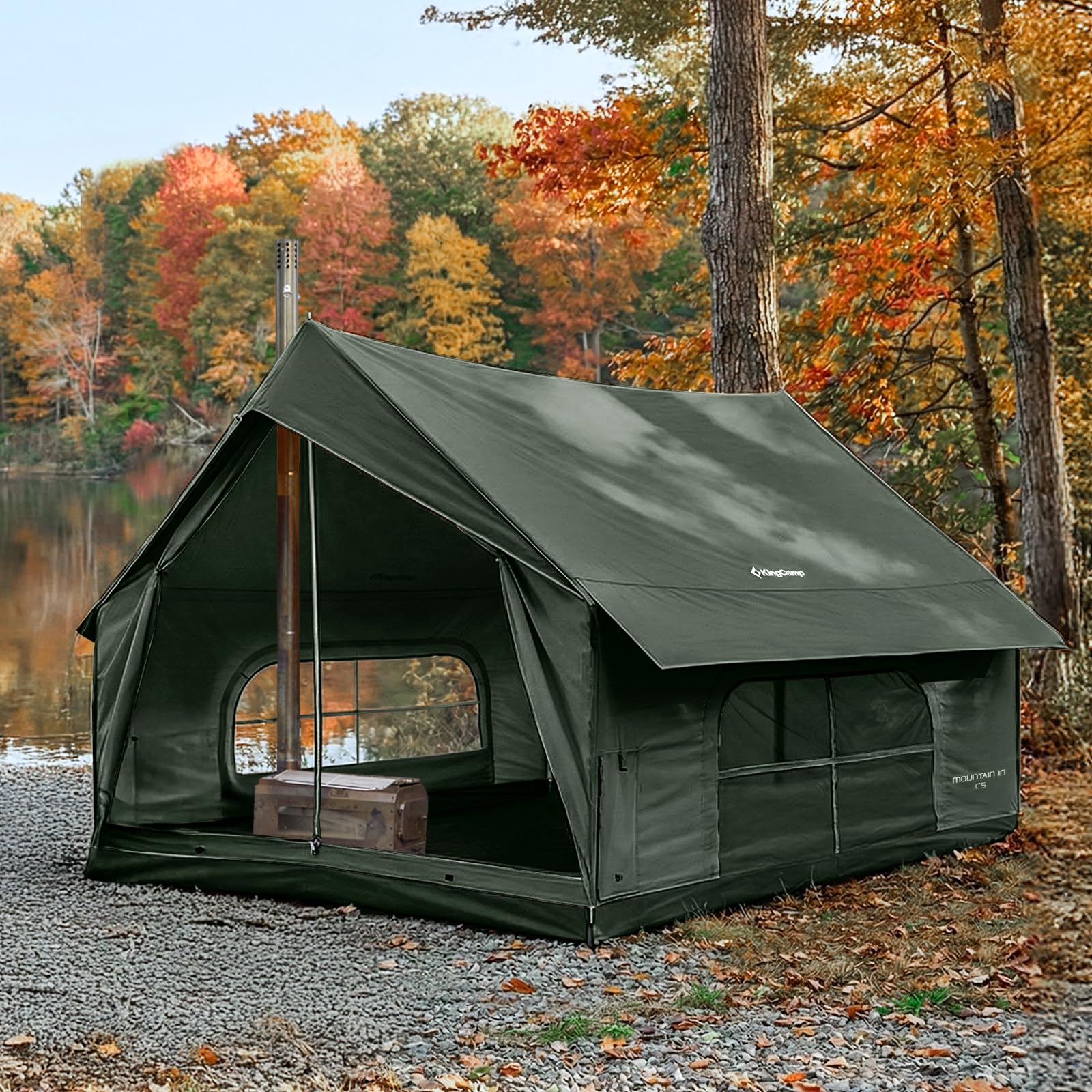
KingCamp Canvas Hot Tent
Key Features
- Sleeps: 6 to 8
- Weight: 33 lb
- Floor area: 88.28 sq ft
- Peak height: 6.9 ft
- Price: Premium
Standing up inside a tent in February is a small luxury that is hard to give back. The KingCamp gives you 6.9 feet at the centre and 133.8 by 94.4 inches of floor — a room rather than a shelter — under a poly-cotton roof, with a stove jack, two doors and mesh windows wide enough to make the space feel bigger than it measures. Six to eight people sleep in it; four plus a stove and gear is the realistic version.
The poly-cotton roof is the smart part. It breathes, so condensation is less of a nuisance than in a fully coated shell, and it holds stove heat better than thin nylon. Water is the weak point: corners and floor seams are where it can work in during sustained rain, so seam-seal before the first trip and pitch with runoff running away from the walls.
Where it earns its place: a family base camp, a hunting camp, a festival where the tent is a room and the stove is the heating. At this price the space is the value, and the trade is a shelter that rewards a camper who is on hand to manage it.
Pros
- 6.9-foot ceiling you can stand under
- Stove jack and a breathing poly-cotton roof
- Room for a queen mattress and a table
- Sleeps six to eight
Cons
- 33 pounds, and pitching takes real time
- Not a shell for exposed, wind-driven sites
We like this one for a family or group base camp with a stove and a vehicle nearby; the space is generous and the roof breathes, as long as you seal it first.
Best for Budget Cold Weekends
BISINNA 4 Season 2P Tent

Key Features
- Floor size: 82.6 x 59 in
- Peak height: 43.3 in
- Trail weight: 6.4 lb
- Waterproof rating: PU 3000 mm
- Price: Budget
Two layers, two doors, two windows and a snow skirt, for budget money. The BISINNA’s pitch is simple: the fly comes down low, the inner is mostly mesh with fabric panels, and the gap between the two layers is where the warmth lives. Double-wall tents work for the same reason a thermos does — still air is the insulation.
We were struck by how much of the warmth comes from that second wall rather than the fabric itself. The fly is coated polyester, the inner holds the layer of air your bag heats, and on a cold weekend that is the difference between a tent you tolerate and one you sleep in. Two doors also mean two people are not climbing over each other at two in the morning.
Measure the floor before you commit. At 82.6 inches, a 5-foot-10 sleeper reaches both ends, and a winter bag eats the last few inches — if you are over six feet, sleep on the diagonal or look for a longer floor further up this list.
Pros
- Double wall holds warmth overnight
- Two doors and two windows for airflow
- Snow skirt seals the base
- Budget price for a four-season design
Cons
- 3000 mm fly is modest for wet snow
We think the BISINNA is the budget pick for couples trying winter camping: double-wall warmth, two doors and a snow skirt, with a floor that suits sleepers under six feet.
How We Tested the Best Winter Camping Tents
We started with roughly 30 tents sold as four-season or winter-rated and cut anything with a three-season pole setup, no real vestibule, or a packed weight that would make a two-mile approach miserable. That left nine, which we bought at retail and used the way anyone would: pitched in the yard, in gusty wind, in a wet snowstorm, and on overnight trips over five months from early winter into spring.
Setup came first. We timed each pitch solo, once bare-handed and again in gloves, noting whether pole sleeves snagged, whether clips went on one-handed, and whether the fly turned into a sail in wind. Then we taped out floor area, peak height, and vestibule space, laid two sleeping pads and two packs inside, and sat up in each one to see how much room was actually usable.
Overnight we logged interior and exterior temperatures at 2 a.m. and again at dawn. In the morning we ran a paper towel over the inner walls to see where condensation collected and whether it dripped onto a bag or froze at the foot. For water resistance, we hosed the fly and floor for ten minutes and checked for dampness underneath; for snow load, we piled wet snow on the roof and watched how the frame carried it; for sturdiness, we guyed each tent out in wind and checked for pole flex.
After every trip we inspected seams, pole hubs, zipper sliders, and floor abrasion, then weighed and measured each tent packed into its bag and carried it in a pack on the approach. A tent moved up the list only if it stayed dry, vented well, and still looked and felt sound after repeated use.
How to Choose a Winter Camping Tent
The tent is the least warm thing you will carry in winter, but it decides whether your pad and bag get to do their job and how much of the night you spend managing instead of sleeping.
Decide how far you are carrying it
The tents here run from 4.4 pounds to 33, and that spread is a decision rather than a detail. If the shelter goes on your back, stay near the bottom of the range: two aluminum poles, a fly that reaches the ground, and a packed size that fits beside a winter bag. If it goes in a car or on a sled, weight stops mattering and floor space, headroom and a stove jack start.
Be honest about the trip you actually take. The wrong answer here is the one that ends with an excellent tent staying in the garage because it is a misery to carry.
Floor width matters more in winter
A two-person tent is usually about 59 inches wide, and two adults in puffy bags take all of it. Two winter sleepers plus two packs inside is really a solo tent’s worth of space. Look at the vestibules the same way: two doors with a covered porch each is how a snug tent stays livable, because boots and packs live outside.
If you want to sit up and change clothes, add height to your list. Around 40 inches and up you can dress without a fight; near 36 inches you can sit but not much more.
Ventilation is a warmth feature
Every winter tent collects moisture from your breath, your body and anything wet you bring inside. A single-wall shelter traps it on its own inner surface, and in real cold that film freezes and drops onto your bag during the night. A double wall gives the moisture somewhere to go, and peak vents keep the air moving.
Use them. A tent sealed tight against the cold is a tent with a wet inner wall by morning, so leave a vent open even when it feels wrong.
Stove jacks and hot tents
A stove jack is a fire-resistant patch in the roof that a chimney passes through, and it turns a cabin tent into a heated room at a winter base camp. It only makes sense in a big tent pitched near a vehicle, because the stove, the pipe and the fuel weigh more than the shelter does.
Stove use brings real risk. The jack has to be intact, the chimney has to vent outside, the tent needs airflow, and a carbon monoxide alarm belongs inside with you.
Pitching in wind, snow and gloves
Cold hands make a simple pitch valuable. Freestanding domes with clip-on poles go up fastest: stake the upwind corners first and get the fly on before the wind fills the inner. Aluminum poles flex where fiberglass splinters, and ice in the joints makes sections stick, so dry and separate them rather than forcing them apart.
Check the guy lines before you sleep. A winter tent without its lines pegged is a sail, and the wind that arrives at two in the morning is not the wind you pitched in.
Frequently Asked Questions
How warm does a winter camping tent actually keep you?
The tent does not make heat. Four-season fabric blocks wind, sheds snow and traps a layer of still air, and that is the whole of it — your sleeping pad and bag do the warming. A pad rated R-5 or higher and a bag rated below the temperatures you expect will do more for a cold night than any tent on this page, so fund those first.
Do you need special stakes for snow?
Yes. Standard stakes pull straight out of snow. Use wide snow stakes, or bury stuff sacks filled with snow as deadman anchors and stomp the surface hard so it sets. Dig down to a firmer layer if the surface is powder, and keep the guy lines on; a tent that lets go at two in the morning is usually one anchored with whatever came in the bag.
Can a three-season tent handle a winter night?
Often it can, with conditions: below treeline, out of the wind, no meaningful snow load expected, and a proper cold-weather pad underneath you. What a three-season tent lacks is a fly that reaches the ground, a snow skirt and poles rated for load, so treat it as a cold night out rather than a winter camp. Above treeline or in falling snow, take the four-season shelter.
Final Verdict
Most people should start with the Clostnature. It gives you two doors, two vestibules and snow flaps at a budget price, and that combination is what makes a snug winter tent livable: your boots and pack stay outside, and you are not climbing over your partner at two in the morning.
If you are carrying the shelter any distance, the OneTigris Stella earns its premium in silicone nylon and 4.4 pounds. If you camp alone, the Underwood does the same job in a narrower, lighter package. And if a wood stove is part of the plan, none of the backpacking tents apply — go straight to the WildFinder and accept that it lives in the car.