This post contains affiliate links. We may earn a small commission when you buy through our links — at no extra cost to you.
Waterproofing is the feature every hiking boot claims and the one most likely to let you down three days into a wet trip. Sealing a boot shut is easy; doing it without turning the thing into a heavy, sweaty brick is the hard part, and that trade-off is where most disappointing pairs fail. What a good pair actually buys you is unglamorous and invaluable: dry socks at the end of a rainy ridge walk, and no hot spots forming at mile six.
I’ve ruined enough socks on sloppy spring trails to be picky. Over the past eight months, my team and I have walked a dozen pairs through mud, standing water, and long rocky descents, and the gap between them came down to fit and weight as much as the membrane itself. Some felt broken in on the first mile; others took two weeks and a box of blister plasters. A couple looked so bulbous I’d think twice about wearing them into town. The ones below earned their place.


Best for Wet-Weather Hiking
Timberland Mt. Maddsen Mid
Key Features
- Sizing: Men’s
- Listed weight: 3 lb
- Water resistance: Waterproof
- Price: Premium
When the forecast turns and the trail is going to be wet for hours, this is the men’s boot we reach for first. The Mt. Maddsen has the most dependable record on keeping water out of any men’s boot here, and it manages that without the stiffness that usually comes with a serious wet-weather boot. Dry feet and a foot that isn’t fighting the boot — that combination is why it tops this list.
Comfort is the other half of the story. The mid cut holds the ankle without pressing on it, the cushioning is soft enough that a first long day doesn’t leave you sore, and there’s essentially no break-in to plan around. Our advice on sizing: it runs snug, so if you’re between sizes, or you plan to wear thick wool socks, go up half a size.
The honest caveat is longevity. The bond between sole and upper is where this boot, and most of the boots in this group, eventually gives out, and a season of hard, wet, rocky use is when it starts. What you’re paying the premium for is the wet-weather reliability and the comfort, and both held up over the miles we put in.
Set against the White Ledge, it’s the more weatherproof of the two and the dearer one; against the Moab 3, it gives up some cushioning and gains real wet-weather headroom. If your hiking involves rain, mud, and a wet climate rather than the occasional damp morning, that’s the trade worth making.
Pros
- Keeps feet dry in slush and standing water
- Comfortable with almost no break-in
- Light on the foot for a leather boot
- Strong value for a wet-weather boot
Cons
- Sole separation under hard, wet use
We buy this one for the wet days: it keeps feet drier more consistently than any other men’s boot here, and it’s comfortable from the first mile. Size up if you’re between sizes.
Best for Women’s Trail Days
Merrell Women’s Moab 3 Mid
Key Features
- Cut: Mid
- Sizing: Women’s
- Listed weight: 1.5 lb
- Water resistance: Waterproof
- Price: Midrange
The ankle collar on the women’s Moab 3 stays put against the ankle bone in a way we didn’t expect from a boot this supportive — no hot spot on the first walk, and none once the miles added up. Add proper arch support and a toe box with room for thick socks, and it’s a boot that disappears under a long day instead of announcing itself with every step.
That combination is what earns it our pick for women. It’s the most complete women’s boot in this set: the strongest support record of the group, comfortable from the first wear, and one of the few here whose durability doesn’t undercut everything else. Waterproofing holds through snow, mud, and wet grass; the failures come when you stand in water above the collar, which is the ordinary limit of a mid-cut rather than a fault.
Sizing is the one thing to get right. It runs small, and narrow through the sides for some feet, so a half size up is the safer call, especially with wool socks. Traction is confident on wet rock and rooty trail, and the boot cleans up easily after mud.
Set against the Columbia women’s boot, the Moab 3 is the more supportive and the longer-lasting of the two; the Columbia is the one that keeps water out more reliably. If your trails are rocky and you want the boot to still feel solid in year three, this is the one.
Pros
- Ankle and arch support that holds without rubbing
- Comfortable from the first wear
- Durable enough for rocky ground
- Keeps feet dry in snow, mud, and wet grass
Cons
- Water gets in once it’s over the collar
The women’s boot we trust on rock: support that holds the ankle without rubbing, comfort straight out of the box, and a fit that rewards going up half a size.
Best for Value-Focused Hikers
Foxelli Men’s Hiking Boots
Key Features
- Upper: Suede leather
- Sizing: Men’s
- Water resistance: Waterproof and breathable
- Price: Midrange
Cheap hiking boots usually ask you to give something up — a soggy foot, a sole that packs up with mud, or a break-in period that never quite ends. The Foxelli asks for very little of any of that, which is why it’s our value pick rather than our compromise pick.
The suede upper is the first surprise: soft out of the box, with no break-in to schedule around, and better looking than the money suggests. Water beads and runs off rather than soaking in, which covers rain, wet grass, and muddy trail edges. Traction is the second surprise — it holds on wet roots, gravel, and leaf-covered downhill, exactly where a cheap lug pattern usually gives itself away. Spare laces come in the box, a small thing that matters the day one snaps.
Where it gives ground is over years rather than miles. The long-run wear story on this brand isn’t as well established as it is for the Timberlands here, and the wet-weather performance is good rather than total: a long soaking can find a way through. For a few seasons of wet weekend trails at a price that doesn’t sting, neither one changes the recommendation.
Pros
- Suede upper looks and feels better than the price
- Water beads off in rain and wet grass
- Grip holds on wet roots and gravel
- Comfortable with no break-in
Cons
- Water can work through in a long soaking
Our value pick asks for almost nothing in return: solid waterproofing, real traction, and all-day comfort for less than the boots it competes with here.
Best for Everyday Mixed Use
Timberland White Ledge Mid
Key Features
- Cut: Mid
- Sizing: Men’s
- Listed weight: 1.1 lb
- Water resistance: Waterproof
- Price: Midrange
Most leather boots charge you a week of sore heels before they start being pleasant. The White Ledge doesn’t. It walks out of the box soft, with a mid cut high enough to hold the ankle, and laces that pull snug without pinching across the top of the foot.
So it’s the boot here we point at for mixed use — a wet commute, a dog walk, a Saturday trail — rather than for one specific job. Rain, slush, and shallow puddles are handled without drama, and the leather looks good enough to wear into town. It’s light for a leather boot, which you notice at the end of a long day.
The reservation is how long it lasts. The sole-to-upper bond is the weak point, and a couple of seasons of hard, wet use is where it starts to show. Set against the Mt. Maddsen, you’re trading a few years for a softer first week and less money. For a boot that gets worn more often than it gets abused, that’s a fair trade.
Pros
- No break-in period
- Comfortable through a full day
- Light for a leather boot
- Handles rain and slush
Cons
- Sole-to-upper bond fails after hard seasons
For comfort from day one and a boot you can wear anywhere, this is our pick — just don’t expect the sole to outlast a decade of wet rock.
Best for Dry, Rocky Trails
Merrell Men’s Moab 3 Mid
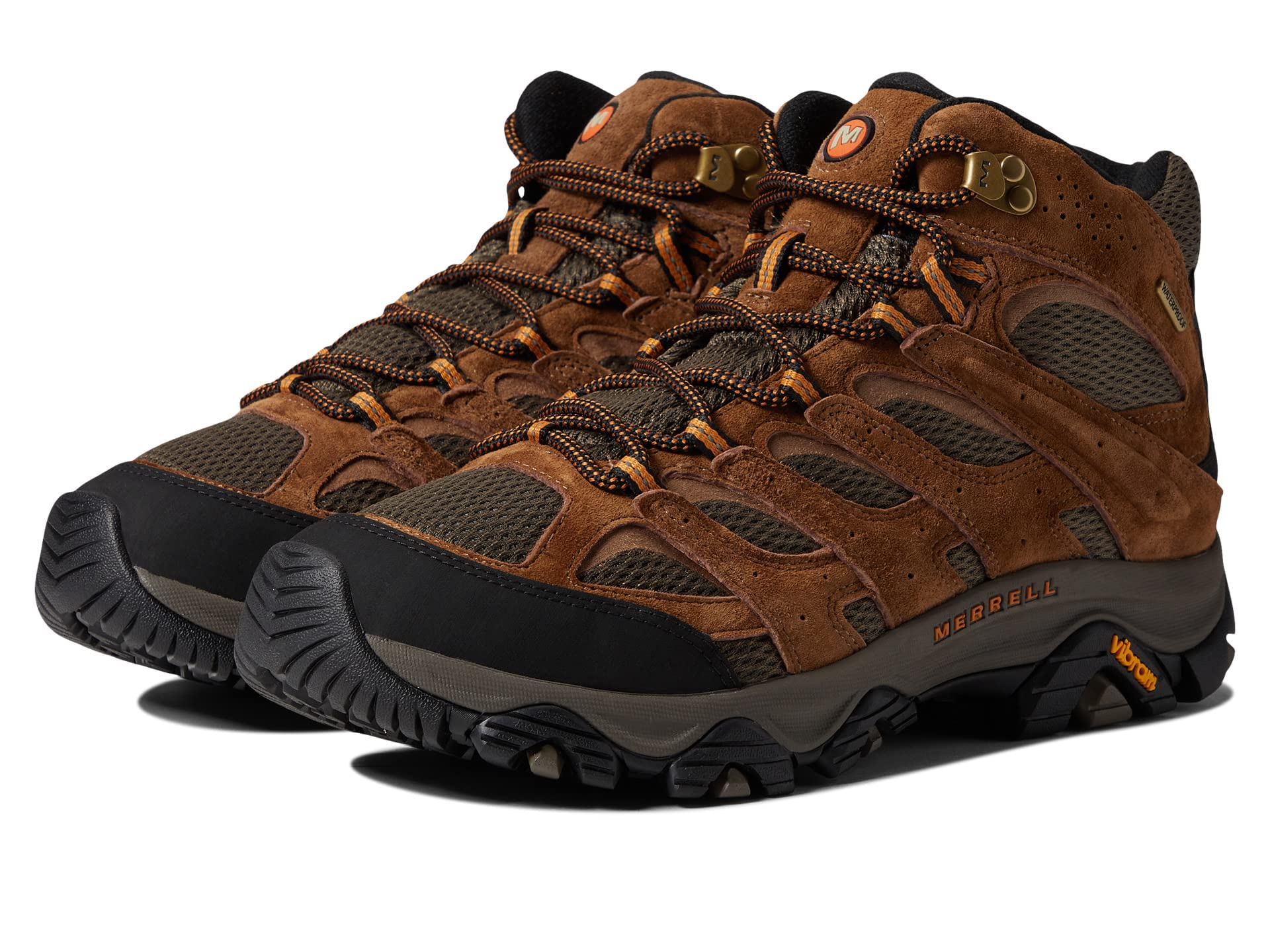
Key Features
- Cut: Mid
- Sizing: Men’s
- Listed weight: 11.7 oz
- Water resistance: Waterproof
- Price: Midrange
Where the men’s Moab 3 stops keeping water out is worth knowing before you buy it. Rain, wet grass, and mud are fine. A sustained soaking — hours in soaked brush, standing water over the collar — gets through, and that’s the same boundary most mid-cut boots have, just reached sooner here.
That matters in a guide to waterproof boots, and it’s why this one sits below our picks rather than among them. What it does better than anything else here is cushioning: the midsole is soft enough that a long day on rock doesn’t leave your feet thumping, the fit accommodates wide feet without ordering a special width, and it needs no break-in.
So the recommendation is narrow and clear. If your trails are rocky and mostly dry — three-season hiking, scree, long approaches — the comfort is worth owning, and the durability record here is a good one, so you aren’t trading lifespan for it. If your trails are wet more often than not, the Mt. Maddsen is the better buy: it gives up some cushioning and keeps far more water out.
Pros
- Most cushioned midsole in this group
- Wide-friendly fit without a special width
- Holds up on rock and gravel
- Needs no break-in
Cons
- Waterproofing gives out in sustained wet
We keep this one for rocky, dry ground — the softest ride here — and look elsewhere when the trail stays wet.
Best for Light Everyday Trails
Columbia Newton Ridge Plus II

Key Features
- Upper: Suede
- Sizing: Men’s
- Listed weight: 1.12 lb
- Water resistance: Waterproof
- Price: Midrange
A listed 1.12 pounds makes the Newton Ridge Plus II light for a leather hiking boot, and the suede upper is why it doesn’t feel like a compromise: soft from the first wear, good-looking with jeans, and free of the break-in period stiffer leathers demand.
We treat it as the everyday boot of this group. It’s comfortable on pavement and gravel, competent on a wet woodland trail, and light enough that a long day doesn’t wear you down. Lightness is where it scores best against the rest of these, and the suede keeps it from looking like technical gear you have to change out of.
Water handling is solid for a suede boot: rain, wet grass, and muddy paths stay outside. Standing water over the collar gets in, the way it does on any mid-cut.
The catch is durability. The sole and the upper separate on some pairs, and it’s the most consistent criticism this boot draws. You’re trading years for lightness and comfort. For someone who replaces boots every couple of seasons, that’s acceptable; for someone who wants one pair to last, it isn’t.
Pros
- Light suede upper, easy from day one
- Dry through rain and muddy paths
- Looks good enough for everyday wear
- Good value for a leather boot
Cons
- Sole and upper separate on some pairs
Light, soft suede and an easy all-day feel make this our everyday pick; heavy-mileage hikers should spend more for better sole durability.
Best for Budget First Pair
NORTIV 8 Women’s Hiking Boots

Key Features
- Sizing: Women’s
- Intended use: Hiking and trekking
- Water resistance: Waterproof
- Price: Budget
Put the NORTIV 8 women’s boot next to the Merrell and the differences are mostly details: a stiffer ankle, eyelets that take more fiddling to get snug, and a price that leaves room for a decent pair of socks.
What it doesn’t give up is the basics. Puddles, shallow mud, and a wet commute stay outside, and it’s light and sturdy enough that a day hike doesn’t punish you. The arch and ankle support is honest for the money, and it held up over the kind of weekend walking most people actually do.
Fit is the variable to manage. Sizing runs inconsistently — some pairs come up big, others snug through the sides — so try them on well before a long trip rather than the night before. Grip is good on dirt and rooted paths and merely ordinary on slick rock.
Where the lower price shows is the horizon. A couple of seasons is the realistic expectation, and the support isn’t in the same class as the Merrell above. For a first pair, a spare pair, or a boot you don’t mind destroying in mud, that’s a fair deal.
Pros
- Keeps feet dry in puddles and shallow mud
- Light and sturdy on day hikes
- Honest arch and ankle support for the money
- Budget price leaves room for gear
Cons
- Sizing runs inconsistently between pairs
- Ordinary grip on slick rock
We point women buying a first pair here: dependable in puddles and mud, light on the feet, and priced so a muddy season doesn’t hurt.
Best for Wet-Weather Reliability
Columbia Newton Ridge Amped

Key Features
- Model: Newton Ridge Plus Amped
- Sizing: Women’s
- Water resistance: Waterproof
The detail that decides how a waterproof boot actually performs is usually the tongue, not the membrane. On the Newton Ridge Amped, the leather runs high up the tongue, so shallow puddles and wet grass don’t get anywhere near your socks — and it’s also why the boot feels secure around the ankle.
It has the best wet-weather record of anything in this guide, and it’s comfortable from the first wear, which is rare for a boot with this much structure. The arch and ankle support is real rather than decorative, and it handles a long day on uneven ground without complaint.
There’s a caveat that has nothing to do with how it performs: Columbia lists this one as discontinued, so sizes come and go. If you find yours, take it. If you can’t, the women’s Moab 3 is the closest thing here on support and reliability.
The rest is ordinary. It isn’t a stiff technical boot, and on very rough ground you’ll feel the difference against a dedicated mid-cut. For wet trails, long walks, and something that looks fine in town, it’s the best value in women’s boots here.
Pros
- Best water resistance in this guide
- Comfortable with no break-in
- Real arch and ankle support
- Strong value for the quality
Cons
- Discontinued, so sizes come and go
- Flexes too much for very rough ground
The most reliable wet-weather women’s boot in this guide, and comfortable from the first wear — grab your size while it’s still listed.
How We Chose and Tested Waterproof Hiking Boots
We started with roughly 40 waterproof boots on the market and narrowed the list by reading spec sheets and customer reviews. Anything relying on a spray-on coating rather than a built-in membrane was cut, as was anything that skipped half sizes, and anything priced well beyond what most people spend on a first or second pair. That left 12 pairs, which we wore for eight months.
Testing happened where boots actually get used: muddy spring trails in the rain, a few knee-deep stream crossings, a three-day trip with two solid days of drizzle, and ordinary town wear on the drive home. To check water resistance, we stood in moving water above the ankle for two minutes, then felt our socks, and repeated the soak after four months to see whether the membrane had softened. For fit, we noted heel lift on steep descents, whether toes jammed on the way down, and how sizing compared with our regular street shoes; two pairs ran a half size small and one was noticeably narrow. Comfort was judged by the blister count at the end of each long day, not by how plush a boot felt in the shop.
Durability came down to stitching, lug depth, and how badly the uppers creased after repeated soakings, and we re-checked every pair at the eight-month mark, by which point a few had visible heel wear. We weighed each boot on a kitchen scale and compared pairs rather than single boots, since a couple hundred grams is the difference between a fun day and a slog. Appearance got an honest vote: would we wear these to a brewery afterward, or do they look like ski boots? Value was the last call, weighing price against how well each pair held up and how much of the test period it spent genuinely dry.
How to Choose Waterproof Hiking Boots
The boot that keeps you dry is less about the membrane than about where the water reaches, so start with the ground you actually walk on.
Waterproofing stops at the collar
Every boot here has a ceiling, and it’s usually the top of the tongue or the ankle collar. Rain, wet grass, mud, and shallow puddles are what the construction is built for; standing water above the collar gets in whatever you paid. If your regular route includes a deep crossing, no mid-cut on this list replaces gaiters or a taller boot.
So think about the wettest point of your usual trail before you pick a height. Our top pick earns its place because it holds that line more consistently than the men’s boots around it, not because it goes deeper.
Fit matters more than any specification
A boot that fits badly will rub, slide, and blister however good its waterproofing is. Sizing runs inconsistently across brands, and a few boots here run small or roomy enough to change the size you order, so treat your running-shoe size as a starting point rather than an answer. Try boots late in the day, with the socks you’ll hike in.
If you’re between sizes and wear thick wool socks, go up. If your heel lifts as you walk, lacing the top two eyelets tighter usually settles it before a smaller size becomes tempting.
Match support and stiffness to what you carry
A mid-cut holds the ankle on uneven ground and carries load, and the stiffer boots here are the ones built for rock and a heavier pack. If your hiking is day-length on maintained trail, a softer boot such as the Foxelli or the Columbia is easier on the feet and less tiring over the last mile.
The trade runs the other way on scree and talus, where a soft midsole lets every stone through. Be honest about the pack weight you carry most weekends rather than the one you carry once a year.
Durability is where light boots pay
The failure point on almost every boot in this group is the same: the joint between the sole and the upper. Lighter boots use less material and less structure there, which is why some of the lightest options here are also the ones that come apart first.
No specification predicts it, so buy for the lifespan you need. If you hike weekly in wet conditions, put the budget toward the boots with the strongest long-run record; if you get out a few times a season, a lighter, cheaper boot is the better use of the money.
Traction on wet ground is a separate question
Grip and waterproofing get sold together but they behave differently. Wide, deep lugs clear mud; softer rubber holds wet rock. A boot that’s excellent in mud can be ordinary on slick granite, and the reverse is just as common.
Before you decide grip is a problem to solve, walk your current boots across a wet slab. If it is a problem, the Foxelli is the boot here whose wet-ground grip holds up most consistently.
Frequently Asked Questions
Do I need to re-waterproof my hiking boots?
Yes, eventually. Factory finishes wear off with abrasion and cleaning, and the tell is simple: water stops beading and starts darkening the leather instead. Clean the boots, let them dry away from direct heat, then treat the upper with something suited to it — suede and nubuck take a suede-safe spray, full-grain leather takes a wax or cream.
Once a season is enough for most hikers, and more often if you walk wet ground weekly.
Are waterproof boots too hot for summer hiking?
They can be. A waterproof layer blocks water in both directions, so sweat has a harder time getting out. On hot, dry trails a non-waterproof breathable boot or a trail runner is noticeably cooler.
Keep the waterproof boot if your summer routes cross boggy ground, long wet grass, or streams. If they don’t, a lighter non-waterproof pair for July and August is money well spent.
Should I choose boots or trail runners for wet trails?
Boots win when you’re carrying weight, walking rough or rocky ground, or want ankle coverage in mud. Trail runners drain and dry far faster, which many hikers prefer where the route means repeated stream crossings.
For a loaded pack and three-season conditions, a mid-cut boot such as our top pick is the more comfortable and more supportive choice.
Final Verdict
The Mt. Maddsen is our pick because it solves the problem the search is about: it keeps water out more consistently than the other men’s boots here, and it does that without a break-in or a foot that spends the day arguing with the boot.
Shopping for women, take the Moab 3 Mid instead — it has better support than anything else in women’s sizing in this group. And if budget is the binding constraint, the Foxelli gets you most of the way for less; what you give up is a little wet-weather headroom, not the basics.