This post contains affiliate links. We may earn a small commission when you buy through our links — at no extra cost to you.
My step count used to fall off a cliff the first week of November — dark by 5 p.m., slick sidewalks, and a desk job that keeps me sitting for eight hours straight. A walking treadmill fixed that in a way a gym membership never did. What I didn’t expect was how much the wrong one grates: a deck that rattles the floor below, a remote that’s never where you left it, a cord two feet too short for the only free outlet in the room.
Over the past eight months, my team and I have walked on nine of them — under standing desks, in front of the TV, on calls I probably shouldn’t have taken while moving. The lesson that surprised me most: top speed is close to meaningless. What matters is whether the deck still feels cushioned at mile three, whether the motor whines at 3 mph, and whether one person can get it out of the box and running before the coffee goes cold. Below are the ones that earned their floor space.



Best for Incline Walking
TRAILVIBER X01
Key Features
- Incline: 0-12% auto, 9 levels
- Warranty: 3 years
- Belt size: 16.5 x 41 in
- Weight capacity: 450 lb
- Price: Premium
A 12% auto incline and a 450-pound frame are what separate the X01 from the flat pads in this group. The incline moves through nine levels at the touch of a button, so you can turn a desk walk into something closer to a hill hike without stopping or stacking blocks under the front.
We rate it first because it addresses the two things that make walking pads feel limited: no challenge and no real sense of stability underfoot. The deck is 16.5 by 41 inches, and the steel frame is rated to 450 pounds, so it feels planted in a way the lighter pads do not. At 44 pounds, it is not the pad you tuck under a sofa every evening; it is the one you leave by the desk.
The controls are complete: remote, FitYo app, Bluetooth speaker, and an LED display that tracks time, speed, calories, and incline. We like the app for logging walks, though the speaker is a nice extra rather than a reason to buy. The 4 mph top speed suits walking and brisk walking, not running.
The trade-off is weight and price: this is the premium machine here and heavier than the budget pads. If you need a handrail for balance, look at the Yagud or WELLFIT instead. For a dedicated walking station where incline and stability matter, it is the most complete package in this set.
Pros
- 12% auto incline with nine levels
- 450-pound capacity and steel frame
- Three-year warranty
- App, remote, and Bluetooth speaker
Cons
- Heavy at 44 pounds
- No handrail for balance
We recommend the TRAILVIBER X01 for daily indoor walks with real incline and a planted deck, as long as you don’t need a handrail.
Best for Budget Handrail Walks
Yagud Walking Pad
Key Features
- Handle bar: Folding
- Item weight: 36.5 lb
- Speed range: 0.6-3.8 mph
- Folded thickness: 4.6 in
- Price: Budget
If you want something to hold onto without paying premium prices, start with the Yagud. It pairs a folding handle bar with a 0.6-3.8 mph range and a 2.5-hp motor, and it is one of the few budget pads here that gives you that support.
We like how it sets up for a desk: 36.5 pounds, 4.6 inches thick, and wheeled, so it moves out of the way without a fight. The five-layer anti-slip belt is comfortable underfoot, and the machine arrives ready to use with a remote and lubricant. It is not a full treadmill, but it does not pretend to be one.
The compromises are familiar at this end of the range. The deck is narrow enough that a larger foot can brush the side rails, and the remote is the weak link: it can be slow to pair or unresponsive. Neither is a deal-breaker for desk walking, but both are worth knowing before you buy.
What makes it work is the combination of support, low weight, and quiet operation at a budget price. For walking while working, it is the pick we point to first.
Pros
- Folding handrail for balance
- Light enough to move and store
- Quiet 2.5-hp motor
- Easy out-of-box setup
Cons
- Narrow deck for larger feet
- Remote can be slow or unresponsive
We choose the Yagud when you want a handrail without spending much; it’s the budget walking pad we recommend for desk use.
Best for Desk Support
WELLFIT WFTM037
Key Features
- Incline: 10%
- Controls: Handlebar, remote, app
- Belt size: 16 x 36 in
- Weight capacity: 350 lb
- Price: Midrange
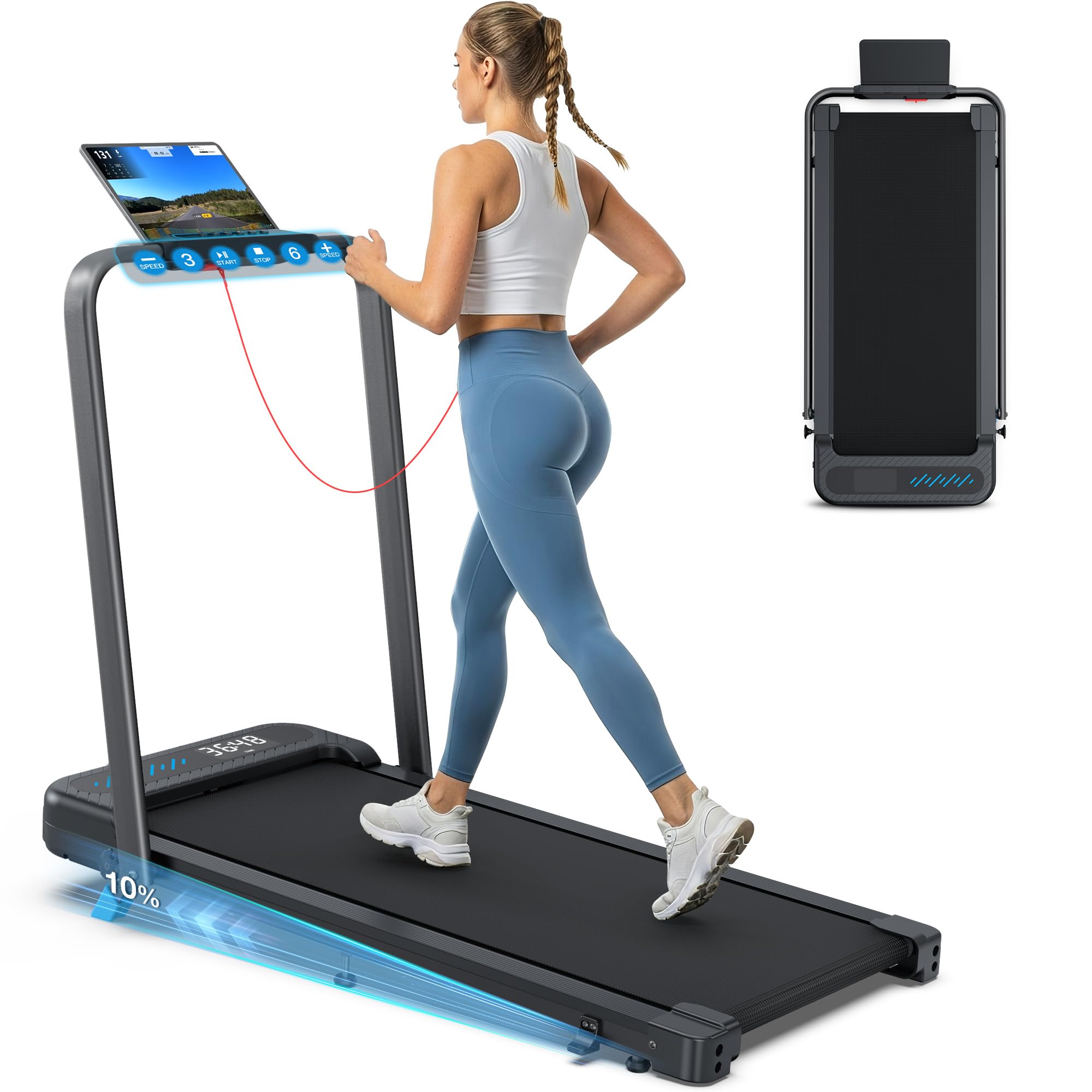
The WELLFIT’s handlebar is the feature that makes it feel different from most walking pads: start/stop, 3 mph, 6 mph, and speed controls sit right where your hands fall, so you don’t have to bend to the deck or hunt for the remote mid-walk.
We appreciate that the handle can be used up or folded down. With it down, the machine works as a normal under-desk pad; with it up, you get support for longer walks. The 10% incline adds another option, and the 36 by 16 inch belt is wide enough for most walkers.
The catch is height. The handlebar runs short, and taller walkers may find it lands closer to the hips than the chest, which takes some of the support out of the design. The power cord is also short enough to dictate where you put the machine. If you are tall, measure the handle height before you commit.
For a small office or apartment, though, the folding design, 350-pound capacity, and four control modes make it one of the most livable midrange picks here. It is the one to choose if you want a handrail for balance but still need to tuck the machine away.
Pros
- Handlebar controls at your fingertips
- 10% incline adds effort
- Folds with the handle attached
- 350-pound capacity
Cons
- Handlebar too short for taller users
- Short power cord limits placement
We like the WELLFIT for its handlebar controls and folding frame, but taller walkers should check the handrail height first.
Best for Budget Incline
Viamotion Walking Pad
Key Features
- Incline: 4%
- Top speed: 3.8 mph
- Item weight: 39.7 lb
- Weight capacity: 265 lb
- Price: Budget
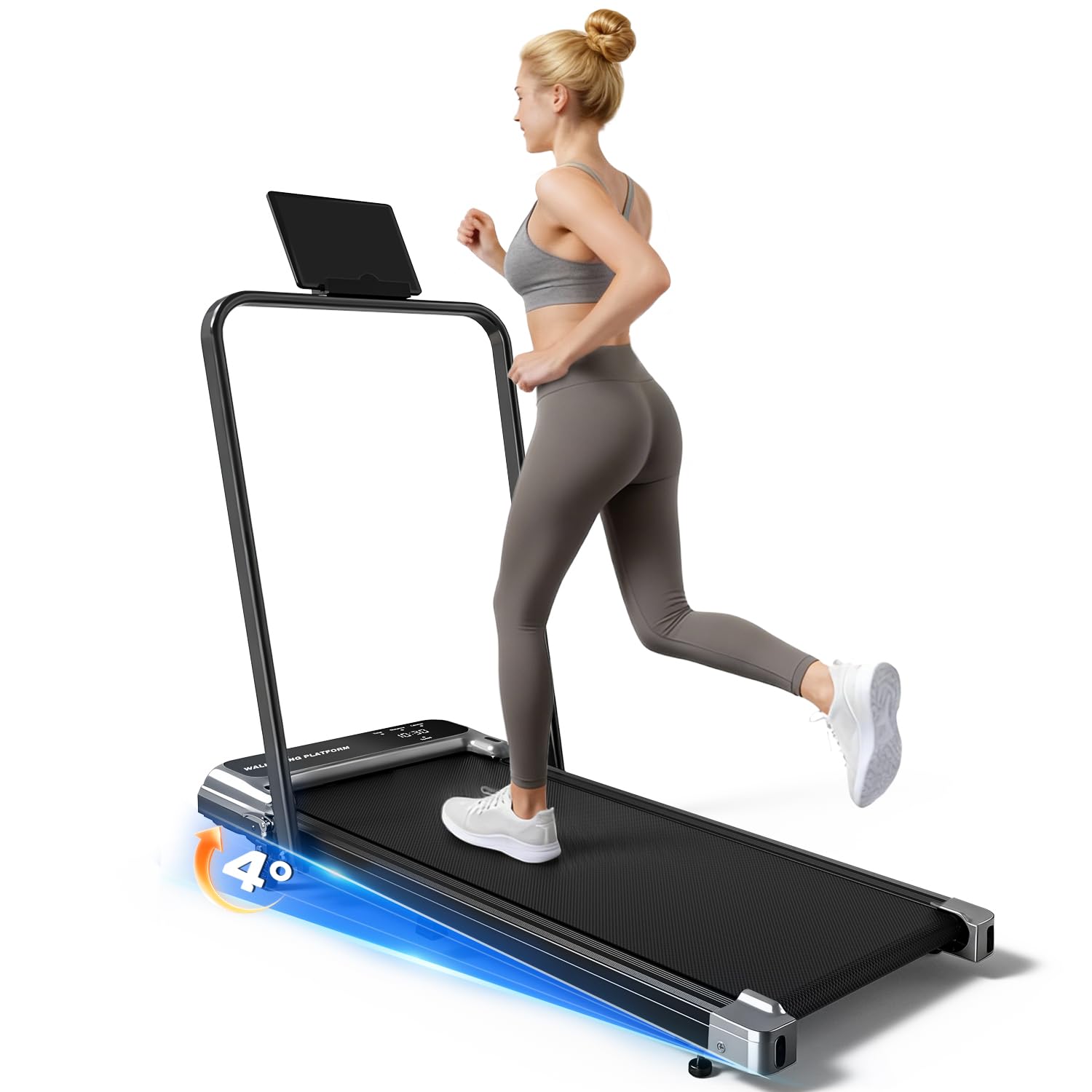
A 4% incline and a folding handrail do not sound dramatic, but they are the reason the Viamotion stands out among the cheapest pads here. It gives you a bit of grade and something to hold, two things most budget walking pads leave out.
The rest is sensible for a home office: a 3.8 mph top speed, a 2.5-hp motor, a 265-pound weight limit, and a listed 45 dB noise level. The handrail folds so the machine can go upright against a wall or under a bed, and the LED display tracks time, speed, distance, and calories.
We see this as the budget alternative for someone who wants a handrail and a little incline but does not need the app or auto incline of the top pick. The controls are simpler than the leaders here, so it is a value call rather than a performance upgrade. The 4% grade is mild; do not expect it to transform the effort.
Still, it is a practical first walking pad. The remote, lubricant, and one-year motor warranty cover the basics, and the folding handle makes it easier to live with in a small room.
Pros
- Incline and handrail at a budget price
- Folds upright for tight spaces
- 265-pound weight capacity
- Listed 45 dB noise level
Cons
- Mild 4% incline only
- No app control
We see the Viamotion as the budget route to a small incline and a folding handrail, with simpler controls than the leaders.
Best for Small-Space Incline
Cybergoing T10
Key Features
- Incline: 7% fixed
- Belt size: 15 x 36 in
- Top speed: 4 mph
- Weight capacity: 300 lb
- Price: Midrange
The T10 takes a different approach to incline: its 7% grade is fixed, set before you walk. That sounds less convenient than the auto-incline machines, and it is, but it also means less to adjust while you walk.
We like it for small spaces and simple routines. The belt is 15 by 36 inches, the machine is 36.4 pounds, and it is built around a Bosch motor with a 300-pound capacity. The 0.6-4 mph range is all walking, and the app plus remote give you two ways to change speed.
The fixed incline is the catch: you set it and live with it for the session. The 15-inch belt is also narrower than most here, which matters for bigger feet or a wider stance. Those are real limits, but the compact footprint and low deck make it easy to slide under a desk.
As a budget-friendly incline pad, it earns a place. It is the one to choose if you want a standing-desk walk with a little extra effort and do not mind setting the grade by hand.
Pros
- Fixed 7% incline for more effort
- Compact and light at 36.4 pounds
- Bosch motor with 300-pound capacity
- App and remote speed control
Cons
- Fixed incline must be set before walking
- Narrow 15-inch belt
The Cybergoing T10 is our pick for small spaces where a fixed 7% incline is enough and auto adjust is not worth the extra.
Best for Simple Desk Walks
Vhorilix XM-A1
Key Features
- Folded size: 41.3 x 19.3 x 4.1 in
- Item weight: 36.4 lb
- Speed range: 0.6-4 mph
- Weight capacity: 264 lb
- Price: Budget
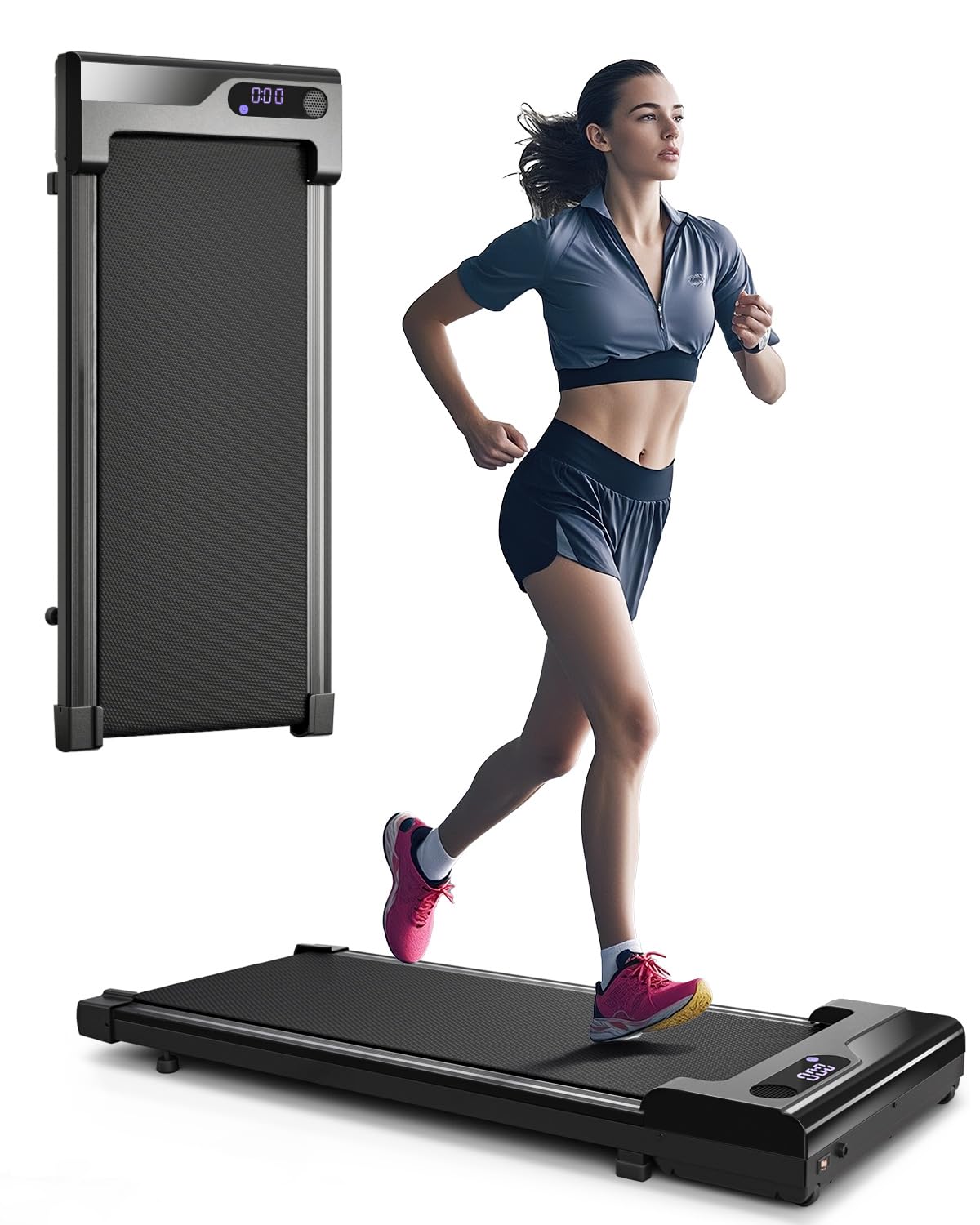
The Vhorilix is what a walking pad looks like when you strip away the handrail, incline, and app: a flat, light belt with a remote and a display. That is not a criticism. For a lot of desks, it is exactly enough.
At 36.4 pounds, it is one of the easier pads to move, and the 42.9 by 19.7 by 4.3 inch body is slim enough to roll under a bed or sofa. The 2.5-hp motor handles 0.6-4 mph, and the 264-pound capacity is fine for most walkers. Setup is essentially none: unbox, plug in, walk.
We miss a handrail for longer or faster walks, and there is no incline to break up the routine. The five-layer anti-slip belt is comfortable, but it is still a flat walk. If you want support or grade, spend elsewhere.
For short, frequent walks while working, though, the simplicity is the point. It is the budget pad we reach for when the goal is just more steps, not a full workout.
Pros
- Light 36.4-pound body
- Slim 4.3-inch profile
- 2.5-hp motor with 0.6-4 mph range
- No assembly required
Cons
- No handrail or incline
We reach for the Vhorilix when the goal is simple, light desk walking without a handrail or incline.
Best for Tight Budgets
Buztrio Walking Pad
Key Features
- Motor: 2.5 hp
- Dimensions: 41 x 19.2 x 4.1 in
- Speed range: 0.6-4 mph
- Weight capacity: 265 lb
- Price: Budget
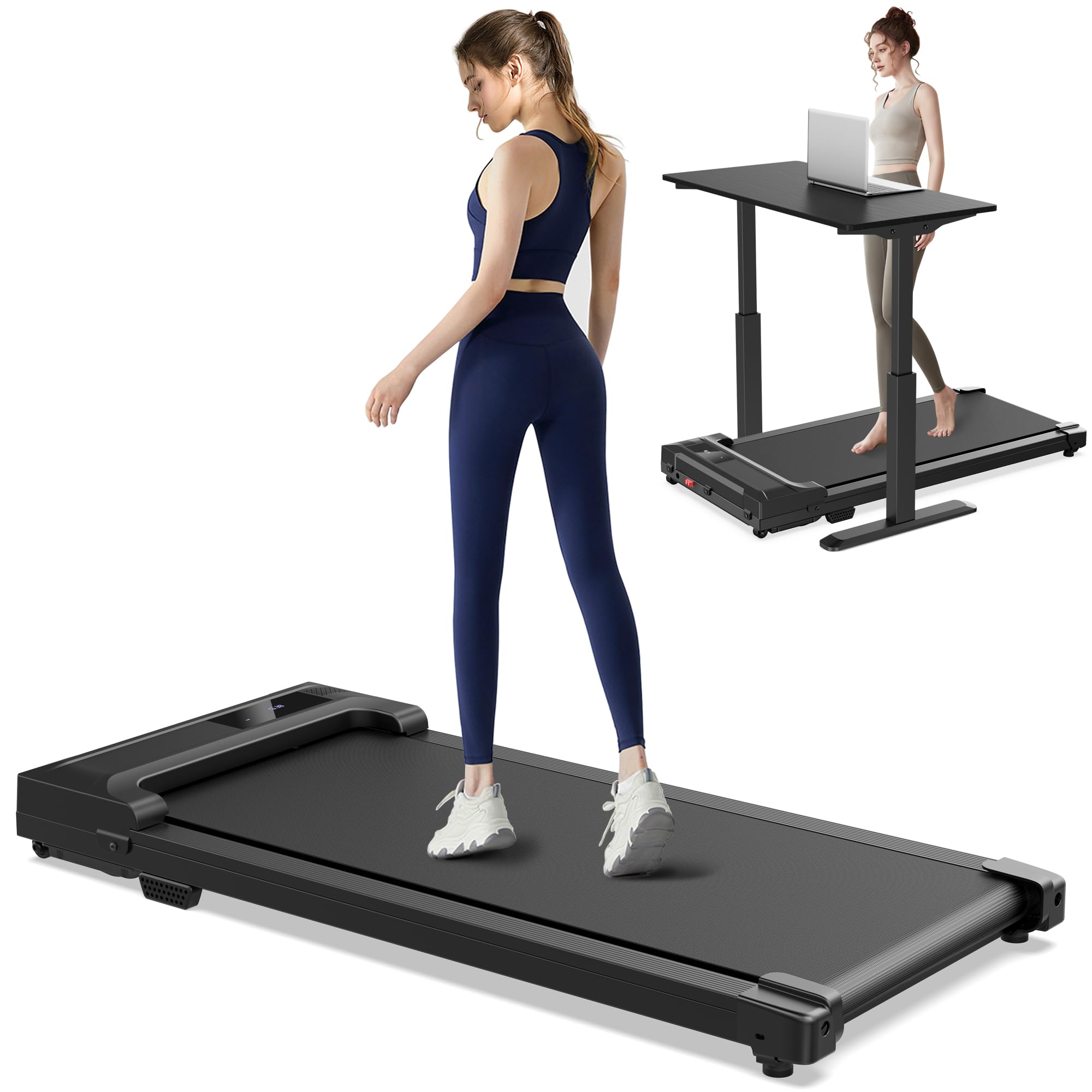
The Buztrio is one of the lowest-profile options here: a 4.1-inch-thick flat pad with a remote, a 2.5-hp motor, and a 4 mph top speed. There is no handle or incline, and the design does not pretend otherwise.
What it does have is a sensible footprint. At 41 by 19.2 inches and with a 265-pound capacity, it fits under a desk or bed without dominating a room. The belt is cushioned and anti-slip, and the LED display covers time, speed, distance, and calories.
The catch is that the design is basic: no handrail, no incline, and a remote instead of handlebar controls. If you need support or grade, this is not the one. The upside is that there is less to adjust and fewer controls to learn.
We see it as a low-cost spare or a first pad for short desk walks. It is not the one for long sessions or for anyone who wants to hold on, but it covers the essentials without clutter.
Pros
- Very slim 4.1-inch body
- 265-pound weight capacity
- Simple remote and LED display
- 2.5-hp walking motor
Cons
- No handrail or incline
The Buztrio is the low-cost first pad we point to for short walks, not for long sessions or support.
Best for Manual Incline
XVCAS Walking Pad

Key Features
- Incline: 0-8 degrees manual
- Top speed: 5 mph
- Folded size: 43.5 x 18.1 x 4.3 in
- Weight capacity: 270 lb
- Price: Budget
The XVCAS is one of the few budget pads here with a manual incline: 0 to 8 degrees, set before you walk. It also folds to about 4.3 inches, so it is aimed at small spaces.
The rest is familiar: a 2.5-hp motor, a 5 mph top speed, a 270-pound weight limit, and a remote with an LED display. The machine measures 43.5 by 18.1 inches, so it is longer than some but narrower than others. It is a walking-first machine despite the higher speed claim.
The incline is the reason to look, but it is manual, so you are stopping to change it. The controls are also basic: a remote and a display, with no app or handlebar buttons. That is not a reason to avoid it, but it is a reason to buy it for simple walks rather than a complicated training plan.
We recommend it for budget-minded walkers who want a little grade and a compact fold, and who are comfortable with a simpler control setup. If you want auto incline, the TRAILVIBER is the clear step up.
Pros
- Manual 0-8 degree incline
- Folds to 4.3 inches
- 270-pound weight capacity
- 5 mph top speed
Cons
- Manual incline only
- No handrail for balance
Our budget pick for a manual incline is the XVCAS, provided you don’t need automatic controls.
How We Tested Nine Walking Treadmills Over Eight Months
We started with specs: we pulled details on more than 60 walking treadmills and narrowed the field to models that could hold a steady 2 to 4 mph for 45 minutes, slide under a standard standing desk, and run their basic controls without a subscription or an app. From that shortlist we ordered nine and set them up in three testers’ homes.
Each machine lived where it actually would — under a desk in a home office, at the foot of a couch, and in one apartment where we drafted the downstairs neighbor as a noise witness. We timed the unboxing and setup alone, noting the moments a second pair of hands would have helped, then checked after the first week whether the belt had drifted off center. Sessions ran 30 to 45 minutes at 2.5 to 3.5 mph, and we noted how the belt felt barefoot versus in sneakers and whether the deck surface warmed underfoot.
Because a walking treadmill is quiet until it isn’t, we took decibel readings at 2, 3, and 4 mph and asked the neighbor below what actually carried through her ceiling. We worked every remote from across the room and from the desk chair, and checked whether each machine could still start, stop, and change speed if that remote went missing. Cord length got the tape measure, too: we measured true reach from the front of the deck to an outlet and flagged which units needed an extension cord. Value came down to miles — we kept walking past 50 on each one, watching for frame creak and belt wear, and weighed that against what each machine cost.
How to Choose a Treadmill for Walking
The right walking treadmill is the one that fits your room and your routine, not the one with the longest feature list.
Pick the feature set you will actually use
The first choice is whether you want a flat pad, an incline model, or one with a handrail. A flat pad is smallest and simplest; incline adds effort without speed, and auto incline is worth paying for if you will change it often. A handrail helps balance, but check the height: a short bar can land at the hips rather than the chest. For most desk walkers, a 4 mph ceiling and a 0.6 mph start are enough. We think the feature you will use daily matters more than the longest spec sheet.
Measure the deck and the parking space
Deck size and storage matter more than the marketing photos suggest. A 15-inch-wide belt is fine for a narrow stride but cramped for larger feet; 19 to 21 inches is more forgiving. Check the folded height against the gap under your bed or sofa, and check the machine weight against the number of times you will actually move it. A 44-pound pad with wheels is easy to roll; a 36-pound pad is easier to lift. Measure both the walking space and the parked space before you buy.
Treat noise and controls as daily-use features
Noise and controls are what turn a good spec sheet into a machine you avoid. A quiet motor helps in an apartment or shared office, but belt hum and footfall still carry. Remotes are convenient until they pair slowly or go missing; handlebar buttons are easier to reach mid-walk, and an app adds logging but not much else. Check the power-cord length, too, because a short cord can decide where the machine lives.
Budget for upkeep, not just purchase
Walking pads are low-maintenance, not no-maintenance. Most need periodic belt lubrication and a quick check that the belt is centered; a dry or drifting belt is the usual cause of noise and uneven wear. Keep the manual and the included tools, and note the warranty terms before you need them. Motor coverage varies from one year to three in this group. A model with a longer warranty is worth a premium if you plan to walk daily.
Frequently Asked Questions
What is the difference between a walking pad and a regular treadmill?
A walking pad is a low, compact treadmill built for slower indoor walking, usually with a top speed around 4 mph. A regular treadmill has a longer deck, a handrail, and enough power for running. If you only need desk steps, a walking pad is easier to store; if you want to run or hold on for balance, a treadmill or a handrail model is the better fit.
Can I run on a walking treadmill?
Most walking pads top out at 4 mph, which is brisk walking, not running. The WELLFIT reaches 6.2 mph, but its 36-inch deck and folding handrail still make it a walking machine first. If running is the goal, buy a running treadmill with a longer deck and a stronger motor.
Do walking pads need assembly?
Most flat walking pads arrive ready to walk after you plug them in and pair the remote. Handrail models may need the upright attached; the WELLFIT’s handlebar comes already in place and needs only the screw-on knobs. Check the packaging for the lubricant and tools before you recycle it, since those small parts are easy to miss.
Final Verdict
The TRAILVIBER X01 is the walking treadmill we recommend for most people who want a dedicated indoor routine. Its auto incline, 450-pound frame, and three-year warranty make it the most complete machine in this group, and the 4 mph ceiling suits walking rather than pretending to be a running treadmill.
If a handrail matters more than incline, the Yagud is the budget choice and the WELLFIT adds handlebar controls for a midrange price. For the simplest possible pad, the Vhorilix keeps the cost and the clutter low.