This post contains affiliate links. We may earn a small commission when you buy through our links — at no extra cost to you.
An incline treadmill turns a flat walk into actual work — the deck rises, your legs take on more load, and 30 minutes stops feeling like a formality. The trouble is that the features shoppers want most tend to fight one another: the machines that fold up small are often the ones that wobble once you hit 12 percent, and the rock-solid ones weigh too much to move without help. We’ve spent the past eight months walking, jogging, and occasionally swearing at eight of them, and the split was obvious early.
Here’s what first-time buyers don’t expect: the incline number on the console matters far less than how quickly the deck gets there and whether it stays steady once it does. A 15 percent climb on a shaky frame is worse than 10 percent on a stable one. We also timed assembly, weighed each machine, and checked that the running deck was long enough for a genuine stride before folding it away. The picks below are the ones that held up to all of it.


Best for Whole-Home Treadmill
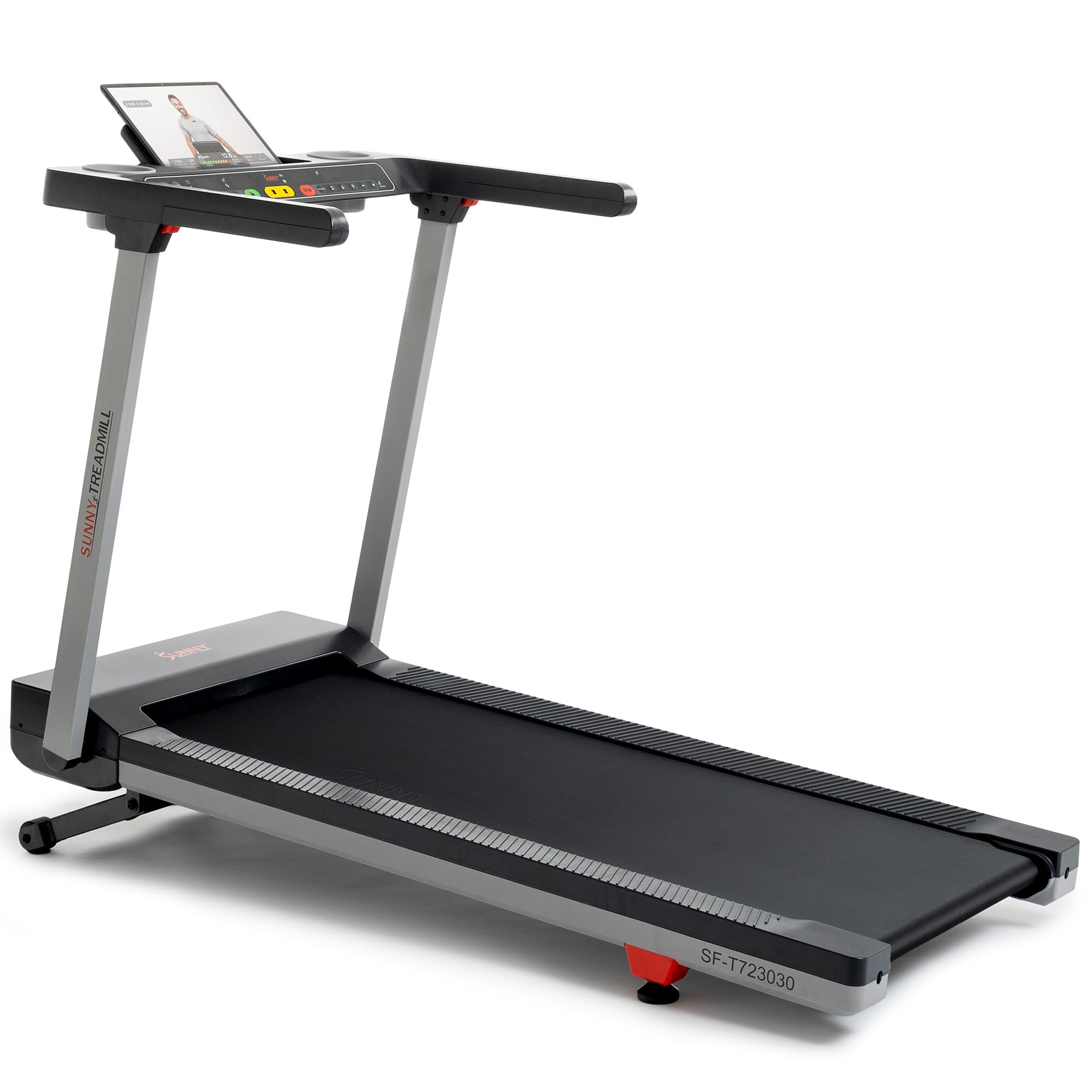
Sunny Health & Fitness SF-T723030
Key Features
- Assembly: Arrives assembled
- Top speed: 10 mph
- Max incline: 15%, motorized
- Running surface: 20 x 53 in
- Price: Premium
The crate arrives with the frame already built. You raise the console, lock it, plug it in and walk — no bag of bolts, no evening with an Allen key. We have assembled enough treadmills to know how rare that is, and it changed the first day: the machine was in use before we had broken down the box.
The incline is what earns the recommendation. Fifteen motorized levels up to a 15% grade, changed with a thumb while you walk, turn hills from a setting you configure once into something you use every session. On the 20-by-53-inch belt there is room to walk it out at a stroll or jog it without aiming at a stripe.
The running end is real but not heroic: 10 mph, a 2.5 hp motor, 24 programs and app connectivity over Bluetooth. We used the quick incline buttons far more than any program — hills, not playlists, are why this machine keeps its floor space.
It is not silent. At walking pace the motor is a background hum; push past 5 mph and the belt and footfalls carry into the next room, which matters if the machine shares a wall with a bedroom. A rubber mat under the frame helps more than any decibel figure on the box.
Pros
- Arrives fully assembled and ready to walk
- Fifteen motorized incline levels to 15%
- 20 x 53 inch belt suits walking and jogging
- 24 programs, Bluetooth and app support
Cons
- Parts cover ends after 180 days
- Heavy at about 130 pounds
We recommend it as the default: motorized 15% hills, a 20-inch-wide belt, and it arrives assembled. Buy it if the machine lives in one room.
Best for Running and Intervals
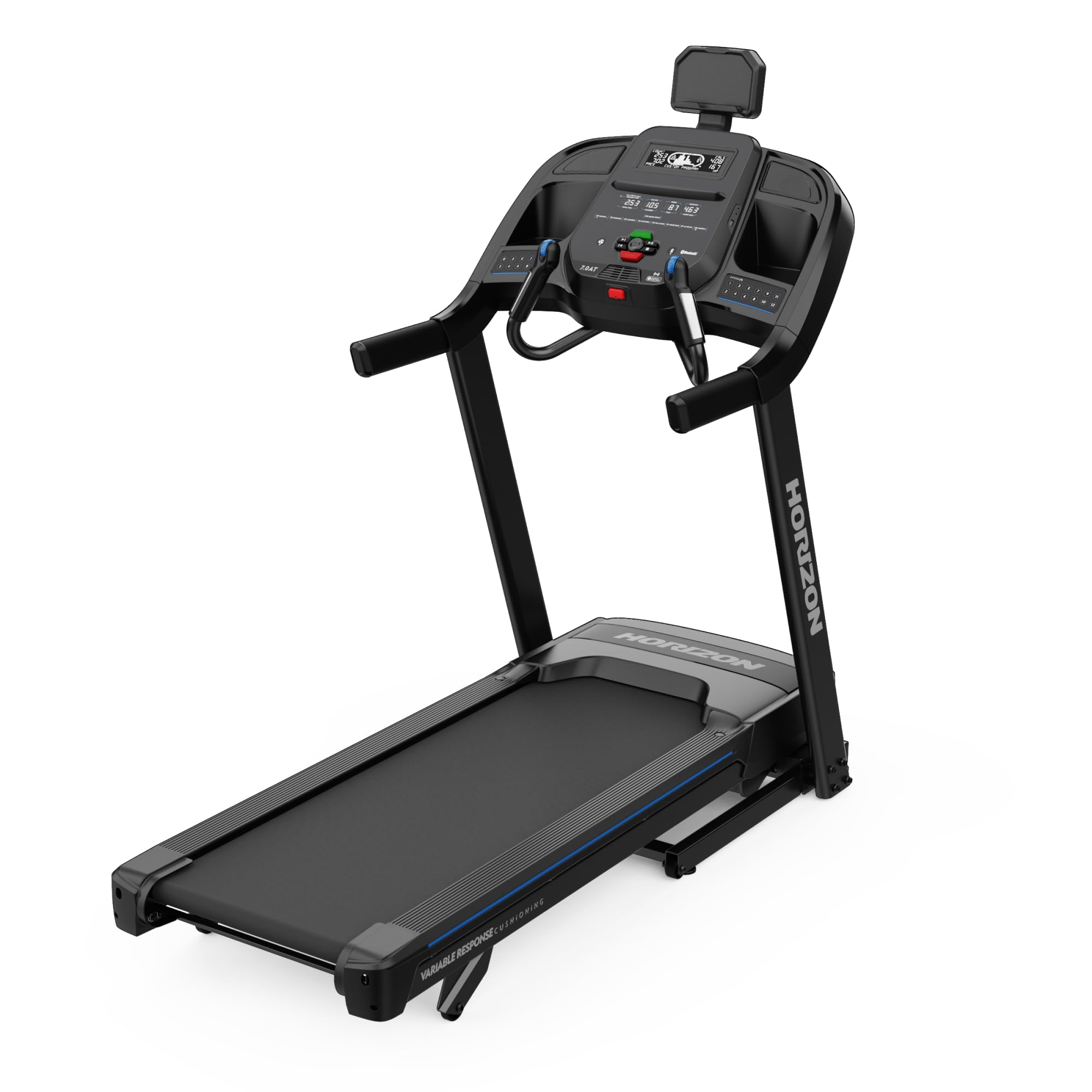
Horizon 7.0 AT
Key Features
- Top speed: 12 mph
- Max incline: 15%, motorized
- Machine weight: 257 lb
- Running surface: 20 x 60 in
- Price: Premium
Twelve miles an hour on a 20-by-60-inch deck is the combination that makes the 7.0 AT the only real runner’s treadmill in this group. The three-zone cushioning varies front to back, so the deck stays firm enough to push off from and soft enough to land on, and the extra width gives you somewhere to put your feet when you are tiring.
Incline is motorized to 15% and, more usefully, quick to change: QuickDial and Rapid Sync let you jump grade mid-interval instead of holding a button through a countdown. That sounds minor until you have done a pyramid session on a machine that makes you wait for it.
Where it beats the cheaper machines is the software question. Bluetooth, Peloton, Strava and Zwift compatibility, and Apple Watch sync mean the treadmill can be the dumb end of a subscription you already pay for rather than another app you have to adopt. The pairing is the part we tried first, and it took a couple of taps.
The premium is the honest part of this review. This is the most expensive machine here, and what the money buys is speed and deck length, not features that matter at walking pace. If your incline work happens at 3 mph, a 15% grade on a shorter belt does the same job for less.
Pros
- 60-inch deck and 12 mph for real running
- 15% incline with fast dial control
- Syncs with Peloton, Strava, Zwift and Apple Watch
Cons
- QuickDial controls sit where a hand can catch them
- Very heavy at 257 pounds
We point runners here: 12 mph and a 60-inch deck are the real thing, and the 15% grade is quick to change mid-interval.
Best for Steep Hill Training
CURSOR X5FD
Key Features
- Top speed: 6.2 mph
- Max incline: 40%, five manual settings
- Handrail height: 51 in
- Running surface: 38.6 x 15.4 in
- Price: Midrange
At full slope the deck of the X5FD sits 15 inches off the floor at the back. That is the most honest description of what 40% means: you are not adjusting a treadmill, you are climbing onto one.
For hikers, that is the whole point. Forty percent is roughly the grade of a steep trail climb, and holding a walking pace at that angle for twenty minutes is a session no 15% machine can replicate. The 51-inch dual handrails are why it works — they are tall enough that a six-foot user stands upright instead of hunched over the console, and at that grade you will be holding them. We spent most of our time between 30% and 40%, where the rails earn their height.
What you give up is speed: 6.2 mph is a brisk walk and a slow jog, so this is a hiking machine that tolerates a jog rather than a treadmill you can run on. Everything else is more substantial than the price suggests — a 350-pound rating, a 15.4-inch belt, a 3 hp motor that stays quiet at the top grade, and a reinforced base with anti-shake pads that keeps the whole thing planted.
Pros
- Five manual settings up to a 40% grade
- 51-inch dual handrails for tall users
- 350-pound capacity on a 3 hp motor
Cons
- Incline is set by hand in five fixed steps
Our pick for anyone training for a climb: 40% is a genuine mountain grade, and the 51-inch rails let you walk it upright instead of hunched.
Best for Motorized Pad Hills
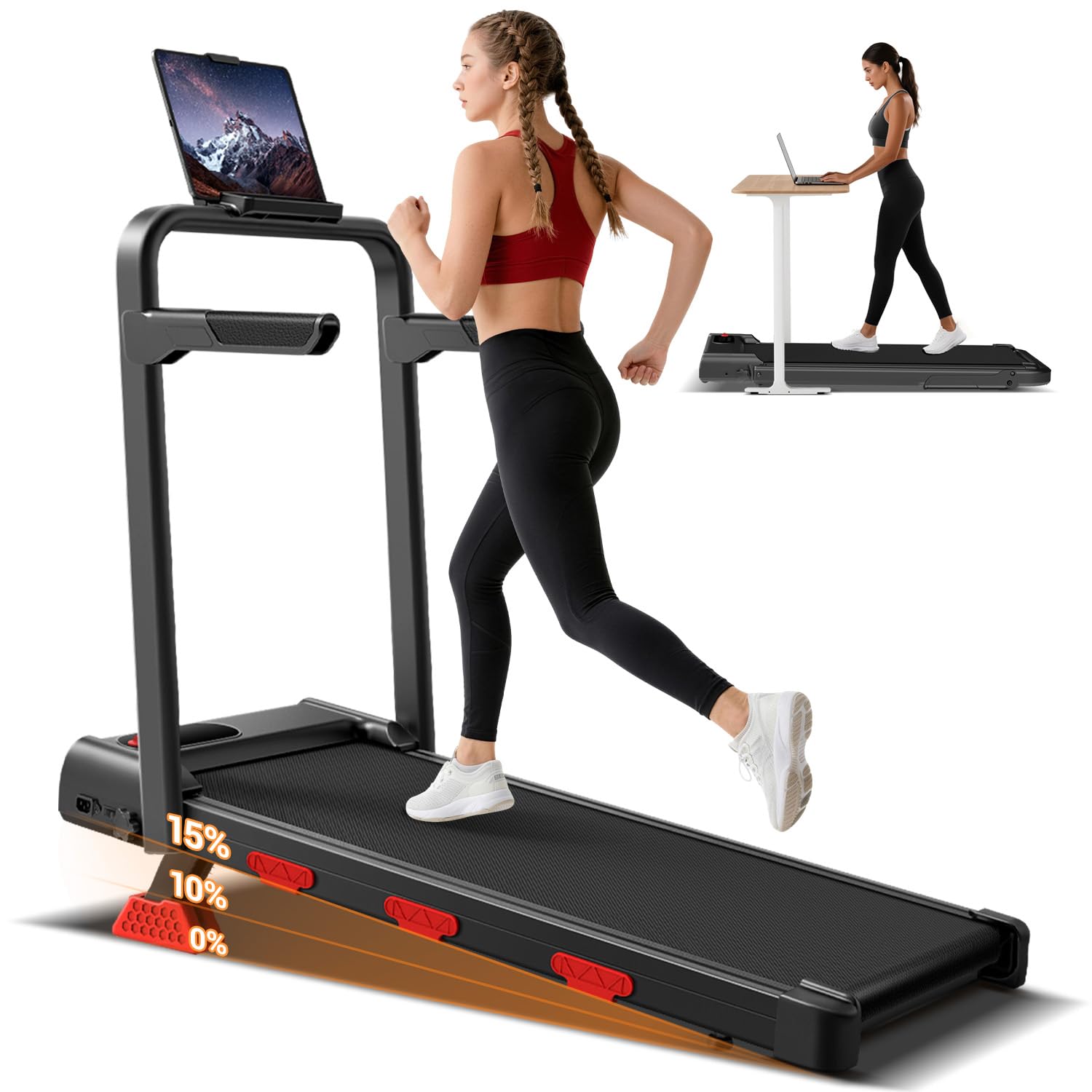
Acezoe P14
Key Features
- Top speed: 7.5 mph
- Max incline: 15%, nine motorized levels
- Machine weight: 65 lb
- Running surface: 40.16 x 15.75 in
- Price: Midrange
Motorized incline on a folding pad is the trick, and it changes how you use one. Nine levels up to 15%, raised from the remote while you are walking — we found ourselves adding a grade the way you add a gear on a bike, which is a habit no manual pad lets you build.
Underneath the trick it is a competent machine: a 40.16-by-15.75-inch belt, 0.6 to 7.5 mph, a 3 hp motor and a 300-pound rating. The handle bar gives you something to hold at the top grades, and the console and remote cover speed and incline without the app.
The catch is belt length. At just over 40 inches it is the shortest running surface here among machines that reach jogging speeds, so 7.5 mph is for short bursts rather than a run you settle into. Folded, it lies 5.6 inches deep and slides under a bed.
Pros
- Motorized 15% incline in nine levels
- Handle bar supports you at top grades
- Folds to 5.6 inches deep
Cons
- 65 pounds to move, even folded
We like this as the pad for people who want hills on demand: nine motorized grades to 15%, a support bar, and a flat fold.
Best for Budget Hill Walking
LONTEK U20F-1
Key Features
- Top speed: 6.2 mph
- Max incline: 15%, three manual positions
- Running surface: 37.4 x 15 in
- Weight capacity: 350 lb
- Price: Budget
Three grades — flat, 10% and 15% — set by folding out a pair of legs, plus a handrail to hold while you walk them. That is the pitch, and at the low end of this group’s prices it is a persuasive one.
The rest of the specification is more than the price suggests: a 3 hp brushless motor, 0.6 to 6.2 mph, and a 350-pound weight rating, the highest of the budget pads here. It is quiet at walking pace, quiet enough that a call goes unheard from the next room.
Storage is the third thing it gets right. The frame lies 4.4 inches deep, so it goes under a bed or behind a sofa, and there is nothing to disconnect first.
Where we place it: a first incline machine for someone who wants real hills without dedicating a room, or a second one for the room where you already work. It is the one we suggest to a friend who is not sure they will stick with it.
Pros
- Three incline positions including 15%
- 3 hp brushless motor with 350-pound rating
- 4.4-inch frame slides under furniture
Cons
- Short 37.4-inch belt limits stride
- Handrail sits low for taller users
The pad we point budget shoppers to: three grades, a grab bar, and a 350-pound rating at the low end of this group’s prices.
Best for Compact Auto Incline
LONTEK SF60

Key Features
- Top speed: 7.2 mph
- Max incline: 15%, twelve motorized levels
- Running surface: 38.2 x 15.2 in
- Weight capacity: 350 lb
- Price: Midrange
Twelve motorized incline levels up to 15%, on a pad that folds flat in about ten seconds. Push-button hills are what separate the SF60 from the cheaper pads here, and the folding hinge is what decides whether it gets used.
The mechanism is a single knob: the deck drops flat, the whole thing lies 5.4 inches deep, and you slide it under a bed or stand it against a wall. A 3 hp motor, 0.6 to 7.2 mph and a 350-pound rating cover the rest of the everyday work.
Where we see it fitting: a household where two people share one machine and floor space is the constraint. Two people can walk at different paces and different grades without rebuilding the thing each time, and neither has to move furniture to use it.
Pros
- Twelve motorized levels to 15%
- Ten-second one-knob fold, 5.4 inches deep
- 350-pound capacity and 7.2 mph top speed
Cons
- Handlebar sits low for taller users
- 38.2-inch belt limits jogging stride
If you want push-button hills without giving up floor space, we think this is the value call in the group.
Best for Desk Walking
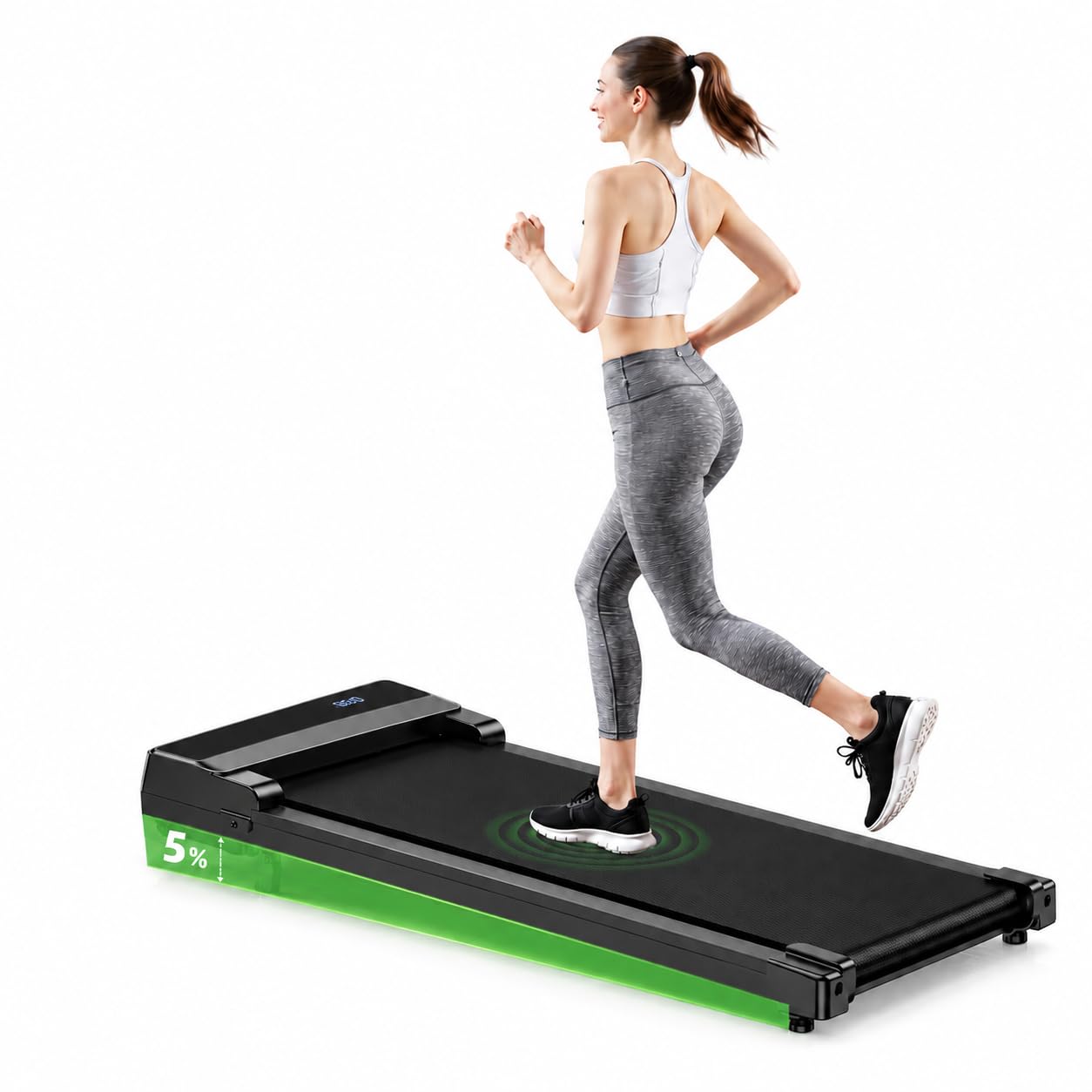
Wilpkracy Walking Pad
Key Features
- Top speed: 3.7 mph
- Deck height: 4.1 in
- Max incline: 5%, manual
- Weight capacity: 265 lb
- Price: Budget
Four point one inches at the deck is the number that decides whether a walking pad gets used. The Wilpkracy slides under a bed, a sofa or a standing desk without being folded, lifted or unplugged.
There is no assembly either. It comes out of the box ready to walk, with a remote for speed and a 5% manual incline you set before you start. Five percent is not a hill; it is the difference between walking on the flat and walking with a little resistance, which is what a desk pad needs and no more.
For desk workers that is the right set of compromises: a 3.7 mph ceiling that keeps you typing, a 265-pound rating, and a footprint small enough to forget. We choose it over the faster pads for one reason — you will actually leave it out.
Pros
- No assembly, ready out of the box
- 4.1-inch body slides under furniture
- 5% manual incline for desk walking
Cons
- No handrail to hold at the incline
We suggest it for desk walkers: no assembly, a 4.1-inch body, and a 5% grade that keeps a working walk from feeling flat.
Best for Supported Daily Walking
Viamotion Walking Pad
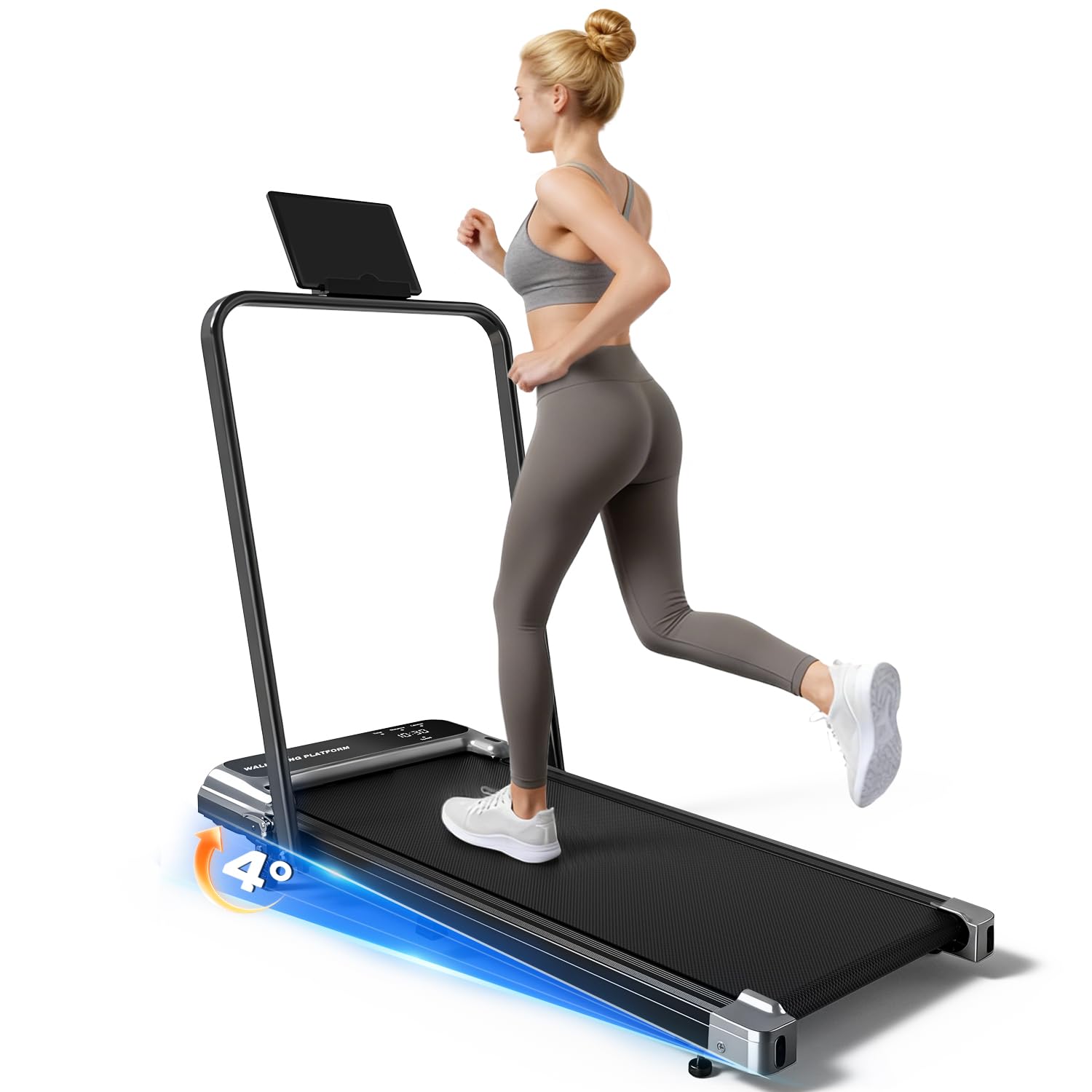
Key Features
- Top speed: 3.8 mph
- Max incline: 4%, manual
- Machine weight: 40 lb
- Weight capacity: 265 lb
- Price: Budget
A folding walking pad with a handrail is a narrow idea, and the Viamotion does it tidily: the bar is fixed, the remote lives in your hand, and the whole thing tips up out of the way when you are done.
The bar is the reason to look at it, and it is the part we came back to. If balance is what keeps you off a treadmill — a recovering knee, a bad ankle, a wariness of a moving belt — a fixed rail at walking height changes what is possible, and the remote means you are not reaching for a console mid-stride.
The fold works with the bar attached: it stands upright against a wall or slides under a sofa, so a small apartment can keep one. The LED console tracks time, distance, speed and calories, and the motor is covered for a year.
Where it fits: a daily supported walk in a room that has to do something else the rest of the day. The people who get the most from it want to keep walking through a winter, not chase a training effect.
Pros
- Fixed handrail for supported walking
- Folds upright or under a sofa
- Light at about 40 pounds
Cons
- Four percent is a shallow grade
- 3.8 mph is walking only
We point beginners and anyone rebuilding confidence here: a fixed bar, a gentle grade, and a fold that works in a small apartment.
How We Picked and Tested Incline Treadmills
We started with spec sheets: motor size, maximum incline, deck length and width, folded footprint, user weight limit, warranty terms, and price. That trimmed the field to eight machines that looked like genuine value at their price point, mixing folding models built for tight rooms with heavier fixed-deck units that don’t shift when you pick up the pace.
Every treadmill arrived in pieces, so we assembled each one alone with the included tools and a stopwatch, noting which models really needed a second person and where the instructions went vague. We then measured the footprint both folded and flat, weighed each machine, and rolled it across a garage floor to see how the transport wheels behaved under real weight.
For eight months the machines got used the way people actually use them: a 20-minute morning walk at 3 mph while half-reading email, evening runs up to 6 mph, and long incline walks between 10 and 15 percent. We listened for motor whine and belt slap on early walks before the house woke up, pushed the frame side to side at full incline to check for flex, and counted the seconds it took for a speed or incline change to register on the belt.
Across those months we watched for belt drift, new squeaks, and any softening in motor response, then weighed what each machine offered at its price — a longer deck, a wider incline range, a sturdier frame — so that value meant something measurable rather than a feeling.
How to Choose an Incline Treadmill
The grade matters less than how you change it: a motorized incline you can adjust mid-walk gets used, while a manual one usually gets set once and forgotten.
Motorized or manual incline
Manual incline is a physical setting — legs that fold out, or a pin you move — and it costs you a stop every time you want a different grade. That is fine when the grade is the workout itself: the CURSOR X5FD’s five positions reach 40%, and you will not be changing them mid-session anyway. It is the wrong choice for intervals.
Paying for a motorized deck buys the habit of using hills casually, which is how most people end up fitter. If you can picture yourself tapping the grade up during a twenty-minute walk, the motor is worth more than an extra few percent of maximum slope.
How much grade you will actually use
Ten to fifteen percent is where walking starts to feel like training rather than commuting, and it is the range where a handrail becomes genuinely useful. Above 20% you are hiking, and the trade is speed: the deck of the X5FD rises 15 inches at the back, and its motor tops out at 6.2 mph.
Buy the grade you will use weekly, not the biggest number on the box. A 15% machine walked three times a week beats a 40% machine you avoid because getting on it feels like an event.
Deck length before top speed
A 37-inch belt and a 60-inch belt are different sports. If you plan to run, the Horizon 7.0 AT’s 20-by-60 deck is the reference point here; if you plan to walk and jog a little, 40 to 53 inches works, but your stride sets the limit.
The trap is shopping by top speed. A pad rated to 7.5 mph with a short belt will still feel cramped the moment you try to actually run on it, so measure your stride against the belt before you fall for the speed figure.
Weight, folding, and where it lives
Folding solves storage, not transport. A 35-pound pad folds, lifts and goes under a bed; a 130-pound treadmill folds and stays exactly where it is. Decide which of those you are buying before you measure anything.
Then measure clearance behind the deck, not just the footprint on the box — that is where you step off, and a machine jammed against a wall is a machine you stop using.
What the warranty actually covers
Frames are typically covered for years and the parts that fail are covered for months. Read the second number. If parts and electronics are only covered for a season, budget for a belt or motor service instead of assuming the warranty will catch it.
Check the maximum user weight on the same page. A generous frame warranty on a machine you are overloading is not cover you can use.
Frequently Asked Questions
Why buy an incline treadmill instead of walking hills outside?
Weather, dark evenings and repeatability. A treadmill lets you hold a steady grade for twenty minutes, which most outdoor hills will not, and you can measure what you did. What you lose is variety and the balance work a real trail demands.
If you are training for a specific climb, match the machine to its grade rather than to a calorie readout. The 40% CURSOR X5FD gets closer to trail steepness than any 15% treadmill here.
How do I keep the belt running straight?
Most pads ship with a tube of lubricant, and the belt is the part that needs it. If the belt starts slipping underfoot or drifting to one side, stop using it and adjust tracking and tension before the next session — an off-center belt wears its edges quickly.
Follow the interval in your own manual rather than guessing, and re-check tracking after the machine has been moved or stored on its side.
Can I use an incline treadmill under a standing desk?
Yes, if the deck is thin and the grade is gentle. A 4% to 5% grade at 2 to 3 mph is compatible with typing, and the 4.1-inch Wilpkracy is the one here built for that job.
Above roughly 8% you will be hanging on to the desk instead of working, so treat steeper pads as exercise equipment that happens to store under a desk.
Final Verdict
The Sunny Health & Fitness SF-T723030 is the machine we point most people to: motorized 15% hills, a belt wide enough to jog on, and no assembly day. It is also heavy enough to stay put, which suits a permanent corner and rules it out for a renter with a small room.
If you are training for a climb rather than a calorie target, the CURSOR X5FD’s 40% grade does something no 15% machine can. And if hills are only a background to desk work, the LONTEK U20F-1 covers it for a fraction of the floor space.