This post contains affiliate links. We may earn a small commission when you buy through our links — at no extra cost to you.
A tent stake holds because of surface area — the ground presses back against the shaft, and that friction does the work. Sand has almost no friction to give, which is why the stakes that come with your tent grip fine in a forest and slide out of a dune around 2 a.m. with the fly snapping. A stake built for sand either spreads that load across a wide fluke or screws down into it like an auger, and the difference between a good one and a bad one is whether you sleep or spend the night re-staking in the dark.
What surprised me most over four months of pitching in beach sand and lake-shore sand with 14 sets is that the loose, powdery stuff up near the dunes is the real test — almost anything will bite in the packed sand by the waterline. Ease of use matters more than I expected, too, because you’re usually setting these one-handed, in wind, with sand already working its way into the moving parts. Below are the ones that held, packed down small, and didn’t cost more than the shelter they were holding up.



Best for Loose Beach Sand
COBARYEN Spiral Sand Stakes
Key Features
- Length: 9.4 in
- Pack count: 10
- Anchor type: Spiral
- Weight each: 1.7 oz
- Price: Midrange
The 9.4-inch spiral is the shape we want in loose beach sand. It gives you more length than the short pegs that come with beach tents, and the corkscrew turns into the sand instead of relying on a straight shaft to wedge in place. That is the difference between a guyline that stays tight and one that slowly walks out.
The 10-pack is the other reason it earns the top spot. Four stakes handle the tent corners; the rest go to canopy legs, extra guylines, or a windbreak. At 1.7 ounces each, the whole set adds little to a beach bag. We also like the two hook points on the head, which let you run a guyline or slide a tarp grommet over the top without adding a separate clip.
In sand, this is the one we reach for first. The thickened spiral bites even when the surface is dry and loose, and the length gives it room to find firmer sand below. It is not a stake for rocky ground or a hammer-in site; treat it as a sand-and-soft-soil tool. For a beach tent, canopy, or sun shade, that is exactly the job.
If you already own a short set of beach pegs, keep them for the corners of a groundsheet and use these for anything that catches wind.
Pros
- Long spiral bites loose sand
- Ten stakes cover tent and canopy
- Two hook points for guylines
- Light 1.7-ounce stakes
Cons
- Black is harder to spot in sand
Our default for beach tents and canopies is this long spiral: it grips loose sand, and the pack has enough stakes to cover the whole setup.
Best for Family Beach Camps
Hikemax 15-Pack Spiral Stakes
Key Features
- Length: 10 in
- Pack count: 15
- Anchor type: Spiral
- Weight each: 1.4 oz
- Price: Midrange
Fifteen stakes is the reason to look at this Hikemax set. A four-corner beach tent leaves plenty spare for canopy legs, guylines, and the friend who forgot their pegs. The bright orange also does what a sand stake should do: it stays findable when the light goes flat.
We prefer it as the group and canopy pack rather than the single-tent pick. The 10-inch spiral turns into sand with a decent bite, and the ABS body is light enough to carry a full set without thinking about it. The oversized T-head gives you something to grip when it is time to twist them out, and the orange color is a real help when the sand is shadowed by a canopy.
Where this set wins is coverage. A 10×10 canopy has four legs and often four guylines; 15 stakes let you double the windward corners instead of hoping four pegs do the work of six. The 1.4-ounce body also makes the whole bundle easy to pass to a kid or stuff into the bottom of a beach cart.
Pros
- Fifteen stakes cover canopy and guylines
- Bright orange stays visible
- 10-inch spiral grips soft sand
- Light 1.4-ounce body
Cons
- Thin shafts are for sand and soft soil
We reach for the 15-pack when a canopy, a family tent, and spare guylines all need anchoring; it is the most useful bulk set here.
Best for Deep, Loose Sand
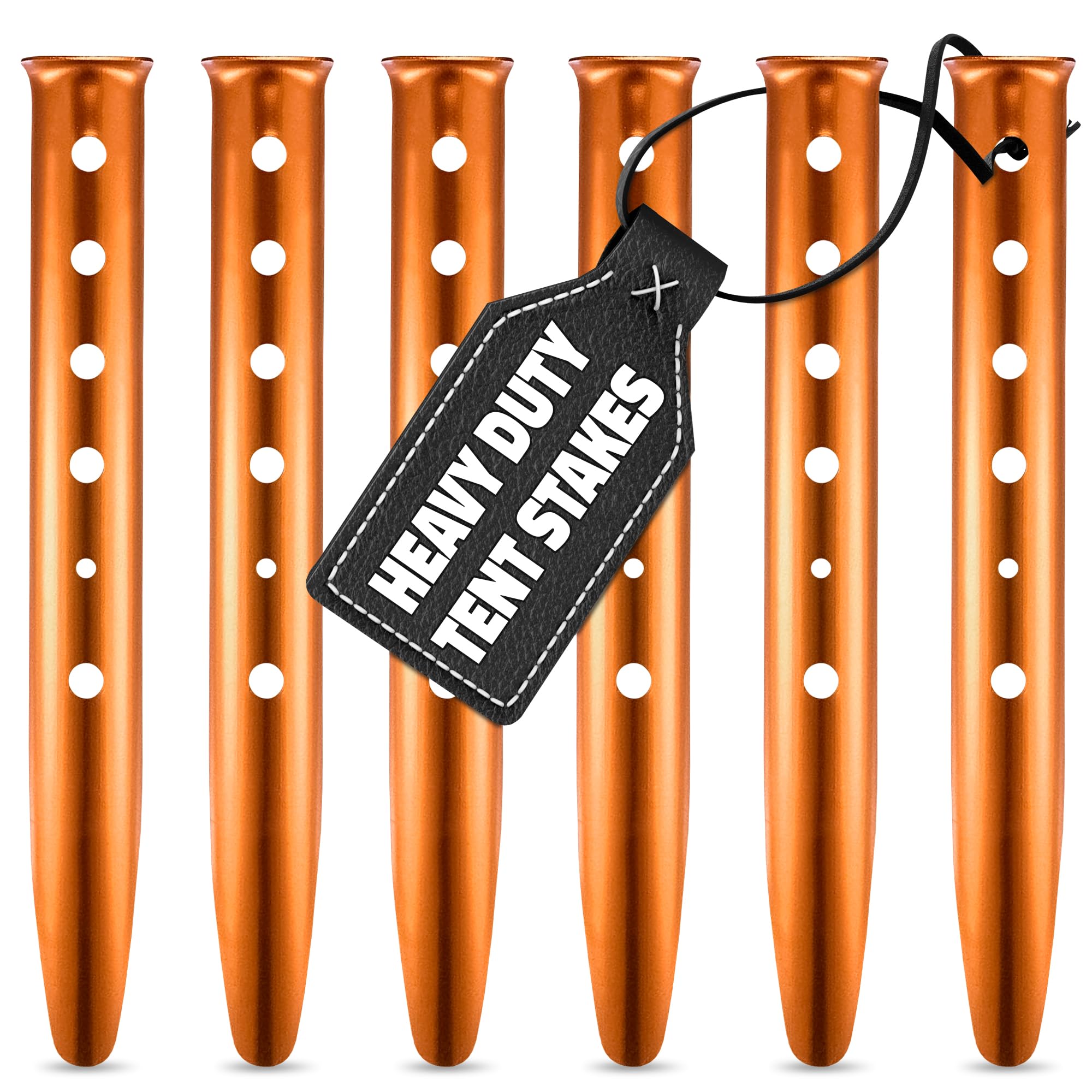
Tesorrio Aluminum Sand Stakes
Key Features
- Width: 1.38 in
- Length: 12.6 in
- Material: Aluminum
- Pack count: 6
- Price: Midrange
The 1.38-inch U-channel is the first thing you notice; it is much wider than a wire peg, and that is the point. In loose sand, surface area does as much work as length, and this stake gives the sand something to grab.
We like it best for car camping and base camps where weight is not the enemy. At 12.6 inches, it reaches deeper than most spiral stakes here, and the six rigging holes let you move the guyline without pulling the stake. The catch is the fit: the wide head will not pass through a small tent loop, so you tie through the holes instead. The other boundary is the ground: this is a sand-and-soft-snow stake, not a hard-ground peg.
For a beach canopy or a large tent in soft sand, the extra width is worth the fuss. We choose it when the sand is deep and the shelter is heavy. The orange finish is also a small mercy when you are packing up at dusk.
Pros
- Wide U-channel grips loose sand
- 12.6-inch length reaches deeper
- Six rigging holes adjust guylines
- Bright orange is easy to find
Cons
- Bends in hard or frozen ground
For deep, loose sand, we reach for the wide Tesorrio U-stake; its 12.6-inch body gives the sand more to grab than any spiral here.
Best for Drill-Assisted Setup
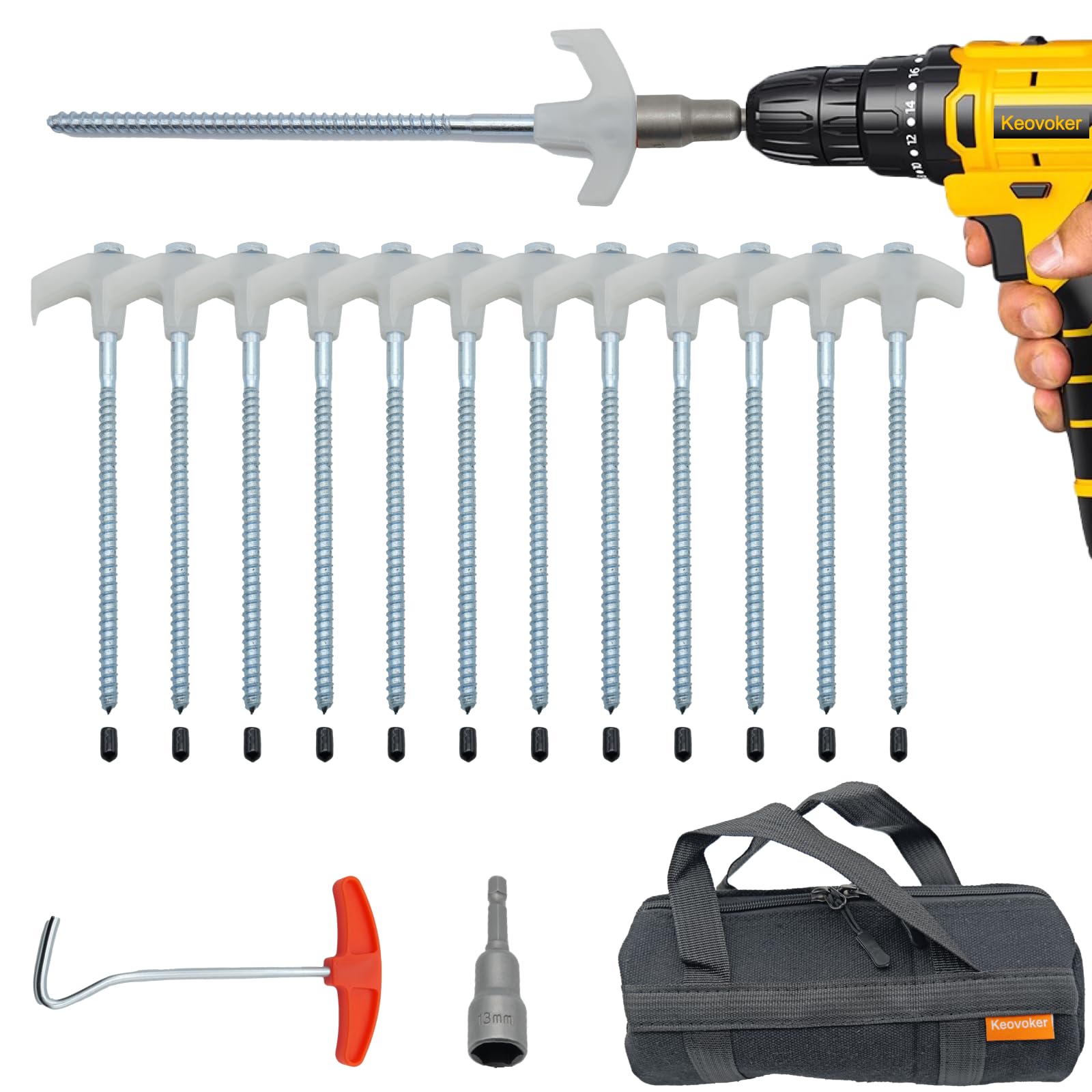
Keovoker Screw-In Tent Stakes
Key Features
- Length: 8 in
- Included: Hex driver and puller
- Material: Galvanized steel
- Pack count: 12
- Price: Midrange
A hex driver, a puller, twelve steel stakes, and a bag: this is less a pack of pegs than a small installation kit. The 8-inch galvanized screws are threaded like a wood screw, and the hex head lets you drive them with a cordless drill instead of twisting by hand.
That speed is the appeal. On packed sand or a mixed campsite, the kit turns setup into a few trigger pulls. The glow tops are a nice touch for finding stakes after dark, and the puller saves your fingers on removal. The protectors keep the threads from chewing through the bag, a detail that matters when the stakes live in a truck.
Our reservation is the ground it suits. The steel thread bites best in packed sand, soil, and mixed ground; in deep, dry sand we still reach for a longer spiral or U-stake. We like this as the fast, compact kit for a canopy on firmer beach sand, not as the out-and-out loose-sand champion.
Pros
- Drill-ready hex head speeds setup
- Threaded steel grips packed sand
- Glow tops and puller included
- Complete kit with storage bag
Cons
- Requires a drill for fast installation
A drill-in kit that turns setup into minutes, and our pick for packed sand and mixed ground where speed matters more than maximum depth.
Best for Packed Sand
Orange Screw Ground Anchors
Key Features
- Length: 9.5 in
- Included: T-grip tool
- Material: Recycled polycarbonate
- Pack count: 4
- Price: Premium
The T-grip is the detail that makes the Orange Screw feel like a tool rather than a peg. You slot it into the top of the 9.5-inch screw and get real leverage, which matters when the sand is packed or the ground is a mix of dirt and grit. The recycled polycarbonate body is the premium material choice in this set, and the made-in-USA build is part of what you are paying for.
The small four-pack suits a sun shelter or a quick beach picnic, not a full family camp. It is the premium option here, and the money goes into the tool and material rather than a big count.
The catch is the sand itself. Orange Screw positions the small anchor for firm soils, and in the loosest, driest sand it does not bite as surely as a long spiral. On packed sand, wet sand, or mixed ground, the T-grip and screw thread are excellent. We reach for it when the beach is firm underfoot and we want a compact, durable set.
Pros
- T-grip gives real leverage
- Recycled polycarbonate is the premium material here
- Compact four-pack for day trips
- Works well in packed sand and mixed ground
Cons
- Only four stakes per pack
This is the premium screw anchor we choose for firm sand and mixed ground, when a compact, durable set matters more than a high stake count.
Best for Mixed Ground
Hikemax 10-Pack Plastic Stakes

Key Features
- Length: 9 in
- Pack count: 10
- Anchor type: T-beam
- Weight each: 0.99 oz
- Price: Budget
The appeal here is simple: a ten-pack of 9-inch plastic stakes that weighs almost nothing and costs less than most of the purpose-built sand anchors here. For a beach bag that already has too much in it, that matters.
The T-beam shape gives it more grip than a smooth round peg, and the bright orange is easy to spot. In packed sand or a grassy dune edge, it does the job and comes out without a fight.
Where it fits is the mixed site: a patch of sand behind the dunes, a grassy campground, a groundsheet that needs a few extra corners. The 9-inch length is enough for that work, and the light weight makes a ten-pack easy to leave in the car.
We keep a pack as a backup and a budget set, not as the main anchor for a wind-loaded canopy. The lower price and lighter pack are the trade we make for a spare set.
Pros
- Ten-pack is cheap and light
- T-beam adds grip over round pegs
- Bright orange is easy to find
- Good for mixed sand and grass
Cons
- Less hold in loose, dry sand
The budget set we keep in the car for mixed ground and low-stakes shade; it is light, bright, and easy to live with.
Best for Backpacking
TRIWONDER Aluminum U-Stakes

Key Features
- Length: 12.2 in
- Pack count: 6
- Weight each: 1.83 oz
- Rigging holes: 6
- Price: Midrange
At 52 grams per stake, the TRIWONDER set is the one we carry when the walk to the beach is part of the trip. The 12.2-inch aluminum U-stake gives you real surface area without the heft of steel, and six rigging holes let you move a guyline without pulling the stake.
The U-shape is built for soft ground: push it in deep, angle it away from the shelter, and it holds better than a narrow peg. The blue finish is easy to find in sand, and the six-pack is enough for a small tent or a single sun shelter.
Aluminum is the trade-off. This is a soft-ground tool, and the thin walls are not meant for rocky or frozen ground. We also treat the six-pack as a small-tent kit rather than a canopy set. For backpacking to a sandy campsite, though, the weight saving is worth it.
Pros
- 52-gram stakes save pack weight
- 12.2-inch U-shape holds soft sand
- Six rigging holes adjust guylines
- Bright blue is easy to spot
Cons
- Six-pack is small for a canopy
We recommend this for backpackers who need a secure hold in soft sand: 52 grams per stake, six rigging holes, and a long U-shape.
How We Tested Sand Stakes
We started with about 30 sand-specific stakes sold by camping and outdoor retailers, then filtered by material, fluke width, packed length, and price, cutting anything that was really just a standard hook stake with a longer shaft. That left 14 sets, which we tested over four months on beach camping trips, lake shorelines, and a few windy afternoons on exposed dunes.
Most of that time was spent in the soft, dry sand above the tide line, since that’s where tents actually go and where ordinary stakes give up. I pitched a low-profile tent using each set alone, timed setup and breakdown solo, and then repeated it in wet, sandy gloves to see which designs needed two hands, a mallet, or a lot of patience. To get a read on holding power, we hooked a luggage scale to each stake and pulled at the same angle until it broke free, first in dry sand and again in the packed sand near the water.
Durability and sand resistance got checked the hard way: saltwater, grit in the threads, and stakes stored dirty between trips. We watched for bent shafts, cracked plastic, worn coatings, and augers that seized after a few days of grit, and we compared what each set includes — stake count, stuff sack, packed length — against what it costs, since a set you replace after one season isn’t a bargain. The ones that came through all of it without fuss are the picks below.
How to Choose Tent Stakes for Sand
The right sand stake is less about brand and more about how much surface area and length you can get into the sand without making setup a chore.
Match the anchor to the sand
Loose, dry sand is the hardest common surface for a tent stake because there is little for a narrow shaft to grip. A spiral or screw-in stake turns into that sand and creates its own hold; a wide U-channel stake relies on surface area and a buried, angled set. A straight peg that works in grass can walk out of dry beach sand. We choose a spiral for a normal beach tent, a wide U for deep soft sand, and a straight stake only for mixed ground.
Length and surface area matter more than the label
A 9- to 12-inch stake has enough length to reach firmer sand below the dry top layer; a 5-inch peg is for a groundsheet or decoration, not a wind-loaded shelter. Width matters too: the Tesorrio’s 1.38-inch U-channel gives loose sand more to grab than a thin wire peg. The trap is tent loops. A wide head may not pass through a small loop, so check the opening before you buy; if it is tight, tie through the stake’s rigging holes or choose a spiral.
Pack count and weight for your setup
Count the corners and guylines before you choose a pack. A four-leg canopy can use six or more stakes once you add windward guylines, and a family tent with a vestibule uses more than a solo tent. Ten to fifteen stakes is a practical beach-camp number; a four-pack is a day-shelter kit. Weight is the other half: 1- to 2-ounce plastic stakes disappear into a beach bag, while aluminum U-stakes around 52 grams each suit backpacking. Steel screws are heavier but earn it in mixed ground.
Installation, removal, and the ground you meet
Spiral stakes twist in by hand and come out the same way. U-stakes go in best when you push them deep and angle them away from the shelter. Steel screws need a T-handle or a drill, and a drill turns setup into minutes. The ground decides durability: thin aluminum U-stakes can bend in hard or frozen ground, and plastic tips are not for rocky sites. We keep a steel screw kit for mixed ground and save the light plastic and aluminum for sand.
Frequently Asked Questions
Can I use regular metal tent pegs in beach sand?
Not happily. A narrow straight peg has little surface area, so it can pull out when the wind loads the guyline. If you are stuck with a regular peg, bury it horizontally as a deadman anchor with the line running up from the middle; that gives the sand something to hold. For a canopy or a tent that will catch wind, use a spiral, screw-in, or wide U-stake instead.
Can sand stakes work in snow?
Yes, especially wide U-channel and screw-in stakes. In soft snow, a U-stake works best buried sideways as a deadman anchor; in packed snow, angle a long stake away from the shelter. The same aluminum U-stakes that hold in sand can bend in hard ice or frozen ground, so keep a steel screw or a snow-specific stake for that. A 12-inch U-stake is a reasonable crossover for soft snow.
How do I get a stuck sand stake out?
Twist a spiral or screw stake out rather than pulling straight up; the threads do the work. For a U-stake, rock it gently fore and aft to break the sand’s grip, then lift. A puller like the one in the Keovoker kit saves your fingers on steel screws, and a little water poured around a stubborn stake can loosen packed sand. Do not lever a thin aluminum stake sideways; it can bend.
Final Verdict
The COBARYEN spiral is the set we recommend first for beach tents and canopies. Its 9.4-inch coil has enough length and surface area to hold in loose sand, and the 10-pack covers a normal setup without making you ration stakes. If you are anchoring a canopy for a group, the Hikemax 15-pack is the better bulk buy. For deep, soft sand where width matters, choose the Tesorrio U-stake; for firm sand and a compact kit, the Orange Screw is the premium pick.