This post contains affiliate links. We may earn a small commission when you buy through our links — at no extra cost to you.
The first time I pulled on a sun hoody for a cloudless hike, I expected to cook. Instead, I stayed comfortable while my arms and neck stayed covered, and I’ve since stopped defaulting to a sunscreen-slathered T-shirt on long days outside. A good sun hoody fixes the tradeoff every sun-sensitive hiker, angler, or gardener knows: you want coverage without heat, and protection without a sticky layer of lotion.
Fit matters more than you’d think: sleeves that stop short leave your wrists burning, and a hem that rides up defeats the whole point. Over the past five months, I’ve worn a dozen sun hoodies on trail runs, desert hikes, and beach days, and the ones that earned repeat wear got the details right—light fabric, real UPF coverage, and a cut that moves with you. You don’t need to spend a fortune, but check the sizing chart and sleeve length before you commit; the picks below are the ones I’d reach for again.




Best for All-Round Sun Cover
BASSDASH FS17M Hoodie
The hood is the whole argument for a sun hoody, and this one gets it right: it sits deep enough to shade your ears and the back of your neck, and it runs cooler up than a cap does. That single detail is why we recommend it first. You stop thinking about your neck, and you stop reaching for a hat.
Sun protection is table stakes in this group, so what separates these shirts is everything around it. The FS17M moves air while you’re working, including when the fabric is damp with sweat, and it kept its shape through repeated washing. On a hot, exposed climb it was the shirt we forgot we were wearing, which is the highest compliment sun gear gets.
The sleeves reach and the hem stays down when you raise your arms. The pattern list leans camo, though, which is invisible on the water and slightly tactical at the trailhead — worth knowing before you wear it into town.
Pros
- Hood shades ears and neck without a hat
- Breathes and vents in real heat
- Holds its shape through repeated washing
- Fit matches the stated size chart
Cons
- Trim through the chest; size up for a loose fit
We recommend it first because the hood genuinely shades your ears and neck, the fabric breathes in heat, and the sizing behaves — a real all-rounder for fishing, hiking or running.
Best for Hot, Humid Days
Columbia PFG Terminal Tackle Hoodie
Key Features
- Gender: Men’s
- Sleeve: Long sleeve
- Listed weight: 9.6 oz
- Price: Premium
On a hot, still afternoon most sun shirts turn into a plastic bag. This one doesn’t, because the fabric is open enough that a breeze passes straight through it — you feel moving air on your skin instead of a layer of warm cloth. That is the property we care about most in humid heat, and it’s where the Terminal Tackle beats everything else in this guide.
The design has been in Columbia’s line since 2014 and it shows in the small things: a hood with enough depth to shade your neck, sleeves you can push up without straining the shoulders, and a fabric that comes back dry quickly after you wet it down. It’s the shirt we reach for when the air is heavy and there’s no wind to speak of.
The fit is the one thing to plan around. It runs large through the body and long in the sleeve, so most people should go down a size rather than up — guess wrong here and you get a shirt that billows instead of covering. Get that right and there’s very little left to fault.
Pros
- Air passes through on still days
- Hood shades the neck and ears
- Dries quickly after a soaking
- Holds up through all-day sun
Cons
- Priciest shirt in this guide
We reach for it on humid, windless days: nothing else here moves air like it, and going down a size fixes the oversized cut.
Best for Vented Fishing Wear
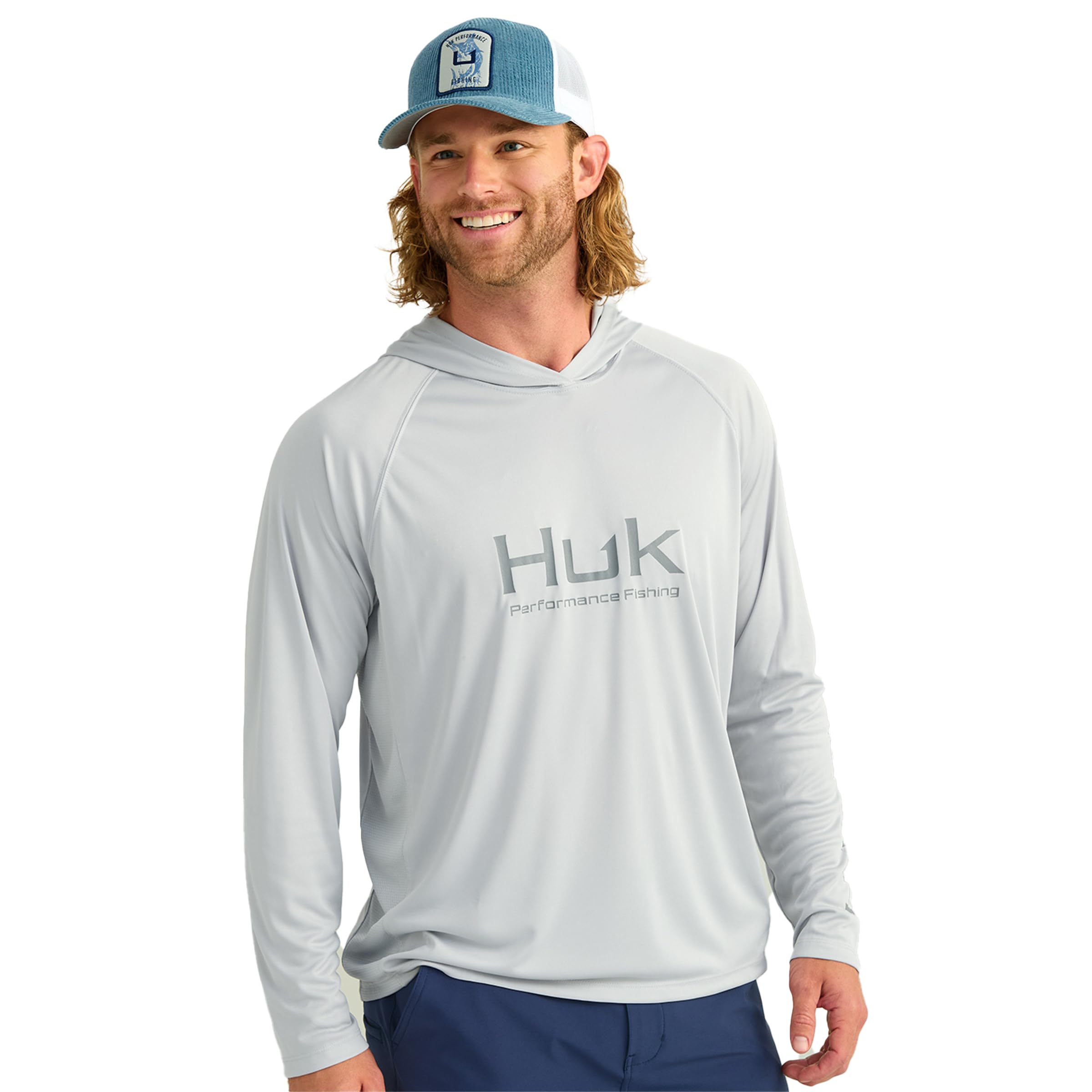
HUK Pursuit Vented Hoodie
Key Features
- Fit: Regular
- Fabric: Polyester honeycomb weave
- Pocket: Kangaroo
- UPF rating: 50+
- Price: Premium
A hood that flops back the moment you turn your head is decoration. This one is cut longer than most, so it sits forward over your ears and stays there while you cast, row or climb — the difference between a hood you wear and a hood you keep fiddling with.
The rest of the shirt is built for heat: a polyester honeycomb weave with cooling fibers, side venting that dumps warmth, and UPF 50+ across the fabric. There’s also a kangaroo pocket, which sounds trivial until you’re standing in the water with a phone, a key and nowhere to put either.
This is the premium end of the group and the one we take when the hood has to work. The fabric has no give, so it fits like a shirt rather than a jersey — order by your measurements and expect a neat, regular cut rather than a loose one.
Pros
- Hood stays up over the ears
- Side venting dumps heat
- UPF 50+ with cooling fibers
- Kangaroo pocket for a phone or key
Cons
- Premium price for a single shirt
We like it for long days when the hood has to stay up — vented, UPF 50+, and cut with more hood than most, at the top of the price range.
Best for Budget Backup Shirt
Roadbox Sun Hoodie
Key Features
- Style: Rash guard cut
- Gender: Men’s
- UPF rating: 50+
- Price: Budget
The Roadbox is the least expensive shirt here and it looks it: thin fabric, a plain cut, no logos anywhere. Thin is the point, though. It packs down to nothing and it’s light enough that you forget it’s in the bag at all.
Soaked and worn in the sun, it cools as it dries, and it blocks sun as well as the premium shirts in this guide. That’s the whole case for it, and it’s a strong one — this is the shirt we hand people who want sun cover without spending much on it, and the one most likely to end up living in a boat bag or a daypack.
The size is what you have to get right. The body is cut generously and the hood is deep, so if you’re between sizes the smaller one is the safer bet — and on a smaller head the hood will feel roomy rather than snug.
Pros
- Least expensive shirt in this guide
- Blocks sun like the premium picks
- Cools you as it dries when wet
- Plain, logo-free look
Cons
- Runs large with a deep hood
Our budget pick: it blocks sun and cools you when wet for less than anything else in this guide, as long as you take the smaller size.
Best for Week-Long Trips
TELALEO 3-Pack Sun Hoodies
Key Features
- Gender: Men’s
- Pack count: 3 shirts
- UPF rating: 50+
- Price: Budget
One sun hoody on a humid trip means one shirt that’s damp by noon and still damp the next morning. Three means you always have a dry one, which is less about luxury than about not pulling on a cold, salty shirt before sunrise.
Each shirt is UPF 50+, hooded and light enough to pack flat. The fabric resists snags, which is the quiet killer of thin shirts on brushy trails, and the hood stays put when it’s up instead of sliding back off your head.
The catch is sizing. These run small and the range stops at 2XL, so anyone at the top of the size chart should look at the Columbia or the BASSDASH instead. For everyone else this is the cheapest route here to a rotation that survives a week of heat.
Pros
- Three shirts per order keeps one dry
- Resists snags on brushy trails
- Hood stays in place when up
- Light and flat enough to pack
Cons
- Runs small, and the range stops at 2XL
Our pick for trips where nothing dries overnight: three light, snag-resistant shirts — provided you order a size up.
Best for Zip-Front Coverage
Soothfeel Women’s Zip Hoodie
Key Features
- Gender: Women’s
- Closure: Full zip
- UPF rating: 50+
- Price: Midrange
A zip changes where you can wear this. The Soothfeel opens flat, so it goes on over a t-shirt or a work uniform in the morning and comes off without dragging your hair or your sunglasses with it — and it’s shaped enough, with a hem that covers the hips, that you can leave it on at lunch. That versatility is why it’s our pick for women.
The details hold up: thumb holes that don’t pinch, a hood deep enough to be useful, and a colour range people come back to for second and third shirts. Sizing is the one wobble — it runs a little big and the sleeves are long, so between sizes, take the smaller one.
Pros
- Full zip for easy on, easy off
- Shaped cut that covers the hips
- Thumb holes that aren’t tight
- Strong colour range
Cons
This is the women’s pick we hand to anyone who wants to layer, zip down and keep wearing it off the trail — size down if you’re between sizes.
Best for Loose, Cool Fit
Willit Sun Protection Hoodie

Key Features
- Fit: Loose
- Style: Rash guard cut
- UPF rating: 50+
- Price: Midrange
The sleeves are the first thing to know about. On a tall frame they run short enough that engaging the thumb loops pulls the hood forward off your head, which is the opposite of what you want from a sun hoody. If you’re long through the arms, this probably isn’t your shirt.
What it does well is feel cold. Pull it on and the fabric is cool against your skin before you’ve started moving, and it stays light when it’s soaked with sweat rather than turning into a heavy, clingy layer. For running and fast hiking in heat, that’s the quality that keeps it in the bag.
The body is cut loose, so it hangs away from your back instead of sticking to it, and the thumb loops cover the back of your hand — the patch that burns first when you’re holding a pole or a rod. It’s a cheap, cool shirt for moving fast in heat rather than a precision garment.
Between sizes, go up: the body runs small even though the cut is loose, which is the odd combination that trips people up here. If you’re tall, the BASSDASH or the HUK will serve you better.
Pros
- Feels cold against the skin on contact
- Stays light when soaked with sweat
- Thumb loops cover the back of the hand
- Loose cut hangs away from the body
Cons
- Sleeves run short for tall wearers
We keep it for hot runs and fast hikes: the fabric feels cold when you pull it on and stays light when soaked, though tall wearers should look elsewhere.
Best for Women’s Hot Hikes
TBMPOY Women’s Sun Hoodie

Key Features
- Style: Pullover hoodie
- Gender: Women’s
- UPF rating: 50+
- Price: Budget
Where the Soothfeel is a jacket you zip, this is a pullover you drag on over your head and forget about — no placket, no hardware, nothing to catch on a pack strap. That’s the whole difference in how the two wear.
It handles a wider temperature swing than most of the shirts here: comfortable on a hot, exposed climb and still useful when the wind picks up or the morning is cold. The fabric dries fast, and the cut is roomy without being boxy, which is why it reads as a shirt rather than a piece of gear.
The sleeves are where it comes apart for some wearers. They run short, and the thumb holes are tight enough that long-armed hikers will feel a pull across the shoulders. Work the thumb holes before you commit to a long trip.
For day hikes and hot-weather walks it’s the least fussy women’s shirt here — light, quick to dry, and cheap enough that a second colour isn’t a decision you agonise over.
Pros
- Handles hot sun and cold breezes
- Roomy but shaped, not boxy
- Dries fast
- Pullover with no hardware to catch
Cons
- Sleeves run short, with tight thumb holes
We rate this the women’s budget pick for hot day hikes — light, roomy and quick to dry, though the sleeves run short.
How We Tested Sun Hoodies
We started by pulling together a shortlist of 40 sun hoodies from brands we trust, then narrowed it by UPF rating, fabric weight, available sizes, and sleeve length. The final 12 spent five months with us—on trail runs, desert hikes, beach days, and long afternoons in the garden. We wore them over base layers, under packs, and with hats, and we washed each one repeatedly to see how it held up.
Fit and sizing got the most scrutiny: we checked sleeve length at the wrist, whether hems stayed put when we reached overhead, and how the hood sat under a cap. We compared each brand’s size chart, tried a size up and down where possible, and noted shrinkage after the first wash. For sun protection, we held fabric up to sunlight, checked UPF labels, and wore each hoody through peak afternoon exposure to see if any burn came through the weave.
Lightweight feel and comfort went hand in hand—we weighed each hoody, packed it into a running vest or daypack, and noted whether it breathed on a climb or turned clammy. We also watched for chafing at the seams, thumbholes that cut in, and hoods that blocked peripheral vision. Quality showed up in the details: flat seams, zippers that didn’t snag, and fabric that resisted pilling after repeated washes. Finally, value came down to whether the price matched the protection and durability—not just the lowest ticket.
How to Choose a Sun Hoody
Almost every shirt in this category blocks the sun, so the decision comes down to the hood, the sleeves and the size that actually turns up.
Start with the hood, not the UPF number
UPF 50 and UPF 50+ both describe fabric that blocks the great majority of UV, so the rating rarely separates two shirts once you’re above 50. The hood does. A shallow hood slides back the moment you turn your head and leaves your ears and the back of your neck open — the two places that burn first and stay burned longest.
Look for a hood cut deep enough to sit forward over your ears without a cap underneath, and thin enough that you’ll actually leave it up. The HUK’s hood is longer than most and stays put; the BASSDASH shades the neck without feeling like a sack. A short, shallow hood is decoration.
Sizing is where these purchases go wrong
Every maker here cuts its own fit, and the same letter size lands differently across brands. Columbia and Roadbox run large; Willit and the TELALEO three-pack run small; the HUK has no give in the weave at all. Assume nothing from the size you buy in a cotton tee.
Read the sizing note for that specific shirt and choose for how you’ll wear it. Over a swimsuit or as a single layer in the heat, err trim; over a tee on a cold morning, err roomy. If you’re between sizes, the maker’s own pattern is the tiebreaker — not the size on the label of the shirt you already own.
Sleeves and thumb holes
Thumb holes sound like a gimmick until the back of your hand has burned while your arms stayed covered. They work only if the sleeve is long enough for your arm. On a tall frame, engaging the loop can pull the sleeve up and drag the hood forward off your head, which is exactly what the Willit does on long-armed wearers.
Work the thumb holes before you commit to a long trip if you can, or size up. The TBMPOY is the other shirt here where the loops run tight. When the sleeve reaches properly, the coverage is worth having — it’s the difference between covering your hands and reaching for gloves.
Heat, sweat and the wet-shirt trick
To stay cool, get the shirt wet. These fabrics cool as the moisture evaporates, which is why a soaked shirt beats a dry one in still heat — the thin, open weaves like the Roadbox and the TELALEO shirts are the easiest to drench and the quickest to come back dry.
A heavier honeycomb weave vented at the sides, like the HUK, moves air without needing water at all. If you run hot with no shade in sight, choose the first kind; if you’d rather not be damp, choose the second.
Frequently Asked Questions
Is a sun hoody worth wearing when I could just use sunscreen?
The advantage isn’t a bigger protection number — it’s that fabric doesn’t wear off, rinse away or need reapplying after four hours of sweating. A hooded long-sleeve also covers your neck, ears and the backs of your arms, which are the spots people miss with lotion.
It doesn’t replace sunscreen on your face and hands. It shrinks how much skin you have to think about, which is the point.
What’s the difference between a sun hoody and a rash guard?
Cut and intended use. Rash guards are built for water — trimmer, stretchier, often without a hood — while sun hoodies add a hood and a looser body for dry land. Plenty of shirts sit in between: the Roadbox, Willit and TELALEO are cut on rash-guard patterns and work for swimming as well as hiking.
If you’ll spend the day in and out of the water, take one of those. If you’re staying dry, the looser cut is more comfortable.
Can I wear one in the water, and will salt or chlorine hurt it?
The rash-guard-derived shirts handle it, but a hood full of water is heavy and keeps soaking the back of your neck, so most people swim with the hood down.
Rinse it in fresh water and hang it to dry rather than leaving it bundled in a wet bag. That single habit is what keeps a sun shirt from coming home sour.
Final Verdict
Buy the BASSDASH FS17M. It’s the shirt here with the fewest ways to disappoint you: a hood that shades your ears and neck, fabric that breathes while you’re working, and a size chart that matches what arrives at your door.
If your summers are humid and windless, the Columbia PFG Terminal Tackle moves air better than anything else in this group — go down a size and it’s the stronger shirt for still, sticky heat.